Yacht Haven Grande (St Thomas)
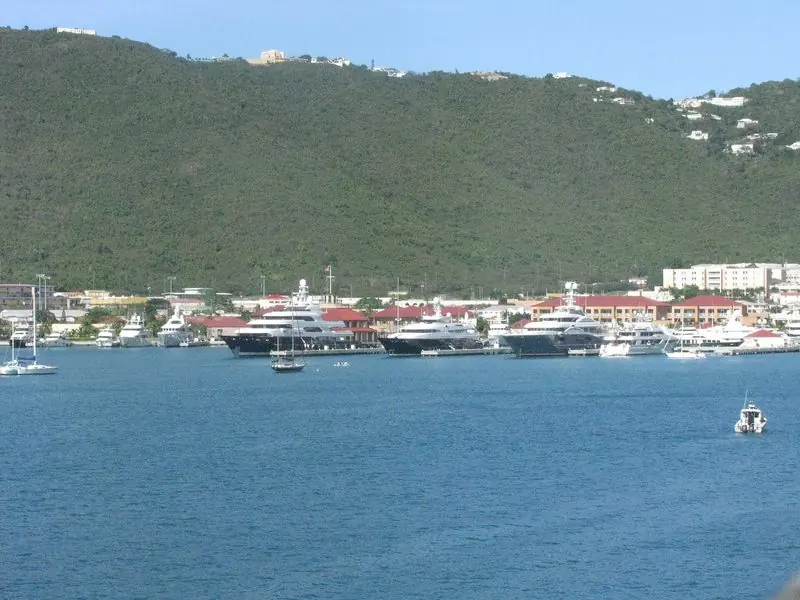
| Location | Charlotte Amalie harbour, St Thomas, US Virgin Islands, at 18 19.9 N, 64 56.0 W |
|---|---|
| Operator | IGY Marinas, a subsidiary of MarineMax, which runs 24 marinas in 14 countries |
| Berths | 46, all of them megayacht berths |
| Maximum LOA | 200 m (656 feet), berthed side-to |
| Maximum draft | 7.6 m (25 feet), with no beam restriction |
| Shore power | 30A and 50A, plus 100A single phase, 100A three phase and 480V 100A three phase |
| Fuel | in-slip high-speed fuelling at the berth |
| Clearance | US Customs and Border Protection and Immigration on site, with a ROAM kiosk |
| Security | 24-hour gated dock security, ISPS compliant facility |
| Accreditation | Five Gold Anchor Platinum, and named Superyacht Marina of the Year in 2016, 2019, 2020 and 2021 |
| Airport | Cyril E. King International, roughly 12 to 20 minutes by road |
| Access | berths are rented, with priority and guaranteed access sold through the invitation-only IGY Trident Club for yachts of 24 m and above |
| Frequency | the US Virgin Islands run 60 Hz, in common with the United States mainland. A 50 Hz yacht arriving from the Mediterranean needs a converter aboard or runs generators. The marina does not state the frequency, checked 28 July 2026 |
| What the published shore power actually amounts to: the top supply of 480 V at 100 A three phase is about 83 kVA. That is a modest number for a marina advertising 200 m alongside | |
| The practical consequence | a yacht much above 50 m will not carry its hotel load on the published shore supply and runs generators alongside. This should be budgeted as fuel and as running hours |
| Berth distribution above 60 m and 80 m is not published by the operator, checked 28 July 2026. The published figures are 46 berths, 200 m maximum LOA side-to and 7.6 m maximum draft | |
| No dockage rate is published. Dockage is quoted by length and season on application, checked 28 July 2026 | |
| No membership figure is published for the invitation-only IGY Trident Club, which is where guaranteed access for yachts of 24 m and above is actually sold | |
| Lifting | no yard on St Thomas can haul a large yacht. The regional answer is Sint Maarten, roughly 100 nautical miles east, or a passage to Florida |
The deep harbour at Charlotte Amalie
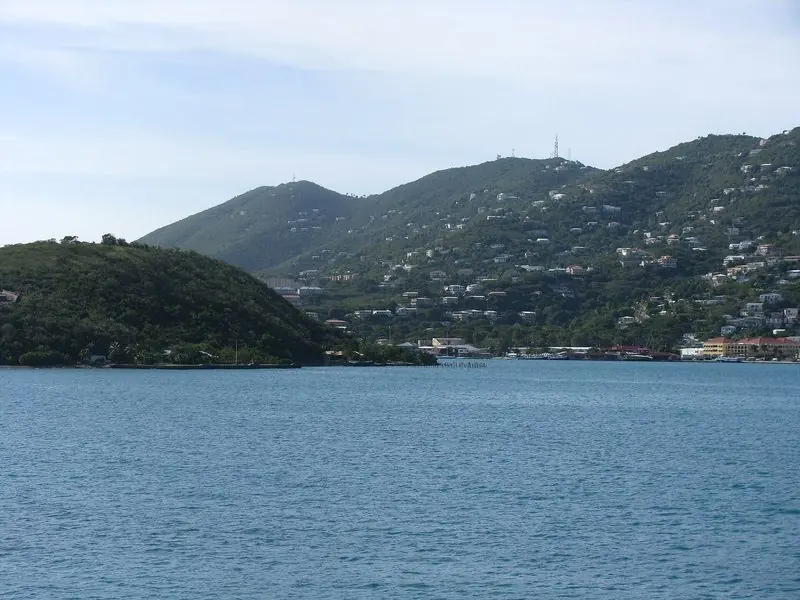
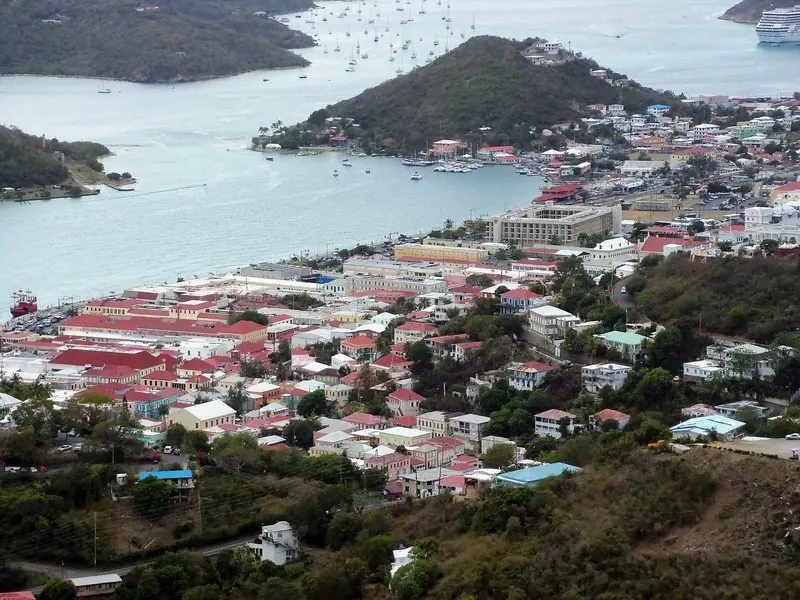
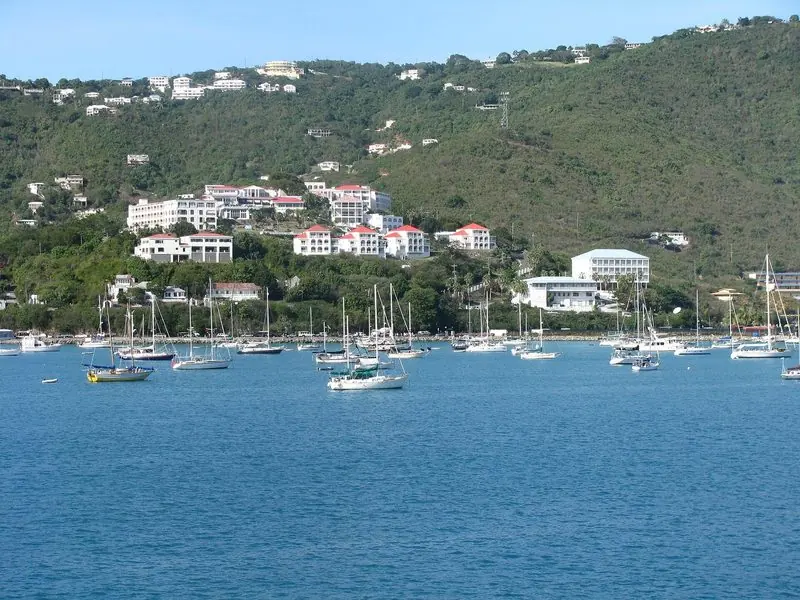
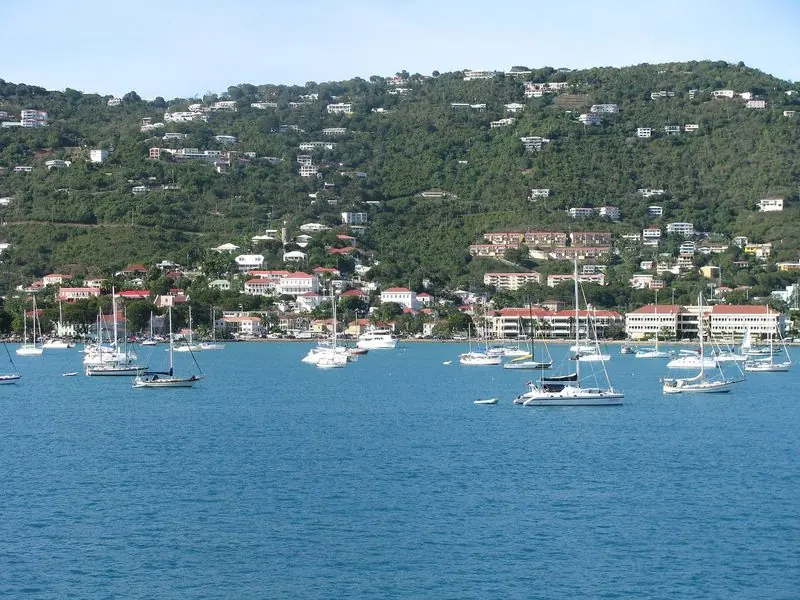
Charlotte Amalie is a large, deep, well-sheltered natural harbour on the south side of St Thomas, and it has been a serious port since the Danish colonial period. Yacht Haven Grande occupies its own basin on the eastern side, next to the Havensight cruise dock. The marina takes 7.6 metres of draft and imposes no beam restriction, and berthing is side-to, which is a considerable comfort difference for guests boarding a 90 metre yacht over the Mediterranean stern-to arrangement.
The approach is straightforward deep water with no bar, no channel and no tidal gate, which is the norm across the Virgin Islands. Tidal range in the eastern Caribbean is under a foot, so departure times are set by the guests and not by the almanac. Trade winds blow from the east at 15 to 20 knots for most of the winter season and the harbour is protected from them. What does reach in is the northerly ground swell that arrives in winter after North Atlantic storms.
Forty-six berths, all of them large
The marina publishes 46 berths and describes every one of them as a megayacht berth, with a maximum length overall of 200 metres, or 656 feet. There is no small-boat component here at all. That makes it a different sort of facility from most Caribbean marinas, where a handful of big alongside spaces are added to a field of pontoons. The largest yachts lie on the outer face and the rest of the fleet works down from there.
Demand is entirely seasonal. From December through April the Caribbean fleet is in the Virgin Islands and the berths are taken, with Christmas and New Year the hardest fortnight in the calendar to get anything. May through November empties out as the fleet crosses back to the Mediterranean or moves south below the hurricane belt. An owner who wants a specific berth for the holidays is committing many months ahead, and often a year.
The only Caribbean berth where a 150 metre yacht clears customs on its own dock and the guests land at a US airport twelve minutes away.
How access is bought
Berths at Yacht Haven Grande are rented and nothing is sold freehold. What IGY does sell is certainty, through the Trident Club, a membership for yachts of 24 metres and above that is offered by invitation, runs on one, three or five year terms and fixes pricing for the length of the term. Berthing across all IGY marinas is reserved for Trident members first, with guaranteed dockage at the higher membership tier. Members get preferential rates on dockage and fuel and a single consolidated invoice across the group.
For an owner running a two-ocean programme this is the real product. IGY holds 24 marinas across 14 countries including Simpson Bay and Isle de Sol in St Maarten, Rodney Bay in St Lucia, Miami, Cannes and Porto Cervo, so one relationship covers a season on each side of the Atlantic. Dockage itself is quoted by length and season, with the Christmas and New Year weeks priced as their own tier at every serious Caribbean marina. Non-members take what is left.
Power, fuel and what the dock provides
Shore power runs from 30 and 50 amp service up to 100 amp single phase, 100 amp three phase and 480 volt 100 amp three phase, which covers everything short of the largest new hulls. Fuelling is done in the slip from high-speed pumps, so a yacht bunkers on its berth without moving. Waste and oil removal, provisioning and laundry are all handled on site. The marina is a full-service operation and the island's chandlery, catering and technical trades are close by.
Heavy engineering is the gap. There is no lift or hardstanding of any size at Yacht Haven Grande, and the Caribbean generally is a place for running repairs and not for refits, so serious work means a passage to Florida. That is around 1,000 nautical miles to Fort Lauderdale, which is a manageable delivery in the shoulder season and part of why so many Caribbean programmes end with a spring run north. Routine attention, divers, engineers and electronics people are all available locally.
American paperwork, and what that is worth
The US Virgin Islands are unincorporated United States territory, so US Customs and Border Protection and Immigration keep offices on the marina site and a ROAM kiosk handles routine clearance. For an owner arriving from the British Virgin Islands, St Maarten or Antigua this removes an entire morning of launch trips and rubber stamps. The dollar is the currency, US mobile networks work, and American medical care is on the island. Guests holding US passports need nothing at all.
Charter rules are where it gets technical, and they are worth understanding before buying a yacht with charter in mind. Local guidance from the Virgin Islands Professional Charter Association is that a foreign-flagged yacht with US citizen or green card crew may run a USVI-only itinerary, while a foreign-flagged yacht with foreign crew may charter here only if the trip includes a foreign component, typically a leg into the British Virgin Islands. Carrying more than twelve passengers requires a full US Coast Guard Certificate of Inspection. Owners planning commercial use should take flag and crew advice early.
Security, and the cruise ships next door
The docks are gated with 24-hour security and the marina is an ISPS compliant facility, so access to the pontoons is controlled and logged. Crew get a lounge, private showers and a business centre. The marina grounds hold a lagoon-style pool, lighted tennis courts, a beach volleyball court and a retail and dining precinct built around the waterfront.
Privacy is the weak point. Charlotte Amalie is reported to be the busiest cruise port in the Caribbean, with one to four ships alongside on a high-season day, and the Havensight dock is immediately adjacent to the marina. That means several thousand day visitors within sight of the yachts, downtown traffic that clogs solid by mid-morning and a shopping district built for them. Owners who want an anonymous berth take the yacht round to a bay for the day and come back in the evening.
Getting there, and a week with a family
Cyril E. King International is 12 to 20 minutes from the marina depending on traffic, with direct services from Miami, Fort Lauderdale, Charlotte, Atlanta, New York and San Juan, and a busy private aviation apron. That access is the single strongest argument for basing a yacht in the USVI instead of further down the island chain. A guest can leave the eastern seaboard in the morning and be aboard for lunch.
The cruising from here is the best short-hop archipelago in the Caribbean. St John and the Virgin Islands National Park are 30 minutes east, the British Virgin Islands and their string of anchorages are an hour, and Anegada, Jost Van Dyke and Virgin Gorda give a family a fortnight without a long passage. Line of sight navigation, flat water inside the reefs and short legs make this the easiest cruising ground in the western hemisphere for children and nervous guests. St Thomas itself has good hotels, a serious duty-free shopping district and reliable provisioning.
Season, hurricanes and the honest downside
The season runs from December to April, framed by the USVI Charter Yacht Show that the charter association holds at Yacht Haven Grande in November and closing after the Easter holidays. The Atlantic hurricane season officially runs from 1 June to 30 November, and most yacht insurance policies require the boat to be out of the box during it, either north in the United States or south of roughly 12 degrees north. Hurricanes Irma and Maria hit these islands in September 2017 and the recovery took years, which is not an abstraction to anyone who was here.
The downsides are cruise traffic, hurricane exposure and the absence of refit capability. Prices for everything on a small island shipped in from the mainland are high, and the crowding downtown in season is real. What no other Caribbean marina matches is the combination of 200 metres of berth, American clearance on the dock and a jet airport twelve minutes away.
Sixty hertz, and the number behind the shore power
This is the dock the Mediterranean fleet reaches after crossing west, which makes the frequency of the supply the single most consequential fact on the page. The US Virgin Islands run 60 Hz, in common with the United States mainland. A yacht wired to the European 50 Hz standard cannot connect without a converter aboard or one supplied at the pedestal. Checked on 28 July 2026, the marina publishes its amperage bands and says nothing about frequency anywhere, which is a strange silence on a facility whose commercial argument to European owners is American clearance and American convenience. It is the first question for the reservation and not something to discover with lines ashore.
The second question is capacity, and here the published figure deserves reading as arithmetic rather than as marketing. The top supply listed is 480 V at 100 A three phase. That is about 83 kVA. A 70 m yacht in the Caribbean runs air conditioning against 30 degree air and 29 degree water, and its hotel load is a multiple of that number. The honest statement is that a yacht much above 50 m does not carry its load on this dock and runs generators alongside, which means fuel, running hours and a maintenance interval that arrives sooner. The operator's phrase for the same fact is that the supply covers everything short of the largest new hulls. That is the marina's framing. The kVA figure is the captain's.
Forty-six berths, no split, and no price
The count is published and the distribution is not. Forty-six berths, all of them described as megayacht berths, a maximum of 200 m side-to and a maximum draft of 7.6 m with no beam restriction. How many of the 46 actually take 60 m, how many take 80 m and how many can take the headline 200 m is not stated, checked 28 July 2026, and on a marina this small that is a table that would fit in two lines. The practical shape of it is that the Christmas and New Year fortnight is the hardest window in the Caribbean calendar and the largest positions in it are spoken for well in advance, but the operator publishes no occupancy and no booking horizon and no honest figure can be given for one.
Price is equally absent. Dockage is quoted by length and season on application, and the real product is the invitation-only IGY Trident Club, which sells priority and guaranteed access for yachts of 24 m and above and publishes no membership figure at all. Nor does the marina say what the slip rate excludes, and in a US marina the list is usually power, water, pump-out, dock cart, crew parking and an ISPS charge. An owner comparing this against a Mediterranean summer needs all of that itemised in writing at the quotation stage. On lifting, the answer is that it does not happen here. No yard on St Thomas hauls a yacht of this size, and the realistic options are Sint Maarten, roughly a hundred nautical miles east, or a delivery north to Florida.
Ashore, access and booking
| Getting there | Cyril E. King International Airport (STT), 12 to 20 minutes by road from the marina. St Thomas taxi fares are fixed per person by the Virgin Islands Taxicab Commission rather than metered, so confirm the rate card posted in the vehicle rather than a quoted online figure. |
|---|---|
| Arriving by sea | Contact the marina office on VHF Channel 16, working channel 10, on approach to Charlotte Amalie Bay for a slip assignment. An ETA given 24 hours ahead is requested where feasible. |
| Reserving a berth | No Dockwa listing found (checked 8 August 2026); book direct through the marina office by phone (+1 340 774 9500) or email ([email protected]), or via the third-party site MarinaReservation.com, which also shows no published tariff. Christmas and New Year need booking many months out. |
| Standard dockage cost | Not published; quoted by length and season on application to the marina. |
| Charter Yacht Show berthing rate | For the 2026 USVI Charter Yacht Show (14-17 November, its 10th edition), IGY published a discounted berthing rate of $1.85 per foot per day for yachts registering and paying in full by 31 August 2026, rising to $2.15 per foot per day after that date, covering the berthing window of 9-18 November 2026. This is a show-specific rate, not confirmed as the standard year-round tariff. |
| Trident Club membership | Invitation-only, for yachts 24 m and above. Collective tier: guaranteed dockage across IGY's marinas plus a 25 percent dockage discount. Club tier: priority berthing without the guarantee. No membership price is published. |
| Fuel | In-slip high-speed fuelling at the berth. No per-gallon price published; quote on application to the marina office. |
| Dock and dinghy services | A dinghy dock sits behind the fuel dock; boaters report a $3-per-bag trash disposal charge there. On-site: a dive shop, a full-service grocer and a small ship's store. A Pueblo supermarket is about three blocks away for wider provisioning. |
| Eating on the boardwalk | The Shops at Yacht Haven Grande carries Enkai Sushi Bar, Indigo 4, Box Bar, 13 Restaurant, Cutlass & Cane, St. Thomas Social, Java Grande Coffee & Craft Cocktails, Momma's Shack and Thali Indian Grill, checked 8 August 2026 against the marina's own retail site. |
| After dark | During Charter Yacht Show week the marina runs nightly entertainment and a vendor showcase on site. Outside the show, the boardwalk bars (Box Bar, Cutlass & Cane) are the evening options on the property, with downtown Charlotte Amalie a short taxi ride for more. |
| Fixed dates to plan around | USVI Charter Yacht Show: 14-17 November 2026, berthing window 9-18 November. Atlantic hurricane season: 1 June to 30 November, when insurers and the marina expect the boat out of the box. |
What owners and crew report
Boater reviews rate the dock crew and grounds highly
Cruiser reviews aggregated on Waterway Guide describe Yacht Haven Grande as immaculately kept, with friendly, attentive dock staff, and rate the on-site shops, restaurants and pool positively.
Waterway GuideThe dinghy dock and shoreside provisioning work, but small fees add up
Boaters using the marina's dinghy dock, sited behind the fuel dock, report a $3-per-bag charge for trash disposal. The property also has a dive shop, a full-service grocer and a small ship's store, with a Pueblo supermarket about three blocks away for broader or cheaper provisioning.
Waterway GuideThe marina's top industry award is a vote of visiting captains, not a magazine panel
The Yacht Harbour Association's Superyacht Marina of the Year award, which Yacht Haven Grande has now won four times, is decided by a vote among slip holders across more than 160 TYHA Gold Anchor and above marinas worldwide. General manager Phil Blake called it an honour "to be selected for this accolade by the captains and officers of some of the world's most notable yachts."
The Yacht Harbour Association (TYHA)The Charter Yacht Show fills the docks even when the fleet itself shrinks
Coverage of the 2025 USVI Charter Yacht Show, held at Yacht Haven Grande, noted the show was more intimate than previous years, dominated by sailing catamarans with only a handful of motor yachts, yet the docks still ran full for the four days.
All At SeaThe calibre of yacht based here for the winter charter season is genuinely large
Reporting on the 2024 show at Yacht Haven Grande described an unprecedented run of luxury catamarans from 46 to 67 feet, with weekly charter rates ranging from roughly $19,000 to $48,000.
H2O Luxury Yachts
What is good, and what to watch
Strong points
- Platinum accreditation earned back after two Category 5 hurricanes in one seasonYacht Haven Grande holds TYHA's Platinum 5 Gold Anchor rating, the accreditation's top tier held by only a handful of marinas worldwide, and is the only one of them to have earned it after rebuilding from two Category 5 hurricanes striking in a single year (Irma and Maria, 2017).
- A genuine boardwalk of independent restaurants and bars, not a food courtThe Shops at Yacht Haven Grande carries nine named restaurants and bars on the water within a few minutes' walk of any berth, including Enkai Sushi Bar, Box Bar, 13 Restaurant, Cutlass & Cane and Java Grande Coffee & Craft Cocktails, checked 8 August 2026, so a crew can eat and drink ashore without a taxi.
- The Trident Club gives large-yacht owners a real cross-Atlantic productIGY's Trident membership for yachts 24 m and above runs two tiers: Collective, which carries guaranteed dockage plus a 25 percent discount on dockage across IGY's marina network, and Club, a priority-berthing tier without the guarantee. For an owner running a Mediterranean-Caribbean programme this converts an uncertain seasonal booking into a fixed arrangement.
What to watch
- No online booking, unlike some other IGY marinasChecked 8 August 2026, Yacht Haven Grande has no listing on Dockwa, the reservation network that IGY's own Rodney Bay Marina uses, and the third-party listing on MarinaReservation.com carries no populated tariff either. Berths are booked by phone or email to the marina office, with rates quoted only on application, which makes it harder to compare cost against a marina that publishes a rate card.
- Show week runs the docks to capacity regardless of fleet sizeThe 2025 USVI Charter Yacht Show at Yacht Haven Grande was reported as a smaller, more intimate fleet than prior years, yet the docks still ran full for the event, which means an owner not participating in the show has essentially no chance of a berth during that week without booking many months ahead.
Who it is for: The owner running a winter Caribbean season with American guests who wants scale, easy clearance and short flights above scenery.