Yalikavak Marina (Turkey)
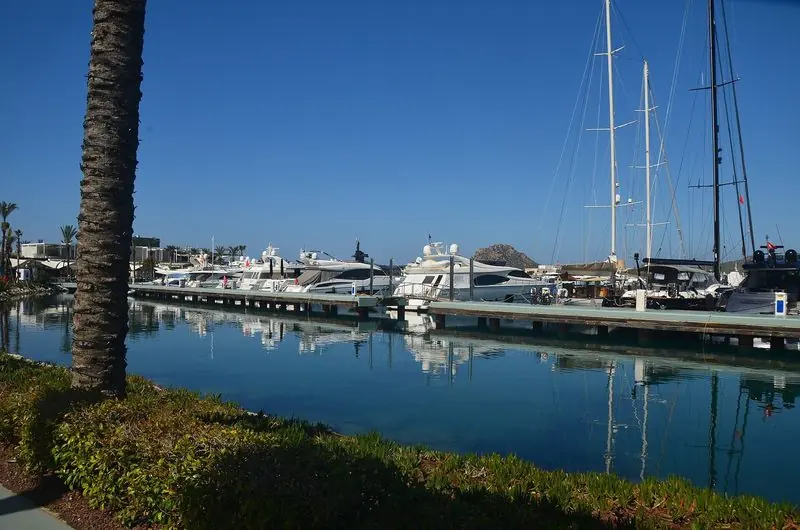
| Location | Yalikavak, north-west corner of the Bodrum peninsula, Mugla province, Turkish Aegean |
|---|---|
| Distance | about 18km from Bodrum town |
| Berths | 620 |
| Max LOA | 135 m, with some listings quoting up to 140 m |
| Mooring | Mediterranean stern-to with dock assistance |
| Former name | Palmarina |
| Accreditation | Five Gold Anchors from The Yacht Harbour Association, with multiple industry awards |
| Tenure | annual, seasonal and transient contracts only, with no berth concession market |
| Customs | Turkey is outside the European Union, so a yacht clears in and out and the stay is not EU time |
| Airport | Milas-Bodrum, 36km north-east of Bodrum, runways of 3,000 m and 2,500 m, over 60 airlines and about 4.36 million passengers in 2025 |
| Cruising | the Greek Dodecanese a short passage west, with the sheltered bays of the Turkish coast to the south |
| Season | roughly June to September, governed by the summer northerly that blows hardest in July and August |
| Shore power | up to 1,400 A. Voltage and frequency are not published by the marina. Turkey runs on the European 230 and 400 V, 50 Hz standard and no 60 Hz supply is advertised, so a 60 Hz yacht converts on board |
| Travel lifts on site | 260 tonnes and 100 tonnes |
| Cost | the marina's own loyalty campaign page quotes annual mooring from EUR 125 per square metre. That page was published in September 2023 and was still live in July 2026, and it states no VAT position |
| Worked example at that rate | a 45 m yacht on a 9 m beam occupies 405 square metres, so about EUR 50,625 a year. A 60 m on an 11 m beam is about EUR 82,500 |
| Depth alongside is not published by the marina. A third-party cruising database gives 4 to 15 m across the basin, which is not the operator's figure and should be confirmed for a specific berth | |
| No berth split above 40, 60 or 80 m is published anywhere. TYHA lists 620 berths and a 140 m maximum berth size | |
| Mooring | Mediterranean stern-to on two bow mooring lines on every dock and pontoon except pontoon G, which is alongside |
| Anchoring is prohibited anywhere inside the marina. Every berth carries laid mooring lines | |
| Pilotage is compulsory for vessels over 1,000 GT, with the pilot boarding station at the entrance to the bay | |
| Diving inside the marina may only be carried out by the marina's own divers | |
| VHF | Traffic Control Tower must be contacted before arrival and before departure. Berthing assistance works VHF 72 |
| Duty-free fuel is supplied to private and commercial vessels, but the yacht must leave Turkish territorial waters on completion of bunkering. Duty-free fuel cannot legally be consumed inside the country | |
| Waste | Blue Card system pump-out for grey, black and bilge water, a pump-out boat service, engine oil disposal tanks and contaminated waste storage |
| Wind | the meltemi, the Aegean etesian, blows from about mid-May to mid-September, strongest in the afternoon and often dropping at night, but can run for days and reach force 7 to 8. In the southern Aegean it arrives as a north-westerly, which is the exposed corner of the Bodrum peninsula |
| Formalities | every foreign-flagged yacht must obtain a Transitlog at the first Turkish port of entry, valid one year and renewable at any port of entry. Applications are now made through the e-Transitlog system, online by the owner or through an authorised agency, followed by the Harbour Master, Port Health, Passport Police and Customs in that order |
| Transitlog 2025 costs | a document fee of about EUR 70 for a foreign-flagged yacht plus a length-based charge, quoted at around TRY 2,600 for 10 to 15 m and rising with length |
| Crew and guest changes during the Transitlog's validity must be registered at the nearest Harbour Master. Anyone on board not recorded on it is not legally there | |
| Cabotage | carriage of passengers between Turkish ports is closed to foreign-flagged commercial yachts unless a charter licence is obtained |
Where it is, and the wind that has a name
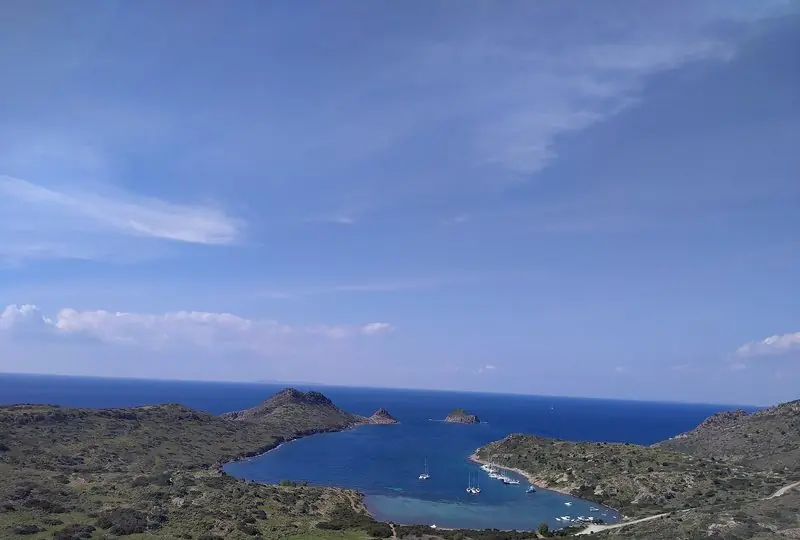
Yalikavak lies on the north-western corner of the Bodrum peninsula in Mugla province, about 18 km from Bodrum town, in a gulf sheltered by an L-shaped peninsula of rocky outcrops to the north with high hills to the east and south. The village was the peninsula's main sponge-diving port before tourism took over and had around 6,500 residents in 2022. The marina was engineered from new, with wide fairways and a deep entrance, so a large yacht comes and goes without the pilotage anxiety that older Mediterranean harbours produce.
The wind is the meltemi, the Turkish name for the Aegean etesian, and it should be planned for by name. It blows from about mid-May to mid-September, north-westerly in the southern Aegean where Yalikavak sits, strongest through the afternoon and often dropping away at night, though it can also run for days without a break. It reaches force 7 to 8 and it comes up in clear weather without warning, which is what makes it dangerous rather than merely tiresome. July and August are the hardest months. Inside the marina the hills around the gulf take most of the sting out of it, but the north-west corner of the peninsula is the exposed side, and a meltemi afternoon ends tender work, beach landings and any plan to cross to the Dodecanese.
What the marina holds, and what it does not publish
The marina offers 620 berths taking yachts up to 140 m, and it publishes two numbers that matter more than the count. Shore power runs up to 1,400 A, which puts Yalikavak in the same class as Barcelona and Tivat and well above Ibiza or Porto Cervo, and there are two travel lifts on site at 260 tonnes and 100 tonnes. Voltage and frequency are not stated anywhere in the marina's material. Turkey runs on the European 230 V and 400 V, 50 Hz standard and no 60 Hz supply is advertised, so a 60 Hz yacht converts on board. Mooring is Mediterranean stern-to on two bow mooring lines on every dock and pontoon except pontoon G, where berthing is alongside.
What is missing from the marina's own material is the pair of figures a captain checks first. There is no published depth alongside, for the marina generally or for any individual berth. A third-party cruising database gives 4 to 15 m across the basin, which is consistent with a marina that takes 140 m yachts, but it is not the operator's number and it should be confirmed in writing for the actual position. There is also no berth split. Nowhere does the marina say how many of its 620 berths take over 40 m, over 60 m or over 80 m, which for a fleet at this end of the market is the only part of the 620 that means anything. Both are one email to the berthing office, and both should be sent before a season is planned around this marina.
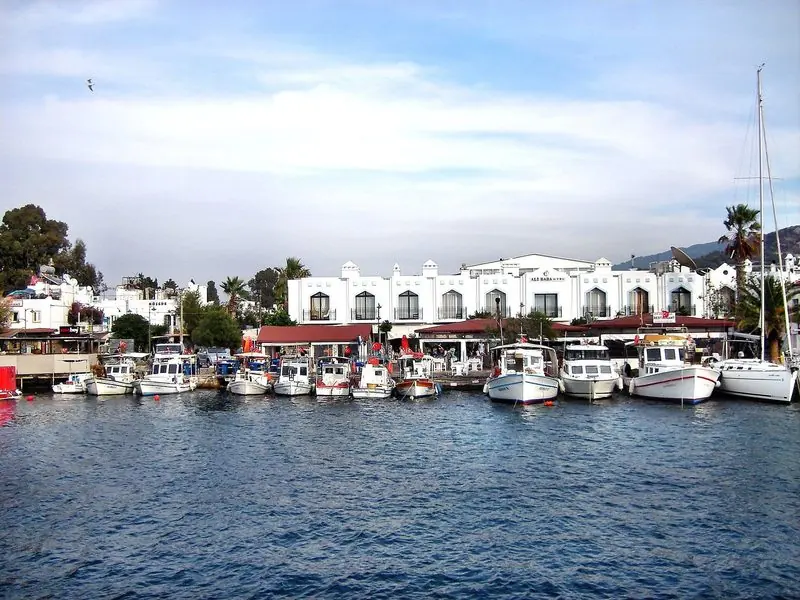
The Greek islands are visible from the entrance, and every trip to them is a border crossing.
The berthing reality, and how a berth is obtained
Berths are contracted directly with the marina on annual, seasonal and transient terms. There is no concession market here and nothing is sold, so an owner is a tenant on a renewable contract with none of the wasting-asset problem that an Antibes lease carries.
Availability is one of the marina's genuine strengths. Outside July and August a large yacht can usually be accommodated at reasonable notice, and the size of the place means a late change of plan is not the crisis it would be in Sardinia. Long-term berth holders sit alongside seasonal arrivals, which gives the marina a settled resident community and a reason for the businesses ashore to open in March.
What it costs, and the one published number
Yalikavak does not publish a tariff, and the berth booking page is a form rather than a rate card. It does publish one figure, on its own loyalty campaign page: annual mooring offers starting at EUR 125 per square metre. That page was posted in September 2023 and was still live in July 2026, so it should be read as a marketing floor from 2023 rather than a current quotation, and it states nothing about VAT. Priced on it, a 45 m yacht on a 9 m beam occupies 405 square metres and pays about EUR 50,625 for a year. A 60 m on an 11 m beam is about EUR 82,500. Set against Antibes, where a 100 m yacht pays EUR 275,388 with VAT for the seven-month winter contract alone, the gap the marina trades on is real and can now be sized rather than asserted.
The offsetting risk is currency, and it is the reason experienced owners handle Turkey differently. Turkish costs are quoted in lira or in euros depending on the supplier, and lira inflation has been high enough in recent years that a quote given in local currency in March may mean something different in September. Owners running significant work here fix prices in a hard currency and put it in writing. One further line is worth reading before the fuel is ordered. Tax and duty-free fuel is available to private and commercial vessels at Yalikavak, but the marina states plainly that on completion of bunkering the yacht must leave Turkish territorial waters, because duty-free fuel cannot be consumed inside the country. That turns a cheap fill into a passage plan and not a saving on the berth.
What the lift can take, and where the rest goes
The marina runs two travel lifts, at 260 tonnes and 100 tonnes, alongside a dry dock facility that it markets to yachts holding annual mooring contracts. That 260 tonne machine is the number to check a hull against. It covers a sailing yacht of most sizes and a motor yacht up to roughly the 40 m class, and it does not cover a 60 m displacement motor yacht, which will be several times that weight. For that boat a lift means leaving, and the Turkish answer is the yards further along the coast rather than a passage back to Europe. Alongside the lifts the marina carries fuel, shore power, maintenance and repair services, waste and technical support at the berth.
Beyond the marina, the Turkish yards are the point. Turkish labour and materials are competitive enough that refit work which would be marginal at western European prices becomes straightforward, and the country has built a serious superyacht construction and refit industry over the past two decades. The comparison an owner should actually run is Turkey against Palma and La Ciotat, and it is now possible to run it with numbers on both sides, because STP publishes its haul-and-launch tariff as a concession holder and Yalikavak does not publish its lift rate at all. That asymmetry is worth remembering when a Turkish quotation looks unanswerable.
Being outside the European Union, and the Transitlog
Turkey is not an EU member and a yacht clears in and out of the country, so time spent on this coast is not time spent in EU waters. For an owner running a non-EU-flagged yacht under temporary admission that is a practical benefit and one of the specific reasons the Turkish coast carries the resident fleet it does. The document that governs it is the Transitlog. Every foreign-flagged yacht entering Turkey must obtain one at the first port of entry, it records the yacht, the owner, the crew and the guests on board along with the ports she will visit, and navigating Turkish territorial waters without one is not legal. It is valid for one year from issue and is renewed at any port of entry if the yacht stays longer.
The process is now largely digital through the e-Transitlog system, applied for online by the owner or through an authorised agency, then completed in person at the Harbour Master's office at the port of entry followed by Port Health, the Passport Police and Customs in that order, ending with a barcoded document that stays on board. For 2025 the document fee for a foreign-flagged yacht was around EUR 70 plus a length-based charge, quoted at roughly TRY 2,600 for a 10 to 15 m boat and rising with length. Two conditions bite in practice. Any change to the crew or guest list inside the validity period has to be registered at the nearest Harbour Master, and anyone aboard who is not on the Transitlog is not legally aboard. And cabotage is closed: carriage of passengers between Turkish ports is reserved to Turkish-flagged vessels unless a foreign-flagged commercial yacht holds a charter licence, so a charter programme run out of Yalikavak is a licensing question and not a scheduling one.
Ashore, and what the marina has built
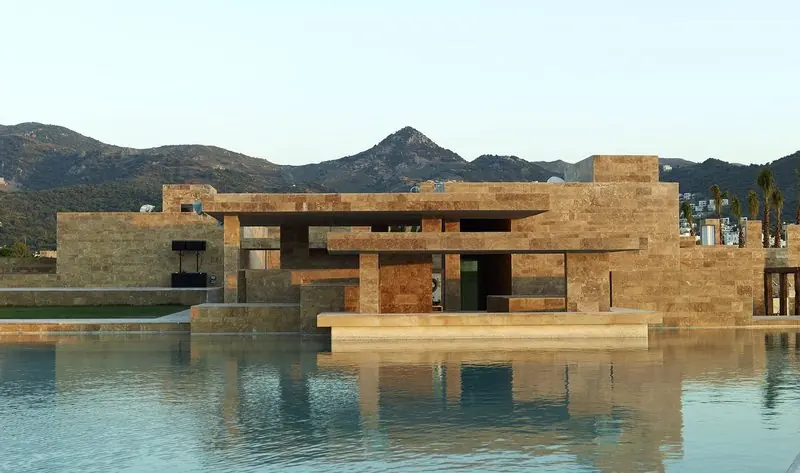
The marina is a destination in its own right, with an open-air quarter of shops and restaurants along the waterfront, hotels and a spa inside the development, and a quay that becomes an evening promenade through the season. The shopping street draws visitors from the resorts around the peninsula as well as from the boats, so it stays busy into the night.
Privacy is therefore moderate. The yacht is behind marina security and controlled access, and Turkey is not a place where anyone is troubling a superyacht, but the boats are visible from a public promenade that the whole peninsula uses. Owners who want to be unseen use the bays down the Turkish coast, which are numerous, sheltered and largely empty by comparison with the Balearics.
Getting there and the season
Milas-Bodrum airport is the access point, 36 kilometres north-east of Bodrum town, and Yalikavak is 18 kilometres from Bodrum on the far corner of the peninsula, so a transfer runs to around an hour. The airport is a serious piece of infrastructure by regional standards, with runways of 3,000 and 2,500 metres, more than sixty airlines and about 4.36 million passengers in 2025, though much of the European schedule is seasonal.
The season runs from roughly June to September with warm, settled weather, and the shoulders on this coast are longer and more usable than on the Riviera. Bodrum town and its castle sit around the peninsula for a day out, the Turkish coast to the south offers a string of sheltered bays with almost no development, and the Dodecanese are within a morning's run. For a family, the cruising is the strongest part of the offer.
The honest downside
The distance is the first thing. Yalikavak is a long way from the Riviera, Sardinia and the Balearics, so a yacht based here has committed to the eastern basin and a repositioning passage of several days. Owners who want to be at Cannes in September and Porto Cervo in August are not basing in Turkey.
The rest is the trade-off that comes with a lower cost base. The regulatory and currency environment is less predictable than western Europe, the marina sits inside a lively resort quarter with the noise that implies, and the peak fortnight in August fills the place like everywhere else. The Greek border adds paperwork to what looks on a chart like the easiest cruising in the Mediterranean. None of it is a reason to stay away, and all of it is a reason to arrive with an agent.
Arrival, and the rules the tower enforces
The marina runs a Traffic Control Tower staffed around the clock, and contacting it on VHF before arrival and before departure is not a courtesy but a requirement. The information wanted on the call is the vessel name, her length, the berth number if it is already known, and the last port of call, with the last of those routed straight into the customs and immigration process if the yacht is coming from a foreign port. The entrance is marked with red and green lights on the breakwater heads, and an arriving yacht waits for the pilot dinghy rather than entering on her own. Working channel for berthing assistance is VHF 72.
Two rules catch crews who assume Turkish informality. Pilotage is compulsory for every vessel over 1,000 GT, arranged through the marina's Yacht Assist team, with the pilot boarding station at the entrance to the bay rather than at the marina itself. And anchoring is not permitted anywhere inside the marina. Every berth carries laid mooring lines and the yacht uses them, which removes the ground tackle problem that makes some Mediterranean harbours slow but also means a yacht cannot improvise a position. Diving inside the marina is restricted to the marina's own divers, so a hull inspection or a fouled line is a marina job and not a crew job.
Ashore, access and booking
| Berths | 620, up to 135 m (TYHA lists a 140 m maximum) |
|---|---|
| Annual cost, indicative | From the marina's own EUR 125/sqm loyalty rate: about EUR 50,625/year for a 45 m x 9 m yacht, about EUR 82,500/year for a 60 m x 11 m yacht - a September 2023 marketing floor, not a current quote |
| How to book | Direct annual, seasonal or transient contract with the marina - there is no berth concession or resale market |
| Getting there | Milas-Bodrum airport, 36 km, about an hour's transfer, over 60 airlines and about 4.36 million passengers in 2025 |
| Lift capacity | 260-tonne and 100-tonne travel lifts on site; anything heavier goes to other Turkish yards rather than back to Europe |
| What is not published | Depth alongside (only third-party data exists, 4 to 15 m) and any berth-size breakdown above 40, 60 or 80 m - confirm both directly with the marina before planning around them |
| Formalities | An e-Transitlog is required for every foreign-flagged yacht, about EUR 70 plus a length-based fee, valid one year; Turkey is outside the EU, so time here does not run against an EU Schengen or temporary-admission clock |
| Fuel | Duty-free fuel is available, but the yacht must leave Turkish territorial waters after bunkering - it cannot legally be consumed inside the country |
What owners and crew report
The marina's own service backs up its marketing - a pilot boat and a real lift
A long-term berth holder who kept a Beneteau 393 there for a full year praised the pilot boat that assists every berthing, the 100-tonne lift-out crane and reliable water and electricity. He also noted the marina was deliberately moving upmarket, with smart shops, expensive restaurants and an open-air theatre going in around the docks.
jimp45, YBW ForumA second small-boat owner chose Yalikavak on that recommendation and found it well run
Berthed a sister Beneteau 393 there partly on jimp45's word, and reported the marina "nice, well organised" and newly built, with costs in line with other Turkish marinas at the time.
krevetka, YBW ForumLong-term berth holders have been priced out as the marina repositioned upmarket
A small-boat owner who held a long-term berth reported his annual fee rose from about EUR 4,000 to about EUR 6,000 - roughly 50 percent - after a change in ownership and management, with the discount for regular small-boat customers withdrawn. He said other long-term owners were leaving as the marina pursued bigger, wealthier boats.
mikehibb, YBW ForumThe yacht tourism industry's own trade body has warned about uncontrolled refit work inside Turkish marinas
After a March 2026 pontoon fire at Yalikavak destroyed seven motor yachts, the president of Turkey's Yacht Tourism Association said marinas including this one had effectively started operating as shipyards, with a refit centre at every berth and no real control or supervision - and warned that insurers may not cover fire damage that originates from unauthorised repair work.
Begum Dogulu, President, Yacht Tourism Association (Turkey)
What is good, and what to watch
Strong points
- The industry's own top rating, more than onceFive Gold Anchors from The Yacht Harbour Association, the first Turkish marina to hold the Platinum tier, plus World's Best Superyacht Marina (2018-19, 2022-23) and International Marina of the Year (2020-21).
- Real operational service, confirmed by a berth holder rather than a brochureA pilot boat assists every berthing and the 100-tonne lift-out crane, water and electricity were all reported as reliable by an owner who actually kept a boat there for a year.
- A genuinely useful cruising baseThe Greek Dodecanese and the sheltered bays of the Turkish coast are both within easy reach, and Milas-Bodrum airport is about an hour away with over 60 airlines serving it.
- Priced well below the western MediterraneanOn the marina's own EUR 125/sqm loyalty rate a 45 m yacht runs to roughly EUR 50,625 a year, against EUR 275,388 for a 100 m yacht's winter contract alone at Antibes.
What to watch
- A real fire safety concern, on record from the industry's own trade bodyUncontrolled refit work at Turkish marinas including Yalikavak was blamed for a March 2026 pontoon fire that destroyed seven motor yachts worth an estimated USD 100 million, and insurers may not cover damage from unauthorised repairs done dockside.
- Long-term small-boat owners have been priced out as the marina moved upmarketOne long-standing berth holder documented a roughly 50 percent fee increase and the withdrawal of loyalty discounts after a change of ownership, and said other long-term owners were leaving as a result.
- No independently published depth dataThe marina does not publish depth alongside for the basin or for individual berths; the only figure available is from a third-party cruising database (4 to 15 m), not the operator, and should be confirmed in writing for a specific berth.
- Four days from the western MediterraneanOwners who want to be at Cannes in September and Porto Cervo in August are not basing a yacht in Turkey - a repositioning passage of several days each way is the cost of the Aegean cruising ground and the lower price.
Who it is for: An owner who cruises the Aegean, wants a guaranteed berth and a low cost base, and will accept being four days from the western Mediterranean.