Nordhavn shuts its Turkish line at 54 hulls, moulds destroyed
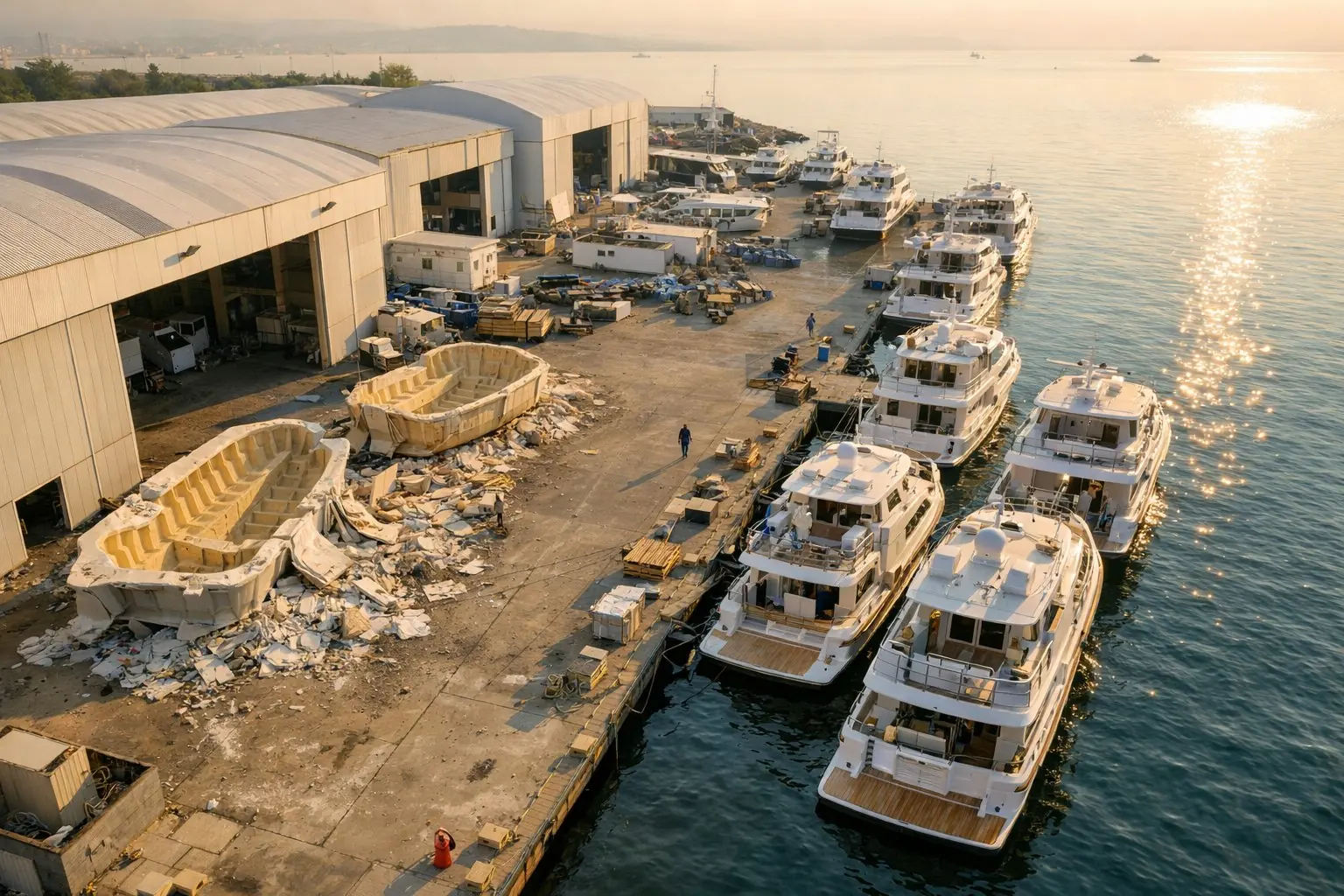
Fifty-four hulls, then the tooling goes
Pacific Asian Enterprises said on 28 July that it has stopped production of the Nordhavn 41 and 51 at the Istanbul factory of Telgeren & Partners, the subcontractor that built both. The combined run came to 54 boats, 44 of them N41s and ten N51s. Dan Streech, PAE's president, said the two projects were only just hitting their stride when the decision was taken. "It is frustrating that the exciting Nordhavn 41 and 51 projects will end their production runs in this way," he said. "Realistically there was no other answer."
The tooling goes with the models. PAE will destroy the production moulds for both, as Nordhavn has always done when a model ends its run. That detail separates this from a pause. A paused model can restart when the currency settles or a new partner appears; one whose moulds have been cut up cannot come back without fresh investment in tooling. The N41 and N51 are closed classes at 54 hulls, and that number will not move.
The currency did it, and PAE paid
PAE put the decision down to economic conditions in Turkey rather than to demand. It cited high inflation and, in its own words, a government-manipulated currency, which it said made building there unpredictable and prohibitively expensive. That is the company's characterisation, not an audited finding, and Turkish currency policy is contested ground. What is not in dispute is that a builder with orders in hand walked away from a working factory rather than keep pricing against it.
The revealing part is what happened to the boats already sold. Telgeren & Partners could not honour the prices it had committed to retail buyers on roughly ten contracted hulls. PAE put in capital of its own to finish those boats and, on its account, fulfilled every contract as written. No buyer was asked to reprice and no deposit went looking for a lawyer. That came from the brand deciding to stand behind the paper, not from the paper itself.
What a closed model does to a value
For the 54 owners the fleet is now finite and the used market is the only market. Scarcity cuts both ways on a discontinued model. A short, well-regarded run can hold value better than a model still coming off a line, because a buyer who wants one has nowhere else to go. The other side is orphan risk. Moulded parts, hatches, hardtops and one-off structural pieces are easiest to replace while the tooling exists, and here it will not.
The questions worth asking before a survey are practical. Who now carries the spares and warranty obligation, the brand or the closed factory. Whether moulded components were catalogued and stored before the tooling went. How the final hulls compare with the middle of the run, since Streech's own line was that the last deliveries were among the finest ever to carry the Nordhavn name.
At the other end, a 30m explorer finds hull two
The same day, Nordhavn published on the other end of its range. Hull one of the N100, Safe Passage, has been handed to her owner in Hong Kong and has run an 800-nautical-mile maiden passage to Palawan, before continuing through the Philippines to Raja Ampat, with Palau, the Galapagos and a Panama transit planned. The brief came from an owner who had chartered traditional Phinisi boats in Raja Ampat and wanted one that could go unaided. Chief of design Jeff Leishman drew it. A second N100 was expected to go to contract in the same week.
She measures 100 feet 11 inches, or 30.76m, on a 7.32m beam, and displaces 181.44 tonnes. Twin Caterpillar C-18s deliver 600hp each, fed from 7,000 US gallons, or 26,498 litres, of fuel. Accommodation is four cabins and eight berths in FRP, with a 2,000-gallon-a-day water maker and Onan sets of 40kW and 27.5kW. The commercially interesting detail is the hull: the N100 is a modified mould section fitted to the existing N86 and N96 tooling, so Nordhavn extended a mould it already owned.
The read for a buyer
Read the two announcements together and the range's centre of gravity has clearly moved up. The N41 and N51 brought first-time buyers to the marque at the smallest sizes it offered, and both are gone at once. What remains starts higher, and the boat taking the attention is a 30m explorer collecting its second order off a mould already paid for. Owners inside the brand are unaffected; buyers looking for the cheapest way in are not.
The wider point sits in the build contract rather than in the boats. Much of what reaches owners is subcontracted work priced years ahead in a currency the buyer does not hold. Anyone with a hull in build should know where inflation and currency risk sits in their contract, and who pays if the yard cannot hold its price. PAE's buyers found out that the answer was the brand, and that was not a contractual outcome.
Questions this story answers
What happened?
Pacific Asian Enterprises has stopped building the Nordhavn 41 and 51 in Istanbul after 54 boats, and the tooling for both will be destroyed. The company blames Turkish inflation and a lira it says the state holds artificially low, and it put its own capital in to hold agreed prices on about ten contracted hulls. For anyone with a Nordhavn, or a hull in build at a yard pricing years ahead in a currency they do not hold, the interesting part is who absorbed the cost.
Who reported this?
Nordhavn / Pacific Asian Enterprises, Soundings Trade Only, Superyachts.com.
We do this for everyone who loves this world. The people who have spent their lives in it, and the people just discovering it. Yotters exists so that what we learn belongs to all of them.
Nobody pays us for this. No ads, no sponsors, nothing for sale. We just believe the world is a little better when knowledge is shared instead of kept.
If it gave you something today, tell us to keep going. Follow us, leave a like, or write a positive comment. We read every one, and they are what keeps us going.