Pendennis buys the oil terminal inside a GBP 150m docks rebuild
What Pendennis has bought, and what it has not said
Pendennis has acquired the former oil terminal at Falmouth Docks and says the site will be returned to maritime use. SuperYacht Times reported the purchase in late July, and BOAT International has since listed it among the largest superyacht business stories of the year so far. What has not been released is almost everything a buyer would want to know: no price, no site area, no completion date, and no statement of what will be built there. Pendennis' own newsroom, which publishes readily on refit arrivals and apprenticeship awards, has not carried the announcement at all. So the fact is firm and the plan is not.
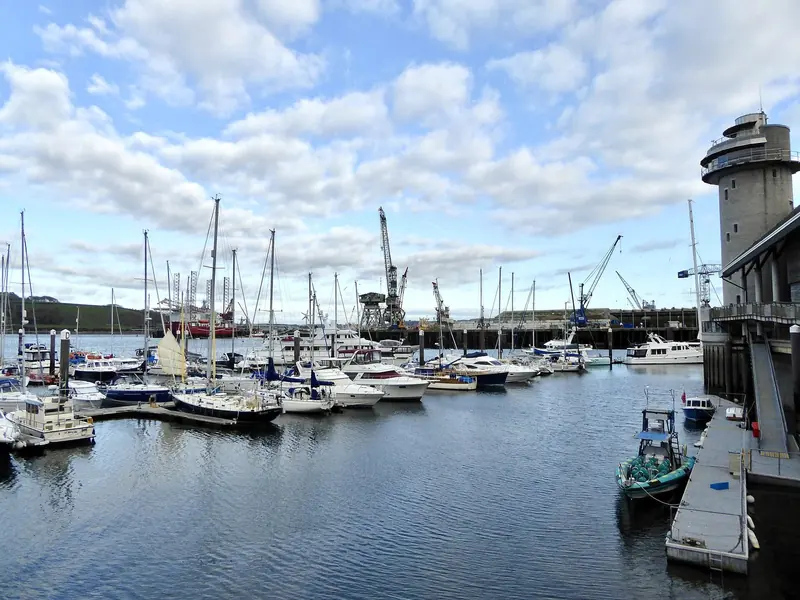
The geography is what makes it worth reading anyway. Pendennis' Falmouth operation sits on a 14-acre waterfront site inside the same working dock estate, and the terminal is the land immediately next to it. For a refit yard, land is the binding constraint, not skill: sheds, hardstanding and quay decide how many hulls can be in work at once, and none of that can be conjured on a site that is already full. An owner should treat this as an option secured, not capacity delivered. The distinction matters if you are choosing a yard for a 2028 slot.
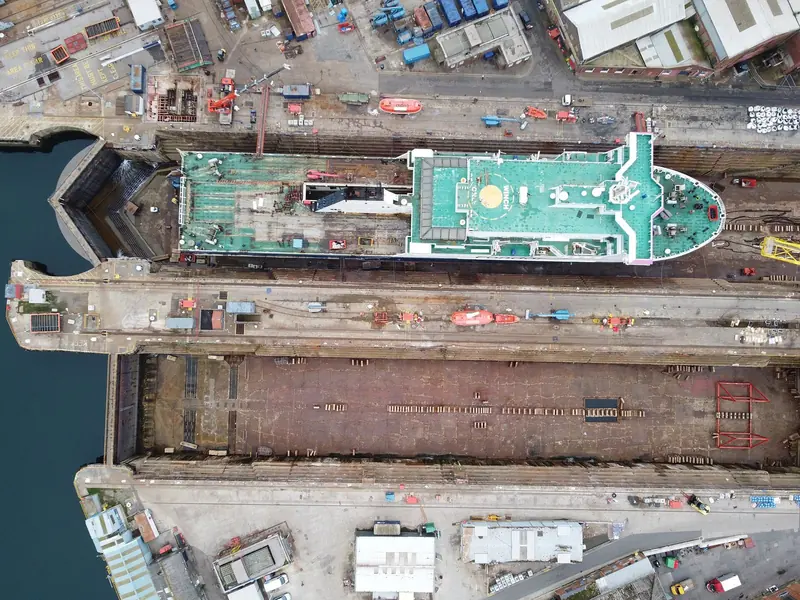
The estate around the yard is being rebuilt for GBP 150m
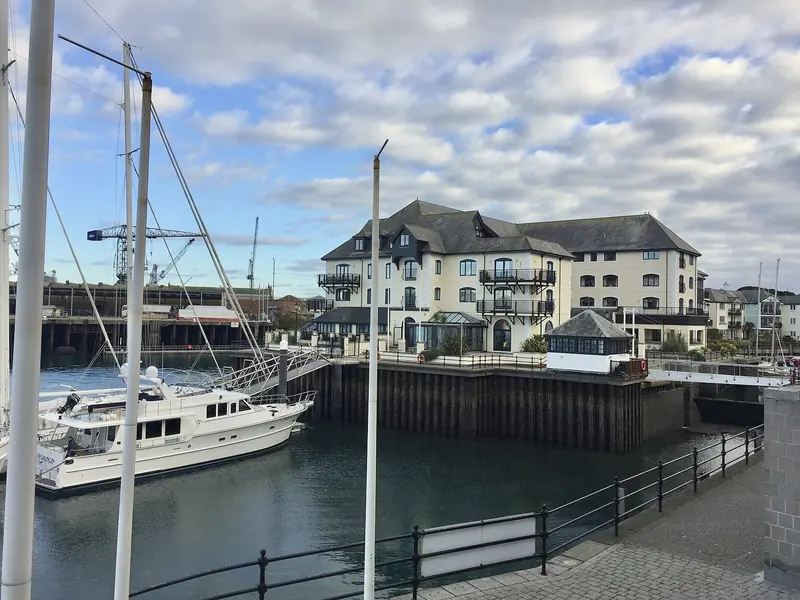
The estate around that purchase is itself being rebuilt. The developer, APCL A&P Falmouth, is running a GBP 150 million redevelopment of Falmouth Docks, and in October 2025 the UK government named the Marine Management Organisation as its Lead Environmental Regulator, a single consenting body working alongside Natural England and the Environment Agency in place of a queue of overlapping ones. Falmouth Docks joined the Lower Thames Crossing as one of the first projects in that scheme. Emma Reynolds, the Environment Secretary, framed the change as speeding approvals without loosening environmental standards. For a yard whose expansion will need marine licences, a faster consenting route is worth as much as the land itself.
What the money buys is worth stating plainly, because very little of it is aimed at yachts. The programme repairs critical dock structures and extends Queens Wharf westwards so the port can berth vessels up to 345 metres, the length of an Excellence Class cruise ship. It adds facilities for assembling floating offshore wind structures and reconnects a disused rail line for bulk import and export, with Cornish lithium in view. The published benefits are cruise and cargo ones: up to 200,000 cruise visitors a year by 2030, GBP 13 million into the local economy, more than 350 tourism jobs, doubled freight capacity, and up to 100 construction workers a day through 2026 and 2027. Mike Spicer, the developer's managing director, describes a working port handling over 100,000 tonnes of product a year and taking 56 cruise calls, alongside Royal Navy and Royal Fleet Auxiliary work.
What the yard can take today
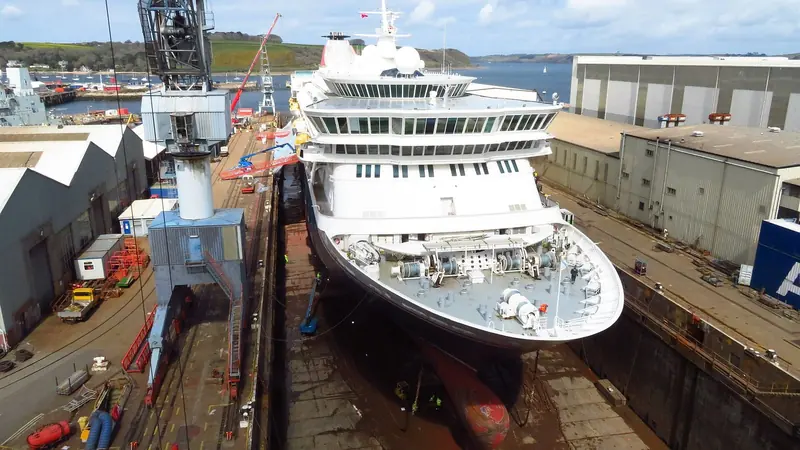
Against that backdrop, here is what the yard can actually take. Falmouth has two 75-metre fully enclosed dry docks that combine into a single dock of 150 by 24 metres, an 800-tonne travel hoist, and 7,564 square metres of enclosed non-tidal wet basin, which is the water Seawolf was brought into before her haul-out. Alongside berthing runs to 100 metres. Enclosure is the detail that earns money in Cornwall: paint and fairing work in a covered dock is not hostage to a Channel weather front, and a repaint that slips a month can cost an owner a season.
The covered space follows the same pattern. Two 90-metre construction halls give 1,800 square metres, a third hall of 45 metres gives 1,200, and there is a purpose-built 80-metre mast hall for rigs. The ceilings are firm and worth knowing before you call: Pendennis builds fully custom to 60 metres LOA and refits, rebuilds and restores to 85 metres. The group runs about 550 people across three sites, Falmouth plus Pendennis Vilanova near Barcelona, a 48-berth superyacht marina and technical service centre opened in 2019, and an interiors workshop in Norfolk. The Spanish base belongs in the calculation, because it lets an owner hold a relationship with the group without always making the passage north.
The work that earned the reputation
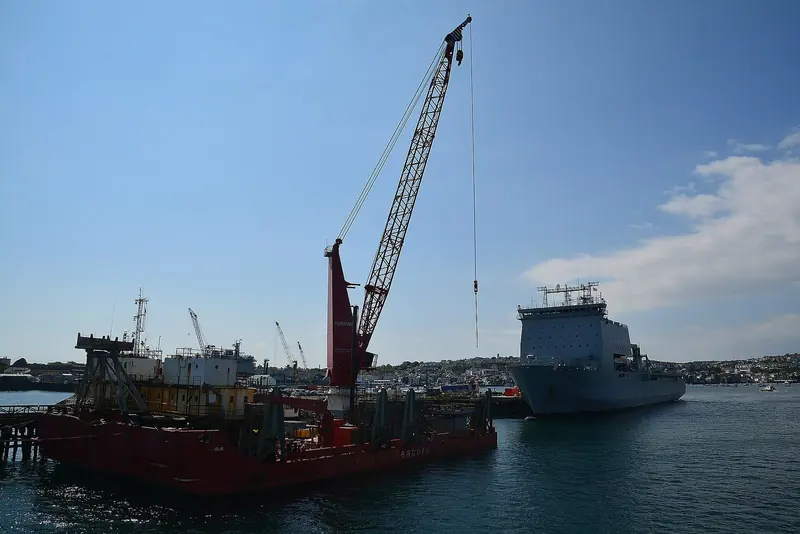
The reputation behind those numbers was built on difficult boats. Seawolf, a 58-metre former ocean-going tug from the 1950s, was towed from Holland into the Falmouth wet basin and emerged from a rebuild that ran from 2022 to 2024, taking new guest and crew interiors, exterior styling changes, extensive engineering and electrical work, and a full repaint of hull and superstructure. Design Unlimited handled a deliberately sympathetic exterior, so she still reads as the ship she was. The World Superyacht Awards gave her a Judges' Special Award in 2026. Her owners, quoted by the yard when she arrived, said they had cruised the Cornish coastline and visited Pendennis in 2020 before committing, which is a reminder that this yard tends to be chosen after somebody has seen the place.
The same year, the 57-metre Feadship Solace took the Refitted Yachts award after a year-long programme at Falmouth led by Vickers Studio, the studio that drew her originally. That refit reworked the aft deck around a sauna and a larger beach club, refreshed the interior, upgraded systems and safety, and repainted her, on a boat carrying 12 guests in five cabins with roughly 4,500 nautical miles of range. In the shed now is Gin-Tonic, a 41.7-metre Feadship from 1981 drawn by H.W. de Voogt en Zonen, in since April 2026 and due out early in 2027. She is taking a four-metre stern extension, a lengthened bridge deck, and new engines in place of her original General Motors units. Her owner's project manager, James Fiske, has described the schedule as complex and demanding, with redelivery expected in as-new condition.
Why an owner makes the passage, and why he might not
The case for going north is partly fiscal. A qualifying yacht refitting in the UK can apply for Inward Processing Relief, which relieves VAT on refit expenditure, and the UK also operates Temporary Admission and Returned Goods Relief. On a seven-figure programme that treatment is not a detail, and it is the one thing a Mediterranean yard cannot match for a non-UK owner. It is also conditional, and the conditions bite: Returned Goods Relief generally requires a vessel back within three years, unsold and unaltered, which a major refit can itself break. Take the advice before the boat moves, not after.
The case against is distance and opacity. Falmouth sits at the western end of the Channel, so a boat working the Riviera spends delivery time and fuel each way and faces a narrowing weather window through the winter. The build ceiling of 60 metres and the refit ceiling of 85 mean owners of 90-metre-plus hulls are not the customer here, whatever length of cruise ship the estate is being rebuilt to berth. And nothing is published on price: not the terms of the oil terminal purchase, not what will go on it, and not the yard's own day rates or dock hire, which are quoted project by project. An owner cannot benchmark Falmouth against Barcelona or La Ciotat from public information. He can only put it on the tender list, and after this purchase the argument for doing so is stronger.
What owners and crew report
Seawolf's owners picked the yard after cruising to it
Pendennis quoted the owners on her arrival saying they had enjoyed cruising the Cornish coastline and visiting the yard in 2020, and were pleased to be returning to the location and the shipyard for the rebuild. The project ran from her tow from Holland in 2022 to completion in 2024.
Pendennis Shipyard, project announcementThe yard set the expectation that its own trades would do the work
Toby Allies, joint managing director, said on Seawolf's arrival that the scope and scale of the project would use many of Pendennis' in-house trade specialists, and pointed to a record of large-scale rebuilds for owners.
Toby Allies, joint managing director, PendennisAn outside panel judged the Solace refit against her original condition
The World Superyacht Awards judges said Solace had been restored to reflect her original delivery condition, with updated finishes and improved functionality, when they gave her the Refitted Yachts award in 2026.
World Superyacht Awards 2026 judging panel, BOAT InternationalThe owner's representative on the current job calls the schedule demanding
James Fiske, project manager for Gin-Tonic's owners, described a complex and demanding schedule of works ahead of redelivery in as-new condition. She entered the build hall in April 2026 for a four-metre stern extension and new main engines, and is due out early in 2027.
James Fiske, owner's project manager, reported by Megayacht NewsThe port operator's own account of the estate is not a yachting one
Mike Spicer, managing director of APCL A&P Falmouth, described a centre of excellence for the Royal Navy, Royal Fleet Auxiliary, offshore vessels, cruise ships and ferries, handling over 100,000 tonnes of product a year and taking 56 cruise calls. An owner should read the estate as shared industrial water.
Mike Spicer, managing director, APCL A&P FalmouthNo independent account of the terminal purchase exists yet
Beyond the trade reports of the acquisition itself, nobody has published terms, a site plan or a use for the land, and Pendennis has not commented in its own newsroom. Every forward-looking statement in this piece is the desk's reading of the geography, not a yard commitment.
Yotters desk
What is good, and what to watch
Strong points
- The trades sit under one roofEngineering, electrical, paint, joinery and rig all run in-house across three halls and a dedicated mast shed. That is why Seawolf's two-year rebuild and Solace's year-long overhaul each ran start to finish at one yard instead of being split between subcontractors.
- A dock that reconfiguresTwo 75m enclosed docks that combine into one 150m by 24m dock let the yard take a single large hull or two mid-size ones. Enclosure means paint and fairing are not at the mercy of a Channel front, which is the difference between hitting a spring delivery and losing a season.
- Land was the ceiling, and it has just movedA refit yard runs out of ground before it runs out of skill. Buying the adjoining terminal is the only kind of purchase that lifts that limit at Falmouth, whatever the eventual use turns out to be.
- The recognition is externalSolace took Refitted Yachts at the 2026 World Superyacht Awards and Seawolf a Judges' Special Award, both decided by an outside panel rather than claimed by the yard.
- A tax route the Mediterranean cannot offerInward Processing Relief can take VAT off qualifying refit expenditure in the UK. On a programme running into seven figures, that is a material line in the comparison against Barcelona or La Ciotat.
What to watch
- It is a long way from the seasonFalmouth is at the western end of the Channel. A yacht working the Riviera gives up delivery time and fuel in both directions, and the winter weather window for the passage is narrow.
- The ceilings are realFully custom construction stops at 60m LOA and refit at 85m. An owner of a 90m-plus hull is not the customer here, however large the cruise ships the estate is being rebuilt to berth.
- None of the GBP 150m is yacht moneyThe published programme serves cruise ships to 345m, defence work, floating offshore wind and bulk cargo. A yacht owner benefits only indirectly, through a healthier estate and better dock structures.
- Nothing about price is publicNeither the acquisition terms nor the yard's rates are published, so Falmouth cannot be compared with a Mediterranean yard on paper. Every comparison starts with a tender.
- The reliefs are conditional, and a refit can break themReturned Goods Relief generally requires the vessel back inside three years, unsold and unaltered. A structural refit is an alteration, so the relief that looks attractive at the outset is not automatically the one that applies at the end.
- The plan is still unannouncedPendennis has not said what the terminal becomes, or when. An owner booking a 2028 slot is buying today's 14 acres, not tomorrow's.
Practical detail
| Dry docks | Two fully enclosed 75m docks, or one at 150m by 24m |
|---|---|
| Travel hoist | 800 tonnes |
| Wet basin | 7,564 square metres, enclosed and non-tidal |
| Alongside berthing | Up to 100m |
| Covered halls | Two 90m construction halls (1,800 sqm), one 45m hall (1,200 sqm), and an 80m mast hall |
| New-build ceiling | Fully custom to 60m LOA |
| Refit ceiling | Refit, rebuild and restoration to 85m LOA |
| Group footprint | About 550 people over three sites: Falmouth (14 acres), Pendennis Vilanova near Barcelona (48-berth marina and technical service centre, opened 2019), and an interiors workshop in Norfolk |
| Founded | 1988, at Falmouth Docks, by Peter de Savary; the first contract was the 125ft ketch Taramber, followed by the refit of the 228ft schooner Adix |
| Who owns the estate | APCL A&P Falmouth, running a GBP 150m redevelopment of the wider docks |
| Estate works funded | Repairs to critical dock structures, Queens Wharf extended westwards for vessels to 345m, floating offshore wind assembly, and a disused rail line reconnected for bulk cargo |
| Consenting route | The Marine Management Organisation acts as Lead Environmental Regulator, a single point of contact working with Natural England and the Environment Agency (announced 20 October 2025) |
| UK reliefs to ask about | Inward Processing Relief on refit expenditure, Temporary Admission, and Returned Goods Relief |
| NOT PUBLISHED: the acquisition terms | No price, no site area and no completion date have been released for the oil terminal, and Pendennis has not said what will be built on it |
| NOT PUBLISHED: what a refit costs here | Pendennis publishes no day rate, no dock hire and no labour rate. Every figure on a Falmouth quotation is project-specific, so the yard cannot be benchmarked without going to tender |
| NOT PUBLISHED: any yacht capacity gain | Nothing in the GBP 150m docks programme is earmarked for yachts; the published works cover cruise, defence, offshore wind and bulk cargo |
Questions this story answers
What happened?
Pendennis has taken over the former oil terminal at Falmouth Docks, the estate where it already works a 14-acre yard, and says the site returns to maritime use. The land sits inside a GBP 150m redevelopment that the UK government put on a fast-track consenting route last October. For an owner weighing a rebuild, it is the clearest signal yet that the northern option is growing while Mediterranean space stays tight.
What is good about it?
The trades sit under one roof. Engineering, electrical, paint, joinery and rig all run in-house across three halls and a dedicated mast shed. That is why Seawolf's two-year rebuild and Solace's year-long overhaul each ran start to finish at one yard instead of being split between subcontractors.
What should an owner or buyer watch?
It is a long way from the season. Falmouth is at the western end of the Channel. A yacht working the Riviera gives up delivery time and fuel in both directions, and the winter weather window for the passage is narrow.
What do owners and crew report?
Pendennis quoted the owners on her arrival saying they had enjoyed cruising the Cornish coastline and visiting the yard in 2020, and were pleased to be returning to the location and the shipyard for the rebuild. The project ran from her tow from Holland in 2022 to completion in 2024. (Pendennis Shipyard, project announcement)
Who reported this?
SuperYacht Times, BOAT International, Pendennis Shipyard, UK Department for Environment, Food and Rural Affairs, Marine Management Organisation, APCL A&P Falmouth, Megayacht News, World Superyacht Awards 2026.
We do this for everyone who loves this world. The people who have spent their lives in it, and the people just discovering it. Yotters exists so that what we learn belongs to all of them.
Nobody pays us for this. No ads, no sponsors, nothing for sale. We just believe the world is a little better when knowledge is shared instead of kept.
If it gave you something today, tell us to keep going. Follow us, leave a like, or write a positive comment. We read every one, and they are what keeps us going.