Pioneer Yachts Launches Pioneer One, a Ground-Up Solar-Electric 60
Built Around the Sun, Not Retrofitted for It
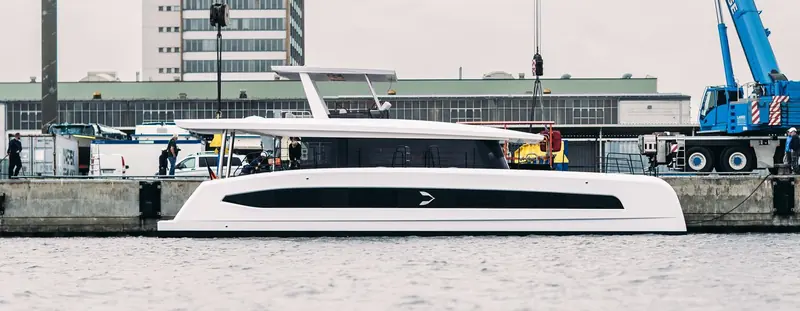
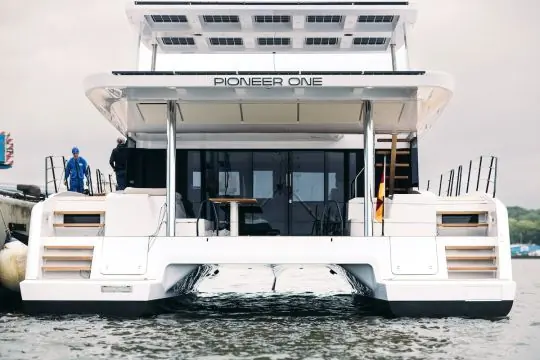
Pioneer One entered the water at Pioneer Yachts' facility in Stralsund, on Germany's Baltic coast, on 8 July 2026 and has been in sea trials since, ahead of a public debut at the Cannes Yachting Festival on 8 to 13 September. She is the first hull of the PY60, a 60-foot catamaran that the yard says was designed from its first sketch around solar-electric propulsion, rather than adapted from an existing combustion-engine platform, according to Yachting Magazine and Boatnews.com. That distinction is the whole premise of the company: most electric or hybrid yachts on the market today started life as a diesel hull that later had batteries and panels added, carrying the weight distribution and system layout of the boat they were converted from.
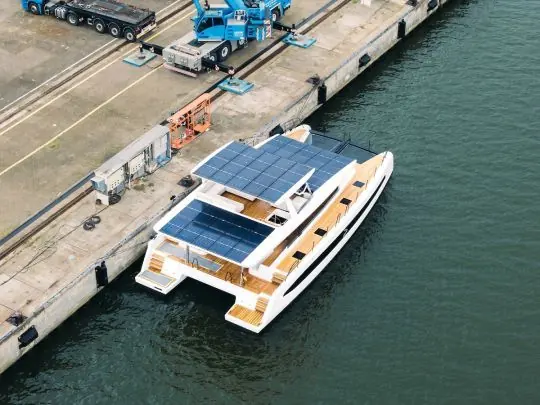
The PY60 instead runs a 48-volt electrical backbone through the entire vessel, with solar panels built into the coachroof, battery banks below, and diesel generators kept as backup rather than the primary source of power, per Boatnews.com and Robb Report. Pioneer Yachts has not disclosed the panel output in watts or the battery bank's capacity in kilowatt-hours, so a buyer cannot yet work out how many hours of silent, generator-free cruising the boat can actually deliver, or under what load. That is the single biggest unpublished number on a boat sold on its energy system.
The Hull, and Who Drew It
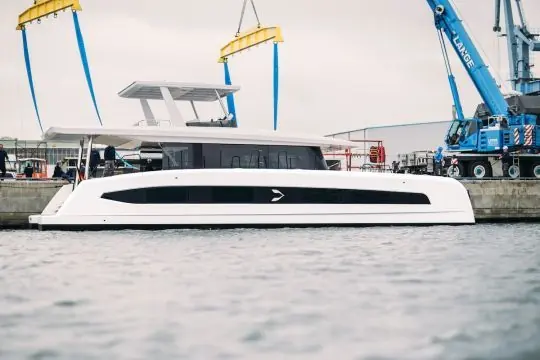
Pioneer One measures 18.30 metres (60 feet) long on an 8.98-metre beam, with a lightship displacement of about 30 tonnes, figures confirmed across Boatnews.com and Robb Report's reporting on the launch. Sunseeker-style planing speed was never the design brief: Pioneer states a cruising speed of 7.5 knots and a top speed of 11 knots, figures that sit well below a conventional 60-foot cruising catamaran running combustion engines. The exterior is by the Italian studio Cossutti & Ganz, known for performance sailing yacht hulls rather than motor cats, and the interior is by Micheletti + Partners. The layout is deliberately single-level, with the cockpit and salon joined by what the yard calls the largest cockpit door in its class, and a joystick control that integrates the electric propulsion motors with the bow thruster for docking.
That single-level, simplified-systems approach is aimed squarely at an owner who wants to run the boat without permanent crew. Pioneer's own language, reported by Yachting Magazine, frames the PY60 as designed for continuous owner operation rather than as a showpiece run by a captain and mate. Whether that ambition holds up in practice is untested: Pioneer One is the only hull built so far, and no owner has yet taken delivery to confirm it.
Who Is Behind It
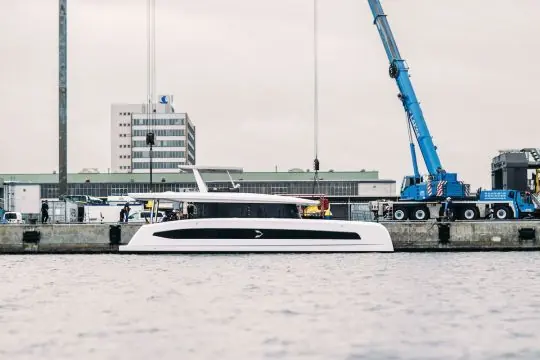
Pioneer Yachts was founded in Stralsund roughly two years before this launch, which makes Pioneer One a debut hull from a genuinely new yard rather than an established builder's new model. Its founder, Mike Frank, is a Bremen-born engineer and the son of a commercial shipping captain; more than twenty years before starting Pioneer Yachts, he founded the meistro Group, an early developer of CO2-free power supplied directly from the company's own photovoltaic parks, according to reporting picked up by Yahoo Finance from Pioneer's own materials. That is a real and checkable energy-industry background, not a marketing claim invented for the boat launch, though it is also Pioneer's own account of its founder and has not been independently profiled by the trade press.
The yard says its build team carries a combined 275-plus years of boatbuilding experience, without naming which yards that experience came from. Pairing an Italian racing-hull designer with a German solar-energy founder and an unnamed veteran production team is an unusual combination for a 60-foot yacht, and it is also, for now, a claim resting entirely on the company's own account of itself.
What Pioneer Has Not Published
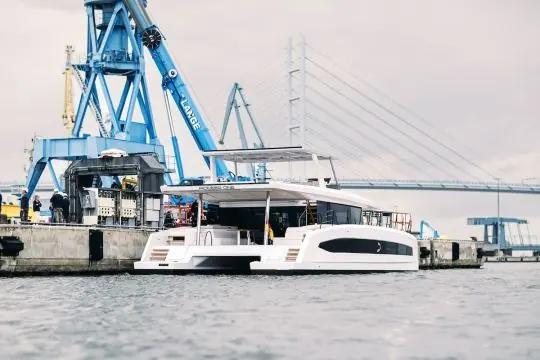
No price has been disclosed for the PY60, at Pioneer One's specification or any other. No independent sea trial exists yet: every speed, range and power figure that has reached the trade press so far originates with the yard, gathered from its own trials that began just weeks before this report. No third party has driven the boat, and no reviewer has published fuel or energy consumption figures against real-world use. A prospective buyer weighing this boat against a conventional 60-foot catamaran currently has to take Pioneer's word for the numbers that matter most: how far it will run on batteries alone, how quickly the panels recharge them, and how often the diesel generator actually has to fire.
None of that makes the project doubtful, only unproven. A first hull from a two-year-old yard, still in its own sea trials, is exactly the stage at which none of that data should exist yet. What it means for now is that the PY60's real test starts at Cannes in September, when brokers, surveyors and potential owners get to see and question the boat directly rather than read the yard's own release.
Why Cannes Is the Real Test
A design debut and a public sea trial are different things, and the PY60 has so far only had the first. Cannes puts Pioneer One in front of the brokers and surveyors who will decide whether the yard's energy-management claims hold up against scrutiny, and whether a genuinely new yard with a single hull built can be trusted with a second order before the first owner has logged a season aboard. For an owner drawn to the idea of a solar-electric cruising yacht rather than a diesel boat with a green coat of paint, Pioneer One is the first purpose-built example to reach the water; whether it is also a boat worth ordering depends on numbers the yard has chosen not to publish yet.
The comparison that will matter at the show is not to other solar yachts, of which there are few built to this size and speed profile, but to a conventional diesel 60-foot catamaran on range, speed and total cost of ownership over several seasons. Pioneer is betting that owner-operators drawn to lower running noise, no fuel stops for coastal cruising, and a simplified single-level layout will pay a premium for a boat that trades outright speed for that autonomy. Nothing published so far proves that trade is a good one; it only shows the boat now exists to test it.
What is good, and what to watch
Strong points
- Purpose-built, not convertedThe 48-volt system and hull are engineered around solar-electric propulsion from the first sketch, rather than batteries added to an existing diesel platform
- Owner-operator systemsA joystick docking control integrating propulsion and thruster, single-level living, and a wide cockpit-to-salon opening all aim at running without permanent crew
- A credible energy pedigree behind itFounder Mike Frank spent two decades running a CO2-free photovoltaic power business before starting the yard
What to watch
- No independent trial dataEvery speed, range and power figure published so far is Pioneer's own, from trials that only began in July 2026
- No price disclosedA buyer cannot judge value against a conventional 60-foot catamaran without knowing what the PY60 costs
- Still diesel-dependentThe generator backup means the boat is not fuel-free; how often it actually has to run is exactly the number Pioneer has not published
- Modest speed for the size11 knots top and 7.5 knots cruise is slow next to a combustion-powered 60-foot catamaran, a real trade-off for owners who cruise on a schedule
Practical detail
| Length / beam | 18.30m (60ft) x 8.98m |
|---|---|
| Displacement | About 30 tonnes, lightship |
| Speed | 7.5 knots cruise, 11 knots top |
| Power system | 48-volt backbone; coachroof solar, battery banks, diesel generator as backup |
| Builder | Pioneer Yachts, Stralsund, Germany, founded around 2024 |
| Price | Not published by the yard |
| What is not published | Solar panel output, battery capacity, silent-running range, and any independent sea trial; every figure so far is the yard's own |
| First public viewing | Cannes Yachting Festival, 8 to 13 September 2026 |
Questions this story answers
What happened?
A two-year-old German yard has put its first hull in the water: an 18.3-metre catamaran engineered from a blank sheet around solar panels and batteries, not a diesel boat with panels bolted on afterward. For an owner weighing a first electric-capable yacht, the pedigree behind the build matters as much as the numbers Pioneer has, and has not, published.
What is good about it?
Purpose-built, not converted. The 48-volt system and hull are engineered around solar-electric propulsion from the first sketch, rather than batteries added to an existing diesel platform
What should an owner or buyer watch?
No independent trial data. Every speed, range and power figure published so far is Pioneer's own, from trials that only began in July 2026
Who reported this?
Yachting Magazine, Boatnews.com, Robb Report, Yahoo Finance.
We do this for everyone who loves this world. The people who have spent their lives in it, and the people just discovering it. Yotters exists so that what we learn belongs to all of them.
Nobody pays us for this. No ads, no sponsors, nothing for sale. We just believe the world is a little better when knowledge is shared instead of kept.
If it gave you something today, tell us to keep going. Follow us, leave a like, or write a positive comment. We read every one, and they are what keeps us going.