Amazon takes on Starlink, and your yacht gets more choice
Amazon Leo crosses into service range
Amazon's low-Earth-orbit broadband network, rebranded from Project Kuiper in November 2025, reached 396 satellites in orbit on 2 July after a United Launch Alliance Atlas V carried 29 more from Cape Canaveral, according to the trade outlet Via Satellite. Chris Weber, the vice president running Amazon Leo Business, said the network now has enough capacity to support continuous service across initial latitudes. That milestone followed a 22 June flight on an Ariane 64, which Smart Maritime Network reported as the largest single launch for the network to date at 36 satellites. Amazon has told the market that full commercial service is on track for later in 2026, with the constellation authorised by the US Federal Communications Commission to grow to 3,236 satellites.
For an owner the headline is choice, because Starlink is about to have a second serious low-orbit rival at sea after Eutelsat OneWeb. Amazon plans to switch on service in latitude bands first, one north and one south of the equator, then widen toward the tropics and the poles as more satellites go up. That sequencing matters if the yacht spends its summers in the Mediterranean or its winters in the Caribbean, because early coverage may not reach peak-season waters on day one. The practical read for 2026 is that a third network is coming, though it is not switched on everywhere yet.
The route to yachts is already open
The path into yachting is not theoretical. On 10 February 2026, Amazon Leo named its first maritime resellers, ELCOME and MTN, both of which list yachting alongside merchant shipping, offshore energy and fishing. ELCOME, a maritime technology supplier of more than 55 years that says it manages connectivity for over 5,000 vessels, will carry the service across the Middle East, Asia, Europe, Africa and North America. Two terminals are in the lineup, the Leo Pro, an 11-inch electronically steered phased array rated up to 400 Mbps download and pitched at yachting and fishing, and the larger Leo Ultra, rated up to 1 Gbps download and 400 Mbps upload for merchant and offshore fleets. Both use fixed phased-array antennas with no moving parts.
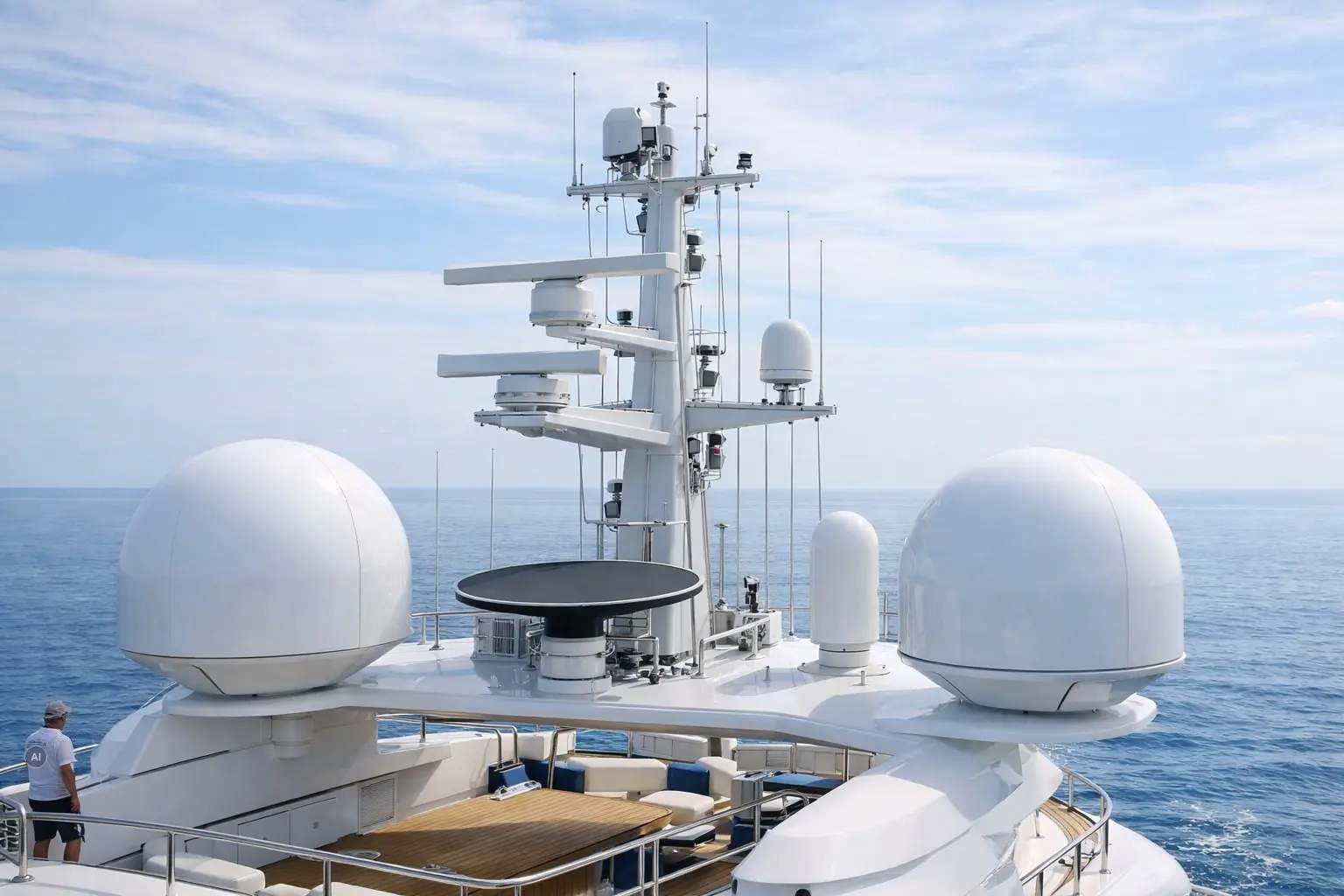
A flat panel with no moving parts is the part that changes a yacht, because it is lighter, lower and less trouble than a gimballed dome, and it competes directly with the Starlink panels already on many boats. The caveat for an owner is that there is no separate yacht service tier yet, so a yacht buying today would take the same Leo Pro terminal offered to commercial fishing boats. Trevor Vieweg, who heads global business for Amazon Leo, framed the early pitch around crew welfare, vessel tracking and remote diagnostics rather than guest streaming, which is a fair signal of where the product is aimed for now.
The one decision for an owner
Since Starlink Maritime arrived, it has become the default primary link on new builds and refits, with OneWeb the usual second orbit and legacy VSAT kept for backup and safety traffic. Amazon Leo turns the low-orbit field into a three-way contest. Industry commentators, including the maritime title The Digital Ship, expect a credible new entrant to put price pressure on the incumbents, though Amazon has not published maritime pricing and its yachting availability is realistically a 2027 matter once oceanic coverage fills in.
The decision this creates for an owner is about staying flexible, not about switching networks today. Asking a yard for the deck space and a multi-orbit setup that can carry Starlink, OneWeb and, in time, Amazon Leo keeps an owner from being locked to a single provider before the market settles. VSAT or L-band should stay aboard for GMDSS safety service where it applies. For anyone signing a connectivity contract this season, the sensible line is a review point in 2027, when Amazon Leo's maritime coverage and pricing should be visible rather than promised.
Questions this story answers
What happened?
Amazon's low-orbit network reached 396 satellites on 2 July, enough, its executives say, to begin continuous service later this year. Starlink's grip on fast internet at sea now faces a second challenger after Eutelsat OneWeb, which is good news for an owner in the form of choice and price pressure. The one decision it creates is to keep a new build or refit open to every network rather than wedded to one.
Who reported this?
Via Satellite (satellitetoday.com), Smart Maritime Network, The Digital Ship, SatNews, Amazon Leo newsroom (press.aboutamazon.com).
We do this for everyone who loves this world. The people who have spent their lives in it, and the people just discovering it. Yotters exists so that what we learn belongs to all of them.
Nobody pays us for this. No ads, no sponsors, nothing for sale. We just believe the world is a little better when knowledge is shared instead of kept.
If it gave you something today, tell us to keep going. Follow us, leave a like, or write a positive comment. We read every one, and they are what keeps us going.