Your guests lose the internet in Monaco, not at sea

How the baseline quietly flipped
The migration is no longer a forecast. Analyst house Valour Consultancy, writing on SuperyachtNews in December 2024, measured yacht consumption of traditional GEO VSAT falling 50 to 75 per cent from 2022 to 2023, with cellular usage down 40 to 50 per cent over the same period. Palma integrator e3 Systems, which fitted the industry's first yacht VSAT back in 2004, told The Islander in December 2025 that it alone has now installed close to 300 Starlink systems.
For an owner the practical meaning is simple. Starlink now carries the guest experience, and the older VSAT dome many yachts still fly has become the fallback rather than the service. Valour puts real-world Starlink throughput at 80 to 200 Mbps outside priority zones, with one catch worth knowing before a full boat of guests arrives. Once a plan's priority data is used up, overage speeds fall to single-digit megabits.

It breaks in a crowded harbour
Congestion, not coverage, is what the crowded seasons exposed. BOAT International reported Captain Paul Clarke of the 54.9 metre Loon seeing "a massive reduction in bandwidth" whenever cruise ships shared the port, and the sailing yacht Atalante logging 35 to 50 Mbps berthed in Palma, with only occasional peaks of 80 to 90. Bluewater Yachting documented the same pattern in the Caribbean, where popular cruising grounds slowed markedly when the superyacht fleet arrived in the winter of 2022.
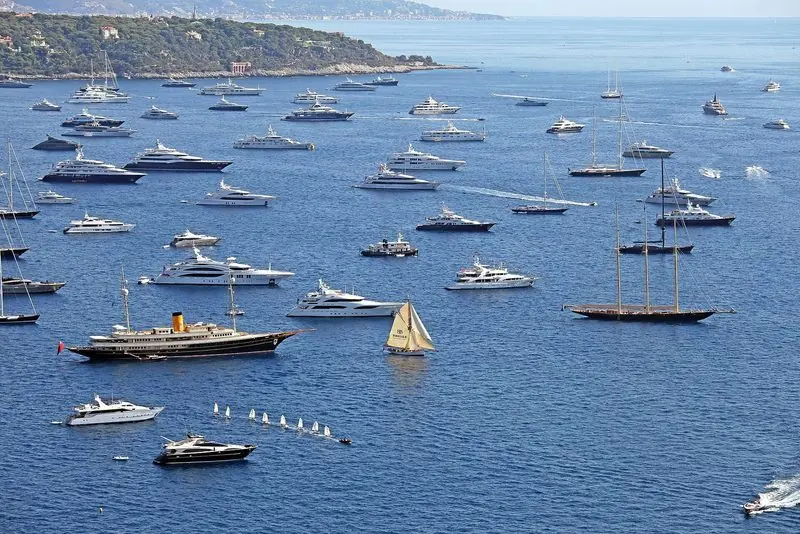
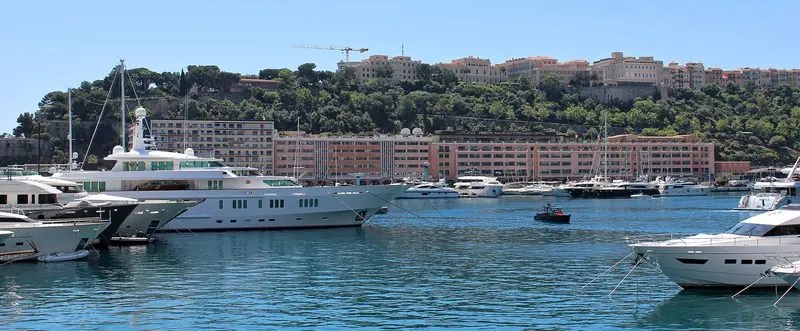
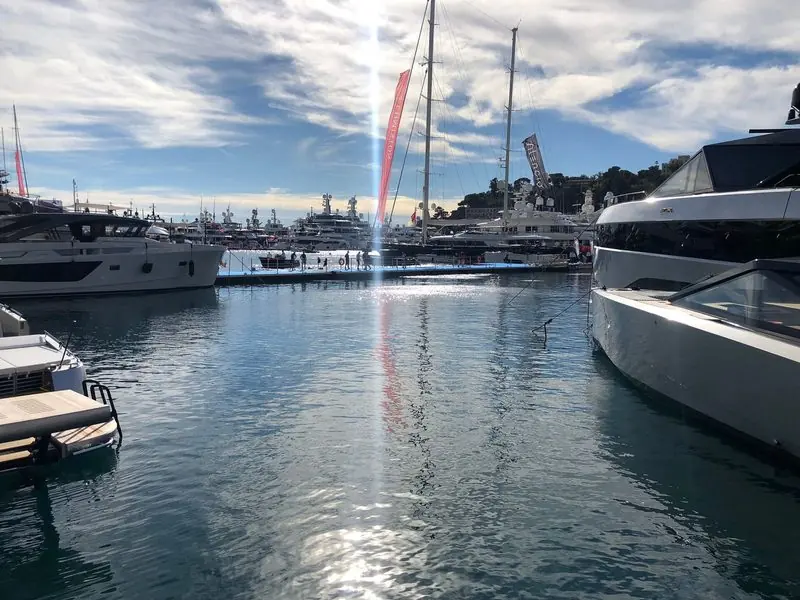
By spring 2026 the trade was naming the hotspots. Connectivity provider Coffee Networks reported that in Monaco, Palma and St Barts class harbours a best-effort LEO link can drop from roughly 300 Mbps to 5 Mbps in peak weeks, because every vessel in the basin competes inside the same satellite cell. This is the week the guests are aboard and the yacht is on show, and no berth comes with a bandwidth guarantee.
The decision that keeps you covered
The answer the market has settled on is not to bet the yacht on one network. Ernesto Esposito of managed provider OmniAccess, writing on SuperyachtNews in June 2026, argues for two LEO constellations plus a GEO layer rather than a single-provider link. In hardware that means pairing Starlink's V4 High Performance maritime panel, launched in July 2025 with an IP68 rating, a 75 to 100 watt draw and 50 metre cable runs, with a Eutelsat OneWeb flat panel such as Intellian's OW11, which The Islander rates at up to 100 Mbps and which reuses existing VSAT coax during a refit.
OneWeb also reaches Turkey, where Starlink is not available, which matters if the itinerary runs east. A slim VSAT contract with a committed information rate is worth keeping for the bridge and for voice, since a guaranteed rate is the one thing no LEO tier sells today. Amazon's LEO service is forecast to reach maritime users in 2027, per SuperyachtNews, so annual terms beat multi-year lock-ins. The prize for an owner is a yacht that holds its connection through the busiest week of the season, when the boat is fullest.
What owners and crew report
A captain's account of harbour congestion
Captain Paul Clarke of the 54.9 metre Loon reported a massive reduction in bandwidth whenever cruise ships shared the port.
Paul Clarke, Captain, M/Y Loon, via BOAT International
What is good, and what to watch
Strong points
- The fix is a known, buyable setupThe market has converged on a specific pattern, two LEO constellations plus a slim GEO layer, not a wait-and-see problem, so an owner can act on it before next season rather than hope for a network upgrade.
- OneWeb closes the one real coverage gapReusing existing VSAT coax during a refit and reaching Turkey, where Starlink cannot, makes the second layer a practical retrofit rather than a theoretical one.
What to watch
- Redundancy costs real hardware and airtimeRunning two LEO constellations plus a VSAT contract means three subscriptions and at least two extra antenna installs, not a cheap add-on, and no source in this reporting prices the combined system.
- No LEO tier guarantees a rateEven with two constellations running, guest wifi can still degrade in the worst weeks; only the VSAT layer offers a committed information rate, so the redundancy manages the risk, it does not remove it.
Practical detail
| Recommended setup | Pair a LEO maritime panel (Starlink's V4 High Performance: IP68, 75-100W draw, 50m cable runs) with a second LEO layer such as Intellian's OW11 Eutelsat OneWeb flat panel, which reuses existing VSAT coax during a refit, plus a slim VSAT contract with a committed information rate for the bridge and voice. |
|---|---|
| Real-world speeds to expect | 80-200 Mbps outside priority zones per Valour Consultancy, but a crowded harbour cell (Monaco, Palma, St Barts) can fall to roughly 5 Mbps in peak weeks per Coffee Networks; once a plan's priority data is used, overage speeds drop to single-digit Mbps. |
| Coverage gap | Starlink is not available in Turkey; Eutelsat OneWeb is, which matters on an eastern Mediterranean itinerary. |
| Contract term | Favour annual over multi-year LEO terms - Amazon's LEO maritime service is forecast to reach the market in 2027 per SuperyachtNews, which could reshape pricing. |
| What is not published | No LEO provider currently sells a guaranteed data rate the way a GEO VSAT contract can; that guarantee still has to come from the VSAT layer, and none of the providers named here publish a combined system price. |
Questions this story answers
What happened?
Traditional VSAT use on yachts fell 50 to 75 per cent in a single year after Starlink took hold, per Valour Consultancy, and the fleet that switched now fights for the same satellite cell in Monaco and Palma. The failure lands where it hurts most, in a full harbour with guests aboard, and the fix is one decision an owner can make before the next season.
What is good about it?
The fix is a known, buyable setup. The market has converged on a specific pattern, two LEO constellations plus a slim GEO layer, not a wait-and-see problem, so an owner can act on it before next season rather than hope for a network upgrade.
What should an owner or buyer watch?
Redundancy costs real hardware and airtime. Running two LEO constellations plus a VSAT contract means three subscriptions and at least two extra antenna installs, not a cheap add-on, and no source in this reporting prices the combined system.
What do owners and crew report?
Captain Paul Clarke of the 54.9 metre Loon reported a massive reduction in bandwidth whenever cruise ships shared the port. (Paul Clarke, Captain, M/Y Loon, via BOAT International)
Who reported this?
Valour Consultancy, SuperyachtNews, e3 Systems, The Islander, BOAT International, Bluewater Yachting, Coffee Networks, OmniAccess, Eutelsat OneWeb, Intellian.
We do this for everyone who loves this world. The people who have spent their lives in it, and the people just discovering it. Yotters exists so that what we learn belongs to all of them.
Nobody pays us for this. No ads, no sponsors, nothing for sale. We just believe the world is a little better when knowledge is shared instead of kept.
If it gave you something today, tell us to keep going. Follow us, leave a like, or write a positive comment. We read every one, and they are what keeps us going.