Espinosa Yacht Design
| Florida, United States | |
| Founded by J.C. Espinosa, 1990 | |
| Exterior design, some naval architecture |
From Chicago Architecture to a Feadship Commission
That is an unusual entry point into the industry: most of the naval-architecture-adjacent designers in this directory trained in marine engineering or came up through a yard's technical office, while Espinosa arrived from residential and commercial architecture and treated a yacht as another building type to solve. He founded Espinosa Inc in 1990, five years after that first exposure, and his debut commission was Gallant Lady, a 39.6 metre Feadship built for Jim Moran, the Chicago-based Cadillac and Jaguar dealer whose name is still attached to Moran Yacht & Ship, a brokerage house active in the market today.
Gallant Lady's profile in the market was real, not just a private commission: she was nominated for Best in the World at the 1992 World Superyacht Awards, a strong result for a debut project from a designer with no prior yacht credits. That result is what a young studio needs to get its next commission, and it set the pattern the rest of Espinosa's career has followed: production-relevant work for established builders rather than one-off flagships for the ultra-wealthy alone.
The Raised Pilothouse: A Real Engineering Partnership
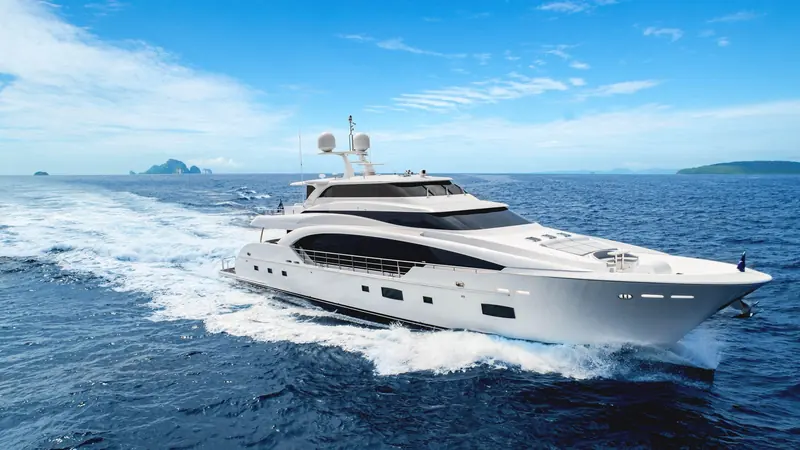
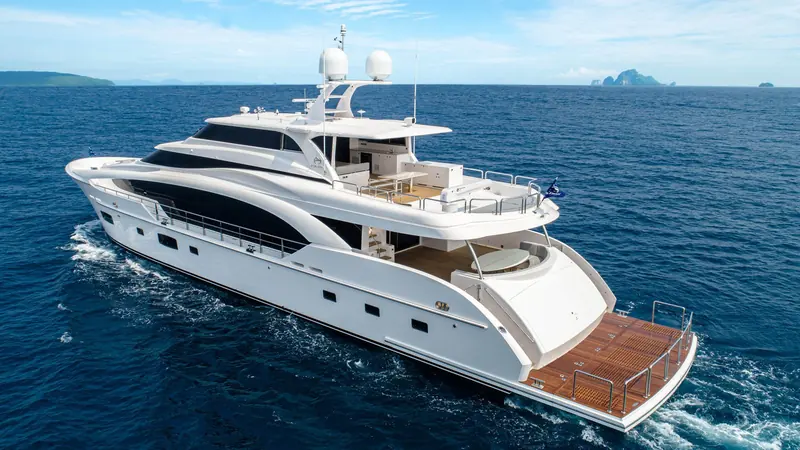
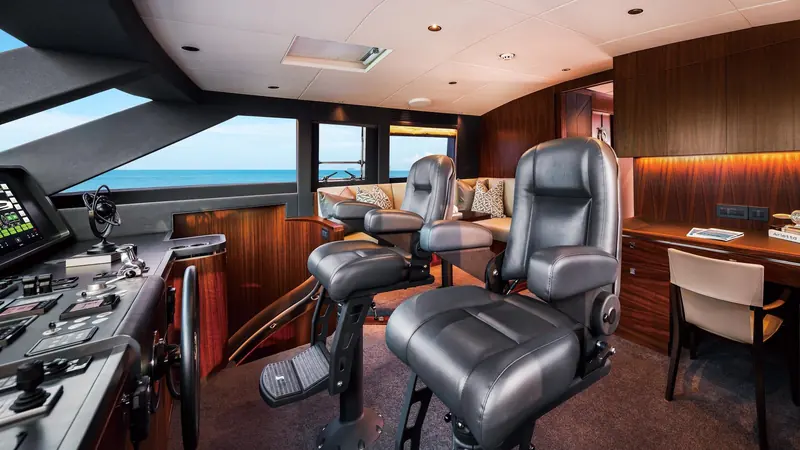
Blount was one of the most respected planing and semi-displacement hull designers in the industry before his death, credited elsewhere with fast-hull work for military and commercial vessels as well as yachts, and his involvement puts the RP110 on firmer engineering ground than a styling exercise alone. The double-chine hull the two of them developed was built explicitly for stability and reduced drag rather than outright speed, a deliberate trade for a boat meant to raise the pilothouse a full deck above the accommodation, opening up the main deck for guest living space in a way a conventional flybridge layout cannot.
Andrea VI, the first hull, completed sea trials with her new owner aboard in 2013; Charterworld's report on the trial describes rough conditions in which the hull sliced through the waves for what the coverage calls a stable, comfortable ride, with a small, smooth turning radius that satisfied the captain at the helm, though no individual aboard is named or quoted directly in that coverage. It is the clearest documented proof this research found that the RP110's hull form performs as intended, even without a named voice to attach the verdict to.
The RP Series, From RP97 to RP120
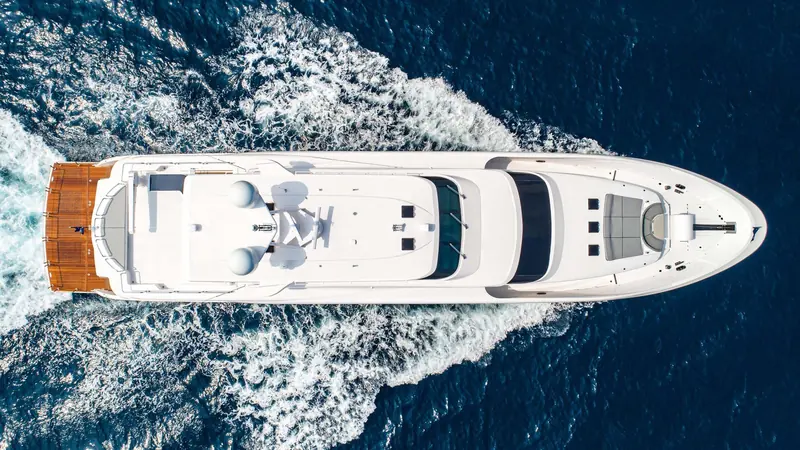
A production line that survives eight years and grows a metre class larger is a meaningfully different kind of evidence than a single celebrated launch: it means owners kept buying the concept, not just the first boat. Horizon's own current model listings put the RP120 at a 26-foot beam with flexible arrangement options, including an on-deck master suite, aimed at the same long-range cruising brief as the original RP110 but at a larger scale.
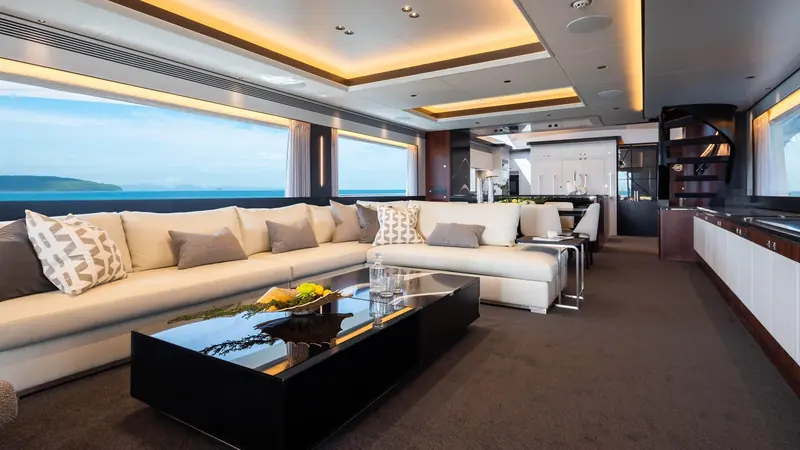
No source in this research gives an exact production count for the RP-series as a whole, and Horizon's pricing for the RP120, like almost every yard's for a semi-custom line at this size, is quoted as price on application rather than published. What is confirmed is the interior-design split: Espinosa styled the exterior of both boats and the interior of the smaller RP97 himself, while the larger current RP120 pairs his exterior with Luca Dini's interior, a builder-brokered pairing rather than an Espinosa-only commission.
Beyond the RP Line: Explorers, Tri-Decks and the Rest of the Horizon Book
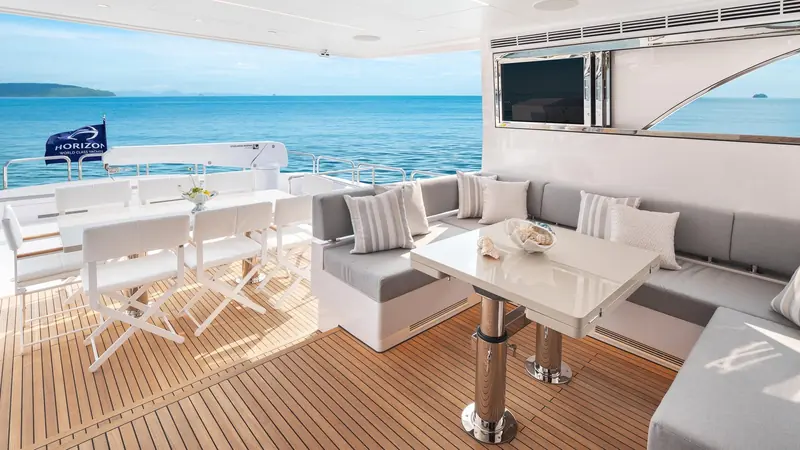
The Explorer line matters as much as the RP series to an honest picture of the studio: EP77, EP110 and EP150 are long-range, go-anywhere designs in the same spirit as the raised-pilothouse boats, and Horizon's own photography of the EP150 shows the same double-chine, high-freeboard hull language carried up to a larger scale. The Tri Deck P-series sits at the opposite end of the brief, a more conventional three-deck motor-yacht layout aimed at guests who want volume and formality over range, and Muses specifically was a finalist for Best Raised Pilot House Semi-Displacement or Planing Motor Yacht at the 2012 World Superyacht Awards while the P136 Angara was a finalist in the three-deck category the same year.
Taken together with the RP and E-series work, this is a studio that has styled almost every hull shape Horizon builds, sedan, catamaran, explorer, raised pilothouse and tri-deck alike, across roughly two decades, rather than owning one signature silhouette the way some studios in this directory do. Espinosa's site also lists interiors-only credits on several further Horizon hulls (Lady Gaga, Simbad) and on other yards' boats (Trinity's Tsumat, Palmer Johnson and Townsend Bay Marine projects), a reminder that not every credit on the list is exterior styling, and a reader should check which scope a given boat actually carries.
Delta, Trinity and the Wider Custom Fleet
Delta and Trinity were, for years, two of the dominant American builders of large custom motor yachts, and a working relationship with both, alongside the long Horizon partnership, gives Espinosa a spread across the US custom-build market that few competing studios in this directory can claim; most of the others are concentrated in Italy or the Netherlands. The Drettmann Bandido relationship, a full five-model explorer range from 66 to 170 feet according to the studio's own project list, is a second production-scale commitment running alongside the Horizon work, this time with a German yard rather than an Asian or American one.
This research found specification-level detail (length, builder, general arrangement) for these American and German projects through the studio's own site and market listings, but no dedicated feature coverage or named owner and captain commentary comparable to the RP110 sea-trial reporting. That gap is consistent across almost every entry in this profile: Espinosa's boats are well documented as objects, far less so as lived experience.
A Studio That Does More Than Yachts
That range is a genuine point of difference. A studio whose principal trained as an architect and still practises architecture brings a different set of reference points to a yacht's general arrangement than one whose whole career has been boats, and Espinosa's own account of his approach, fluid curves and flowing shapes across his production yachts, reads as an aesthetic carried over from that broader design background rather than one developed purely inside the marine industry.
It also means a reader evaluating the studio purely as a yacht specialist is seeing only part of the practice's workload, which may explain why its yacht output, while extensive at the Horizon-production level, has not produced the very large one-off flagships that dominate coverage of some competing studios in this directory.
What It Costs and How to Commission
That routing through a production builder matters for a prospective buyer's expectations: pricing for an RP120 or any other Horizon hull he has styled is quoted by Horizon on application, bundled into the yard's own build contract, rather than negotiated as a separate design fee with Espinosa's studio the way a client would commission Studio Spadolini or Claydon Reeves in this directory for a fully bespoke one-off. The general industry band for full design scope, cited by marine design-cost guides such as Cad Crowd and DraftXL, still applies loosely, roughly 10 to 20 per cent of build cost, but no Espinosa-specific figure or Horizon-specific breakdown of what portion of the build price the design work represents was found in this research.
A buyer wanting Espinosa's exterior styling on a proven, sea-trial-tested hull form has a straightforward, well-documented route: order through Horizon's current RP or FD line. A buyer wanting a fully bespoke, one-off flagship the way some other studios in this directory deliver should be clear-eyed that most of Espinosa's confirmed, well-documented recent work sits inside a production programme rather than outside one.
معلومات عملية
| Design fee | not published; most buyers reach Espinosa's styling by ordering a Horizon RP, Explorer or Tri Deck hull, priced by Horizon on application as part of the build contract rather than as a separate published design fee |
|---|---|
| Studio base | Florida, United States, alongside an active architecture, residential-interiors and furniture practice |
| Main production route | Horizon Yachts' RP series (RP97 discontinued 2021, RP110 in production since 2013, RP120 current flagship), plus the E, PC and EP-Explorer lines and the P-series Tri Deck range, per the studio's own completed-projects page |
| Confirmed one-off and small-series work | Gallant Lady (Feadship, 39.6m, 1990, styling only), Gran Finale and Usher (Delta Marine), interiors on Trinity Yachts' Tsumat and the five-model Bandido explorer range for Germany's Drettmann |
| What is not published | studio headcount, exact RP-series production totals and any figure for what share of a Horizon build price the design work represents |
ما يذكره الملاك والأطقم
The RP110's hull form performed as designed on its first sea trial, according to trade reporting of the event
Charterworld's coverage of Andrea VI's 2013 sea trial, held in rough conditions, describes the double-chine hull slicing through the waves for a stable and comfortable ride and reports the boat's small, smooth turning radius satisfied the captain at the helm, though the report does not name or directly quote that captain or the owner.
CharterworldNo independently reported owner, crew or captain interview specific to an Espinosa-designed hull was found in this research
Coverage of Gallant Lady, the RP110, RP97, RP120, Gran Finale, Mr Terrible and Tsumat is consistently specification-led (length, builder, awards) or paraphrases the yard's own marketing language; no named owner, captain or crew member speaking in their own words about any of these yachts turned up in this research.
Yotters research desk
نقاط القوة وما يستدعي الانتباه
نقاط القوة
- A real, sustained production record, not a portfolio of unbuilt conceptsEspinosa's own project list names Horizon RP, E, PC, EP-Explorer and P-Tri-Deck hulls delivered from the mid-2000s through the 2020s, spanning roughly 17 to 51 metres, a scale of actual production few boutique studios in this directory can match
- A proven engineering partnership behind the signature hull formthe RP110's double-chine hull was co-developed with naval architect Donald L. Blount and demonstrated its stability and turning performance on a documented 2013 sea trial
- Genuine reach across the American custom-build marketin addition to Horizon, delivered work for Delta Marine and Trinity Yachts, with three finalist nominations across two yards at the 2012 World Superyacht Awards
- A broader design practice feeding the yacht workan active architecture, residential-interiors and furniture practice alongside the marine studio, a background most single-discipline yacht studios do not have
ما يستدعي الانتباه
- Most current work is routed through one builder's semi-custom programmea buyer cannot commission Espinosa the way they would a purely independent studio; Horizon controls the contract and the pricing for the RP and FD lines
- No confirmed one-off flagship above roughly 51 metresthe documented fleet tops out in the low 50-metre range; buyers seeking a large bespoke one-off should look elsewhere in this directory
- No public fee schedule or studio headcount foundas with most boutique yacht studios, pricing and staffing are simply not published anywhere this research could find
- No independently reported owner or crew testimonyevery account of an Espinosa-designed yacht in this research traced back to specification listings or the builder's own press material, not to a named person describing life aboard
لمين هو: buyers considering a semi-custom Horizon RP, Explorer or Tri Deck yacht, and anyone researching the naval-architecture pedigree behind the raised-pilothouse hull form