Mark Berryman Design
| Founder | Mark Berryman, British; studio incorporated as Mark Berryman Design Limited on 9 January 2007 (Companies House) |
|---|---|
| Training | first year in yacht design under British designer Don Starkey; first credited project Loon, 47.2m, built by Christensen |
| Prior career | eleven years across what Berryman calls the most famous British yacht design studios before founding his own |
| Based | Lymington, Hampshire, on the edge of the New Forest, not London or Monaco |
| Team | a boutique studio; outside business databases put headcount under ten; the studio does not publish its own number |
| Breakthrough | Arkley, 60m Lurssen, delivered 2009, Motor Yacht of the Year at the 2010 World Superyacht Awards; now trades as Caipirinha |
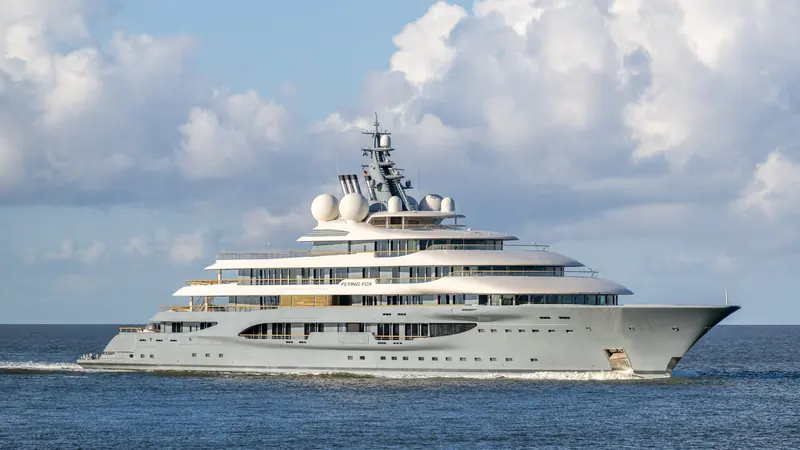
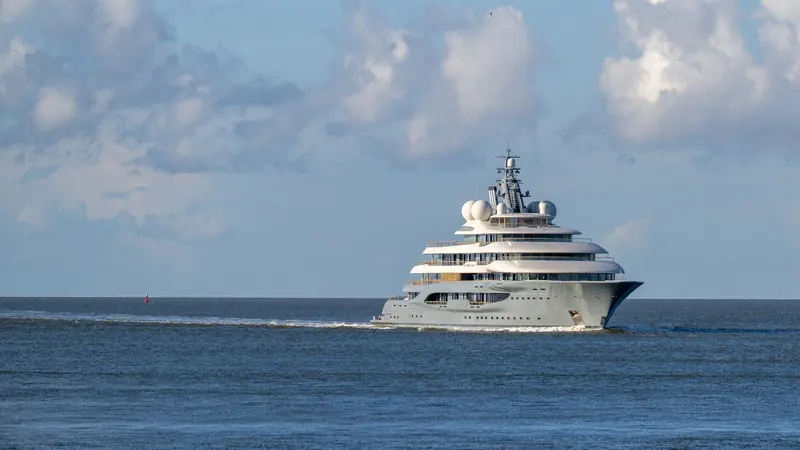
| Credit-defining project | Flying Fox, 136m Lurssen, delivered March 2019; 11 suites (1 master, 10 VIP), up to 25 guests, crew of around 54 |
| Flying Fox amenities | 12m transverse pool, two-tier 400 sqm spa, beauty salon, cinema with D-box seating for 14 and a 3,000-plus title library |
| Award | Best Displacement Motor Yacht 5,000 GT and above, World Superyacht Awards 2020 |
| Ownership since | sold off-market in 2025 to a member of Abu Dhabi's ruling family, renamed Hadar; interior reported retained through the refit |
| Refit portfolio | Indian Empress (95m Oceanco, 2014, GBP 5 million, 8 months), Pelorus (114.5m Lurssen, 2017, updating Terence Disdale's original interior), NAIA ex Pegaso (73.6m Freire, research-vessel conversion, 2014) |
| Beyond yachts | two Boeing BBJ MAX cabin concepts (2021); MBD-87, an 85m concept styled inside and out for a repeat client (revealed January 2024), the studio's first full exterior credit |
| Design fee | not published; the market-wide band is 1 to 5 per cent of build cost plus 2 to 4 per cent project management (SuperYachtReview 2026 price guide, updated March 2026) |
From Don Starkey's Studio to His Own Name
Berryman trained inside other people's offices before he ran his own. His first year in yacht design was spent working for the British designer Don Starkey, who had moved into yacht interiors after twenty years as an architect, and Berryman's first credited project under him was Loon, a 47.2 metre built by the American yard Christensen. He has since described spending eleven years across what he calls the most famous British design studios before striking out alone.
Mark Berryman Design Limited was incorporated on 9 January 2007, according to Companies House, and the studio has stayed in Hampshire ever since, based in Lymington on the edge of the New Forest rather than in London, where most of its British rivals sit. It designs the great majority of its furniture and fittings in-house rather than specifying from a catalogue, and it has stayed small: outside business databases put the headcount at well under ten, and the studio itself has never published a number.
What the Studio Actually Sells
The house style draws more from Japanese domestic architecture than from the gilt, mirror and onyx tradition Berryman was trained to replace on his refit work. He has said that his own dream brief would bring living plants and running water into a yacht interior, and that if he were not designing boats he would be laying out small Kyoto courtyard gardens. In practice that becomes soft neutral tones, honed and riven stone and layered seagrass and bamboo rather than lacquer and polished brass.
The stated aim is a home away from home rather than a showroom: rooms that look lived in rather than merely admired, built from materials chosen partly because they age well under salt air and daily guest traffic rather than staying pristine for one photograph. Berryman has framed his own approach as designing to the client's brief rather than to a season's trend board, which is one reason his fleet spans a Lurssen flagship and a converted research vessel without either looking like an afterthought of the other.
The boat needed a wow factor, Berryman said of Flying Fox's split-level saloon, because the alternative in a room that size was a guest standing in the middle of a field.
Arkley, the Breakthrough
The 60 metre Arkley, delivered by Lurssen in 2009, was the commission that put Berryman in front of a major German yard for the first time. Her interior for twelve guests across six cabins won Best Displacement Motor Yacht in her size class and then the overall Motor Yacht of the Year trophy at the 2010 World Superyacht Awards, judged by Boat International against every yacht delivered that year regardless of size.
She has changed hands and names twice since, passing through 5 Angels before becoming Caipirinha in 2016, and still trades and charters under that name today. For Berryman the lasting value of Arkley was less the room itself than what it proved to Lurssen: that a small English studio with no naval architecture arm of its own could deliver a fully resolved, awards-grade interior on one of the yard's flagship-scale hulls, which is the credential that put him in the room nine years later for Flying Fox.
Flying Fox, Inside the Largest Volume He Has Filled
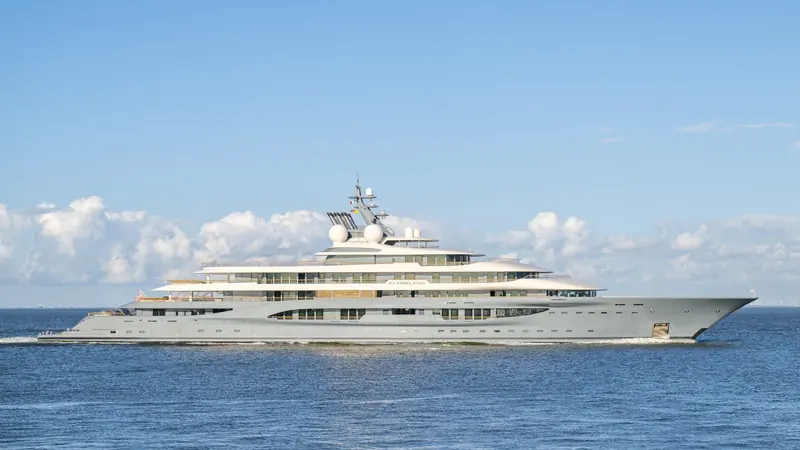
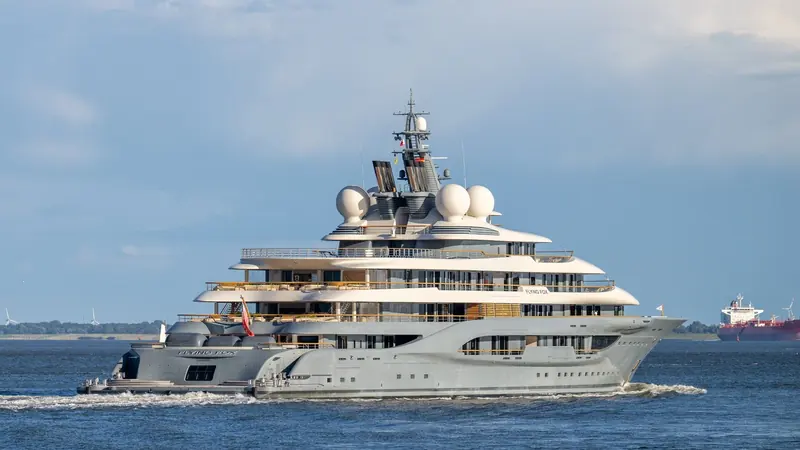
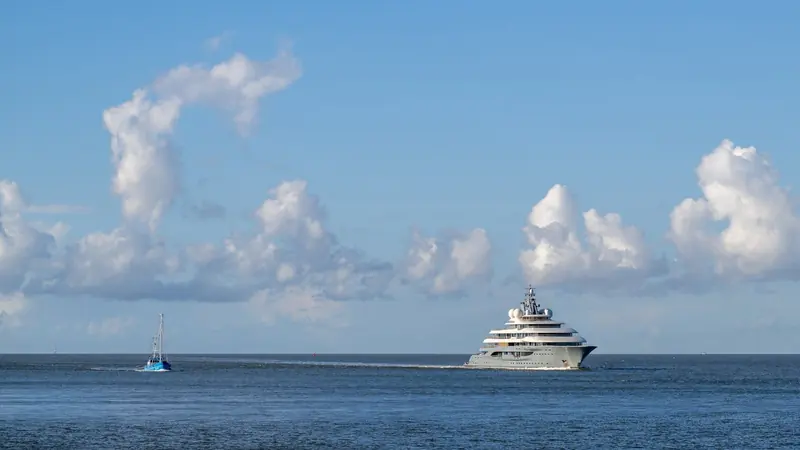
Flying Fox, delivered by Lurssen in March 2019 at 136 metres on a 20.5 metre beam, gave Berryman by far the largest interior volume he has ever fitted out, and he has called the master suite alone a difficult area to do, given its scale. The interior sleeps up to 25 guests across 11 suites, a master and ten VIP staterooms, every one with its own sea terrace, run by a crew of around 54.
Berryman split the enormous bridge deck saloon over two floors around a wood burning fireplace rather than leave it as one undifferentiated hall, telling Boat International that the boat needed a wow factor and that his job was to stop a guest simply standing in the middle of a field of open deck. Cutaway bulwarks on the bridge and upper decks bring floor to ceiling glass into rooms that would otherwise sit behind solid steel, and the same calm palette of oak, limestone and seagrass carries through a 12 metre transverse pool, a two tier, 400 square metre spa with a hammam, sauna, cryotherapy chamber and gym, a beauty salon and a cinema fitted with D-box motion seats for 14 guests, Dolby Atmos sound and a library of more than 3,000 titles.
The Award, and an Interior That Outlasted Its First Owner
The World Superyacht Awards judges placed Flying Fox in the displacement class for vessels of 5,000 GT and above in 2020 and named her Best Displacement Motor Yacht in it, a category where Boat International noted her interior volume ran roughly three times that of the next largest boat entered, making a conventional comparison almost impossible.
Ownership has since moved on. Built for the Russian businessman Dmitry Kamenshchik and chartered at reported weekly rates around 3 million euro, Flying Fox changed hands in an off market sale in 2025 to a member of Abu Dhabi's ruling family and re-emerged from a German refit yard in 2026 with her grey hull repainted white and a new name, Hadar. Trade reporting on the refit describes Berryman's interior as retained rather than replaced, with the visible changes concentrated on the exterior, which is itself a kind of verdict on a decade-old scheme.
The Refit Side of the Practice
A good share of Berryman's book is refit work, taking over a room another designer built rather than starting from a bare hull. The most visible is the 2014 refit of the 95 metre Oceanco Indian Empress, where he won the commission competing against several other studios and had eight months and a 5 million pound budget to replace a deep red and gold, heavily gilded scheme with a neutral, contemporary one built around limed oak, walnut and pale dressings.
The same instinct for editing rather than erasing shows on other designers' icons. At the 2017 refit of the 114.5 metre Lurssen Pelorus, Berryman updated sections of Terence Disdale's original interior at the Peters Werft yard while admitting he was scared to touch a design he loved. The 47 metre Cantieri di Pisa Balista, originally delivered as Project 12, went through its own interior refresh in 2019, and NAIA, the 73.6 metre Freire-built yacht delivered in 2011 as the Lloyd's classed research vessel Pegaso with a five person submarine and an onboard laboratory for her oceanographer owner, was converted under Berryman in 2014 into a charter yacht, its laboratory traded for two extra crew cabins.
Beyond Yachts: A Boeing Cabin and a Move Into Exteriors
The studio's most unusual credit sits outside yachting altogether. In 2021 Boeing brought Mark Berryman Design in to design two cabin concepts for its BBJ MAX business jet line, reported by Boat International and Runway Girl Network: an executive layout with convertible workstations for twelve, and a more private layout built around bulkheads that break the cabin into intimate niches, both finished in the same tan, brown and warm neutral palette the studio uses at sea.
On the yacht side, the practice has also started drawing hulls, not just rooms. In January 2024 it revealed MBD-87, an 85 metre concept for a repeat client who already owns yachts between 60 and 120 metres and wanted one mid sized boat combining the features he liked best from all of them, styled inside and out by Berryman's own office for the first time; a shipyard will only be chosen once the owner signs off the exterior. The studio's own site also lists more than ten land based residential projects, including a Moscow residence, though it publishes little detail on any of them.
What the Commission Costs, and the Honest Limits
Like every studio in this directory, Mark Berryman Design publishes no fee scale, and the only market wide figure available is not specific to interior work alone: SuperYachtReview's 2026 price guide, updated March 2026, puts a yacht's combined designer fee at 1 to 5 per cent of build cost with project management a further 2 to 4 per cent, both charged on top of a yard's own quote. The one project with a public number attached is a refit rather than a new build: Indian Empress, where Turquoise Yachts and Berryman delivered a full interior overhaul for a reported 5 million pounds in eight months, an unusually concrete figure in a field that almost never discloses one.
The limits are as real as the credentials. This is a studio of well under ten people by outside estimate, so an owner is buying a small number of specific people rather than a large bench, and the founder's name is the whole brand with no public succession plan. It draws no naval architecture of its own and only started drawing exteriors in 2024, so most new builds still need a second office for the hull and profile. And the calm, neutral, natural material palette that defines the studio sits at the opposite end of the market from the deliberately theatrical work now winning attention at the very top of it, such as Reymond Langton's Louis XIV meets Interstellar scheme for the Lurssen Kismet, Motor Yacht of the Year in 2025; an owner who wants a room that argues with itself should look elsewhere, and one who wants a room that feels the same in ten years as it did on delivery day is Berryman's actual customer.
معلومات عملية
| Design fee | not published; the market-wide band is 1 to 5 per cent of build cost plus 2 to 4 per cent project management, both outside the yard's quoted price (SuperYachtReview 2026 price guide, updated March 2026) |
|---|---|
| The one disclosed figure | the Indian Empress refit: a reported 5 million pounds over eight months, from initial general arrangement to handover (Turquoise Yachts and Berryman, 2014) |
| How the studio wins work | even as an established name it has competed against other studios for commissions, as on Indian Empress; repeat clients also return directly, as on MBD-87 |
| What is new | MBD-87 (revealed January 2024) is the studio's first commission to cover exterior styling as well as interior; a shipyard is chosen only once the owner approves the exterior |
| Studio scale | a boutique practice, outside estimates put it at well under ten people; no in-house naval architecture; based in Lymington, Hampshire, not London |
| What is not published | headcount, any day rate, a studio-specific fee percentage or details of the land-based residential projects listed on its own site |
ما يذكره الملاك والأطقم
The owner's representative on Flying Fox describes an unusually demanding brief
Evgeniy Kochman, chief executive of Imperial, the company that represented the owner and handles the yacht's charter, told Boat International that like every yacht you start with a white sheet, but in this case you have many more spaces to fit and to adapt to a very demanding, meticulous owner. That is a rare on-record account of the commissioning process at this scale, but it comes from someone paid to represent the owner, not from a disinterested guest or crew member.
Evgeniy Kochman, ImperialNo independently attributable guest or crew review found
General praise for Flying Fox's interior circulates in charter marketing and press features, but this research found no on-the-record account from a private guest or a working crew member assessing how Berryman's rooms hold up day to day. Flying Fox charters under strict confidentiality, and her subsequent owner has kept the 2025-26 refit almost entirely out of the press.
Yotters research desk
نقاط القوة وما يستدعي الانتباه
نقاط القوة
- A genuine credit-defining flagshipFlying Fox was the world's largest charter yacht at delivery and, after a 2025-26 change of ownership and rename to Hadar, trade reporting describes the same Berryman interior as retained rather than replaced
- Proven at both ends of a buildawards-grade new-build interiors (Arkley, Flying Fox) sit alongside sensitive refits of other designers' icons, including updating parts of Terence Disdale's Pelorus without erasing it
- One consistent hand across very different hullsthe studio designs almost every fitting itself rather than specifying from a catalogue, which is why a Lurssen flagship and a converted research vessel both read as unmistakably his
- Repeat client business and a widening remitthe MBD-87 concept was commissioned by an owner already running a 60 to 120 metre fleet, and it is the studio's first commission to cover the exterior as well as the interior
- One of the few concrete cost figures in this class of designerthe Indian Empress refit is on record at 5 million pounds over eight months, a specific number most studios in this directory never disclose
ما يستدعي الانتباه
- No published fee scale or headcountan owner is buying trust in a small, named practice rather than a benchmarked service, and outside estimates put the team at well under ten people
- No naval architecture, and exteriors only since 2024most new builds still need a second office for the hull and profile, unlike studios that offer both under one roof
- Key person risk with no public succession planthe practice carries the founder's name, and nothing in the public record says what happens to an in-progress commission if he becomes unavailable
- A calm, neutral palette that is the opposite of the market's loudest workhouses like Reymond Langton are winning top awards with deliberately theatrical schemes such as the Louis XIV meets Interstellar interior of Kismet, so an owner chasing a conversation-starting room should look elsewhere
- No independent owner or crew testimony on recordwhat exists in the press comes from the owner's own representative or from charter marketing, not from a disinterested account of how the rooms perform in daily use
لمين هو: Owners commissioning a full interior from one named studio in a calm, contemporary, Asian-influenced palette of natural materials, especially at the largest end of the market, who will pair it with a separate naval architect and, until recently, a separate exterior designer.