Michael Peters Yacht Design
| Studio | Michael Peters Yacht Design, Sarasota, Florida; about 10 staff (Soundings, 2025) |
|---|---|
| Founder | Michael Peters, self-taught, no naval architecture degree; worked professionally since the early 1970s |
| Founded | 1981 per a directory listing; the studio itself cites more than 45 years |
| Output | more than 500 designs and more than 50,000 boats built (studio's own figure) |
| Racing | 20 offshore world championships claimed by studio and founder; an older directory says 13 |
| Hull patent line | Stepped-V Ventilated Tunnel (SVVT), used on Viking's Valhalla boats |
| Iceberg (Tencara, for Norberto Ferretti): 39 ft carbon catamaran, about 105 to 130 mph after redesign; broke up in 1992 | |
| Groupe Beneteau | about 25 years of planing hulls; studio credited as naval architect of the Gran Turismo 40 |
| Valhalla V-37 (Saltwater Sportsman test): over 60 mph on triple Yamaha F300s, cruise just under 50 mph; 421,000 dollars as tested | |
| Aquarella (Devonport Yachts, 1994) | about 42 m, twin MTU for 4,510 hp, 24 knots top, refitted 2009 and 2018 |
| Hinckley Dasher | 28 ft 6 in electric day boat unveiled September 2017; 545,000 dollars in Power and Motoryacht's January 2018 test |
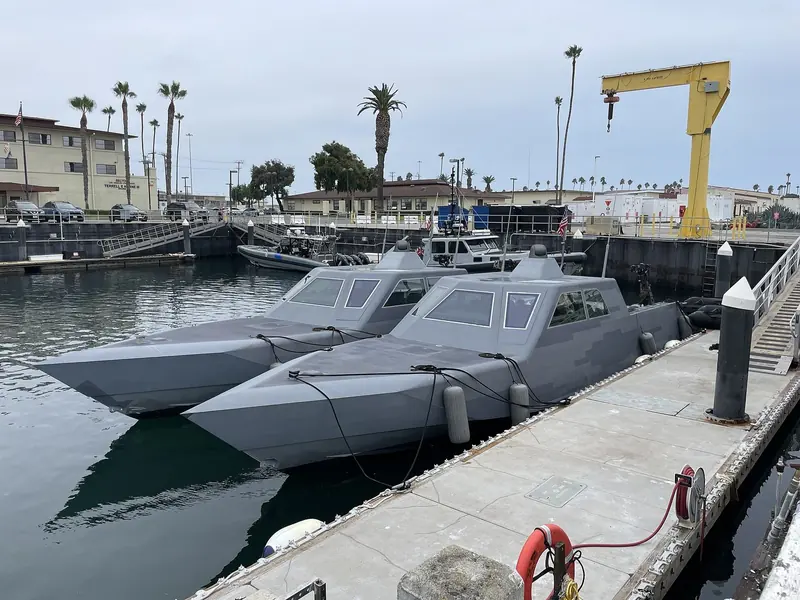
| U.S. Navy Combatant Craft Medium Mk1 | 18.47 m, over 52 knots, built by Vigor Marine Group, delivered from 2015 |
| Design fees and royalties | not published |
A Sarasota Studio Built on One Patent
Michael Peters grew up in Los Angeles, where his father was a professor and later dean at the University of Southern California and ran a summer camp on Catalina Island. At 14 he took over keeping the camp's donated boats running, and he learned naval architecture from library books and by studying hulls in the San Pedro boatyards. He enrolled in mechanical engineering at USC, moved to architecture and left in his third year to chase a stepped hull he'd drawn and later patented. Soundings reported in December 2025 that he has no naval architecture degree and calls himself grandfathered in. Directory listings give 1981 as the founding year of the studio, which fits the move to Sarasota after his time at Halter Marine, though Peters hasn't stated a year in the interviews we read.
The studio's own client page puts the output at more than 500 designs and more than 50,000 boats built, across composite, aluminum and wood. An older directory entry says 350 designs and 30,000 boats, so those figures grow with the date of the listing and neither is audited. Soundings counted ten staff in 2025, three of whom had been with Peters for more than 25 years by 2021. The studio moved into a two-story Sarasota office after a developer bought the old building, and the upper floor handles U.S. Navy work behind a coded door. If you're asking whether this is a one-man brand: it isn't, and the interviews suggest Peters was stepping back to a consultant role while the senior staff carry daily work.
Stepped Hulls and the Racing Years
The first stepped design was a 19 foot test boat built around age 21. Cigarette Racing Team founder Don Aronow looked at the prototype and told him not to waste his time. Halter Marine in New Orleans, which owned Cigarette at the time, took an option on the patent anyway and paid for it, and Peters later worked for Aronow for the last nine years of Aronow's life. In 1987 Aronow asked him to run his Miami company, USA Racing Team, and was shot dead a day later according to Soundings. Peters says C. Raymond Hunt and Sonny Levi influenced him most, with his own approach closest to Levi's.
The patent line that matters to a buyer today is the Stepped-V Ventilated Tunnel, which the studio calls SVVT. Soundings explained in 2011 that an aft centerline tunnel with vertical walls acts like a pair of mini keels, so the hull resists spinning out in a hard turn without tripping the way a deep keel would. A touch of rocker ahead of the transom reduces stern lift. Zodiac built an 11 metre rigid inflatable to the design that ran a 10 day Northwest Passage trip without spinning out. In 2025 Peters said the vertical bow trend was one he'd fought for years and that his team eventually found a way to build one that doesn't spin out.
Listening to the client and not giving them a Michael Peters boat.
Iceberg and the Italian Connection
A telegram from CUV in Viareggio led to 37 and 41 foot aluminum catamarans, and Peters has recalled competing with British Cougar hulls. Ferretti then asked for a composite catamaran. Iceberg was built from pre-impregnated carbon and Nomex honeycomb, cured in an autoclave in two halves, and Peters says she outran more than 30 Class 1 boats once she'd been reworked. Trade Only Today's 2020 interview describes it as the first offshore race boat to use aerospace-level composites that set a benchmark without winning championships. Soundings has her breaking up after hitting a wave in the last race of her second season, and Trade Only Today places that failure in 1992 at Marbella.
We think that failure is useful to read. A designer who tells a story where his own advanced boat disintegrated is one who'll describe his limits to a client, and a CUV commission also produced a four-engine Superboat hull that Peters says reached 165 mph with 600 gallons aboard (one account only, so treat it as unverified). The Italian years also left a commercial scar: Peters told Trade Only Today that Azimut once dropped his firm from a design job because he was American, then worked with him later on the Verve, where he handled only the hull and naval architecture while an Italian designer did deck and styling.
Production Boats for Beneteau, Chris-Craft and Viking
The Beneteau list is the longest. Soundings reports almost 25 years of work, mostly planing hulls, and the builder's own page for the studio shows the Gran Turismo 35 and 40. Yachtbuyer credits the studio as naval architect of the Gran Turismo 40, with exterior styling attributed elsewhere, and the sources we read disagree on whether that was Andreani Design or Nuvolari and Lenard, so we don't name a stylist here. Intrepid's founder John Michel accepted a stepped V-bottom hull and about six Peters hulls followed. Chris-Craft work dates to 1999, and Peters says some of those boats are still built. He also drew the Bertram 35 sportfisherman retake and owns three Bertrams himself, including a customized 1971 model.
Valhalla is the best-tested example for fishing buyers. Saltwater Sportsman credits Peters and Viking's head of design David Wilson with the Valhalla hulls and tested a V-37 on triple Yamaha F300s. It passed 60 mph, cruised just under 50 mph at better than 1 mpg and tracked well in big inlet waves without slipping in tight turns. Price on the test boat was 421,000 dollars. The reviewer listed no drawbacks, which is itself a reason to ask an owner. For Beneteau, boats.com saw the GT40 plane in about six seconds, MBY recorded 32 knots on twin D4 engines in its trial and BoatTest.com recorded 38.4 knots with D6 engines, so engine choice swings the figure by more than six knots.
Custom Yachts and the Electric Dasher
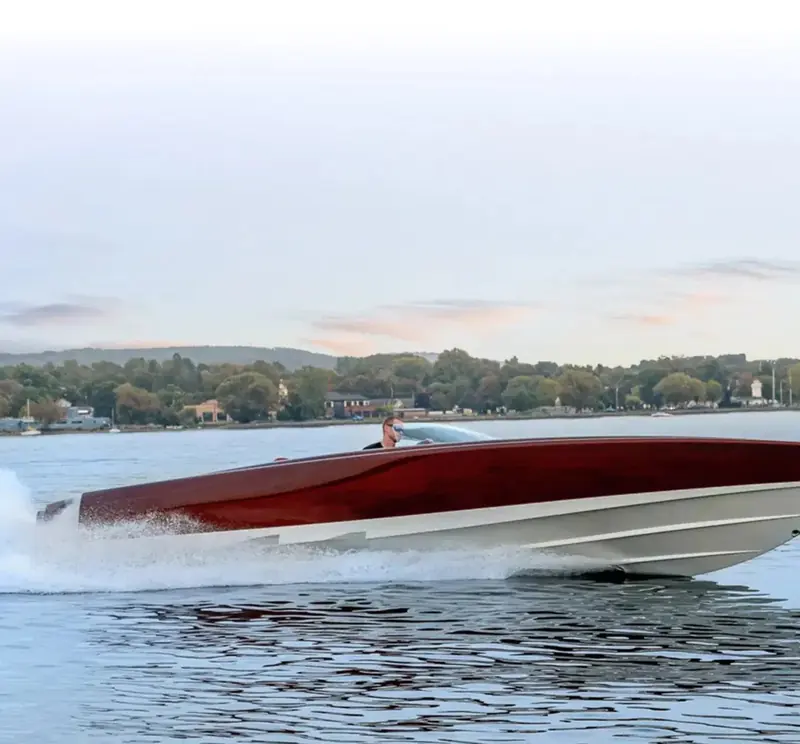
Aquarella is the largest delivered hull we could source. Devonport Yachts of Britain built her in 1994 at about 42 metres, with twin MTU diesels totaling 4,510 hp for a 24 knot top speed and 19 knot cruise. Yachtbuyer lists Michael Peters for exterior design and the studio for naval architecture, and Felix Buytendijk for the interior, though some brokerage listings name other interior designers. She was refitted in 2009 and 2018, so a buyer can check how the hull has aged. At the other extreme, Van Dam Custom Boats of Boyne City, Michigan builds wooden speedboats from Peters plans. Alpha Z topped 70 knots, and Peters told Trade Only Today the construction was exceptionally flawless.
Hinckley's Dasher is the studio's electric proof. Hinckley unveiled the 28 foot 6 inch boat at the Newport International Boat Show in September 2017, and Power and Motoryacht tested it for its January 2018 issue. Displacement is 6,500 pounds with twin 80 hp Torqeedo inboards and about 17 knots on plane against a 22 knot maximum. The reviewer logged about 20 miles on the day, liked the joystick docking and flagged a charging cable running under the helm seat. The magazine gave the price as 545,000 dollars, while a video headline elsewhere said 500,000, and we trust the test over the headline. Peters himself is cool on electric: he says battery weight is the main problem.
Work for the U.S. Navy
Soundings' April 2021 profile described a five-year Navy contract for a series of 61 foot boats for the SEALs, which matches the Mk1. Contracts were awarded in September 2011 and the production contract in February 2014, with construction running to 2021. Oregon Iron Works, which won the original award, merged with Vigor in May 2014. A photograph taken at a California pier in September 2023, shown on this page, shows two of the boats, and the angular faceted hull and low profile are visible even from the dock.
Soundings quoted Peters in 2025 saying the Mark 2 combatant craft is his biggest project and that it will be the Navy's design until 2050. Seapower reported that ReconCraft holds an agreement to build an engineering development model of an entirely new Mark 2, and neither the company nor the command had images to share. So the Mk2 credit rests on Peters's own word, and the 2050 date is his projection. For a civilian buyer, the useful read-across is that a studio trusted with a 52 knot hull for special operations has structural and seakeeping engineering a fishing-boat builder can use.
How a Commission Works and What It Costs
Peters's stated rule is that the hull comes first: he told Trade Only Today that if the studio isn't doing the hull, it doesn't want to do the boat. He starts from the client's problem, including propulsion and materials, and says the key is listening and not giving clients a Michael Peters boat, so Hinckley gets a Hinckley. Custom one-offs, he says, give the most control over quality. The interviews we read give no fee, percentage or royalty, and for context only, general small-craft market quotes run 10 to 12 per cent of build cost for a custom commission, which are not Peters's rates. How long a brief takes isn't published either.
Who'll you work alongside? On production boats the builder's in-house team and a stylist, such as Viking's David Wilson on Valhalla or an Italian designer on the Azimut Verve. On custom yachts a separate interior firm, as with Felix Buytendijk on Aquarella. If you want an alternative, Peters himself names Morrelli and Melvin as a firm he respects, and C. Raymond Hunt Associates is the other planing-hull specialist a buyer would compare. Peters also said 2025 was the studio's worst year in 25 years, with a South African venture on hold over a 30 per cent tariff, so check current capacity before signing.
Where the Studio Is Weaker
Look at where the praise comes from. The V-37 test, the Dasher test and the GT40 trials are independent magazine reviews of the finished boats, yet none isolates the hull from the engine, the builder and the stylist, so we can't say how much of a good ride is Peters. The Iceberg failure is on the record, and Peters admits an early hull that didn't make speed until it was revised. Wide hullside windows, which he dislikes, and floating-villa layouts on 60 foot-plus boats are fashions he says he'd rather not follow, so a client who wants that look may find his advice blunt.
Fees, royalties and typical timelines are unpublished, and the 20 versus 13 world championship count shows how loose the studio's own numbers can be. The studio's interview material is thin on large yachts: Aquarella from 1994 is the only delivered superyacht-class hull we could confirm. If you want a 60 metre displacement yacht with a signature profile, this isn't the firm. If you want a 30 to 60 foot planing hull that holds a course, it's one of the few with a patent, race results and a Navy contract behind it.
معلومات عملية
| Design fee | not published; ask the studio for a written scope. For context only, general small-craft market quotes run 10 to 12 per cent of build cost for a custom commission, and these are not Peters's rates |
|---|---|
| Where | Sarasota, Florida, in a two-story office; the upper floor handles U.S. Navy work |
| Size range | 20 to 160 feet, with much of the work between 40 and 60 feet (Soundings, 2021) |
| Materials | composite, aluminum and wood; the Navy boats are aluminum-hulled production craft by Vigor, Van Dam's boats are mahogany |
| Usually alongside | the builder's design team and a stylist: Viking's David Wilson on Valhalla, an Italian designer on the Azimut Verve, Felix Buytendijk on Aquarella's interior |
| Alternatives | Morrelli and Melvin, whom Peters names as a firm he respects; C. Raymond Hunt Associates for planing hulls (desk suggestion) |
| Brief length and lead time | not published |
| What is not published | fees, royalties, lead times, and any independent comparison of Peters hulls against rivals on the same engines |
ما يذكره الملاك والأطقم
Valhalla V-37 tracks well in tight turns and rough inlets
the tester said it never slipped or shuttered in tight turns and rode smoothly leaving the inlet in big waves, quartering wind against tide
Saltwater SportsmanHinckley Dasher is quiet and simple but not finished
the reviewer called the drive really simple and quiet, then flagged the charging cable under the helm seat and the single-button control as work in progress
Power and MotoryachtBeneteau GT40 gets on the plane easily
the hull soaked up abuse in a long rolling swell without creaks, and the small D4 engines show their limit at the top end
Motor Boat and YachtingHull-quality comment from the builder's own side
Peters called the Van Dam Alpha Z construction exceptionally flawless in his own interview; it's the designer's view of a builder, not an owner report
Soundings Trade Only TodayNo owner-forum evidence found
we could not find independent long-term owner reports isolating the Peters hull from the rest of any boat
Yotters desk
نقاط القوة وما يستدعي الانتباه
نقاط القوة
- A patented hull with independent tests behind itSaltwater Sportsman found the V-37 tracked well and never slipped in tight turns, and Soundings explained how the tunnel resists spin-out
- Range from production to one-off to militarythe same studio drew Beneteau Gran Turismos, the 1994 Aquarella, Van Dam's mahogany runabouts and the Navy's Mk1
- He designs to the client's brandPeters says he gives Hinckley a Hinckley, which is why the boats don't share one look
ما يستدعي الانتباه
- No published fees, royalty or timelinenothing in the interviews or on the sites we read gives a rate, so you learn it only by asking
- Hull credit is mixed with otherson the Azimut Verve and the Gran Turismo 40 the studio drew the hull and others did the styling, so you can't judge it as a whole-boat designer
- Thin large-yacht recordAquarella from 1994 is the only delivered superyacht-class hull we could confirm
- Loose self-reported numbersthe world championship count, designs total and boats built differ by listing date
لمين هو: Production builders and owners of 30 to 60 foot planing boats who want a proven hull from a firm with race, Navy and series-production credits, and who'll bring their own stylist for deck and interior.