PLANA - Pierluigi Ausonio Naval Architecture
| Trained in naval architecture and mechanical engineering, University of Genoa, graduated 1981 | |
| Early career | Cantieri Navali Riuniti, later folded into Fincantieri's naval vessels division, on hydrodynamics and propeller design for fast attack craft, corvettes, destroyers and submarines |
|---|---|
| Independent practice from 1989; first yacht commission 1991 to 1992, the 37m Aquajoy for Fulvio Codecasa | |
| Current practice | P.L.A.N.A. Design, PierLuigi Ausonio Naval Architecture, based in Sanremo, partnered with Nav.Ars Srl in Arenzano |
| Client list beyond Benetti and Azimut | Baglietto, Mondo Marine, Rodriquez, Cantieri di Lavagna, Canados, Perini Navi, Picchiotti, Sanlorenzo, Overmarine |
| Benetti flagship | FB277 M/Y Lana, 107m, delivered 2018 to 2020, 3,900 GT, twin diesel-electric 2,800kW, 18.5 knots top speed, 5,500nm range at 12 knots |
| Benetti mid-range | naval architecture credited on the Oasis 40M, Oasis 34M, B.Yond 37M and Motopanfilo 37M, alongside Benetti's own engineering department |
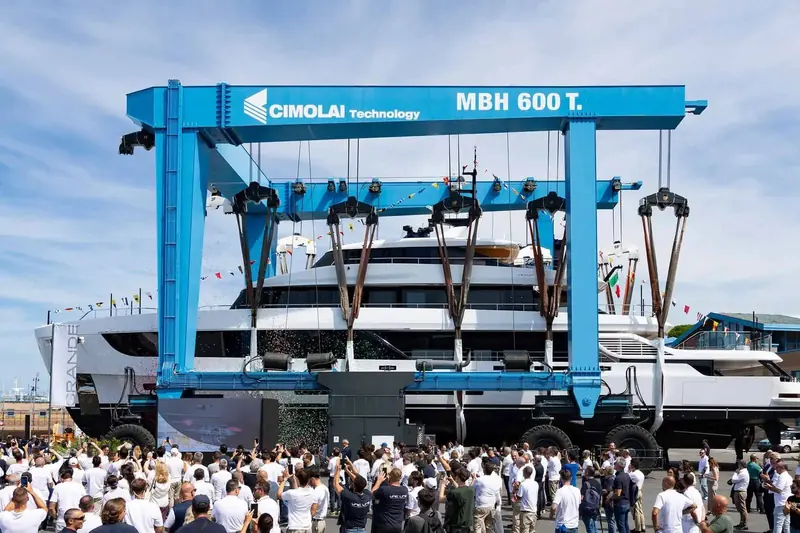
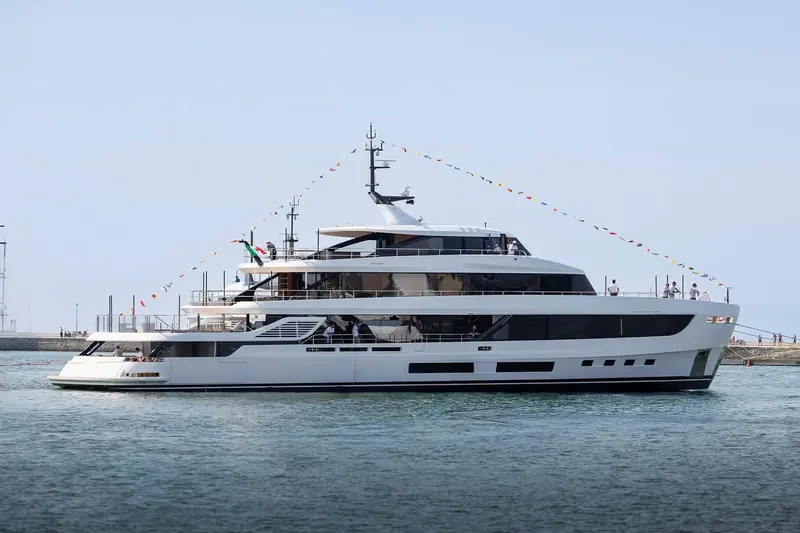
| Azimut relationship | naval architecture credited jointly with Azimut's own R&D department across the Grande 44M, Grande 36M, Azimut S10, Fly 68, Magellano 60 and Seadeck 6 |
| The Magellano's Dual Mode hull | a semi-planing and displacement form that switches operating modes, one of the practice's most distinctive production results |
| Also credited on the Mangusta GranSport 54, Mangusta Oceano 50 and Oceano 44, and the Codecasa 57 (Legacy 4) | |
| Design fee | not published by the practice or independently reported in this research |
| Nearly 35 years in yacht naval architecture as of 2026, spanning small semi-custom Azimut models to some of the largest yachts ever built | |
From naval hulls to Aquajoy, the boat that changed his career
Pierluigi Ausonio did not set out to design yachts. He graduated in naval architecture and mechanical engineering from the University of Genoa in 1981 and spent his first working decade at Cantieri Navali Riuniti, later absorbed into Fincantieri's naval vessels division, on hydrodynamic hull and propeller design for fast attack craft, patrol vessels, corvettes, destroyers, landing ships, oceanographic vessels and submarines built for Italian and export navies.
He went independent in 1989, still consulting mainly for shipyards rather than private owners, until Fulvio Codecasa commissioned him in 1991 to develop the naval architecture for a new kind of yacht: a 37-metre fast-displacement vessel in light alloy with demanding performance targets. Launched in 1992 as Aquajoy, the boat's successful sea trials are, by Ausonio's own later account, what convinced him yacht design would become his actual career rather than a side consultancy.
What a naval architect actually contributes, and what he does not
Ausonio's practice, P.L.A.N.A. Design, does one thing: naval architecture. That means the hull form, the structure, the weight and stability calculations, and the performance targets a yard has to hit, worked out before anyone draws a profile or fits a cabin. On every project traced in this research, a separate firm or a yard's own in-house team handled the exterior styling and the interior.
That narrow remit is precisely why his name rarely appears in a yard's own marketing. Azimut's published specification sheets for the Grande and Magellano ranges credit the exterior and interior designers by name and leave the naval architecture credit to appear only in more detailed trade listings, alongside Azimut's own R&D department. A buyer reading a brochure would reasonably have no idea who actually engineered the hull underneath the styling they are looking at.
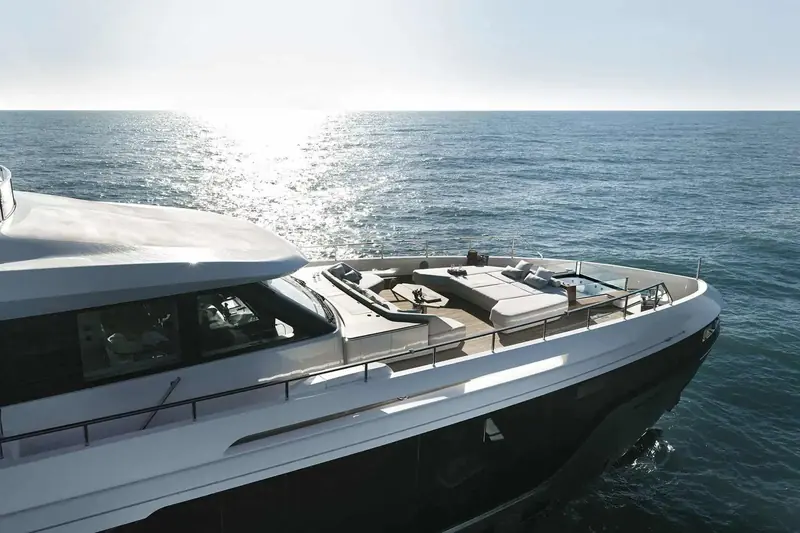
Lana displaces 3,900 gross tons on diesel-electric power and still turns 18.5 knots, a naval-architecture result that gets none of the credit a profile sketch does.
Lana, and the physics of a 107-metre diesel-electric giga-yacht
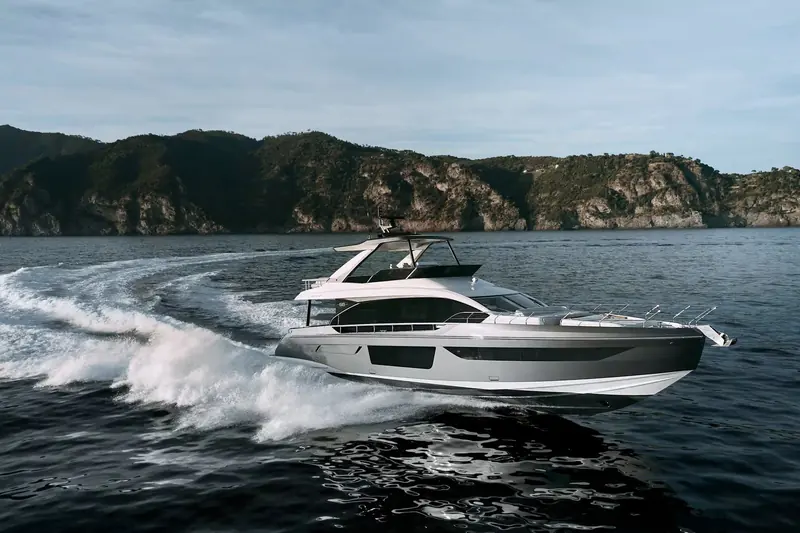
Lana, Benetti's FB277, is a 107-metre motor yacht delivered between 2018 and 2020 with naval architecture by P.L.A.N.A. Design, one of only three Benetti full-custom yachts to clear 100 metres. She displaces 3,900 gross tons on a steel hull with an aluminium superstructure, powered by twin diesel-electric plants of 2,800 kilowatts each, and still reaches 18.5 knots with a 5,500 nautical mile range at 12 knots, figures that only make sense as a naval architecture achievement once you consider the weight and complexity a diesel-electric plant that size adds.
Diesel-electric propulsion at this scale is a genuinely different engineering problem from a conventional shaft-driven giga-yacht: it trades some top-end speed for efficiency, quieter running and more flexible machinery-space layout, but only if the naval architect gets the weight distribution and structural integration right from the start. Lana's helipad forward, beach club with a hammam, and accommodation for 12 guests across eight cabins and up to 32 crew all sit on top of that underlying hull-and-propulsion decision, made years before any of those amenities were designed.
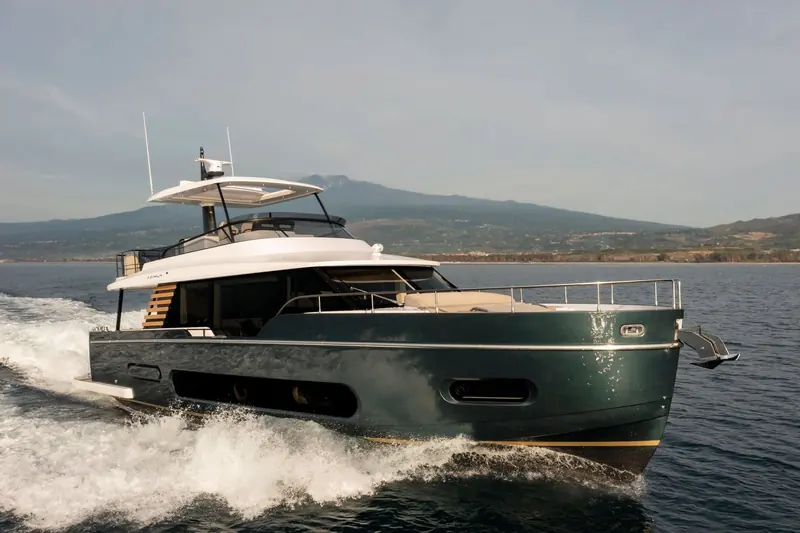
The Benetti mid-range, and a naval architect who answers for the whole line
Beyond Lana, Ausonio's naval architecture appears across a run of Benetti's mid-size custom and semi-custom ranges: the Oasis 40M and 34M, the B.Yond 37M, and the Motopanfilo 37M, each credited jointly with Benetti's own in-house engineering department rather than as a sole external commission. That pattern, a named outside naval architect working alongside a yard's internal team, is common at production and semi-custom scale and different from the sole-author model a full bespoke commission implies.
For a buyer, that joint credit is worth understanding rather than glossing over: it means the yard's own engineers are involved in every hull Ausonio is credited on at this size, so responsibility for how the hull actually performs is shared rather than resting entirely with the outside consultant. It also means Benetti has kept re-engaging the same naval architecture practice across at least four separate model lines over several years, which is itself a form of endorsement a one-off commission cannot demonstrate.
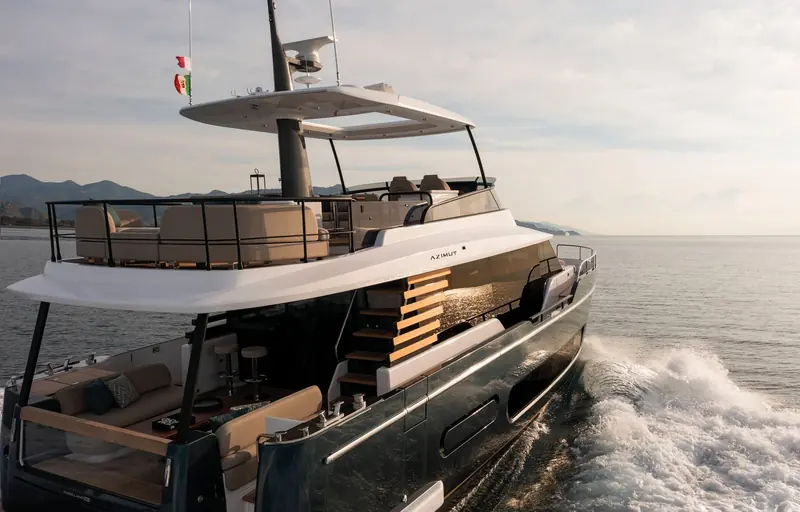
Azimut, and thirty years of one name across several ranges
Ausonio's naval architecture credit runs across a genuinely wide slice of Azimut's current range: the Grande 44M, Grande 36M, Azimut S10, Fly 68, Magellano 60 and Seadeck 6, each crediting P.L.A.N.A. Design and Azimut's own R&D department together. That breadth, spanning a 35-metre production flybridge and a 44-metre semi-custom flagship at the same time, is a different kind of evidence from a single celebrated flagship: it shows a naval architecture practice trusted across an entire brand's engineering programme, not one boat.
The relationship also spans genuinely different hull types. The Grande 36M runs a D2P displacement-to-planing carbon-superstructure hull reaching 24 knots; the Fly 68 is a conventional planing flybridge cruiser at up to 32 knots; the Magellano 60 runs the brand's semi-planing Dual Mode hull at a more modest 26 knots but with a completely different operating envelope underneath. Naval architecture credited across all three, alongside Azimut's own team, points to a practice comfortable moving between hull forms rather than repeating one solution.
The Magellano's Dual Mode hull, a production result almost nobody notices
The Magellano range's Dual Mode hull is the single most distinctive naval architecture result in Ausonio's Azimut work: a semi-planing form engineered to switch between an efficient displacement mode for long-range cruising and a faster planing mode when the owner wants speed, on the same hull, without the compromises either pure hull type usually forces. The Magellano 60 runs this hull to a 26-knot top speed and 464 nautical miles at economical cruise, figures that read like a compromise until you consider what the alternative, a purpose-built hull for only one of those two jobs, would give up.
This is exactly the kind of result that never makes it into a styling conversation, because it lives entirely in how the boat behaves rather than how it looks. Ken Freivokh, credited with the Magellano's exterior, gets named in every piece of coverage about how the boat looks; the Dual Mode hull underneath, which is arguably the more technically interesting achievement, is credited to Ausonio and Azimut's own team in specification sheets that most buyers never read past the top line.
Who else sits on this client list
Beyond Benetti and Azimut, Ausonio's client list, drawn from his own practice's account, includes Baglietto, Mondo Marine, Rodriquez, Cantieri di Lavagna, Canados, Perini Navi, Picchiotti, Sanlorenzo and Overmarine, a roster covering almost every significant Italian yard building yachts above about 24 metres. Overmarine's Mangusta range alone carries his naval architecture credit on the GranSport 54, Oceano 50 and Oceano 44, and Codecasa's 57 (Legacy 4) carries it too.
That range of clients over 35 years is itself a form of evidence a single flagship project cannot provide: it shows a naval architecture practice that yards keep re-engaging across changes in ownership, design trend and hull material, from GRP performance boats to full-custom steel giga-yachts. It also means, practically, that a buyer researching almost any major Italian-built yacht from the last three decades has a real chance of finding Ausonio's name somewhere in the naval architecture credit, if they know to look for it.
What the commission costs, and what nobody will say
P.L.A.N.A. Design does not publish a fee scale, and this research found no independently reported day rate or percentage figure specific to Ausonio's practice at all, a gap even wider than for some rival naval architects who at least have a market-wide benchmark quoted against their name. The nearest available figure is the industry-wide band SuperYachtReview's 2026 price guide gives for naval architecture consultancy generally, roughly 1 to 5 per cent of build cost, though a joint credit with a yard's own in-house engineering team likely changes how that percentage would actually be split in practice.
What is clear from every project in this research is that the naval architecture was commissioned by the yard, Benetti, Azimut or whichever builder, not by the private owner. A buyer choosing a Benetti or Azimut model is not separately negotiating a naval architecture fee at all; that cost is already folded into the yacht's build price long before a specific hull is ordered, which is standard practice at this end of the market but worth understanding rather than assuming.
Judging a naval architect's work when his name is never on the profile
The hardest part of assessing a naval architect like Ausonio is that almost none of the usual evidence, an owner's glowing quote, a magazine's styling praise, a resale premium tied to a name, exists in a form that credits the naval architecture specifically rather than the finished yacht as a whole. Press coverage of Lana and the Azimut ranges quotes Benetti's and Azimut's own executives and, for the Magellano, exterior designer Ken Freivokh on the boat's sea-keeping, but this research found no on-the-record captain or owner assessment naming Ausonio's contribution by name.
What a buyer or researcher can actually verify is the pattern rather than a single testimonial: a naval architecture credit that keeps recurring, across 35 years, across two of Italy's most significant yacht groups, across hull sizes from 18 metres to 107, and across at least three fundamentally different hull types. That pattern is itself the evidence, in the absence of the kind of quotable owner endorsement a visible exterior or interior designer more easily collects.
معلومات عملية
| Design fee | not published; the market-wide band for naval architecture consultancy is 1 to 5 per cent of build cost, SuperYachtReview 2026 price guide, updated March 2026, though a joint credit with a yard's in-house team likely changes how that figure is split |
|---|---|
| Contract structure | engaged by the yard, not the private owner, on every project found in this research; a buyer commissions the yacht from Benetti, Azimut or the relevant builder, not from P.L.A.N.A. directly |
| Where credit is hardest to isolate | on the Benetti mid-range and every Azimut model in this research, the naval architecture credit is shared with the yard's own engineering department, so responsibility is joint rather than sole |
| The one figure that is published | Lana's diesel-electric propulsion and 3,900 GT are Benetti's own release figures, not an independent sea-trial result |
| What is not published | no day rate, percentage fee or total naval-architecture cost for Lana or any Azimut model in this research |
| Fastest route to this naval architecture | an existing Azimut Grande, Fly or Magellano hull, where the naval-architecture cost is already amortised into the production list price |
ما يذكره الملاك والأطقم
No independently attributable owner or captain testimony on the naval architecture found
press coverage of Lana and the Azimut Grande and Magellano ranges quotes Benetti's and Azimut's own executives and, for the Magellano, exterior designer Ken Freivokh on the hull's sea-keeping, but this research found no on-the-record captain or owner assessment naming Ausonio's naval architecture specifically
Yotters research desk
نقاط القوة وما يستدعي الانتباه
نقاط القوة
- An unbroken 35-year run across nearly every major Italian yardBenetti, Azimut, Baglietto, Sanlorenzo, Perini Navi and Overmarine among them, evidence of a reputation that survives changes of ownership and design trend
- Proven at both ends of the size range at oncea 107-metre diesel-electric giga-yacht and a 35-metre production flybridge sit in the same active client list
- A genuinely original production result that keeps being specifiedthe Magellano Dual Mode hull remains in the range years after its introduction, rather than a one-off show boat never repeated
- A naval background in defence and commercial hulls before yachtsexactly the hydrodynamics pedigree a giga-yacht's engineering review wants to see, and unusual among yacht-only naval architects
ما يستدعي الانتباه
- Almost never named in a yard's own marketingAzimut's own key-spec sheets credit the exterior and interior designers and leave the naval architect off entirely, so most buyers never learn who actually engineered the hull
- No published fee scaleand unlike some rivals, no independently reported day rate or percentage figure surfaced in this research at all
- Credit sits jointly with each yard's in-house teammaking it often unclear from outside exactly where Ausonio's contribution ends and the yard's own engineering department begins
- No standalone public portfolio foundwhat is known about the practice comes from yard press releases and third-party yacht-design profiles, not P.L.A.N.A.'s own account
لمين هو: Yards and owners who need a genuinely difficult hull problem solved, such as giga-yacht displacement, a dual-mode planing and displacement form, or diesel-electric integration, rather than a signature exterior look.