Van Oossanen Naval Architects
| Founder | Dr Ir. Peter (Piet) van Oossanen, naval architect and hydrodynamicist, formerly head of the advanced-ships department at MARIN, the Maritime Research Institute of the Netherlands |
|---|---|
| Founded 1992 in Wageningen as Van Oossanen & Associates; renamed Van Oossanen Naval Architects in 2011 | |
| Leadership | Perry van Oossanen (Peter's son, joined the firm in 2001) and Niels Moerke, both appointed managing director in January 2012 |
| Based | Nude 46, 6702 DM Wageningen, Netherlands |
| Disciplines | naval architecture, hydrodynamics, marine and structural engineering, computational fluid dynamics, construction management |
| Patented technologies | the Fast Displacement Hull Form (FDHF), developed by Perry van Oossanen from 2001 and first built into Heesen's Galactica Star, delivered 2013; the Hull Vane transom foil, first fitted to Heesen's Alive, delivered 2014 |
| The Fast Displacement XL variant let Royal Huisman's PHI (58.5 m, delivered 2021) register at 499 GT, the longest motoryacht in the world to stay under the 500 GT threshold | |
| Client shipyards on the public record | Heesen (its main partner, a dozen-plus hulls), Royal Huisman, Sirena Yachts, Alia Yachts, Royal Hakvoort, Icon Yachts, Dynamiq and Sarp Yachts |
| Named deliveries | Galactica Star / Illusion (65 m Heesen, 2013), Alive (42 m Heesen, 2014), Azamanta (55 m Heesen, 2015, first FDHF steel hull over 50 m), Gaja (70 m Heesen, 2016), Aquamarine (50 m Heesen, 2021), PHI (58.5 m Royal Huisman, 2021), Sparta (67 m Heesen, 2023), Genesis (80.07 m Heesen, 2023, 1,711 GT, 29 knots) |
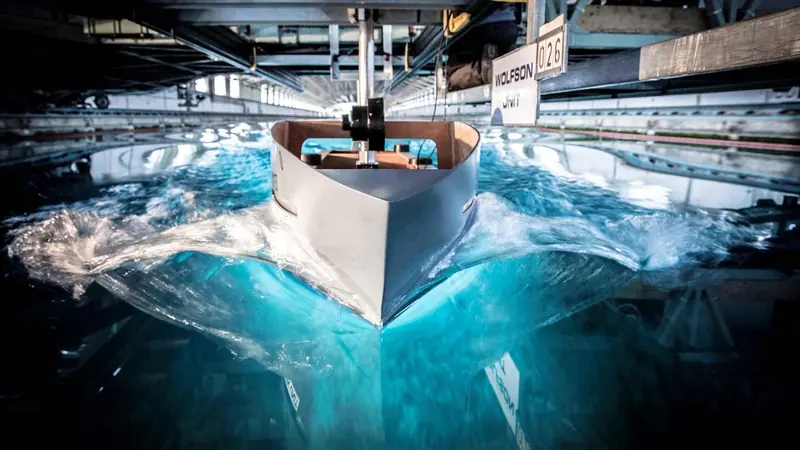
| R&D | about 20 percent of internal capacity committed to research annually; a dedicated four-person CFD team running an in-house supercomputer, using CFD methods since 2005 alongside physical model testing at the Wolfson Unit towing tank in Southampton |
| Recognition | the Hull Vane won the Royal Institution of Naval Architects' Maritime Innovation Award in 2016 |
| Founder controversy | a May 2024 paper in the Journal of Engineering Ethics, co-written by Peter van Oossanen, argues he rather than Ben Lexcen designed Australia II's 1983 America's Cup-winning winged keel; Australia II's skipper John Bertrand and crew member John Longley have rejected the claim |
| Membership | a founding member of SYDNA, the Superyacht Design and Naval Architecture Association launched in May 2026 with Espen Oeino as president |
| Design and engineering fee | not published by the firm; independent industry guides put a full naval-architecture and engineering commission at roughly 10 to 25 percent of build cost depending on customisation, typically bundled into the yard's own quoted price rather than billed to the owner as a separate line |
An engineering firm before it was a design brand
Peter van Oossanen, a Dutch naval architect who had headed the advanced-ships department at MARIN, the Netherlands' state model-testing institute, founded the practice in Wageningen in 1992 as Van Oossanen & Associates. The business came out of the sailing and racing world first, built on Peter's America's Cup work at MARIN, and it began as consultancy across propulsion, vibration and hull form before growing into a full naval architecture studio. Perry van Oossanen joined his father's firm in 2001, straight out of a maritime technology degree, when the team numbered three people; the company was renamed Van Oossanen Naval Architects in 2011, and Perry and Niels Moerke were appointed joint managing directors in January 2012.
The firm today describes itself as a multidisciplinary team of naval architects, hydrodynamicists, marine engineers and project managers, working from Nude 46 in Wageningen, though it has not published a current headcount. It puts roughly 20 percent of its internal capacity into research and development every year, runs a dedicated four-person computational fluid dynamics team on an in-house supercomputer, and has used CFD methods since 2005 alongside physical model testing at the Wolfson Unit towing tank in Southampton. Construction management is also listed among its services, meaning some clients keep the firm on through the build, not only through the drawing stage.
The keel controversy that shadows the founder's name
That is genuinely disputed. Long before the yacht-design business existed, Peter van Oossanen worked on the 1983 America's Cup winner Australia II at the Netherlands Ship Model Basin in Wageningen, assisted by aerodynamicist Joop Slooff at the National Aerospace Laboratory in Amsterdam. Australia II's winged keel ended the New York Yacht Club's 132-year hold on the Cup, and it was, at the time, credited entirely to the Australian designer Ben Lexcen, who is listed as sole inventor on the February 1982 patent application.
In May 2024, a paper in the Journal of Engineering Ethics, co-written by van Oossanen himself, argued that Lexcen should not have been the sole named inventor and that he had already left Holland before the winglet work that produced the final design was carried out. John Bertrand, Australia II's skipper, and John Longley, a senior member of the campaign, have both rejected that account using documentary evidence of their own. Yotters found no independent third party who has adjudicated between the two positions; what is clear is that the firm's founder has now revived, in his own name, a credit dispute over the single most famous hull he ever touched, which is worth knowing before taking any of the studio's other historical claims at face value.
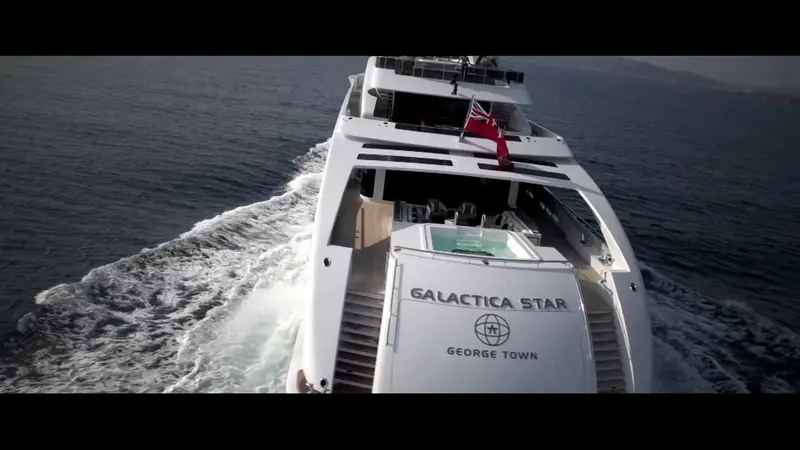
"I can't fault the hull design, they got that right on the money," Illusion's captain said of the Fast Displacement Hull Form, after taking the 65 metre past 25 knots with, in his words, the comfort of 12.
Perry van Oossanen and the creation of the FDHF
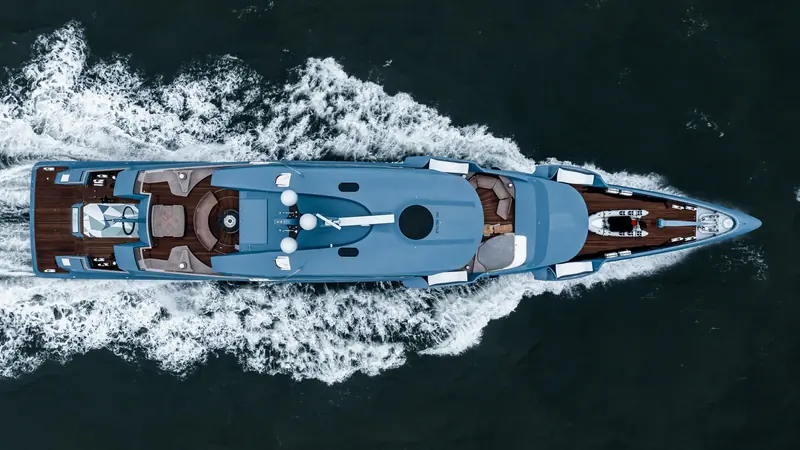
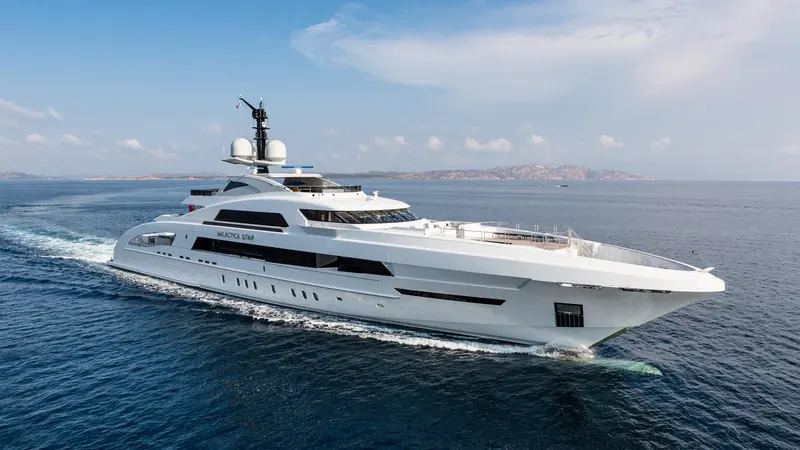
The Fast Displacement Hull Form is a patented hull shape, developed by Perry van Oossanen from 2001, that keeps a yacht efficient across its whole speed range instead of only near top speed; it was proven at sea for the first time on Heesen's Galactica Star in 2013. By Perry's own account, the idea came out of a company-wide push into research and development around the 2008 financial crisis, when each member of the small team took on a personal engineering project; his was a faster, more efficient hull form, refined through repeated tank testing and CFD runs after some unexpected results in the towing tank pointed toward a specific set of hull particulars worth pursuing further.
The first hurdle was not engineering but perception: yards and owners assumed the slender, fine-entry waterlines the FDHF favours would eat into interior volume compared with a conventional round-bilge hull. Van Oossanen has said it took roughly four or five years of scepticism before Galactica Star's 2013 launch became, in his words, the best calling card the firm could have asked for. Every FDHF hull since has been sold, in part, on that yacht's record rather than on the tank-test numbers alone, which is the normal way engineering credentials get established in a market that trusts delivered boats over promised ones.
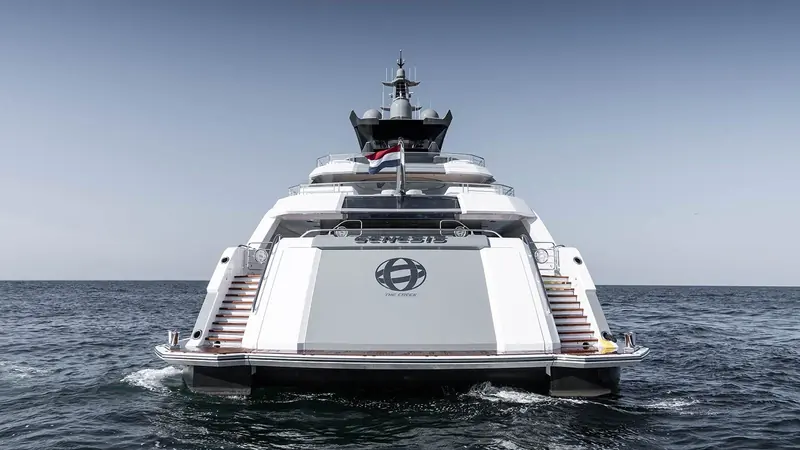
Galactica Star, now Illusion: the yacht that proved it
Galactica Star, Heesen's 65 metre delivered in 2013 as the first FDHF superyacht, beat her contractual speed by nearly two knots on sea trials, a margin Perry van Oossanen said exactly matched the firm's own predictions. Heesen's own figures put her fuel burn at 20 percent below comparable yachts and her range at roughly 4,200 nautical miles at 14 knots; the yacht sold, was refitted in 2019, and now sails under the name Illusion, registered out of George Town in the Cayman Islands, which is the name still lettered on her transom in period photography.
The clearest independent verdict came later, from her working captain rather than from Van Oossanen or Heesen. Captain Will Alpers, writing while cruising the yacht off Sardinia's Costa Smeralda after her North Sea sea trials, told Yachts International and The Gentleman's Journal: "I can't fault the hull design, they got that right on the money. It's awesome to travel at 25-plus knots on a yacht of this size with no vibration, no sound and a level of comfort that feels like you're making 12 knots." A captain's on-the-record assessment of a hull he has actually driven is a rarer and more useful data point than any brochure claim, and it is the strongest single piece of third-party evidence this research found for the FDHF's core promise.
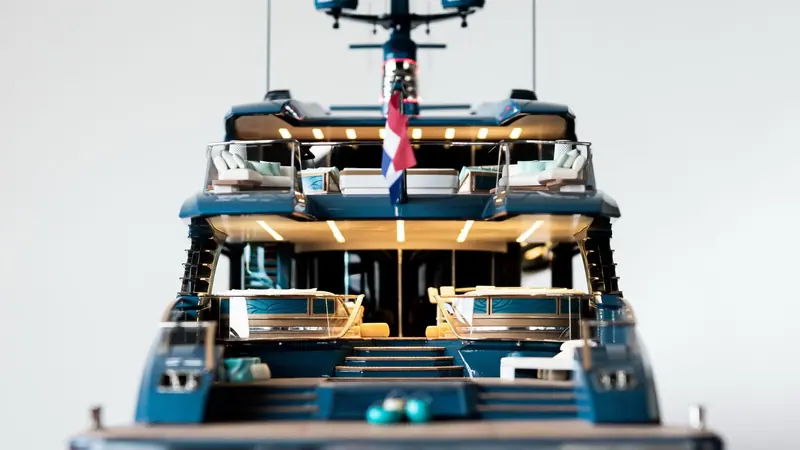
Hull Vane: a fin with a pedigree in a very different keel
The Hull Vane is a patented foil mounted below a vessel's transom that generates forward thrust and suppresses stern waves, and it grew directly out of Peter van Oossanen's winglet work on Australia II's keel four decades earlier. The wing's low-pressure upper surface pulls down the stern wave a hull would otherwise be climbing, cuts resistance, reduces the bow-up running attitude common to fast displacement hulls, and dampens pitching in a seaway; it was tank-tested at the Wolfson Unit before its first fitting.
Heesen's 42 metre Alive, delivered in October 2014, was the first superyacht built with one. Two independent trade titles, Professional BoatBuilder and Megayacht News, both reported the same sea-trial figures: roughly 35 percent less power needed to reach 16 knots in flat water, a 40 percent reduction in pitching in 3-10 foot seas, and about 20 percent more thrust in the same conditions. The device can also be retrofitted; Van Oossanen has reported a 25 percent range increase on a 36 metre motoryacht fitted after the fact, and the Royal Institution of Naval Architects gave the Hull Vane its Maritime Innovation Award in 2016, a recognition that sits outside the yachting press and outside Van Oossanen's own marketing.
PHI, and engineering around a tonnage rule
For Royal Huisman's PHI, a 58.5 metre delivered in 2021, Van Oossanen developed a wider, longer variant of its signature hull called the Fast Displacement XL, which let the yacht register at 499 gross tons and become the longest motoryacht in the world to stay under the 500 GT threshold. Royal Huisman is primarily a sailing-yacht builder, and PHI was its first Van Oossanen-hulled motoryacht; owner's representative Guy Booth has said the choice of a sailing yard came precisely because more conventional motoryacht builders kept telling the owner's team "you can't do that."
Neither Royal Huisman nor Van Oossanen has published exactly why the owner wanted to stay under that specific tonnage line rather than simply building larger; gross-tonnage bands are a long-standing industry lever for survey, crewing and registration requirements, and yards market a result like this on the tonnage figure precisely because everyone in the trade understands what crossing it would have cost. What is verifiable is the outcome: exterior and general concept by Cor D. Rover, interior by Lawson Robb, and a hull that let a sailing-yacht builder deliver a fast, efficient, three-deck motoryacht at a length that would ordinarily demand a far higher tonnage. Rover has explained the efficiency brief bluntly - "there are no electric chargers between the Azores and the Caribbean" - which is the kind of range-first thinking an FDHF-family hull is built to answer.
Beyond Heesen: who else builds on a Van Oossanen hull
Heesen remains the firm's largest and longest client, but Van Oossanen's hull work also sits under yachts from Royal Huisman, Sirena Yachts, Alia Yachts and Royal Hakvoort, among others. Sirena Yachts revealed a new high-speed superyacht range at the 2022 Monaco Yacht Show in three sizes, 35, 42 and 50 metres, all designed around Van Oossanen's FDHF principles for a 15 to 19 knot cruising band; Perry van Oossanen said at the launch that "these models are all designed for high displacement speeds, a speed range that puts specific demands on the hull design," and credited Sirena with sharing the firm's own focus on efficiency. Alia Yachts has delivered the Van Oossanen-hulled Ruya and, more recently, the 43 metre Ximena; Royal Hakvoort's Milele carries the same naval architecture credit.
The relationship with Heesen continues to run at pace: Project Setteesettanta, a 57 metre full-custom hull, was launched in mid-2026 and moved toward sea trials by that summer, and the 55 metre steel-hulled Pa'lante was delivered in 2026 as well. In May 2026, Van Oossanen became a founding member of SYDNA, the newly formed Superyacht Design and Naval Architecture Association, led by Espen Oeino, whose own studio is covered elsewhere in this directory - a sign that the naval-architecture side of the business has only recently organised itself into something resembling the trade body shipyards have had for years through SYBAss.
How a yard actually commissions Van Oossanen, and what it costs
Almost always it is the shipyard's decision, not the owner's, and the commercial terms are not published. Van Oossanen's client relationships run through the builders named above, and the naval architecture credit typically sits alongside a separately appointed exterior or interior studio chosen by the owner; PHI is the clearest exception on record, where the owner's own exterior designer, Cor D. Rover, brought Van Oossanen in rather than the yard doing so. An owner who wants a specific hull technology therefore has to ask for it, by name, when choosing a yard, rather than commissioning Van Oossanen the way they would a stylist.
No fee scale is published, and this research found none in any trade source either. Independent naval-architecture pricing guides, such as those from Kasten Marine Design and Cad Crowd, put a full engineering and naval-architecture commission at somewhere between roughly 10 and 25 percent of build cost depending on how custom the project is, generally bundled into the yard's own quoted price rather than itemised separately for the owner. Construction management is also on offer as a distinct service, for owners or yards who want the same office involved from tank test through to sea trial rather than handing the drawings over and stepping back.
What the record does not show
The FDHF is a specialisation for displacement and semi-displacement speeds rather than a universal high-speed hull, the firm is functionally invisible to most buyers because the yard chooses it rather than the owner, and its founding story now carries an unresolved credit dispute the founder himself reopened. On the technical side, the hull form is built to be efficient across a working speed range, not to chase planing-hull top speeds; Genesis's 29-knot performance comes from four MTU engines delivering a combined 19,000 horsepower on an 80 metre platform, not from the hull form alone, and an owner who wants genuine planing performance on a smaller, less powerful yacht is not the client this technology is built for.
On the commercial side, an owner shopping for a yacht cannot easily ask for "a Van Oossanen hull" the way they can ask for a Nuvolari Lenard exterior; the choice sits with the yard's own engineering department, and beyond one working captain's testimony this research found no independently attributable owner-side account of what it is like to operate one of these hulls day to day, only yard press releases and trade-press sea-trial figures. And the Australia II dispute, however distant from current yacht-building practice, is a live question as of 2024, reopened by the founder in his own academic writing rather than settled by an outside historian; anyone weighing the studio's other historical claims should know that its most famous credit is, by its own founder's admission, contested.
معلومات عملية
| Design and engineering fee | not published by the firm; independent naval-architecture pricing guides (Kasten Marine Design, Cad Crowd) put a full engineering commission at roughly 10 to 25 percent of build cost depending on customisation, usually bundled into the yard's own quoted price rather than itemised to the owner |
|---|---|
| How to commission | almost always through the shipyard's own engineering department, not directly by an owner; the one documented exception on record is PHI, where the owner's exterior designer, Cor D. Rover, brought Van Oossanen onto the project |
| What the firm actually offers | naval architecture, hydrodynamics, CFD and physical model testing (Wolfson Unit, Southampton), plus construction management for clients who want the same office involved from tank test through sea trial |
| Where the technology suits and where it does not | the FDHF is built for efficiency across displacement and semi-displacement speeds; an owner chasing genuine planing-hull top speed on a smaller, lower-powered yacht should look elsewhere |
| Retrofit option | the Hull Vane transom foil can be retrofitted to an existing hull; Van Oossanen has reported a 25 percent range increase on one 36 metre motoryacht fitted after delivery |
| What is not published | current staff headcount, a fee scale, standard contract terms, and any account from a private owner (rather than a captain, a yard, or the firm itself) of what it is like to commission this office |
ما يذكره الملاك والأطقم
A working captain's on-the-record account of the FDHF at speed
"I can't fault the hull design, they got that right on the money. It's awesome to travel at 25-plus knots on a yacht of this size with no vibration, no sound and a level of comfort that feels like you're making 12 knots," sent by email while cruising off Sardinia's Costa Smeralda following North Sea sea trials
Captain Will AlpersNo independently attributable private-owner testimony found
coverage of Illusion, Azamanta, PHI and Genesis draws on Heesen's and Royal Huisman's own press material, Perry van Oossanen's interviews, and one working captain's quote, but this research found no on-the-record account from a private yacht owner describing what it was like to commission a Van Oossanen hull
Yotters research desk
نقاط القوة وما يستدعي الانتباه
نقاط القوة
- A patented hull technology with a checkable delivery record across four yardsthe FDHF sits under Illusion, Azamanta, Aquamarine and Genesis at Heesen, and under PHI at Royal Huisman, spanning aluminium and steel hulls from 42 to 80 metres
- Independent, on-the-record praise from someone who actually drove the hullCaptain Will Alpers' account of Illusion at 25-plus knots feeling like 12 is a rarer and stronger data point than any brochure claim, and it is not Van Oossanen's or Heesen's own words
- A demonstrated ability to solve a specific engineering problem, not just build a fast hullthe Fast Displacement XL variant let Royal Huisman deliver the longest motoryacht under 500 GT on PHI, a bespoke technical answer to a client's stated need rather than a stock product
ما يستدعي الانتباه
- The hull form is a specialisation, not a universal answerthe FDHF is built for efficiency across displacement and semi-displacement speeds; Genesis's 29 knots comes from raw horsepower on a large platform, not proof the hull form suits every size or brief
- An owner cannot easily commission this firm directlythe yard, not the buyer, almost always chooses the naval architect, so an owner who wants this specific technology has to know to ask for it by name when picking a yard
- The founder's own most famous credit is, by his own recent account, disputedPeter van Oossanen's 2024 paper reopening the Australia II keel-design question was rejected by the yacht's own skipper and a senior crew member, and the matter remains unresolved
لمين هو: A shipyard's technical office, or an owner's own naval-architecture-literate project manager, weighing hull-performance and efficiency claims before a build contract is signed - not an owner shopping for a signature exterior silhouette, since this practice is rarely part of that conversation at all.