Harken
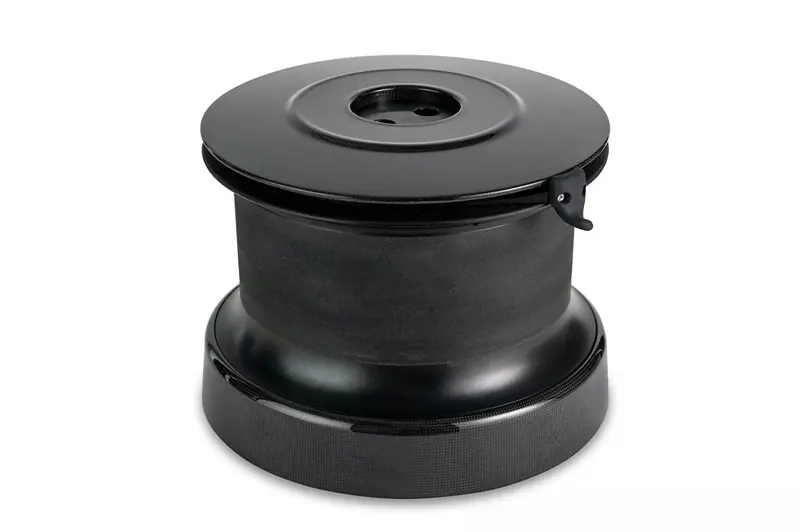
| Category | sailing yacht deck hardware, winches, furling systems, travelers, blocks and hydraulics, dinghy to superyacht |
|---|---|
| Founded 1967 by brothers Peter and Olaf Harken, first as the short-lived Scanda boatbuilding venture, then as Harken/Vanguard from a 60 foot rented garage in Waukesha, Wisconsin | |
| Moved to Pewaukee, Wisconsin in 1971; the boatbuilding side, Vanguard, was sold off in 1986 so the brothers could concentrate on hardware | |
| Ownership | 100 percent employee owned since 2020, financed through an ESOP backed by a Wells Fargo loan and the 2019 sale of the old Pewaukee headquarters for USD 15 million |
| Manufacturing | winches and pedestals built at Limido Comasco, Italy, acquired as the winch maker Barbarossa from the Bassani brothers in 1987; blocks, travelers and other hardware built at a 175,000 square foot plant on 26 acres in Pewaukee, Wisconsin, opened after Harken bought its longtime tooling partner Accurate Products in 2010 |
| Range | small boat and big boat blocks, travelers, mainsail and headsail handling, manual, electric, hydraulic and epicyclic powered winches, furling systems and custom megayacht hydraulics, plus non-sailing Safety and Rescue, Canvas and Hoister divisions |
| A Radial 46, a manual two-speed self-tailing winch sized for a boat of roughly 12 to 15 m, lists at USD 1,703, confirmed at both Defender Marine and Fisheries Supply | |
| A MKIV Ocean Unit 1 headsail furling system, for a boat of about 28 to 36 ft, lists at USD 3,134 | |
| An electric Performa 70, three speed, 24 volt, the size used on grand prix 50 footers, lists at USD 18,403, equipment only | |
| A manual to electric conversion kit for a Radial 35 lists at roughly USD 3,700, with street prices commonly USD 2,965 to 3,430 | |
| Winches, hydraulic cylinders, valves, pumps, reservoirs and control panels carry a 3 year warranty; electric and hydraulic motors, captive reel winches and hydraulic power units carry 2 years | |
| Custom megayacht hydraulic packages, like the 52 m Nazenin V's push-button backstay, outhaul, vang, furling and winch system, are quoted per project with no published price | |
From a Rented Garage to a Cigar Box of Blocks
Peter Harken was replacing the steel needle bearings in his dinghy's pulleys with plastic ball bearings when some rolled off his workbench, and he noticed how high they bounced. Less mass accelerates faster, which is exactly what a block does every time a sail is eased, and the block he built around that idea outperformed anything else on the water. He and his brother Olaf, back from three and a half years in the Navy, formed Harken/Vanguard that year, building dinghies to fund a hardware side business they deliberately kept under a different name so competing boatbuilders would still buy it. Gary Comer, the Lands' End founder, put the first blocks in his mail order catalogue and suggested the Harken name specifically so it would not read as a rival boatbuilder's brand.
The company moved to a bigger building in Pewaukee in 1971 on the strength of a US license to build the Olympic 470 dinghy, and spent the next decade doing both jobs at once, boats and hardware. By the mid 1980s the hardware business had outgrown the boat business, and in 1986 Peter and Olaf sold the Vanguard tooling and name to concentrate on deck gear. The decision that shaped the next forty years came a year later, in 1987, when they bought Barbarossa, a small Italian winch maker owned by the Bassani brothers in Limido Comasco near Milan. Harken aluminum winches, built in that plant ever since, became the winch most raced yachts specify by default.
Ball Bearings, Torlon Plastic and a Torsion Cable
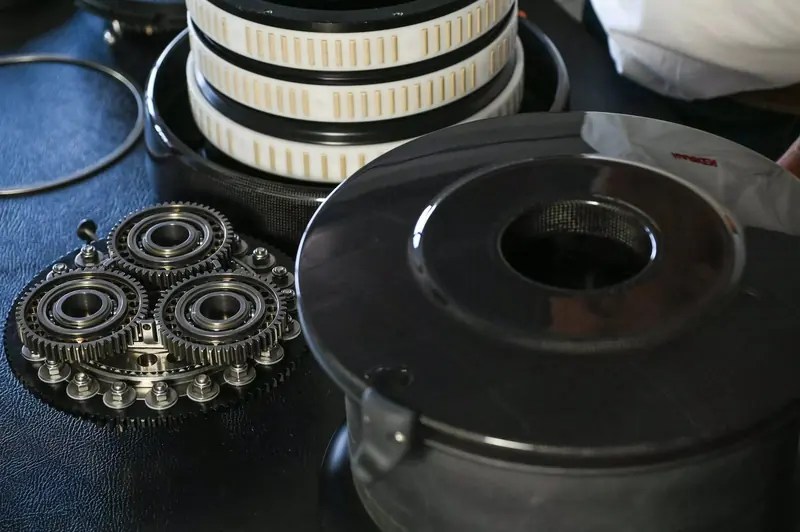
Self-tailing was not Harken's invention. Patents for a jaw that clamps the sheet automatically date to the mid 1970s and were held by competitors including Barient, and the mechanism on a modern Harken winch is the same basic idea: a spring loaded jaw and stripper arm above the drum hold and feed the tail as the drum turns. Harken's own contribution goes back further, to Peter Harken swapping steel needle bearings for plastic ball bearings in a block, and the same logic scaled up into winches once Amoco released Torlon, a plastic tough enough to carry the loads a big boat winch drum sees. A prototype Torlon mainsheet block went on the 12 metre Sverige at the 1977 America's Cup, and the Swedish crew told Harken afterwards it was the only block on the boat they never had to replace.
Furling systems use a different mechanism again. A Harken MKIV drum turns a foil that wraps the luff of the jib around a rotating extrusion, driven through a torsion cable inside the foil rather than the wire halyard the sail hangs from, so the sail furls evenly from the top of the luff down without twisting. The Ocean version of the MKIV carries four extra races of Torlon ball bearings compared with the entry level Cruising model, and neither needs grease. Both mechanisms, the winch and the furler, are sold on the same idea: a ball bearing that never needs lubricating carries a load with less friction and less maintenance than one that does.
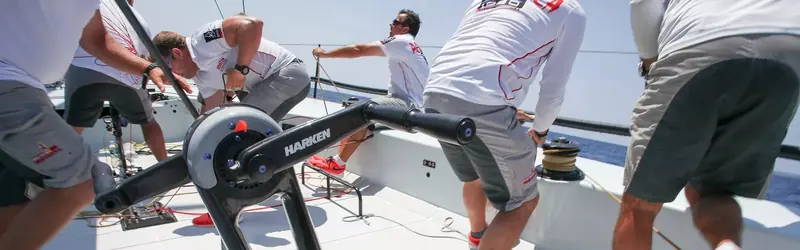
Peter Harken noticed how high a dropped ball bearing bounced, and fifty years later that same idea still turns the winch on an America's Cup boat.

The Range, and What It Actually Costs
Harken's own shop lists a price for every winch size, and independent retailers confirm them: a Radial 46, a two speed manual self-tailing winch for a 40 to 50 ft cruising boat, lists at USD 1,703 at both Defender Marine and Fisheries Supply. Smaller Radial self-tailing winches for dinghies and daysailers run from roughly USD 500 to 600. At the other end, an electric Performa 70, the three speed 24 volt winch sized for a grand prix 50 footer's primary sheets, lists at USD 18,403, and that is equipment only, before wiring, a breaker panel and the labour to cut a hole in the deck for it.
Furling is priced the same way, by unit size against boat length. The MKIV Ocean range runs Unit 0 at USD 2,553 for boats to about 28 ft, Unit 1 at USD 3,134 to about 36 ft, Unit 2 at USD 4,721 to about 44 ft and Unit 3 at USD 7,105 to about 54 ft, all confirmed across more than one retailer and all equipment only, before the sail loft cuts a new luff tape onto the jib. A manual to electric conversion kit, which swaps the top of an existing manual winch for a motor and gearbox rather than replacing the whole winch, lists around USD 3,700 for a Radial 35 and commonly sells for USD 2,965 to 3,430. Above the catalogue sizes, custom hydraulic packages for megayachts are quoted project by project. Harken's system for the 52 m Nazenin V, with push-button backstay, outhaul, vang, furling and winch control run off a central hydraulic plant, carried no published price at all, and that remains true of every yacht in that bracket.
Racing Pedigree, Proven Before It Reaches a Cruising Boat
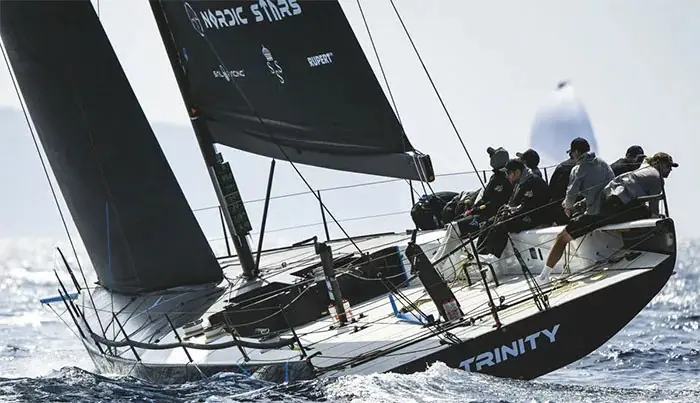
The 1995 America's Cup is the case Harken still points to. A long friendship between the company's Auckland distributor and Team New Zealand's Sir Peter Blake got Harken the contract, and the winches it built carried carbon fibre drums, lighter than anything else in the fleet, on both the New Zealand and American boats. New Zealand won, and the rest of the fleet noticed whose winches were on the winning boat. Harken has held an America's Cup supply contract in most cycles since, most recently with INEOS Britannia, and its True Clutch technology, which lets a grinder shift between winch and hydraulic pump load without stopping the handles, ran on the AC75 foiling monohulls for more than a year before it was shown publicly.
Below the Cup, Harken has been the official winch and deck hardware supplier to the Volvo Ocean Race, now the Ocean Race, since the fleet went one design for 2014-15, and its technicians travel with the fleet. The TP52 circuit runs almost entirely on Harken deck gear, and it is where the DynaDrive and Performa lines are proven under daily racing load before the same engineering reaches a cruising boat's Radial winch a product cycle or two later. A buyer paying for a Harken winch on a production cruiser is, in a real sense, paying for testing that already happened on a raceboat.
What It Means for an Owner: Shorthanded Sailing and Servicing
The case for going electric is almost entirely about crew. A manual two speed winch still needs someone grinding and, on anything but the smallest boat, someone else tailing the sheet, and short-handed cruising couples are among the fastest growing part of Harken's customer base by its own account. An electric winch collapses that to one person at a switch, and the DynaDrive line goes further, building the motor into the drum itself rather than bolting one under an existing manual winch, which saves headroom below deck on boats where that space is already spoken for by an engine or a berth. Harken markets DynaDrive explicitly on that basis, as a design decision for cruising boats rather than a race winch adapted for cruising.
Servicing is the other half of ownership. Harken recommends stripping, cleaning and regreasing every winch at least once a season, twice if the boat lives in salt water, though owners who cruise rather than race commonly stretch that to every two or three years without trouble. A yard doing the job properly, rather than an owner at the cockpit table, typically charges USD 200 to 500 or more per winch depending on size and condition, with bearing sets running USD 30 to 200 and a full jaw kit USD 40 to 180 on top if either is worn. None of that is unique to Harken, every winch on the market needs the same attention, but a boat with eight or ten winches on deck turns an afternoon job into a real annual bill either way.
The Real Tradeoffs: Cost, Bearings and Power
Ask on an owner forum which brand to fit and the answers split almost evenly. One long running Sailing Anarchy thread has an owner with Harken 53s and 48s reporting no reliability problems at all, set against posters who rate Lewmar just as good and note that Harken costs noticeably more for the same load rating. Parts and service support come up on both sides of the argument, with some owners calling Harken's customer service the best in the business and others reporting the opposite experience with Lewmar, which suggests the real variable is the dealer an owner happens to be near rather than the badge on the winch. What does recur, on both brands, is roller bearing failure on older, under-serviced winches: one owner stripping a Harken 40 for the first time on a newly bought boat found the top bearing cage had broken apart, scattering loose rollers into the pawl mechanism.
Electric winches add a second failure mode that manual winches do not have. Owners report a Harken 65.3 losing drive after running under sustained load, the motor spinning but the drum not turning, which points at the clutch or gearbox rather than the motor itself, and a running electric winch can draw 150 to 200 amps even though any single hoist rarely takes more than a few minutes. That is a real load to ask of a house battery bank on a boat that was not wired with powered winches in mind from the start, and it makes a retrofit to electric a wiring project as much as a winch project. None of this makes Harken the wrong choice. It makes it a winch that rewards the same annual service every winch needs, and a buyer who has priced the generator or battery capacity an electric conversion actually requires before signing for it.
معلومات عملية
| Manual winch pricing across the range | Harken's own shop and independent retailers agree closely: small Radial self-tailing winches for dinghies and daysailers run roughly USD 500 to 600, a Radial 46 for a 40 to 50 ft cruising boat lists at USD 1,703 (Defender Marine and Fisheries Supply both confirm), and the largest manual Performa and Air sizes used on grand prix maxis run well past USD 3,000. |
|---|---|
| Electric and powered winch pricing | An electric Radial 40, two speed, chrome, lists from around USD 4,250. At the top of the catalogue an electric Performa 70, three speed, 24 volt, sized for a grand prix 50 footer, lists at USD 18,403, equipment only, before wiring, breakers and installation. |
| Furling system pricing (MKIV Ocean) | Unit 0 (to about 28 ft) USD 2,553, Unit 1 (to about 36 ft) USD 3,134, Unit 2 (to about 44 ft) USD 4,721, Unit 3 (to about 54 ft) USD 7,105. Figures confirmed across more than one retailer; equipment only, before the sail loft fits a new luff tape. |
| Manual to electric conversion kits | A kit that motorises an existing Radial 35 rather than replacing the winch lists around USD 3,700 and commonly sells for USD 2,965 to 3,430 depending on voltage and motor orientation. It is the cheaper route to power on a boat that already has the right size manual winch fitted. |
| Service interval | Harken recommends a full strip, clean and regrease at least once a season, twice if the boat lives in salt water. Cruising owners on the forums commonly stretch that to every two or three years; racing crews check before every regatta. |
| What a professional service actually costs | A yard doing the job properly runs roughly USD 200 to 500 or more per winch depending on size and condition, with a bearing set adding USD 30 to 200 and a full jaw kit USD 40 to 180 if either needs replacing. A boat with eight to ten winches turns this into a real annual line item. |
| Warranty terms | Winches and handles, hydraulic cylinders, valves, pumps, reservoirs and control panels carry a 3 year limited warranty. Electric and hydraulic winch motors, captive reel winches, hydraulic power units, switches, control boxes and breakers carry 2 years. |
| What voids the warranty | Harken's published terms exclude installation, wiring, service or repairs improperly performed, non-conforming replacement parts, accidents, misuse, abuse or lack of reasonable maintenance, and any product altered from factory specification. A defect also has to be reported within 60 days of discovery. |
| Power draw on a retrofit | A running electric winch can draw 150 to 200 amps, even though a single hoist rarely runs more than a few minutes. A two speed electric winch draws less than a single speed doing the same job, because the low gear does more of the work. |
| What is NOT published | Custom hydraulic packages for megayachts, the winch, furling, backstay, outhaul and vang systems run off a central plant, are quoted per project with no published price at all. Harken publishes no bearing overhaul price for its winches and no independent load or roll test; every service-life figure in this entry comes from yards and owners, not the factory. |
ما يذكره الملاك والأطقم
Owner opinion on Harken against Lewmar splits, and cost is the recurring theme
One owner outfitting a new 54 ft short-handed cruiser reported no reliability problems at all on the Harken 53s and 48s already fitted to his current boat, but noted Harken is definitely more expensive than Lewmar and asked the forum whether that premium was worth it; replies were split between owners who rated Lewmar just as good and others who called Harken's customer service the best in the business.
Sailing Anarchy ForumsAn under-serviced winch fails at the bearing cage, not the gearing
An owner servicing his Harken 40 genoa winches for the first time after buying a used J/92 found the top roller bearing had come apart, with loose metal rollers jammed under the pawls and the drum unable to lift by hand, and asked how long the bearings normally last before failing this way.
Sailing Anarchy ForumsElectric winches can lose drive without warning under sustained load
An owner reported a Harken 65.3 electric winch losing drive, the motor still spinning but the drum no longer turning, after running under load for an extended period, pointing at a clutch or internal gearbox fault rather than the electric motor itself.
Sailing Anarchy ForumsMKIV furling draws few complaints beyond one minor niggle
Cruising owners report the MKIV working perfectly season after season with no lubrication needed, one saying he sails more often simply because tacking is so much less work, though a small number note the furling line occasionally escapes the drum cage and needs straightening by hand.
Sailboat Owners ForumsThe Italian factory runs on hand-drawn engineering, not just CNC output
Harken's Limido Comasco winch plant is built around large windows between the design office and the test centre, a culture the trade press ties to Luciano Bonassi, the Harken Italy chief engineer credited with more than 36,000 hand-signed winch drawings over his career.
Barche Magazine
نقاط القوة وما يستدعي الانتباه
نقاط القوة
- Racing pedigree that genuinely filters down to the cruising lineHarken has supplied America's Cup, Ocean Race and the entire TP52 fleet for decades, and lines like DynaDrive and Performa are proven under daily racing load before the same engineering reaches a Radial winch on a production cruiser a cycle or two later.
- A low friction, low maintenance mechanism, not just a brand nameThe ball bearing drum, built around Torlon plastic since the 1970s, and the four extra bearing races on an Ocean furling unit over the Cruising version, are genuine engineering choices, not marketing language, and neither the winch bearings nor the furler need grease.
- Pricing published across nearly the whole catalogueAlmost every winch and furling system size has a list price confirmed by more than one independent retailer, which is unusual in marine hardware and lets a buyer build a real budget before a dealer is involved.
- Stable, employee-owned, and still investingThe 2020 ESOP removed the risk of a private equity flip, and the company has kept acquiring since, from Accurate Products in 2010 to the Safety and Rescue businesses from 2016 on, which funds the factories that build the sailing hardware.
- Two owned factories, not an outsourced supply chainWinches and pedestals come from Harken's own plant in Limido Comasco, Italy, and the rest of the hardware from its own Pewaukee, Wisconsin plant, which is what let it build a first-of-its-kind megayacht hydraulic package for the 52 m Nazenin V rather than turning the job away.
ما يستدعي الانتباه
- Costs more than Lewmar for a comparable winchOwner forums consistently note the price gap on like-for-like load ratings, and the premium is not reliably reflected in a longer service life; several long-time owners rate Lewmar just as reliable at a lower price.
- Under-serviced winches fail at the bearing cageA neglected Harken winch's top roller bearing can break apart and scatter loose rollers into the pawl mechanism, jamming the drum solid. Harken's recommended annual interval is stricter, and costlier to keep up, than many cruising owners actually manage.
- Electric winches add a real failure mode and a real power billOwners report electric winches losing drive under sustained load, likely a clutch or gearbox fault rather than the motor, and a running unit can draw 150 to 200 amps, a load that has to be planned for rather than discovered after the retrofit.
- Nothing published above the catalogue rangeCustom hydraulic packages for megayachts carry no published price at all, so a buyer above roughly 40 m starts every conversation from zero information, unlike the transparent pricing on the standard winch and furling range.
- A powered retrofit is a wiring project, not just a winch swapConverting manual winches to electric or powered means checking generator and battery bank capacity first; skipping that step is the most common reason an otherwise sound conversion disappoints its owner.
لمين هو: Owners fitting out or refitting a sailing yacht from about 30 ft to grand prix maxi size who want deck hardware proven on a raceboat first, and who are prepared to pay more than Lewmar for it and service it every season.