Iridium
| Constellation | 66 active satellites plus in-orbit spares, in 6 polar orbital planes of 11 satellites each, at about 780km (485 miles) altitude, 86.4 degree inclination, cross-linked to four neighbors via Ka-band inter-satellite links so a signal routes sky-to-sky without needing a ground station in view |
|---|---|
| GMDSS status | IMSO signed a Letter of Compliance on December 19, 2019 and formally authorized Iridium for GMDSS distress and safety service on January 13, 2020, ending Inmarsat's exclusive hold on that role since 1999; Iridium covers GMDSS Sea Areas A1 through A4, the only network that does |
| Certus speed tiers | Certus 100 gives 22kbps up / 88kbps down, Certus 200 up to 176kbps and Certus 700 up to 352kbps up / 704kbps down, the fastest L-band data Iridium offers as of 2026 |
| Terminal hardware, street pricing found September 2026: Lars Thrane LT-4200 (Certus 200) around USD 6,100-7,300; Cobham SAILOR 4300 (Certus 350/700-capable) around USD 7,000-9,000; Thales VesseLINK 200 listed at USD 3,995; the Lars Thrane LT-3100S GMDSS terminal around USD 5,500 | |
| Airtime is resold, not sold direct | Iridium has no retail storefront for Certus or GMDSS airtime; plans are quoted by service providers such as Ground Control, Satphone.io, OCENS and Global Marine Networks, most of them session-based (100-byte increments, 5KB minimum charge) rather than a flat published per-MB rate |
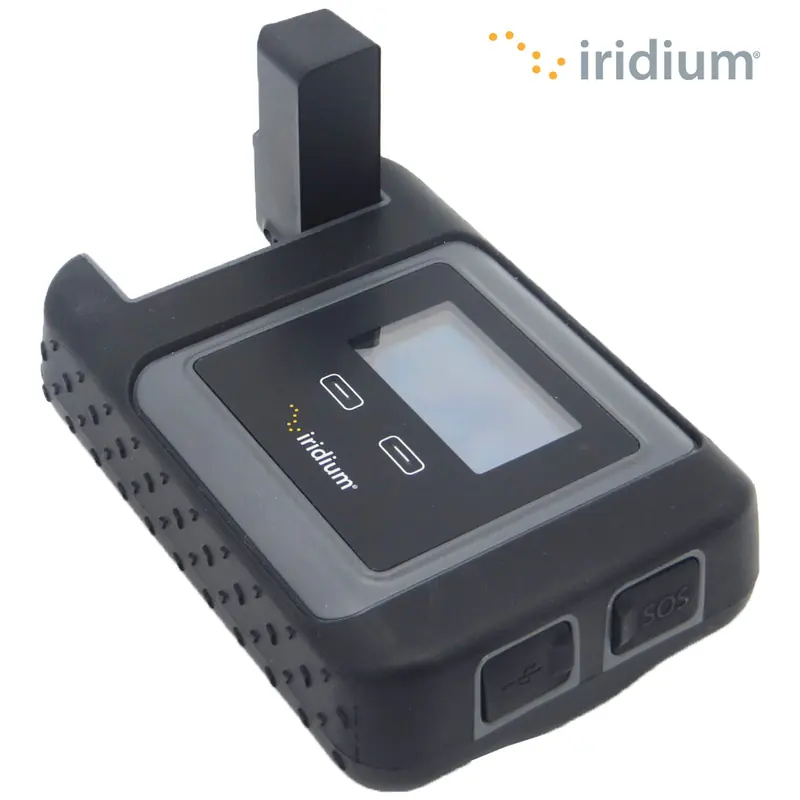
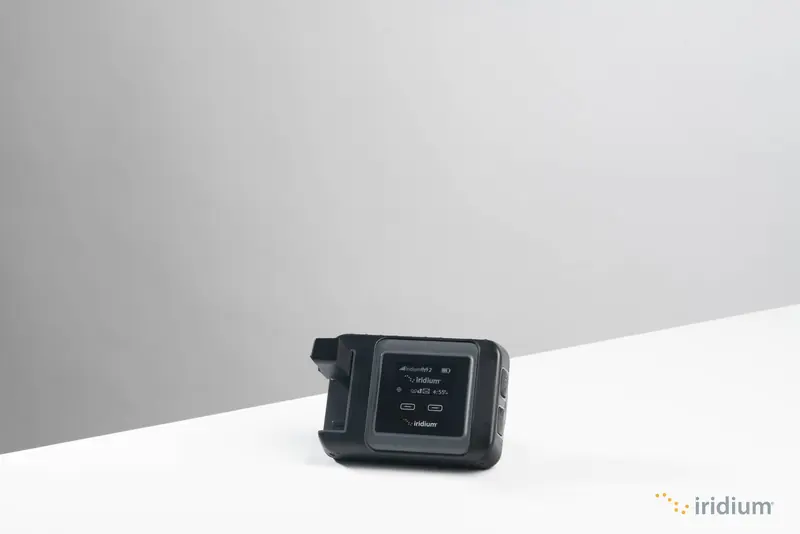
| Iridium GO! exec | preorder price USD 2,150 against roughly USD 1,200 for the original GO!, delivering the same 22/88kbps Certus 100 speeds in a battery-powered handheld hotspot rated 6 hours of active use and 24 hours standby |
| Company history | Motorola-backed Iridium filed Chapter 11 on August 13, 1999 after a roughly USD 5 billion build, one of the 20 largest US bankruptcies to that date; relaunched under new owners in 2001; the second-generation Iridium NEXT constellation completed February 5, 2019 |
| Public company | Iridium Communications Inc trades on Nasdaq as IRDM, headquartered in McLean, Virginia, reporting 2025 revenue of USD 871.7 million and net income of USD 114.4 million |
| Third-party use case | YB Tracking, the tracker behind the Vendee Globe, Rolex Fastnet and Sydney Hobart, runs its position beacons over the Iridium network, with battery life to send a fix every six hours for up to a year unattended |
What Iridium Actually Sells A Yacht
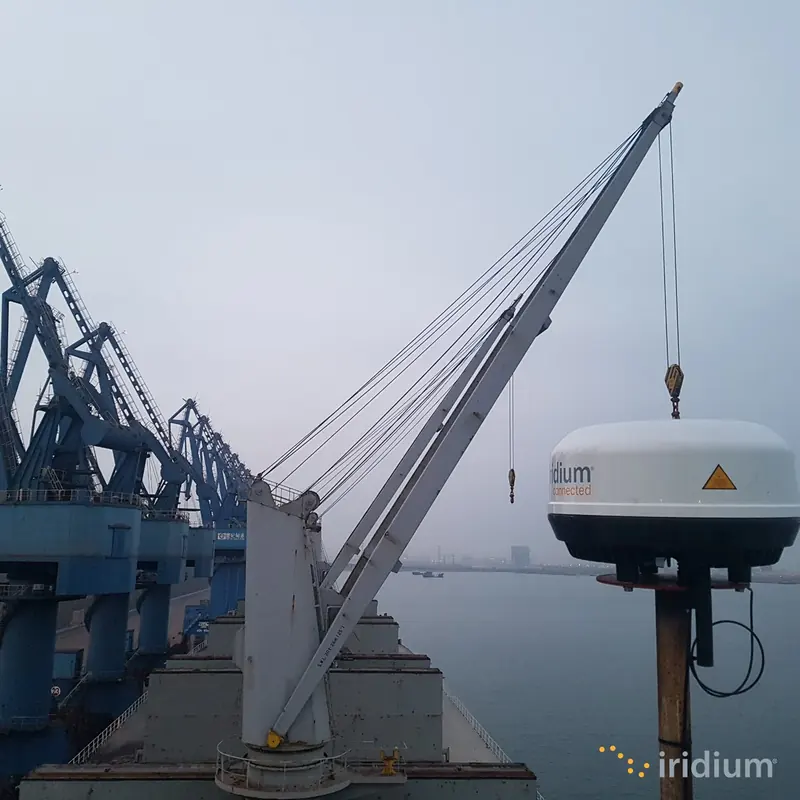
Iridium Certus is the IP-data and voice service, delivered through marine terminals built by Cobham SATCOM (the SAILOR brand), Thales (VesseLINK) and Lars Thrane, each pairing a below-deck modem with a stabilized or fixed topside antenna. These terminals are sold and installed through marine electronics dealers such as Global Marine Networks, Ground Control resellers, Satcom Global and regional integrators, not through Iridium's own storefront, which lists specifications and partner products but no consumer checkout. Separately, GMDSS-approved terminals headlined by the Lars Thrane LT-3100S give a yacht the distress-and-safety-calling capability that SOLAS-class vessels are required to carry, an alternative to the Inmarsat FleetBroadband and mini-C hardware that held that role alone for two decades.
The third family is portable: the Iridium GO! and GO! exec turn a phone into a satellite handset over WiFi, and the classic 9555 and 9575 handsets remain in production as dedicated satphones. On a working yacht these three families rarely stand alone. A vessel running Starlink or a VSAT dish for day-to-day internet typically also carries an Iridium Certus terminal, a GMDSS unit, or a GO! exec as the link that is designed to keep working when the primary system loses its license, its power budget or its line of sight, a layering explicitly recommended by resellers including Global Marine Networks and covered as standard practice by trade titles such as Yachting Magazine.
The Constellation That Makes Polar Coverage Real
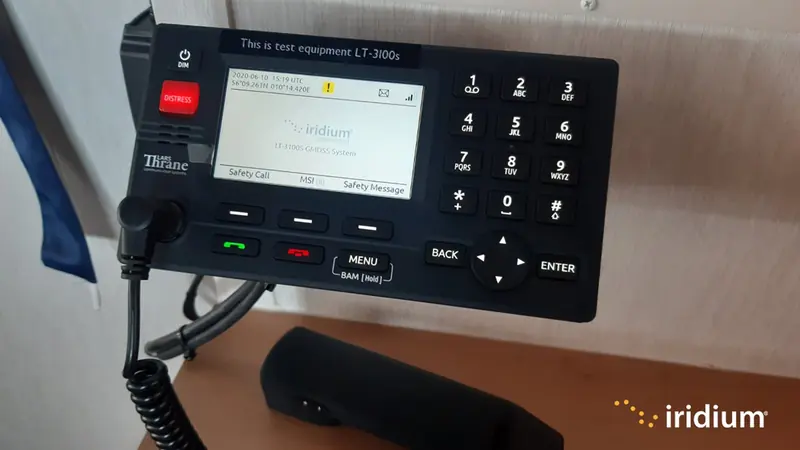
The constellation, confirmed by Wikipedia's satellite-tracking sourced data and eoPortal's Iridium NEXT mission page, places 11 satellites in each of six orbital planes, spaced 31.6 degrees apart for the co-rotating planes and 22 degrees for the two counter-rotating planes, at an inclination of 86.4 degrees, close enough to polar to guarantee coverage at both ends of the earth. Each satellite links to its four neighbors by Ka-band inter-satellite crosslinks, so a call or data session can be handed from satellite to satellite across the sky without ever needing a ground gateway in view, the design detail that keeps a connection alive over open ocean and high latitudes where ground infrastructure does not exist.
Because the orbit is low, at about 780km against the roughly 35,786km of a geostationary VSAT satellite, an individual satellite is only overhead for about 7 minutes before a call hands off to the next one in the plane, a full orbit taking roughly 100 minutes. Field reports posted by resellers put Iridium's round-trip network latency at roughly 400ms, well under the 500 to 1000ms typical of geostationary services like Inmarsat FleetBroadband or a traditional VSAT link, though Iridium does not publish an official latency figure and this page could not independently verify an exact number beyond that industry-reported range.
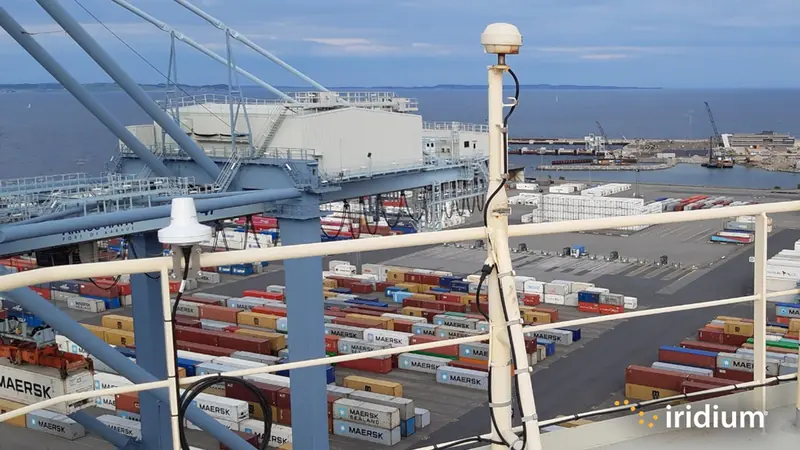
Iridium is the network that is supposed to still be working when the storm that just took out the Starlink dome is the reason you need it.
GMDSS Approval, And Why It Broke A Twenty-Year Monopoly
GMDSS, the Global Maritime Distress and Safety System, is the internationally mandated set of equipment and procedures SOLAS-class commercial vessels must carry for distress alerting and safety communications. From 1999 until early 2020, Inmarsat was the only satellite operator authorized to carry that traffic. Iridium's approval, covered at the time by Seatrade Maritime, SatellitePro ME and Iridium's own investor announcement, gave the maritime industry a second network and, for the first time, a second choice of hardware vendor for a mandatory safety system. Iridium markets its version as covering GMDSS Sea Areas A1 through A4, meaning the full range from coastal VHF-covered waters out to the open ocean and the poles, a claim Inmarsat's own geostationary satellites cannot make since they lose useful elevation near either pole.
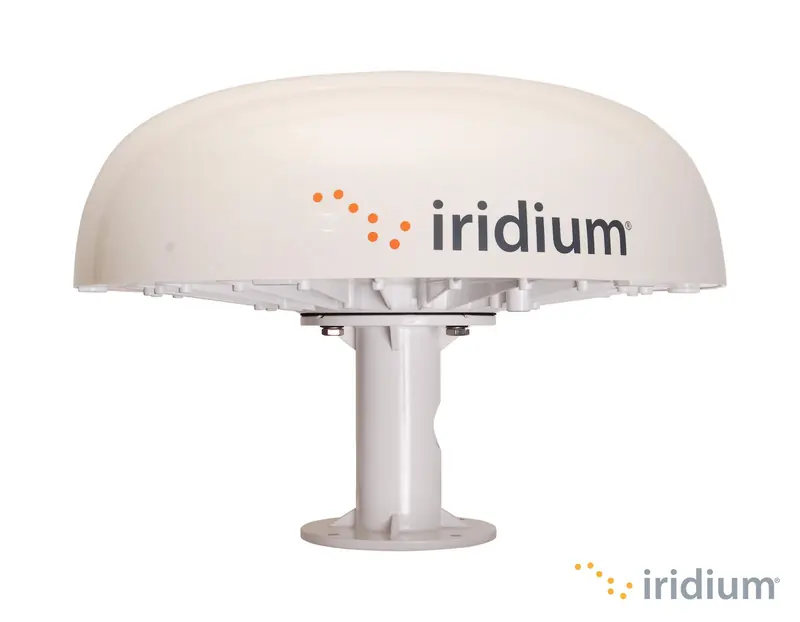
The practical yacht-facing product is the Lars Thrane LT-3100S, described by Iridium's own product page and by Multihulls World as the first Iridium GMDSS terminal, combining a control unit, handset and antenna for around USD 5,500 with airtime plans reported by resellers to start at a small monthly rate and run to roughly USD 660 a year for a fuller safety-service commitment. GMDSS carriage is legally mandatory only for SOLAS commercial ships, not private yachts, but larger yachts operating under commercial coding, or owners who simply want the same distress-calling redundancy, increasingly specify it, and several yards now offer Iridium GMDSS as an alternative to an Inmarsat FleetBroadband installation at the design stage rather than a retrofit.
Certus Terminal Speeds And Hardware Prices
These are real, published numbers from Iridium's own Certus 700 product page and reseller Ground Control's spec sheets, and by any broadband standard they are modest: even the fastest Certus 700 tops out well under 1Mbps, nowhere near a VSAT or Starlink connection. That is by design. Certus trades speed for something VSAT and Starlink cannot always guarantee, an L-band signal that is markedly less affected by rain fade than the higher-frequency Ku, Ka or Starlink's Ku-band links, so a Certus terminal is more likely to still be carrying voice, email and weather data through the kind of severe weather that degrades or drops a higher-bandwidth system, a tradeoff both Ground Control and trade title Yachting Magazine describe as the point of running it as a second system rather than a first.
Hardware pricing found across resellers in September 2026 runs from the Thales VesseLINK 200 at a listed USD 3,995, through the Lars Thrane LT-4200 (Certus 200 class) at roughly USD 6,100 to 7,300 depending on discount and region, to the Cobham SAILOR 4300, a Certus 350-class terminal field-upgradable to Certus 700 speeds, at roughly USD 7,000 to 9,000 across the US and European dealers checked, with the same unit priced noticeably higher in Europe before discount. All three pair a below-deck modem with a compact, low-profile topside antenna designed to sit alongside a yacht's larger VSAT or Starlink dome rather than replace it.
Airtime: Resold Through Providers, Rarely Published
This is a structural fact worth understanding before buying, not just a pricing quirk. Iridium's business model, unlike Starlink's direct-to-consumer storefront, has always run through a distribution layer of value-added resellers who buy network capacity wholesale and package it into named plans, add their own support and often bundle hardware. Ground Control's published Certus plans, for instance, bill in 100-byte increments with a 5KB minimum charge per data session rather than a simple per-megabyte figure, which makes a straight price comparison to a VSAT or Starlink plan difficult without a real usage profile in hand. Older public references, including one 2019-era plan cited on Sailing Anarchy Forums, put Certus data as high as USD 18.25 per megabyte on a basic plan, a number this page treats as historical context rather than a current price given how much reseller plans have changed since.
In practice, a yacht buyer gets a quote, not a price list. Providers ask for expected monthly data volume, whether voice minutes are needed, and whether the plan is for year-round use or seasonal, then return a tailored monthly rate; Ground Control's own Certus 100, 200 and 700 pages state sample plans and explicitly invite a call for anything beyond them. The GMDSS-specific LT-3100S plans are the exception with something closer to published numbers, reported by resellers at a small monthly minimum rising to roughly USD 660 a year for a fuller safety package, reflecting that safety airtime is a much lighter, more predictable load than broadband data.
From Chapter 11 To A Nasdaq Safety Standard
The 1999 collapse is one of the most cited case studies in telecoms history, covered at length by outlets including Time, the Smithsonian and Dartmouth's Tuck School of Business: Iridium built a $5 billion satellite phone network aimed at global business travelers just as cellular coverage was expanding fast enough to undercut the entire premise, and the handsets themselves were bulky and needed a clear sky view that didn't work well in cities, the exact environment most of its target customers lived in. Motorola and its partners pulled funding, the company was delisted from Nasdaq in November 1999, and for a period the constellation itself was slated for de-orbiting before a group of investors bought the satellites and the business out of bankruptcy in 2001 for a reported fraction of the original build cost.
The company that exists today is a genuinely different business built on that rescued hardware. Iridium completed its second-generation constellation, branded Iridium NEXT, when the final two satellites of 75 launched were activated on February 5, 2019, a program that also opened capacity for new services including Aireon's space-based aircraft tracking. Iridium Communications Inc now trades on Nasdaq under IRDM from a McLean, Virginia headquarters, reporting 2025 revenue of USD 871.7 million and net income of USD 114.4 million per its own SEC filings, a scale and stability far removed from the 1999 filing, though the bankruptcy still surfaces in owner-forum skepticism about the brand even among people who have never had a service problem with it.
Iridium Against Starlink, KVH And Intellian
Starlink Maritime, covered in this directory's own Starlink Maritime entry, delivers far higher throughput, multiple megabits against Certus 700's 704kbps, at a lower typical monthly cost, and has genuinely displaced traditional VSAT on a fast-growing share of the fleet. But it carries no guaranteed service level on the plans a yacht actually buys, its use is banned or geofenced off in Chinese, Russian and Iranian waters, and its higher-frequency signal does not have Iridium's L-band resilience against rain fade at exactly the moment a rough-weather connection matters most. KVH and Intellian, the two big VSAT antenna makers with their own entries on this page, sell stabilized Ku and Ka-band dishes that track geostationary satellites; those satellites sit fixed over the equator, so a VSAT antenna's usable signal degrades and eventually disappears as a yacht's latitude climbs toward either pole, a hard physical limit neither company can engineer around with a bigger dish.
Iridium's low-earth-orbit design sidesteps that limit entirely: the satellites themselves pass over the poles, so coverage is genuinely global in a way no geostationary system, including Starlink's current build-out, fully matches at extreme latitude. That is why the realistic yacht setup, described consistently across KRM Yacht Glossary, Yachting Magazine and reseller Global Marine Networks, pairs a primary Starlink or VSAT system for daily bandwidth with an Iridium Certus terminal or GMDSS unit as the layer that stays licensed and stays connected everywhere else fails, rather than picking one network to do everything. An owner buying only for bandwidth should generally look at Starlink first; an owner buying for guaranteed global safety coverage, polar cruising or GMDSS compliance has no real substitute for Iridium.
What Owners And Delivery Crews Actually Report
Practical Sailor's field test of Iridium GO! found it did its core job, delivering usable weather updates, but with real limits: the longest single GRIB download during their passage test ran four minutes, and separate accounts on Cruisers Forum and SailNet describe connections that can take 30 minutes to an hour in poor conditions, occasionally dropping mid-transfer and forcing a restart. John Harries' widely cited Attainable Adventure Cruising review, aimed squarely at serious offshore and high-latitude cruisers, pushed back on some of the more inflated claims made for the original GO! while still recommending it as a realistic budget option once expectations are set correctly, a review still referenced in cruising circles a decade later.
On the Certus and GMDSS side the record is quieter but positive: trade coverage from Yachting Magazine and KRM Yacht Glossary describes Certus terminals as the standard fit for yachts wanting a resilient backup once a Starlink or VSAT primary system is aboard, valued specifically for continuing to work through weather that interrupts higher-frequency links. Beyond direct yacht use, Iridium's reliability case is reinforced by YB Tracking, which has run its race-tracking beacons over the Iridium network for events including the Vendee Globe, the Rolex Fastnet and the Sydney Hobart, with trackers reporting positions from mid-ocean for months at a time on a single battery, a workload that depends on exactly the polar, ocean-wide coverage Iridium is built to provide.
معلومات عملية
| Certus terminal hardware | Thales VesseLINK 200 from USD 3,995; Lars Thrane LT-4200 (Certus 200) roughly USD 6,100 to 7,300; Cobham SAILOR 4300 (Certus 350, field-upgradable to 700) roughly USD 7,000 to 9,000, all prices vary by dealer, region and discount. |
|---|---|
| GMDSS terminal | Lars Thrane LT-3100S, the first Iridium GMDSS terminal, around USD 5,500 for the control unit, handset and antenna, reported airtime plans running from a small monthly minimum to roughly USD 660 a year for a fuller safety package. |
| Portable backup | Iridium GO! exec preordered at USD 2,150 (original GO! around USD 1,200), delivering Certus 100 speeds (22kbps up, 88kbps down) as a battery-powered WiFi hotspot rated 6 hours active use, 24 hours standby; not waterproof, needs an external antenna for reliable performance underway. |
| Airtime is not published | Iridium sells no plans direct. Certus and GO airtime is quoted by resellers such as Ground Control, Satphone.io, OCENS and Global Marine Networks, usually billed per data session rather than a flat per-megabyte rate; get a quote against your real expected monthly usage rather than comparing a single headline number. |
| How to buy it | Through a marine electronics dealer or systems integrator alongside your primary VSAT or Starlink install, not from Iridium directly; specify Certus and/or GMDSS hardware at the refit or new-build electronics stage if pole-to-pole redundancy or SOLAS-adjacent safety coverage matters to the cruising ground. |
| What is not published | An official Iridium latency figure (reseller field reports put it around 400ms, well under geostationary's 500-1000ms, but Iridium does not publish this itself); current per-megabyte Certus airtime pricing; and any yacht-segment revenue breakout inside Iridium's public financial filings. |
ما يذكره الملاك والأطقم
Iridium GO! delivers usable weather but tests patience
Practical Sailor's field test found Iridium GO! reliably pulled GRIB weather files, its core job, but downloads could run four minutes even in a good test case, and separate cruiser accounts describe 30 minutes to an hour in poorer conditions with occasional mid-download drops.
Practical Sailor / Cruisers ForumA widely cited review pushed back on inflated GO! claims while still recommending it
John Harries' Attainable Adventure Cruising review, aimed at serious offshore and high-latitude sailors, corrected several myths about the original Iridium GO! but concluded it was still worth buying once expectations were set realistically, a verdict cruisers still reference years later.
Attainable Adventure CruisingCertus is described as the standard backup fit once a primary system is aboard
Yachting Magazine and KRM Yacht Glossary both describe Certus terminals as the go-to secondary link for yachts running Starlink or VSAT as their main system, valued specifically for staying connected through weather that degrades the primary connection.
Yachting MagazineYB Tracking's race beacons prove the network's remote-ocean endurance
YB Tracking runs its position beacons for the Vendee Globe, Rolex Fastnet and Sydney Hobart over the Iridium network, with trackers reporting a GPS fix every six hours for up to a year on one battery from open ocean far from any other network.
YB TrackingForum members contrast Iridium's global reach with Starlink's regional limits
Discussions on Sailing Anarchy Forums comparing Certus plans to Starlink note that owners cruising toward higher latitudes or into waters where Starlink is restricted or unlicensed keep an Iridium terminal specifically for that reason, not for everyday bandwidth.
Sailing Anarchy Forums
نقاط القوة وما يستدعي الانتباه
نقاط القوة
- The only satellite network with real pole-to-pole coverageIridium's 66 satellites orbit close enough to polar (86.4 degrees inclination) to physically pass over both poles, something no geostationary VSAT antenna from KVH or Intellian, and no current Starlink build-out, can match at extreme latitude.
- GMDSS approval broke a 20-year monopolyIMSO's January 2020 authorization made Iridium the first alternative to Inmarsat for satellite distress and safety calling since GMDSS began, giving yachts and commercial vessels a genuine second vendor for mandatory safety equipment.
- L-band resilience where it matters mostCertus and GMDSS terminals keep working through the rain fade and severe weather that can degrade higher-frequency VSAT or Starlink signals, which is exactly the moment a backup or safety link needs to still be there.
ما يستدعي الانتباه
- Bandwidth is genuinely lowEven the fastest Certus 700 terminal tops out at 704kbps down, a fraction of what Starlink or a modern VSAT terminal delivers; nobody should buy Iridium expecting to stream video, run a busy guest network or replace a primary broadband system.
- Airtime pricing is opaque by designIridium sells no plans direct and most resellers quote rather than publish, so a buyer cannot compare a straightforward headline price the way they can with Starlink's published monthly tiers; the one historical per-megabyte figure this page found, USD 18.25 in 2019, is too old to be a reliable current benchmark.
- The 1999 bankruptcy still shadows the brandIridium is a financially different, Nasdaq-listed company today with 2025 revenue of USD 871.7 million, but the collapse of the original venture remains a recurring reference point in cruiser-forum skepticism about the brand, even where the modern service has no comparable reliability problems.
لمين هو: An owner, captain or refit yard specifying safety-grade or backup satellite comms for genuine ocean or polar cruising, or anyone who needs GMDSS-compliant distress calling and wants to understand why Iridium exists alongside, not instead of, a yacht's main broadband system.