Spectra Watermakers
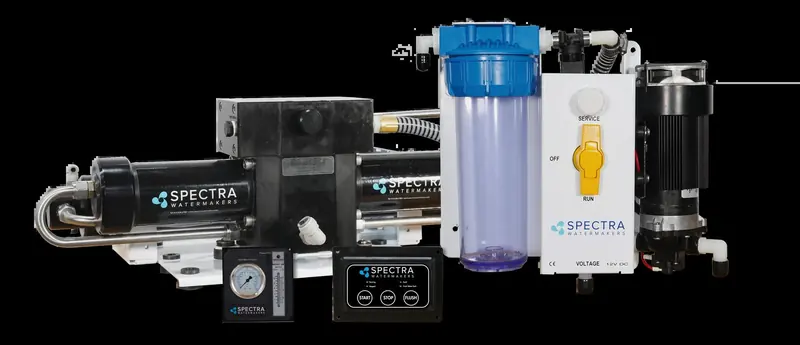
| Category | reverse osmosis watermakers (desalination systems) for boats and yachts |
|---|---|
| Founded | by Bill Edinger, after 25 years running Edinger Marine Service, launching the first energy-recovery systems built specifically for marine desalination in the 1990s |
| Key technology | the Clark Pump, introduced in 1997, an energy-recovery device that reuses pressure from the reverse-osmosis brine stream to cut power draw by up to 75 percent versus a conventional system |
| Ownership | acquired by the Katadyn Group, the Swiss water-treatment and outdoor-equipment company, in 2015; manufacturing remains US-based |
| Range | from the Ventura and Aquifer series (around 6 to 15 gallons per hour) through the Catalina and Cape Horn Extreme (around 14 to 15 GPH) up to the Newport series (up to 30 GPH) and the LB commercial-grade series (up to 420 GPH at 3.5 kW) |
| Ventura 150-D price | about USD 7,900 |
| Catalina 340 price | about USD 14,500 |
| Newport 400c price | about USD 17,000, rated around 15 watts of power per gallon produced |
| Control technology | Spectra Connect touchscreen and wifi-enabled control introduced 2018; a remote manual controller launched 2021 for owners who want simpler one-touch run-and-flush operation |
| Energy recovery claim | Spectra states its systems recover 90 percent or more of available energy through automatic hydraulics that adjust for water temperature and salinity without manual tuning |
The Watermaker Built Around One Clever Pump
A reverse osmosis watermaker forces seawater through a membrane at high pressure, commonly up to 1,000 psi, and most of that pressurised water leaves the system as concentrated brine rather than product water. The Clark Pump captures that departing pressure and uses it to boost the incoming feed water before it reaches the membrane, so the boat's own boost pump and motor do far less of the work. Spectra states this recovers 90 percent or more of the available energy in the system, adjusting automatically for changes in water temperature and salinity rather than needing an owner to retune it by hand, which is the reason a Spectra unit can run usefully off a small DC circuit that would struggle to power a conventional watermaker of the same output. That efficiency claim is also the main reason the brand became a default recommendation among long-distance cruisers specifically, well before it was a common name on larger crewed yachts with generator capacity to spare.
Spectra Watermakers itself was built by Bill Edinger, who ran Edinger Marine Service for 25 years before turning the energy-recovery idea into a dedicated manufacturing business aimed at ocean-going sailors rather than commercial vessels first. The company was bought by the Katadyn Group, the Swiss maker of portable and outdoor water-treatment equipment, in 2015, while keeping its US manufacturing and the Spectra name on every product.
The Range and What Size Fits a Boat
At the small end, the Ventura and Aquifer series produce roughly 6 to 15 gallons per hour and are aimed at smaller cruising boats with limited power budgets. The Catalina 340 and Cape Horn Extreme sit in the middle at 14 to 15 GPH, described by Spectra as suited to midsize yachts, with the Spectra mag-drive pump and Spectra Connect controller for remote, low-noise operation. The Newport series steps up further, with the Newport 400c rated around 15 watts of power per gallon produced, and the Newport 700 and 1000 extending output higher still for larger boats or higher-demand crews.
Above the recreational range, Spectra's LB series is built for commercial and superyacht duty, with the LB 14,000F and LB 10,000F both rated at 420 gallons per hour drawing 3.5 kW, roughly thirty times the output of the smallest Ventura on a similar power-per-gallon basis. That LB range is the part of the catalogue most relevant to a 21 m to 33 m yacht with real daily water demand from guests and crew, though it is priced and specified project by project rather than off a published retail list the way the recreational range is.
Some owners run a Spectra for a decade on nothing more than filter changes; others spend ten thousand dollars chasing the same fault for three years. Both accounts are genuine.
What It Costs to Buy
A Ventura 150-D, the smaller end of the range at around 6 gallons per hour, was priced at about USD 7,900 through a US dealer. The mid-range Catalina 340 was priced around USD 14,500, and the larger Newport 400c, rated at roughly 15 watts per gallon produced, at about USD 17,000. None of these figures include professional installation, the through-hull fittings, plumbing and electrical work a proper fit needs, or ongoing consumables such as replacement pre-filters and membrane elements over the unit's service life.
Spectra does not publish pricing for its LB commercial-grade series, the units with genuine capacity for a crewed yacht's daily water demand; those are quoted through a dealer against the specific boat and duty cycle. An owner comparing Spectra against a rival brand should price total cost of ownership, not just the sticker: pre-filter and membrane replacement, and the possibility of a Clark Pump rebuild at some point in the unit's life, are all real recurring costs that do not show up in the initial hardware price. Running costs on a well-maintained unit are modest rather than negligible: pre-filters are typically changed every six to twelve months, the reverse-osmosis membrane itself commonly lasts three to five years under normal use and sometimes considerably longer if it is flushed properly after every run, and industry guides aimed at US buyers put typical annual maintenance for a cruising-size watermaker at a few hundred dollars in consumables, before counting labour if an owner does not do the work themselves.
The Reliability Question, in Owners' Own Words
On Cruisers Forum, owners report a range of Clark Pump problems including leaks around the cylinder at high pressure, feed pump pressure falling short of the recommended 60 to 90 psi range, and corrosion in the nickel-bronze fittings Spectra used in some units, which one experienced owner blamed for clogging that a stainless equivalent would have avoided; the same owner reported replacing a cracked cylinder after 200 hours and later a piston and related components. A Spectra representative quoted on the same forum said the differential pressure between strokes of a healthy Clark Pump should stay under 3 psi, and that most production shortfalls trace back to a feed-flow problem rather than the pump itself.
The sharpest documented account comes from the cruising blog Lazy Geckos, whose Newport 400 Mk II failed repeatedly over three years despite what the owner, an aircraft mechanic by trade, described as proper maintenance and regular flushing: two separate repairs cost roughly USD 5,000 each, and systematic troubleshooting eventually pointed to the feed pump and the Clark Pump's internal seals, with Spectra unable to supply some of the needed parts. Rather than keep chasing the fault, the crew fitted a Sea Water Pro 40 GPH unit, a simpler AC-powered watermaker producing six times the output, as a backup that cost less than the Spectra parts they had been buying. Set against that, other owners on the same forums describe Spectra units running reliably for many years on nothing more than the recommended flushing and filter changes, which is consistent with a product whose failure modes are well documented precisely because so many are in service, rather than a design that fails more often than its rivals.
Buying, Installing and Keeping It Running
Spectra's automated MPC and Connect systems exist specifically to make the self-flushing cycle a watermaker needs after every run happen reliably without an owner remembering to do it by hand, which several forum threads suggest is the single biggest factor separating a unit that lasts a decade from one that fails early. The 2021 remote manual controller exists for owners who found the fully automated touchscreen more complexity than they wanted, offering one-touch run-and-flush operation instead.
Because parts availability was cited as a real problem in at least one documented multi-year failure, an owner relying on a Spectra as a boat's sole source of fresh water in a remote cruising area should weigh whether a simpler backup system, even a smaller one, is worth carrying, exactly the conclusion the Lazy Geckos crew reached after their own repeated failures. For a yacht in the 21 m to 33 m range with real daily demand, the LB commercial series is the right conversation to have with a dealer rather than trying to scale up several smaller recreational units, since duty cycle and membrane life are engineered differently at that capacity. Cruisers researching the category on forums such as Trawler Forum routinely weigh Spectra against rivals including Sea Recovery, Village Marine and Schenker, and the recurring theme in those comparisons is the same trade-off this entry describes: Spectra's energy efficiency is rarely disputed, while its long-term mechanical reliability draws a wider spread of owner opinion than some competing brands built around simpler, less power-efficient pump designs.
معلومات عملية
| Entry price | The Ventura 150-D, producing around 6 gallons per hour, was priced at about USD 7,900 through a US dealer, hardware only. |
|---|---|
| Mid-range price | The Catalina 340, around 14 GPH and marketed for midsize yachts, was priced at about USD 14,500. The Newport 400c, rated near 15 watts per gallon produced, was priced at about USD 17,000. |
| Commercial-grade capacity is quoted, not published | The LB series, up to 420 gallons per hour at 3.5 kW, the capacity actually relevant to a crewed yacht's daily demand, is priced project by project through a dealer rather than published as a retail figure. |
| The Clark Pump is the reason for the power savings, and the main service item | Spectra states the Clark Pump recovers 90 percent or more of available energy and cuts power draw up to 75 percent versus a conventional system. It is also the component named most often in owner accounts of repeat failures and repair costs, so budget for its eventual service life alongside the pre-filters and membrane. |
| Flushing discipline is the biggest reliability factor owners report | Spectra's automated systems exist to make the mandatory post-use flush happen without the owner remembering by hand. Forum accounts consistently link skipped or inconsistent flushing to premature membrane and pump problems, regardless of model. |
| Real repair costs, from a documented case | One owner's Newport 400 Mk II needed roughly USD 5,000 in repairs on two separate occasions over three years, with parts availability from Spectra cited as part of the difficulty; the owner eventually added a smaller, simpler backup watermaker rather than continue troubleshooting. |
| What is NOT published | Spectra does not publish pricing for its LB commercial series, a standard labour-hour guide for a Clark Pump rebuild, or an independent long-term reliability study comparing failure rates against competing brands such as Sea Recovery or Schenker. |
ما يذكره الملاك والأطقم
Clark Pump problems are specific and named, not vague complaints
Owners on Cruisers Forum report leaks around the cylinder at high pressure, feed pressure falling short of the recommended 60 to 90 psi range, and corrosion in nickel-bronze fittings that one experienced owner blamed for clogging; a Spectra representative on the same forum said differential pressure between Clark Pump strokes should stay under 3 psi and that most production problems trace to feed flow.
Cruisers ForumA three-year, ten-thousand-dollar failure that ended in a backup system
The Lazy Geckos, cruising aboard a boat with a Spectra Newport 400 Mk II, documented roughly USD 5,000 in repairs on two separate occasions over three years despite regular maintenance, could not get all the needed parts from Spectra during troubleshooting, and ultimately installed a simpler Sea Water Pro unit as backup rather than continue chasing the fault.
The Lazy Geckos (cruising blog)The energy-recovery technology works as claimed
Spectra's own technical material states the Clark Pump recovers 90 percent or more of available energy and adjusts automatically for water temperature and salinity, a claim consistent with the brand's long-standing reputation among cruisers specifically for low power draw rather than raw output.
Spectra Watermakers
نقاط القوة وما يستدعي الانتباه
نقاط القوة
- Genuinely class-leading energy efficiencyThe Clark Pump's claimed 75 percent power saving over a conventional reverse osmosis system is a real engineering advantage, not a marketing rounding error, and is the reason Spectra became a default choice for cruisers running watermakers off limited battery and generator capacity.
- A genuinely wide range, recreational to commercialFrom a 6 GPH Ventura at under USD 8,000 to a 420 GPH LB unit for a crewed yacht's full daily demand, Spectra covers a far wider span of boat sizes and water needs than most single-brand watermaker ranges.
- Automation aimed directly at the main cause of failureThe MPC and Connect automated flushing systems target the single factor owners most consistently link to premature failure, inconsistent post-use flushing, rather than leaving it to memory and discipline alone.
- A real corporate parent since 2015Ownership by the Katadyn Group, an established Swiss water-treatment and outdoor-equipment company, gives Spectra more institutional backing than a small independent manufacturer, while US manufacturing has continued under the same name.
- Long-term happy owners exist in real numbersAlongside the well-documented failure accounts, plenty of owners on the same forums report a decade or more of reliable service on nothing more than the recommended filter changes and flushing, suggesting the design is sound when maintained as specified.
ما يستدعي الانتباه
- Documented multi-year, multi-thousand-dollar failure casesAt least one detailed, named account describes roughly USD 10,000 in repairs across two incidents over three years on a Newport 400 Mk II, with the owner eventually giving up and installing a different brand as backup rather than continuing to chase the fault.
- Parts availability has been a real problem, not a hypothetical oneThe same documented failure case specifically cites Spectra being unable to supply needed components during troubleshooting, a serious issue for a system a cruiser may be relying on for fresh water in a remote location.
- Material choices have drawn specific owner criticismNickel-bronze fittings used on some units were blamed by an experienced owner for corrosion and clogging that a stainless equivalent would have avoided, a criticism aimed at a specific design choice rather than the Clark Pump concept itself.
- No published pricing for the capacity a real yacht needsThe LB commercial series, the range actually sized for a crewed 21 m to 33 m yacht's daily water demand, carries no public price list, so a buyer cannot budget without first engaging a dealer.
- Reliability appears to depend heavily on flushing disciplineBecause inconsistent flushing is repeatedly linked to premature failure in owner accounts, a Spectra watermaker on a boat used inconsistently, or crewed by people who do not follow the flush routine reliably, may be a worse bet than a simpler, less efficient system that tolerates neglect better.
لمين هو: Owners who want the best power efficiency available in a watermaker and are prepared to flush and maintain it disciplined, and who budget for the real possibility of a Clark Pump repair rather than assuming set-and-forget reliability.