Bering's New Flagship 130 Trades Range for Volume
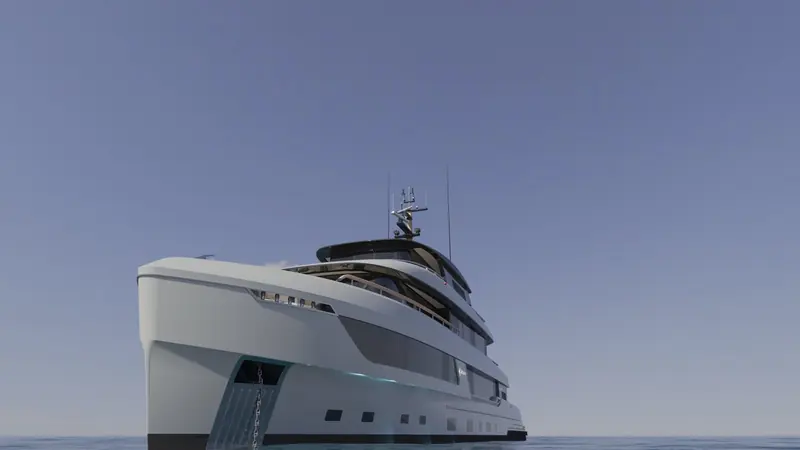
What is the Bering 130 and when was it revealed?
The Bering 130 is Bering Yachts' newest explorer, a 39.76-metre, 399 GT steel-and-aluminium yacht the yard unveiled on 2 September 2026 as its first Vector Yacht, a category Bering created to sit between its pure long-range explorers and a more amenity-driven cruising yacht.
Bering built its name on steel hulls meant to cross oceans, and the 130 is the newest flagship of that programme, revealed just ahead of the Cannes and Monaco boat shows where it goes on display this month. The yard calls the concept a Vector Yacht, its own term for what it describes as a direct-line approach to an untapped niche: the practical range and steel-hull toughness of a Bering explorer, wrapped in a more overtly lifestyle-oriented look, at a size the yard treats as modest for a superyacht rather than as a flagship in its own right. Alexei Mikhailov, Bering's founder and chief executive, put the pitch in one line: the 130 and its stablemates "combine the steel explorer foundations that define Bering with contemporary volume and lifestyle flexibility."
The 130 sits one rung below Bering's actual flagship, the 49.68-metre B165, which already has two hulls under construction on a five-deck layout, and two rungs above the yard's under-24-metre B88 and BC60 explorer models. Bering showed all four, the B88, the BC60, the 130 and the 165, together at Cannes and Monaco this month, giving its full current range a single unified show presence for what the yard describes as the first time. That positioning matters for a buyer: the B165 programme now has real contracts and steel being cut, which is the strongest evidence that Bering can carry a design like the 130 from render to delivery, but the 130 itself has no hull under contract yet. It is, for now, a fully worked design available to order, not a yacht anyone owns.
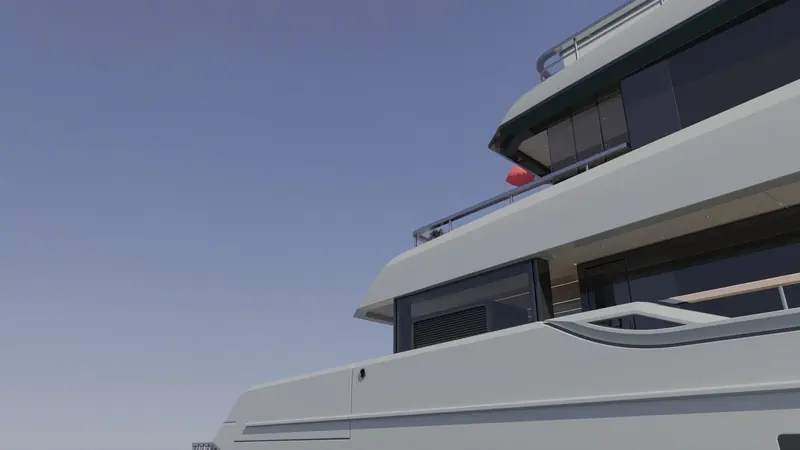
What are the Bering 130's specifications?
The Bering 130 measures 39.76 metres overall on an 8-metre beam and 2.55-metre draft, displaces 420 tonnes fully loaded at 399 GT, and is rated for 4,500-plus nautical miles of range at a 10-knot cruise, roughly 500 nautical miles less than the B165's own 5,000-plus nautical mile figure at the same cruise speed.
The full spec sheet, published by Bering, gives 56,550 litres of fuel and 9,100 litres of fresh water, a 14-knot top speed at half load against 10 knots cruising, accommodation for 10 to 12 guests, and a crew of 7 to 9, carried aboard a 5.6-metre tender. The hull is steel below the waterline with an aluminium superstructure, a full-displacement design built for long, slow passages rather than outright speed, the same construction logic behind every Bering explorer since the yard's smallest models. None of these numbers has been independently verified by a sea trial, because no hull has been built yet; they are the yard's own figures, retrieved from Bering's model page on 3 September 2026.
Set against the B165, which carries a pair of 1,300hp Caterpillar engines, 70,000 litres of fuel and crew space for up to 9 plus 2 additional, the trade on the 130 is explicit rather than accidental: around 500 nautical miles of range and 100 GT of volume given up for a hull nearly 10 metres shorter and, presumably, cheaper to build, crew and run, though Bering has not published a price for either model. For an owner who has never actually used a 5,000-mile range in a decade of ownership, that trade may be the more honest boat; for one who bought into Bering specifically for extreme range, it is a smaller yacht wearing the family's styling rather than its full capability.
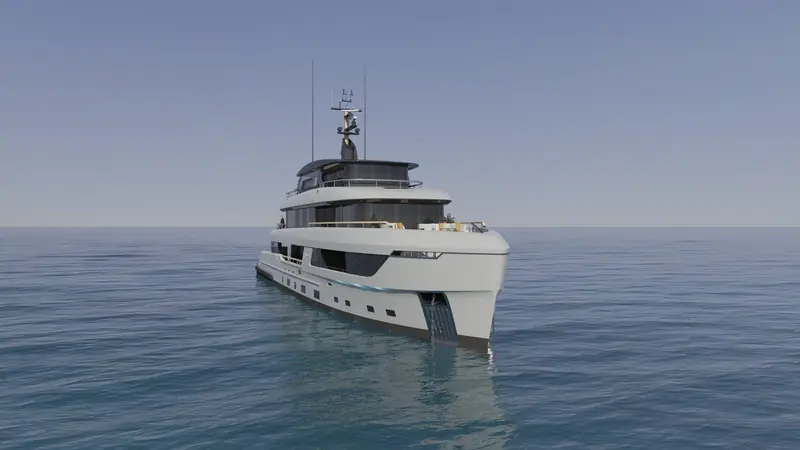
What does the Bering 130 offer that a traditional explorer does not?
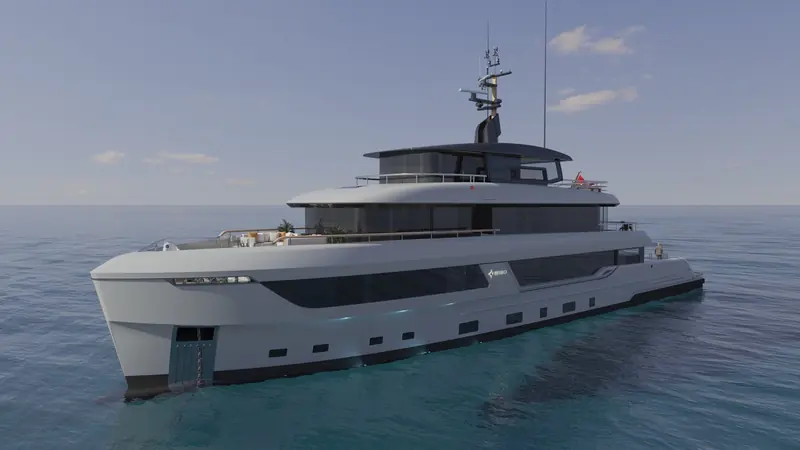
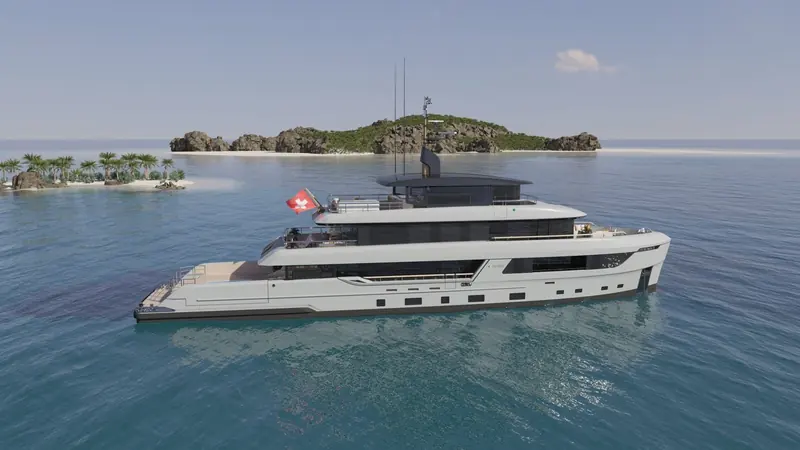
The Bering 130 replaces the conventional side deck on its main level with an asymmetric salon that widens the interior, and stacks an owner's deck with a private balcony, a main-deck VIP suite with its own balcony, and an integrated beach club with a swimming pool and hydraulic fold-down terraces onto a hull that is still, structurally, a steel expedition yacht.
The asymmetric main-deck salon is the clearest design choice in the reveal: dropping the starboard walkway that most explorer yachts keep for crew access and safety in heavy weather, in exchange for more usable interior volume on a 40-metre hull. Bering pairs that with extensive cold and dry stowage, multiple walk-in refrigerators and freezers, and several dedicated provisions areas, features drawn from the yard's expedition heritage rather than from a charter yacht brief, even as the amenity list above deck reads like one.
A beach club and pool at 40 metres is not unusual on a Mediterranean-focused yacht, but it is a genuine departure for Bering, whose earlier explorers were built around fuel tankage, rugged construction and range rather than lounging space. Whether that reads as a smart broadening of the brand or a dilution of what made Bering's explorers distinctive is exactly the question a buyer comparing the 130 against the yard's own smaller, more purely expedition-focused models will have to answer for themselves; Bering has not framed it as a replacement for those models, only as a new line alongside them.
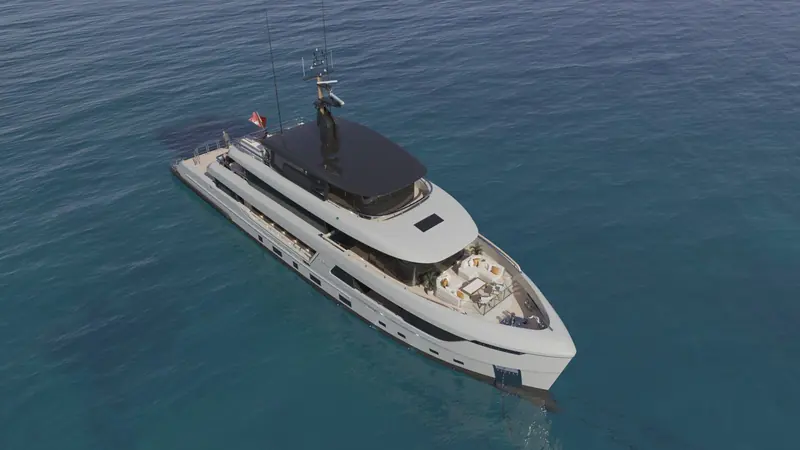
Is the Bering 130 actually being built?
No hull of the Bering 130 is under contract, no price has been published, and no delivery date exists, which makes the 2 September reveal a design unveiling rather than a build announcement; the closest evidence that the programme is real is the B165, where two hulls are already under construction.
Bering is offering full customisation on the 130 from the outset, which is standard for the yard but means an early buyer is effectively commissioning a one-off within a proven hull form rather than choosing from a catalogue of built options. There is no independent sea trial, because nothing has been built; there is no owner report, because nobody owns one; and there is no verdict from a class society or surveyor, because the design has not reached that stage. All of that is normal for a September reveal timed to a boat show season, but it means everything the yard has said so far is a claim, not yet a delivered fact.
The strongest evidence in Bering's favour is the B165 programme running in parallel: a 49.68-metre flagship with two hulls already under construction, steel being cut on a design of similar scale and philosophy to the 130. That track record is the reason to take Bering's timeline at its word rather than treat the 130 as a render with no path to a shipyard. It is not, however, evidence about the 130 itself, and a buyer signing early on a design this new should expect to be the yard's test case for exactly the trade-offs described above, from the untested asymmetric salon to a range figure that, until a hull is built and trialled, remains the yard's own claim rather than a measured result.
What is good, and what to watch
Strong points
- A genuine four-deck layout on a 40-metre hullThe asymmetric main-deck salon drops the conventional side walkway to add usable interior volume, an unusual trade for an explorer-class design.
- A beach club and pool at 40 metresA full-beam owner's deck and main-deck VIP suite each get a private balcony, on top of an integrated beach club and hydraulic fold-down terraces, features more typical of a much larger yacht.
- Backed by a builder already cutting steel on its flagshipTwo hulls of the 49.68-metre B165 are under construction, the strongest evidence Bering's flagship programme is real rather than a rendering exercise.
- Full customisation offered from the first hullAn early buyer commissions a one-off within a proven hull form rather than choosing from fixed built options.
What to watch
- Less range than Bering's own bigger sibling4,500-plus nautical miles against the B165's 5,000-plus at the same 10-knot cruise, roughly 500 nautical miles given up for volume.
- No price publishedA buyer cannot yet compare the 130's cost against a similarly sized rival explorer, steel or otherwise.
- No hull under contractThis is a design reveal, not a build in progress; unlike the B165, no keel has been laid and no delivery date exists.
- Nothing has been independently verifiedNo sea trial and no owner report exists, because nothing has been built, and no class society sign-off has been disclosed.
Practical detail
| Builder | Bering Yachts, founded and led by Alexei Mikhailov. |
|---|---|
| Design | Exterior by Valentin Design (Switzerland); naval architecture by Aberton Yachts. |
| LOA / beam / draft | 39.76m / 8.00m / 2.55m. |
| Gross tonnage / displacement | 399 GT / 420 tonnes full load. |
| Fuel / fresh water | 56,550 litres / 9,100 litres. |
| Speed | 10 knots cruise, 14 knots maximum, both at half load. |
| Range | 4,500-plus nautical miles at cruise speed, per Bering; unverified by sea trial. |
| Guests / crew | 10-12 guests, 7-9 crew. |
| Price | Not published. |
| What is not published | Price, any signed hull contract, a delivery date, and any independent sea trial or owner report, since the design has not yet been built. |
Questions this story answers
What happened?
Bering Yachts has revealed the Bering 130, a 39.76-metre steel-and-aluminium explorer it calls its first Vector Yacht, built to sit below the 50-metre B165 flagship on four decks with a beach club and pool. The new flagship carries roughly 500 fewer nautical miles of range than its own bigger sibling, which makes it the clearest data point yet on how much ocean-crossing range a modern explorer buyer is actually willing to trade for volume and lifestyle.
What is good about it?
A genuine four-deck layout on a 40-metre hull. The asymmetric main-deck salon drops the conventional side walkway to add usable interior volume, an unusual trade for an explorer-class design.
What should an owner or buyer watch?
Less range than Bering's own bigger sibling. 4,500-plus nautical miles against the B165's 5,000-plus at the same 10-knot cruise, roughly 500 nautical miles given up for volume.
Who reported this?
Bering Yachts, Megayacht News, BOAT International, DriveMag Boats.
We do this for everyone who loves this world. The people who have spent their lives in it, and the people just discovering it. Yotters exists so that what we learn belongs to all of them.
Nobody pays us for this. No ads, no sponsors, nothing for sale. We just believe the world is a little better when knowledge is shared instead of kept.
If it gave you something today, tell us to keep going. Follow us, leave a like, or write a positive comment. We read every one, and they are what keeps us going.