Seawolf X
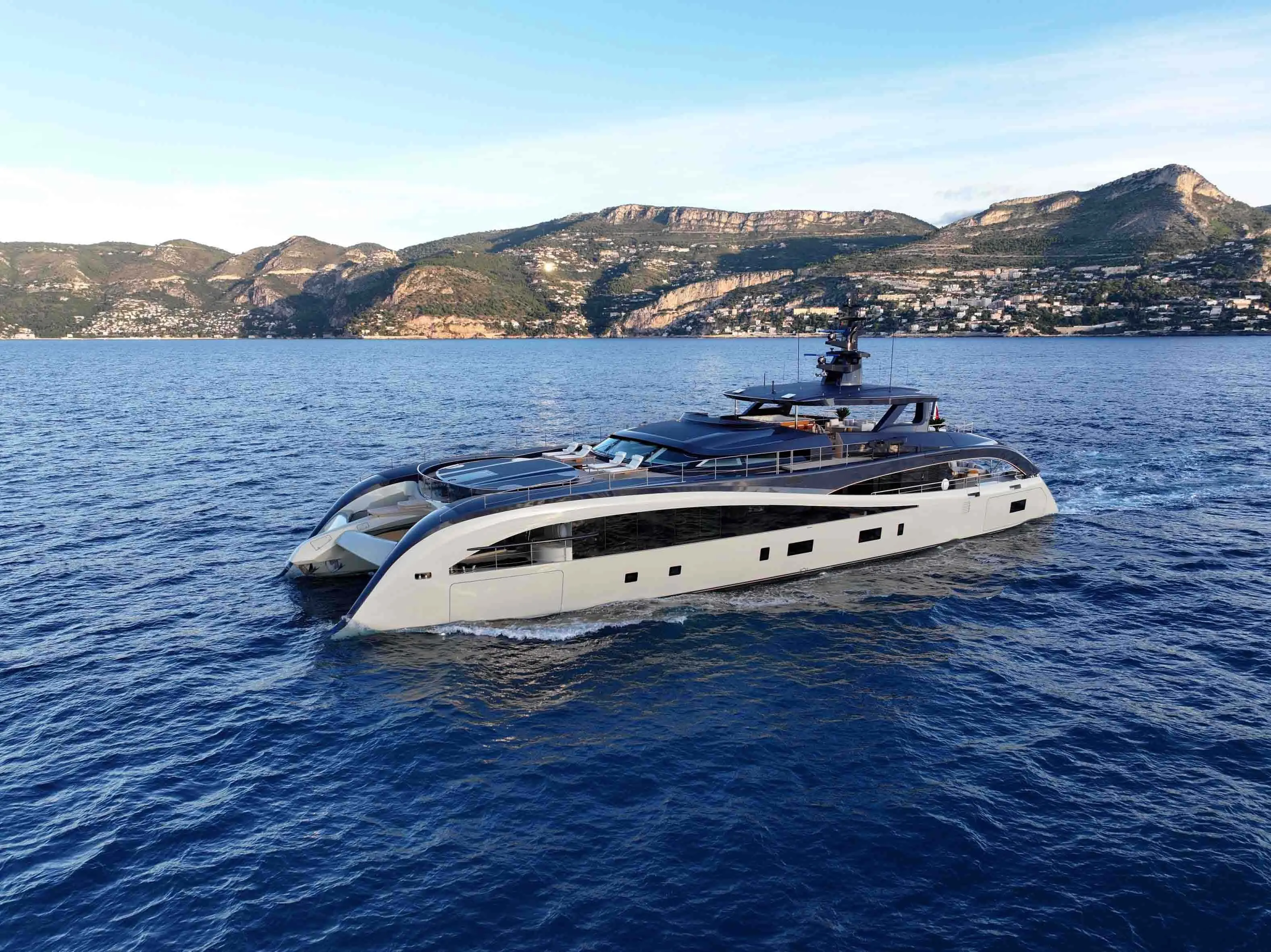
| LOA | 42.8 m |
|---|---|
| Beam | 13.75 m |
| Gross tonnage | Under 500 GT |
| Platform | All-aluminium catamaran, Rossinavi's first multihull (Sea Cat series) |
| Design | Fulvio de Simoni (exterior), Meyer Davis (interior) |
| Propulsion | Hybrid-electric with electric motors, battery banks, diesel generators and around 150 sqm of solar panels |
| Green tech | Rossinavi AI energy management, battery held at 20 to 80 per cent, up to 75 per cent fuel saving claimed |
| Guests and crew | 12 guests in 4 staterooms, 7 crew (delivered 2024) |
A first multihull, and a manifesto
Seawolf X, delivered in 2024, was the first catamaran Rossinavi had ever built and the debut of its Sea Cat series. At around 43 metres, she is not the largest boat the yard has launched, but she may be the most important for its future direction. She was conceived to prove that a large yacht could cut fuel use sharply without asking the owner to give up comfort. Rossinavi had built only monohulls before, so the move to two hulls meant learning a new discipline almost from scratch.
The project brought together an owner set on sustainability and a yard keen to lead on green propulsion. The result reads less like a private commission and more like a working argument for where luxury yachting could go. It has drawn attention across the industry well out of proportion to its size. The yard has been open about wanting the boat to shape how the rest of the sector thinks about power.
A sports car stance on two hulls
Fulvio de Simoni handled the exterior, giving the all-aluminium catamaran a low, sharp look that several reviewers compared to a sports car on the water. The wide 13.75 metre beam of the twin-hull platform creates enormous deck and interior space for the length. Despite the eco brief, the styling avoids the boxy look many green catamarans carry. The extra width also does much of the efficiency work, since slim twin hulls need less push than a broad monohull.
The interior was the first superyacht project for the New York studio Meyer Davis. They took inspiration from a Miami beach hotel, aiming for a calm, casual feel built around natural materials. Their own phrase for the approach was the luxury of sustainability, and the relaxed result matches the boat's purpose. Bringing in a hospitality studio rather than a yacht specialist gave the interior a fresh, unforced feel.
Solar panels, battery banks and an onboard AI that keeps the yacht electric on day trips.
Space that a monohull cannot match
The catamaran layout gives Seawolf X far more usable area than a monohull of the same length. She carries twelve guests in four staterooms with a crew of seven, and the wide beam lets the designers spread out living spaces that would feel tight on a single hull. Large glazing and open decks keep the interior bright and connected to the sea. That volume is one of the quiet arguments for the whole catamaran experiment, well beyond the fuel figures.
Meyer Davis kept the mood informal, favouring soft textures and a muted palette over gloss. The aim was a boat that feels like a quiet coastal retreat rather than a formal superyacht. That fits the way the owner intended to use her, with long, low-impact stays at anchor. The result sits closer to a modern beach house than a traditional showpiece yacht.
Solar, batteries and a thinking power system
Seawolf X runs a hybrid-electric package that combines electric motors on shaft lines, large battery banks, around 150 square metres of solar panels and diesel generators for backup. On day trips she can run entirely on electric power, and on a transatlantic crossing she can still stay electric for up to 80 per cent of the time. Rossinavi claims fuel savings of up to 75 per cent against a comparable monohull. Those numbers are the core of the boat's case, and they explain why so much attention has followed her.
The clever part is Rossinavi AI, an energy management system that watches consumption across the whole boat and trims demand automatically. It keeps the battery pack within a 20 to 80 per cent window to protect its life and can even learn the guests' routines. In a hibernation mode at anchor, the yacht can feed stored power back to a shore property, an unusual trick for a boat this size. An owner effectively gets a floating power plant that can keep the boat silent for long spells.
Pointing the way for the yard
Seawolf X has already joined the charter fleet and been listed for sale, giving buyers a rare chance at a proven large hybrid catamaran. Boats that combine genuine green credentials with real luxury are still thin on the ground, which gives her a clear position. For a certain owner, the low running costs and the quiet are the whole appeal. Chartering her also lets prospective owners test the concept before committing to a build of their own.
For Rossinavi, the Sea Cat series is a bet on where the market is heading, and Seawolf X is the proof of concept. The yard has followed her with further catamaran concepts, and the technology is filtering into its monohulls. Whatever her eventual owner does with her, she has already earned her place as the boat that set the yard's green course. If the industry does swing towards hybrid multihulls, she will be remembered as an early marker.
Questions owners ask
How big is the Rossinavi Seawolf X?
LOA: 42.8 m. Beam: 13.75 m.
What does the Rossinavi Seawolf X cost?
Reported brokerage asking price ~EUR 36.9M (per BOAT International / TWW Yachts listings). 42.8m hybrid-electric catamaran, Rossinavi's first multihull, delivered 2024.
Who is the Rossinavi Seawolf X for?
A sustainability-minded owner who wants low running costs, quiet anchorages and genuine green technology without giving up a luxury interior.
Design
| Exterior | Fulvio De Simoni Yacht Design |
|---|---|
| Interior | Meyer Davis |
| Naval architecture | Rossi Engineering Design & Services (Rossinavi) |
Who it is for: A sustainability-minded owner who wants low running costs, quiet anchorages and genuine green technology without giving up a luxury interior.
Guide price: Reported brokerage asking price ~EUR 36.9M (per BOAT International / TWW Yachts listings). 42.8m hybrid-electric catamaran, Rossinavi's first multihull, delivered 2024.