Marina di Portofino
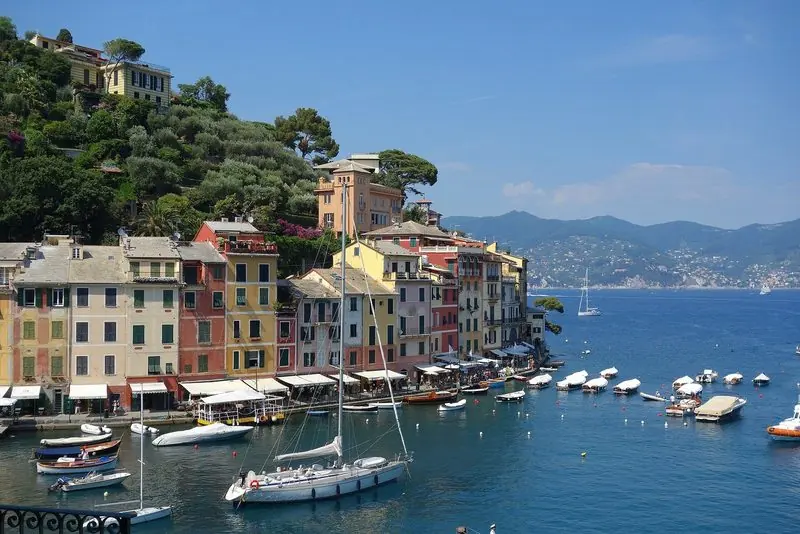
| Lage | Portofino, ligurische Küste, Italien |
|---|---|
| Betreiber | Portofino Yacht Marina, seit 2021 von der Gemeinde geführt |
| Zentraler Kai | einige wenige Superyachten bis rund 64m längsseits |
| Angrenzende Bucht | ein oder zwei Muringplätze für Yachten bis etwa 80m |
| Größere Yachten | ankern in der Bucht und kommen mit dem Tender an Land |
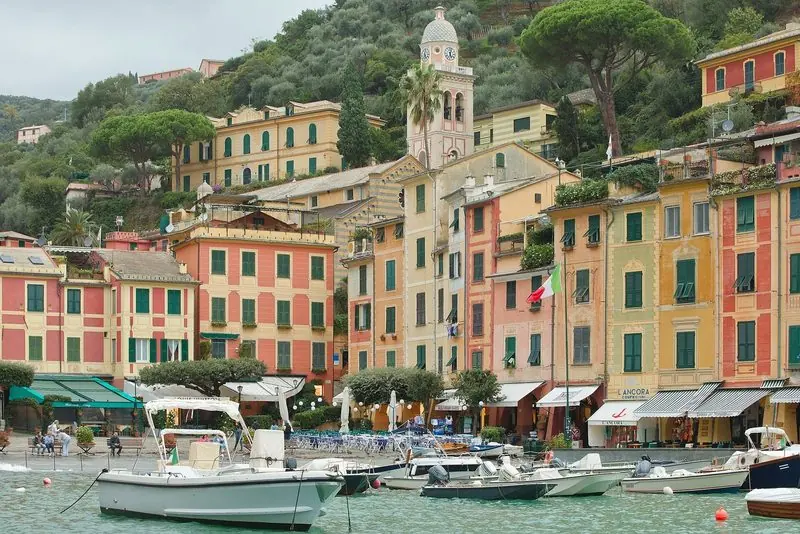
| Umgebung | ein winziges Naturhafenbecken, gerahmt vom Dorf |
| Hochsaison | Juli und August |
| Services charge | compulsory daily services charge on top, at EUR 675 for a sailing yacht over 60 m and EUR 900 for a motor yacht |
| Carbon neutrality contribution | charged daily by length, EUR 3.51 under 12 m up to EUR 121.53 over 64 m, plus VAT |
| ISPS | EUR 650 plus VAT for commercial yachts over 500 GT, valid for periods of three days |
| Timing | berth day runs 14:00 to 12:00, exit strictly by midday, lunch stops requested by 11:00 and charged at 50 per cent of the rate |
| Marine protected area | anchoring prohibited from the Cenobio dei Dogi to the Tonnarella of Camogli and within 100 m of the Chiesa di Portofino dive site, with a booked buoy system at San Fruttuoso and Punta Chiappa from 25 April 2026 |
| Berths | 16 in total. The harbour is entirely quayed apart from the two Cannone Bay moorings |
| Lateral quay | 8 moorings, 6 on buoys and 2 on chains, for boats to 18 m LOA, with no anchor required |
| Central Quay | 6 moorings for units to 64 m LOA, five taken with an anchor down and one on a mooring block |
| Cannone Bay | 2 moorings for yachts to 80 m LOA, laid with stern buoys and an anchor |
| Depths | 1.4 m to 4 m alongside the quay, 1 m to 1.7 m at the buoys, 0.5 m to 16 m across the harbour. Bottom is mud with good holding |
| Hazards | two shoals with rocks awash, one at the surface off the Local Maritime Office building and one at 0.5 m to starboard of the fuel berth |
| Winds as named by the operator | prevailing libeccio and scirocco, traversia from the grecale, shelter from the maestrale |
| Approach | wait at the harbour mouth, call the port service on VHF 12, keep below 3 knots and give way to outbound vessels |
| Lights | white flashing 5 s, 15 M range on Punta di Portofino. Green flashing 3 s, 7 M on the inner corner of the Maritime Authority building. Red flashing 3 s, 7 M on Punta del Coppo |
| Lifting gear | a slewing crane on the quay. No capacity is published for it and there is no yard |
| Shore power | voltage, amperage and frequency are published nowhere. Italy runs at 230 and 400 V, 50 Hz and no 60 Hz supply is advertised |
| A mobile pontoon inside the harbour near the Isolotto receives cruise ship tenders | |
| Position | 44 18.18 N, 009 12.83 E |
Der berühmteste kleine Hafen der Küste
Portofino liegt in einem geschützten Einschnitt an der ligurischen Küste östlich von Genua, ein Dorf pastellfarbener Häuser, das sich um ein winziges Naturhafenbecken legt. Die Bucht zieht seit mehr als einem Jahrhundert Künstler und Reisende an, und ihr Bild gehört zu den bekanntesten Italiens. Der Hafen ist klein, eingefasst von den Hügeln und dem Dorf, mit wenig Raum zur Erweiterung. Diese Begrenzung ist die ganze Geschichte des Ortes.
Die Marina wird von der Gemeinde unter dem Namen Portofino Yacht Marina betrieben, nachdem sie 2021 in die direkte Verwaltung übergegangen ist. Es gibt hier kein weitläufiges Stegsystem, nur eine kurze Kaistrecke und einige wenige Muringplätze. Dieser Maßstab hält den Hafen intim und den Wettbewerb um den Platz erbittert. Portofino lebt von Seltenheit und nicht von Kapazität. Das Dorf hält die meisten Autos aus seinem Zentrum heraus, sodass Hafen und Piazzetta einen einzigen Fußgängerraum am Wasser bilden.
Eine Handvoll Liegeplätze und der Ankerplatz
Der Hafen bietet nur eine kleine Zahl an Liegeplätzen, wobei der zentrale Kai einige wenige Superyachten bis rund 64 Meter längsseits aufnehmen kann. Ein oder zwei separate Muringplätze in der angrenzenden Bucht können Yachten bis etwa 80 Meter halten. Kleinere Boote füllen die übrigen Muringplätze näher am Dorf. Die Zahlen sind winzig nach den Maßstäben der Marinas weiter entlang der Küste. Ein Platz am zentralen Kai wird über das Hafenbüro vergeben und wird im Hochsommer kurzfristig kaum frei.
Weil der Hafen selbst so begrenzt ist, ankern viele größere Yachten in der Bucht davor und kommen mit dem Tender an Land. Das Wasser fällt außerhalb des Dorfes steil ab und bietet Yachten, die vor Anker liegen, guten Halt. Ein Liegeplatz am Kai bringt einen Eigner mitten ins Herz von Portofino, weshalb die wenigen Positionen so begehrt sind. Der Platz wird hier in einzelnen Yachten gemessen und nicht in Hunderten.
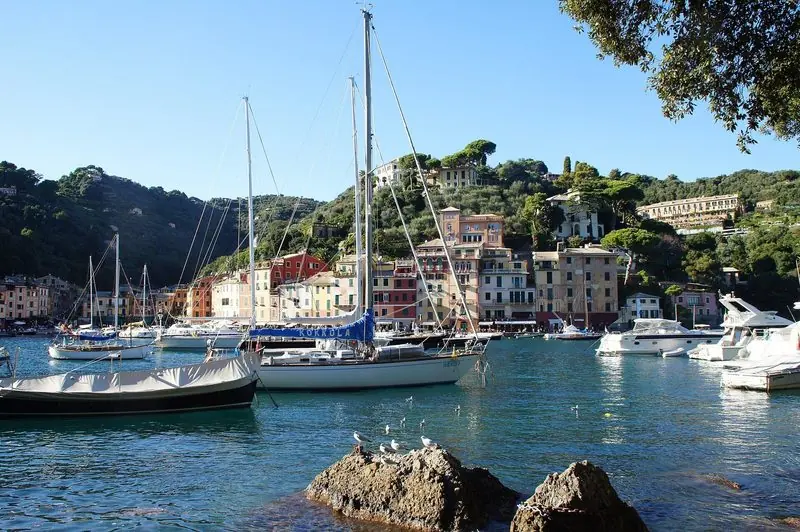
Platz für nur eine Handvoll Yachten, und genau darum geht es.
Dienstleistungen in einem Dorf
Portofino ist zuerst ein Dorf und erst danach eine Marina, weshalb seine Leistungen im Vergleich zu den großen Superyachthäfen bescheiden sind. Treibstoff und Wasser lassen sich organisieren, doch ein Eigner, der größere Arbeiten plant, würde sich an Genua oder die Werften entlang der ligurischen Küste wenden. Das Hafenbüro koordiniert die Ankünfte und die begrenzte Liegeplatzvergabe. Die Proviantierung kommt aus dem Dorf und den Orten in der Nähe. Tender fahren ständig zwischen den ankernden Yachten und der Kaitreppe, und das ist hier der normale Weg an Land.
Was der Ort stattdessen bietet, sind Kulisse und Exklusivität. Die Restaurants und Cafes der Piazzetta liegen wenige Schritte vom Kai entfernt, und die Geschäfte des Dorfes führen die Namen, die ein Eigner erwartet. Der Reiz liegt darin, in Portofino zu sein, und nicht im technischen Angebot. Für ernsthaften Service verlassen sich Yachten, die hier liegen, auf die weitere ligurische Küste.
Der ligurische Sommer
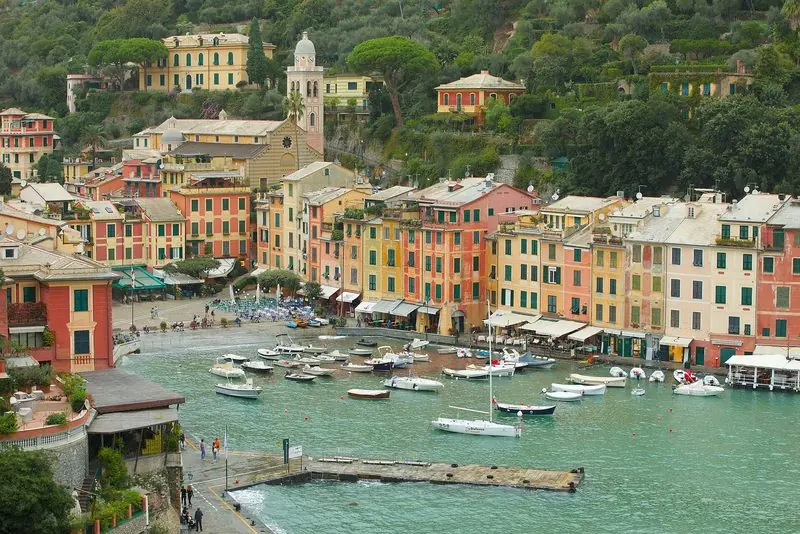
Portofino läuft den Sommer über auf voller Tonlage, wenn sich das Dorf und sein Hafen mit Tagesgästen und Yachten füllen. Juli und August sind der Höhepunkt, und die kleine Bucht kann sich auf dem Gipfel der Saison eng anfühlen. Die umgebende Küste, von Santa Margherita bis zu den Cinque Terre, erhöht den Reiz. Die Lage ist so gefeiert wie kaum eine im Mittelmeer. Tagesboote und Fähren drängen sich mittags auf dem Wasser und werden dünner, sobald die Besucher am Abend abziehen.
Die weitere ligurische und tyrrhenische Küste öffnet sich von Portofino aus für alle, die die italienische Riviera befahren. Genua liegt eine kurze Fahrt westlich, und der Schlag nach Süden Richtung Toskana und ihre Inseln ist bequem erreichbar. Die Szene ist glamourös, wurzelt aber in einem alten Dorf und nicht in einem gebauten Resort. Diese Echtheit macht einen großen Teil des Reizes aus.
Wo es in die Pläne eines Eigners passt
Portofino ist ein Ziel, das man besucht, und kein praktischer Heimathafen. Es passt zu einem Eigner, der die italienische Riviera befährt und Zeit in einem der schönsten Häfen dieser Küste verbringen will. Die meisten Yachten laufen hier als Teil einer weiteren Sommerfahrt an, statt sich für die Saison hier zu stationieren. Der Mangel an Kapazität macht den Ort zu einem Halt und nicht zu einer Basis. Eine Übernachtung am Kai oder vor Anker ist oft der Grund, weshalb sich ein Sommerprogramm zu diesem Küstenabschnitt hin biegt.
Für jene, die sich einen der wenigen Kailiegeplätze sichern, gibt es nichts Vergleichbares dazu, mitten in Portofino zu liegen. Die Knappheit, die den Hafen begrenzt, ist zugleich das, was ihn besonders macht. Eigner verbinden einen Besuch in Portofino meist mit einer Basis in einem größeren Hafen in der Nähe und nutzen das Dorf allein für seine Kulisse. Es ist ein Ort, der für das geschätzt wird, was er ist, und nicht für das, was er leisten kann.
The fees on top of the fee
The headline rate is not the invoice. A compulsory daily services charge applies on top, and it differs by hull type, with a yacht over 60 metres paying EUR 675 a day if she is a sailing yacht and EUR 900 if she is a motor yacht, before VAT. In the roadstead there is a garbage service charged at a single rate of EUR 120 a day, while the Cannone Bay garbage rate is zero.
Portofino has also introduced a carbon neutrality contribution, charged daily and scaled by length, running from EUR 3.51 for a boat under 12 metres up to EUR 121.53 for anything over 64 metres, with VAT added. Commercial yachts over 500 GT at anchor or moored in Cannone Bay or on the Central Quay pay an ISPS fee of EUR 650 plus VAT for periods of three days. There is a further overnight departure charge in peak season for movements between 23:00 and 08:30.
Services, and the absence of them
Portofino is a village first, and the published service list is correspondingly short: fuel, a diver, showers and WCs, refuse, a power supply, ISPS handling, laundry, marine supplies and provisioning delivered to the boat. There is one piece of lifting gear, a slewing crane on the quay, and no capacity is published for it, which in a harbour whose deepest quay water is 4 m should be read as tender and gear handling rather than anything structural. There is no yard and no technical depth. Anything beyond a minor fix means a run down the coast to Genoa or to the Ligurian yards. On shore power the operator lists a supply and no numbers at all, with neither voltage, amperage nor frequency published. Italy runs at 230 and 400 V, 50 Hz and no 60 Hz supply is advertised anywhere, so a 60 Hz yacht converts on board.
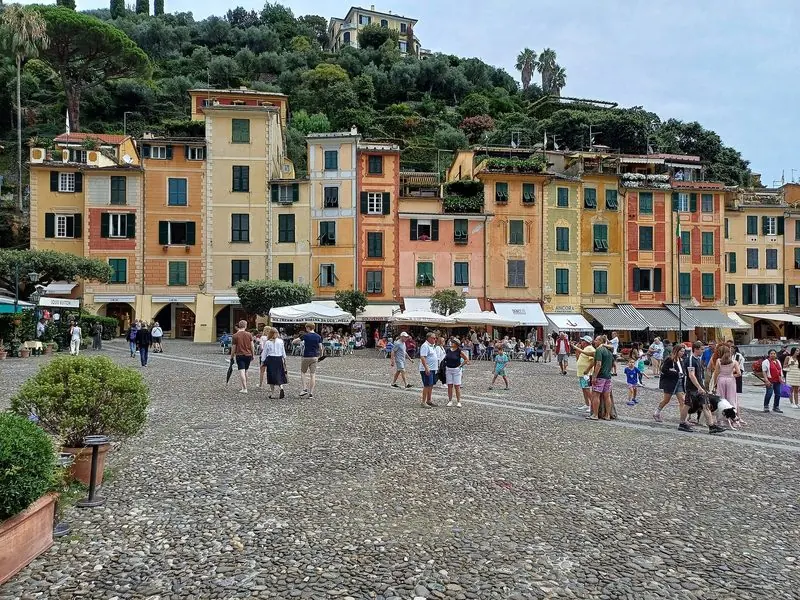
Privacy is nil and every owner who comes here knows it. The quay is a public promenade, the piazzetta terraces look straight down onto the boats from a few metres, and the harbour is the single most photographed scene on the Italian Riviera. Day boats and ferries fill the water through the middle of the day and thin out in the evening. A yacht here is on display for as long as she is alongside.
Ashore, and getting to it
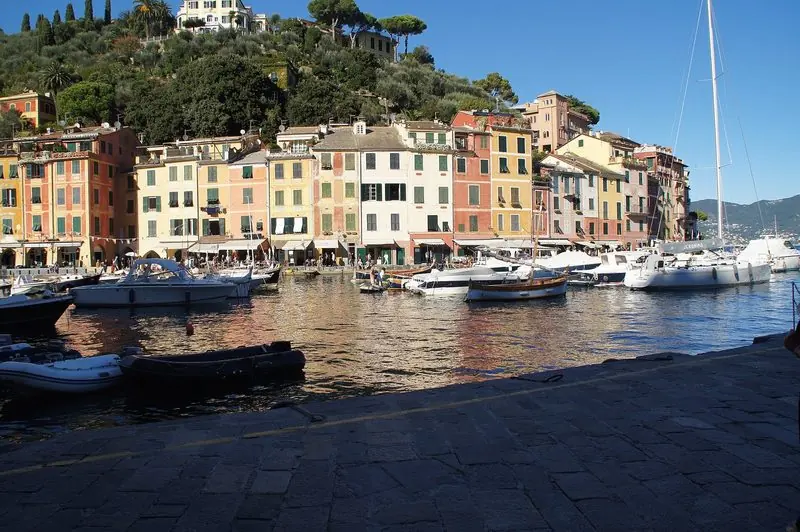
The village keeps cars out of its centre, so the harbour and the piazzetta form one pedestrian space at the water's edge, with a short run of restaurants, hotels and boutiques and the walk up to the Castello Brown and the church of San Giorgio. Genoa's Cristoforo Colombo airport is the closest, roughly an hour by road, with Milan's airports two to three hours away.
For a family week the surroundings do more than the village. Santa Margherita and Rapallo sit around the headland with proper beaches and shops, San Fruttuoso abbey is reachable only by boat or on foot, and the Cinque Terre are a short cruise south-east. The promontory itself has good walking. The village alone will not hold a family for a week, and few people try.
The honest downside
There is almost no supply. The Central Quay is a handful of positions in a harbour the size of a large swimming pool, and in July and August availability is close to nil at short notice. The pricing has moved sharply, the compulsory extras are material against the headline rate, and a yacht that leaves overnight in peak season pays for the privilege. An owner planning around Portofino should treat a confirmed quay booking as the exception.
The other constraint is that this is a stop and not a base. There is no technical support, no crew infrastructure, no airport within easy reach and no capacity to hold a yacht for a season. Portofino also carries a level of day-tripper traffic that surprises people who have only seen photographs of it at eight in the morning. Owners who want the harbour usually base at a larger port nearby and bring the yacht in for a night.
The depth at the quay, and the winds the operator names
The depths are published and they are the constraint that the headline lengths hide. Alongside the quay the bottom carries 1.4 m to 4 m. At the buoys it is 1 m to 1.7 m. Across the harbour as a whole it runs from 0.5 m to 16 m. The holding is mud and good. So a 64 m yacht on the Central Quay lies stern-to with her stern in no more than 4 m of water, and the arithmetic on her stern draught wants doing at the booking and not on the approach. Two shoals with rocks awash appear in the operator's own hazard note, one at the surface in front of the Local Maritime Office building and one at 0.5 m immediately to starboard of the fuel berth.
The operator also names its winds, which most marinas do not. The prevailing winds are the libeccio from the south-west and the scirocco from the south-east. The traversia, the quarter that sends sea straight into the harbour, is the grecale from the north-east, and that is the direction that ends a stay here. Shelter is from the maestrale in the north-west. The approach procedure is to wait at the harbour mouth and call the port service on VHF 12, hold below 3 knots and give way to vessels coming out. Three lights mark it: a white flashing light of 5 second period and 15 mile range on the point of Portofino, a green flashing 3 second light of 7 mile range on the inner corner of the Maritime Authority building, and a red flashing 3 second light of 7 mile range on Punta del Coppo.
An Land, Anfahrt und Buchung
| Getting there | Genoa's Cristoforo Colombo airport is the closest, roughly an hour by road around the coast. Milan's two airports run two to three hours away. There is no heliport at Portofino itself; a helicopter transfer lands at Genoa or is arranged privately further along the coast. |
|---|---|
| Arriving by sea | Call the port service on VHF channel 12 and wait at the harbour mouth. Keep below 3 knots inside and give way to vessels coming out. Three lights mark the approach: white flashing 5 seconds and 15 miles on Punta di Portofino, green flashing 3 seconds and 7 miles on the inner corner of the Maritime Authority building, red flashing 3 seconds and 7 miles on Punta del Coppo. |
| Reserving a berth | Berthing is arranged through Portofino Yacht Marina, Via Roma 35 and Piazza Liberta 13B, by phone or its booking system. There is no walk-up availability against the 6 to 8 large-yacht positions in peak season. Boat International groups Portofino with Capri and Bonifacio as a Mediterranean hotspot where a berthing agency's local relationships matter more than calling direct. |
| What a berth costs | Central Quay, 2026 card, before VAT: a yacht over 60 m pays EUR 2,100 a day low season, EUR 4,200 high season, EUR 4,700 peak. A compulsory daily services charge adds EUR 675 to EUR 900, a carbon neutrality contribution scales with length, and a garbage charge and ISPS fee apply where relevant. Cannone Bay runs EUR 1,500 to EUR 3,500 a day across the same bands. |
| The clock | The rate day runs 14:00 to 12:00 and the exit is strictly fixed at midday. A lunch-only stop between 12:00 and 15:00 can be requested by 11:00 that morning, is never guaranteed, and is billed at 50 per cent of the reference rate. In August the answer is frequently no. |
| Eating within walking distance | Ristorante Puny sits on the quay itself, run by the Miroli family for generations on Ligurian seafood and pesto. Carlo Cracco's restaurant occupies the site of the old Pitosforo, a former harbour landmark. The Hotel Splendido's cliff-top terrace looks straight down over the bay from above the village. |
| After dark | Covo di Nord Est at Paraggi beach, a short run around the headland toward Santa Margherita, is the Riviera's best-known nightclub and where the yacht crowd goes after the harbour quiets down. |
Was Eigner und Crew berichten
A booking agency, not a phone call, is how experienced captains get in
Portofino is grouped with Capri and Bonifacio as a Mediterranean hotspot where berths are scarce enough that an agency's local relationships matter; a captain calling the marina direct is competing with everyone else dialling the same number for eight positions.
Boat InternationalThe midday exit is treated as absolute, not a guideline
The operator's own rate day runs 14:00 to 12:00, the exit is described as strictly fixed at midday, and a lunch-only extension has to be requested by 11:00 that morning with no guarantee, billed at half the daily rate when granted.
Portofino Yacht Marina
Was gut ist und worauf zu achten ist
Stärken
- One of the only marinas anywhere with an exact published tariffThe 2026 Central Quay card prices every length band by season, so an owner can cost a stop to the euro before ever calling, which almost no Mediterranean harbour of this reputation does.
- The dining matches the settingRistorante Puny on the quay, Carlo Cracco's restaurant on the old Pitosforo site and the Splendido's terrace above the bay put three serious kitchens within a two-minute walk of the boat.
- Cannone Bay takes the largest yachts the Central Quay cannotTwo stern-buoy positions are rated to 80 m LOA, six metres longer than the Central Quay's own 64 m ceiling, so the biggest boats still have a place to lie.
Worauf zu achten ist
- Six large-yacht positions for the whole Mediterranean fleetPeak-season availability at short notice is close to nil, and Boat International names Portofino alongside Capri and Bonifacio as exactly this kind of scarce-berth hotspot.
- The headline rate is not the invoiceA compulsory services charge, a carbon neutrality contribution and an ISPS fee where it applies all stack on top, and an overnight departure in peak season carries its own surcharge.
- No technical depth and no published shore power specOne slewing crane on the quay with no stated capacity, no yard, and voltage, amperage and frequency published nowhere on the operator's own site.
- Zero privacyThe piazzetta terraces look straight down onto the boats from a few metres away, and day-tripper and cruise-tender traffic fills the water through the middle of the day.
Für wen: Eigner, die die italienische Riviera befahren und in einem der gefeiertsten kleinen Häfen überhaupt liegen wollen.