Shelter Bay Marina (Panama)
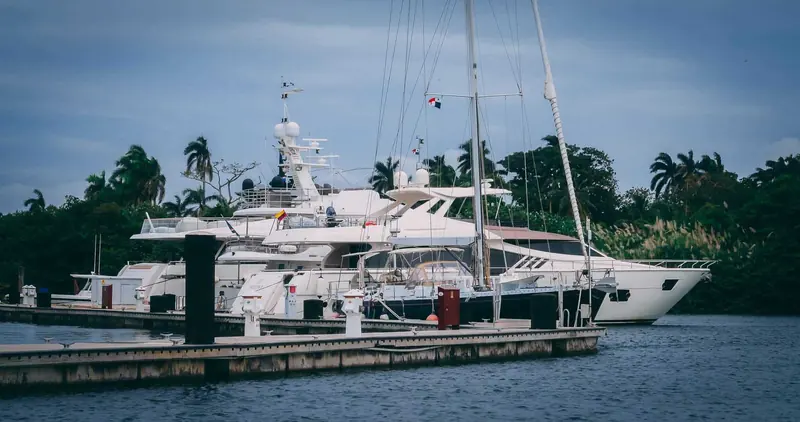
| Location | former Fort Sherman, inside the San Lorenzo Protected Area, Colon Province, Panama, at 9.37165 N, 79.94972 W, on the Caribbean side of the Panama Canal entrance |
|---|---|
| Opened | 2005 |
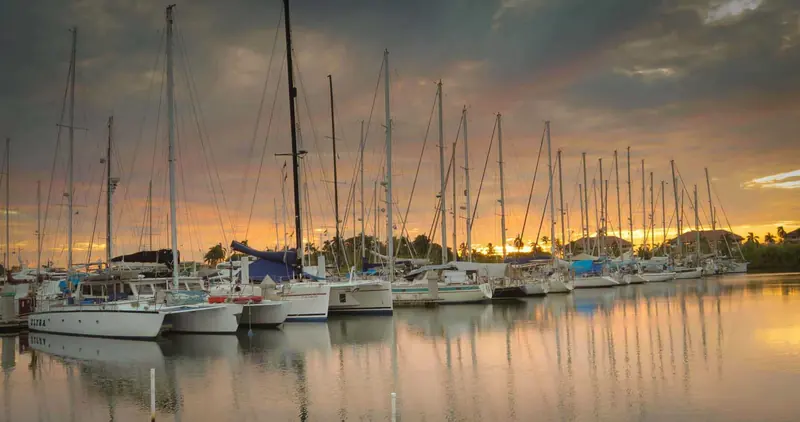
| Capacity | roughly 200 berths across docks A to J, over 6,000 ft of dock space, for vessels up to 320 ft (98 m) LOA and 20 ft (6.1 m) draught |
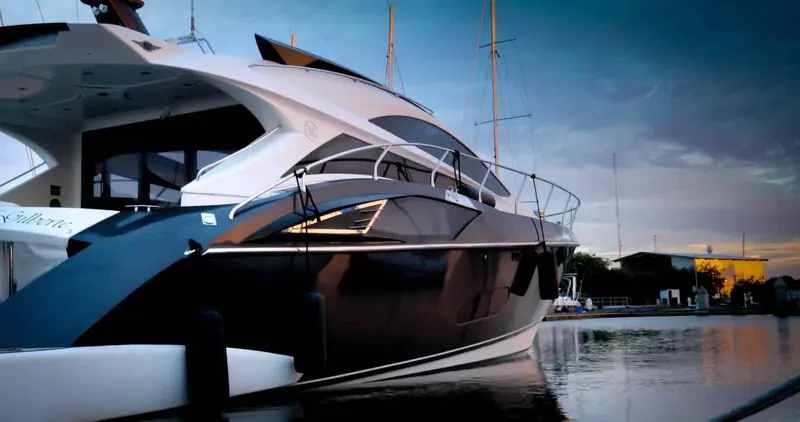
| Power | 120V/240V at 50A standard on every slip; 240V at 100A on Docks A, B and C; 480V three-phase at 150A on Docks A and B; 208V three-phase on Dock B |
| Wet slip rates effective 1 July 2025, per ft per month: under 38 ft USD 10.82 non-resident / 9.73 resident, rising in bands to USD 14.12 / 12.71 at 60 ft and above; overwide slips carry a premium up to USD 21.20 | |
| Guest/transient moorage | USD 1 per ft per night |
| Boatyard | a 100-ton Travelift, 29 ft wide, for vessels up to 28 ft beam, using up to six sets of 75,000 lb lifting straps; a 55-ton Hostar hydraulic trailer; two forklifts; a 30-ton Grove crane for un-stepping masts on sailboats under 80 ft |
| Dry storage, per ft per day | secure storage over six months runs USD 0.35 (monohull) or 0.50 (catamaran); work-yard storage where the owner does the work runs USD 0.75 (monohull) or 1.10 (catamaran); a 7 percent Panama tax applies on top, per the marina's own boatyard rate sheet |
| Canal transit | using a licensed agent needs no cash deposit; the agent pays the toll and fees, schedules the inspection and transit, and supplies lines, extra fenders and line-handlers |
| On site | the marina office houses the Port Captain and Immigration/Customs, so check-in and check-out do not require a trip into Colon |
| Transport | a free marina bus runs to Cuatro Altos in Colon most weekday mornings; a taxi to Panama City runs about USD 90 and up, to Tocumen International Airport about USD 120; the Panama Railroad runs one round trip a day between Colon and Panama City for about USD 25 a person |
| History | built 1911 to 1912 during canal construction, Fort Sherman became the US Army's Jungle Operations Training Center in 1951, training around 9,000 US and Latin American troops a year until the base was returned to Panama in 1999 under the Torrijos-Carter treaties |
| The wider San Lorenzo Protected Area covers 12,000 hectares and also contains Fort San Lorenzo, the 16th to 18th century Spanish fortress that is part of the Fortifications on the Caribbean Side of Panama UNESCO World Heritage Site inscribed in 1980; the marina itself is not part of that listing | |
A Marina Built Around One Job
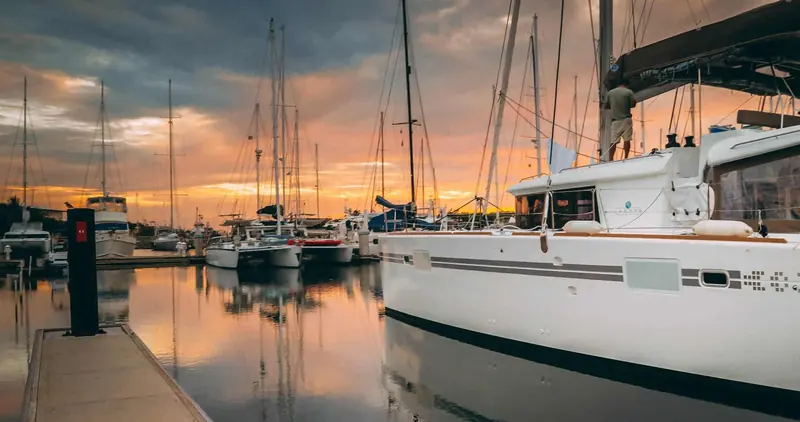
Most marinas sell a location. Shelter Bay sells a job done well: getting a yacht through the Panama Canal without the owner having to solve customs, fenders, line-handlers and a berth to wait in as four separate problems. It sits on the grounds of the old Fort Sherman, on the west side of the Canal's Caribbean entrance, opposite Colon across the bay, and every piece of it points at the canal. The marina office holds the Port Captain and Immigration and Customs, so a yacht can clear in and out without a special trip into the city. A licensed transit agent, arranged through or alongside the marina, pays the toll, schedules the mandatory admeasurement and transit inspection, and supplies the lines, fenders and line-handlers a Panama Canal transit legally requires, and using one removes the cash deposit a self-organised transit still needs.
That single-purpose design shows in the calendar as much as the paperwork. Two long-distance cruising rallies, the Ocean Cruising Club's Atlantic circuit and the Pacific Puddle Jump's eastbound leg, both use Shelter Bay as a staging point before their fleets transit west, according to the cruising blog Out Chasing Stars, which the authors say fills the marina with cruisers all working through the same checklist at the same time and produces an unusually sociable dock. A canal transit is not a quick errand; agents recommend starting the paperwork weeks ahead, and a yacht can easily be on the dock for a week or two either side of its slot, waiting on weather, a convoy partner or a scheduling window from the Panama Canal Authority.
The Yard Behind the Docks
Behind the docks is a working boatyard, not a token one. The 100-ton Travelift is 29 ft wide and rated to a 28 ft maximum vessel beam, using up to six sets of 75,000 lb lifting straps, which is enough for a genuinely large monohull or a beamy catamaran, and a separate 55-ton Hostar hydraulic trailer moves boats once they are ashore. A 30-ton Grove crane un-steps masts on sailboats under 80 ft, useful for a yacht laying up for the season or fixing rigging before a transit. Stands are set every 8 ft of boat length to ABYS standards, and the yard says it will move them at no extra charge for a bottom-paint job, a detail that matters more than it sounds once a boat is actually up on stands.
None of this is free, and the yard prices it in detail rather than folding it into a single day rate. Dry storage runs from USD 0.35 a ft a day for a monohull staying over six months up to USD 1.10 a ft a day for a catamaran in the work yard doing its own labour, with a 7 percent Panama tax on top of every figure on the marina's own boatyard rate sheet. A pressure wash with a 5,000 psi machine is a flat USD 50 or 75 depending on length, moving a boat from the work area to storage is USD 100, and a contractor working aboard is billed at USD 15 a day per person. An owner planning a haul-out gets a real, itemised quote rather than a vague one, which is unusual enough in this part of the world to be worth noting on its own.
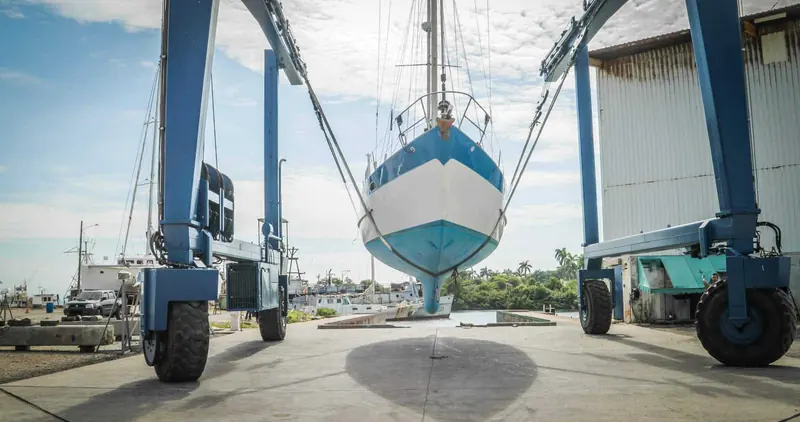
A working canal-transit marina inside a national park, with its own 100-ton travel lift and a Port Captain's office on site, a few kilometres from one of the highest-crime cities in Panama.
South of the Hurricane Belt
The single biggest reason a cruising yacht ends up on the hard at Shelter Bay rather than afloat somewhere prettier is latitude. Panama sits close enough to the equator, and far enough south and west, that it falls outside the Atlantic hurricane belt that threatens the Eastern Caribbean, the Bahamas and the US Gulf Coast every June to November. A boat stored at Shelter Bay through that season is not gambling on a storm track the way one left in Grenada, the Rio Dulce or Florida is. That is the marina's own core pitch, and it lines up with the basic geography rather than being marketing colour alone.
The trade-off is that the shelter comes from geography and a breakwater, not from a resort setting. The basin sits inside the old Fort Sherman anchorage, ringed by rainforest rather than a town, and cruising blogs including Out Chasing Stars describe hearing howler monkeys call from the docks and hiking jungle trails inside the surrounding San Lorenzo Protected Area to see sloths, capuchin monkeys, parrots, a coatimundi and a motmot. That same protected area, a 12,000-hectare park returned to Panama with the old base in 1999, also holds Fort San Lorenzo, a 16th to 18th century Spanish fortress that is part of a UNESCO World Heritage Site inscribed in 1980. The fort itself is the listed monument; the marina, built later on the neighbouring military waterfront, is not part of that listing, but it sits inside the same protected ground.
A Fort That Trained Soldiers for the Jungle
The marina's ground has a longer history than the marina does. Fort Sherman was built at Toro Point in 1911 and 1912, during construction of the canal itself, and by 1951 the US Army had turned it into the Jungle Operations Training Center, training around 9,000 American and Latin American soldiers a year in jungle survival, navigation and waterborne operations through the Cold War and beyond. The school closed with the last rotation in March 1999, and the whole of Fort Sherman was returned to Panama that June under the Torrijos-Carter treaties that handed back the canal itself the following year.
The buildings that trained soldiers now largely serve the marina and its hotel, and the surrounding jungle the school once used for exercises is the same jungle guests now walk for wildlife. A wider US-Panama exercise reviving some jungle warfare training elsewhere in the country got under way again in 2025, a reminder that the terrain here never stopped being useful for that purpose, but the training school itself has not returned to Fort Sherman; the fort's second life is as a marina, a hotel and a national park.
Getting There, and What It Costs to Leave
There is no quick way out. The marina runs a free bus most weekday mornings to Cuatro Altos, a shopping centre in Colon, leaving at 08:00 and returning at 11:15, with a second afternoon run that is only free in low season, and a weekly free Wednesday run all the way to Panama City for guests. Outside that schedule, a taxi to Panama City is generally USD 90 or more, and a taxi to Tocumen International Airport runs about USD 120 whether it is booked for day or night; the marina's own transport page suggests planning around those fares rather than treating a same-day airport run as routine. The Panama Railroad offers one round trip a day along the canal between Colon and Panama City, about USD 25 a person, a scenic run through the jungle that doubles as transport rather than a tourist add-on.
A public coach from the Colon terminal to Panama City is the cheapest option, taking around two hours and leaving roughly every 15 minutes once full, with return coaches from the Albrook terminal. None of these options are fast, and an owner flying crew or guests in and out on a schedule should build real slack into the plan. Car rental is available at the Colon cruise port and, per the marina's own page, priced comparably with US rates, which is at least one option that does not depend on a bus timetable or a shared coach.
Colon Is a Few Kilometres Away, and That Matters
The marina's isolation is a real asset and a real limitation at the same time. Inside the gates, on the old Fort Sherman waterfront, the setting is a national park with a controlled entrance, and cruising blogs describe a sociable, low-key dock life built around a pool, a small gym and weekly events rather than any sense of risk. Colon itself is a different matter. Multiple independent sources, including cruise-line guidance and traveller advisories, describe Colon as a high-crime city where walking beyond guarded tourist areas is strongly discouraged, day or night, and where visitors report being aggressively approached outside the port zone. That reputation is well enough established that some cruise lines no longer let passengers disembark independently in Colon at all.
For a yacht crew this mostly means treating the free marina bus and its Cuatro Altos stop, or a pre-arranged taxi, as the way into Colon rather than wandering on foot, and saving any real city time for Panama City instead. It is worth saying plainly rather than leaving unstated: the marina's own safety and its neighbour's reputation are two different facts, and an owner briefing guests or new crew should be clear about which one applies where.
On the Quay
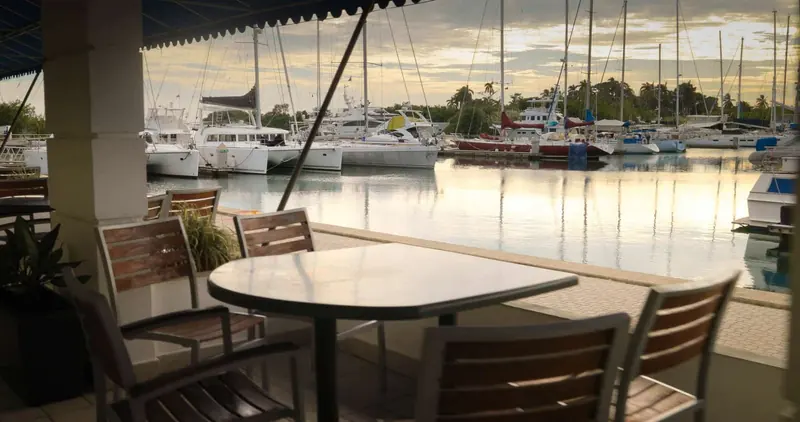
The marina runs a fuel dock for diesel and petrol, a chandlery stocked for genuine repair work rather than just souvenirs, and a sail loft, alongside the pool, small gym and laundry that make a week or two on the dock waiting for a transit slot bearable rather than dead time. Weekly events, including movie nights, nature walks and a happy hour, are organised for the cruising community rather than laid on for hotel guests, and a vendor visits weekly with marine supplies for boats that cannot easily get into Colon themselves. Power is genuinely built for large yachts: 120V and 240V at 50A on every slip as standard, rising to 240V at 100A on Docks A, B and C, and 480V three-phase at 150A on Docks A and B for a proper superyacht load.
The one amenity that gets a mixed word of mouth is the restaurant. Cruising accounts describe the food as ordinary in earlier years, improving as management has changed, which is a fair-minded way of saying it is not the reason to come. Fresh water is supplied at every slip, and Wifi is available across the property, though as with most marinas this far off a major grid, an owner relying on it for serious connectivity should have a backup.
Booking a Berth, and What Is Not Published
Reservations go through the marina office directly, by phone or email, rather than through a booking platform; this is a working transit marina and a boatyard first, and its systems reflect that rather than a resort's self-service model. The published wet-slip rate sheet, effective 1 July 2025, is the marina's own document, and Yotters could not find an independent third party publishing the same figures for comparison, which is common for a marina at this scale but still worth naming rather than leaving silent.
Two other things are not published anywhere Yotters could find. First, how many of the roughly 200 berths and 6,000 ft of dock space are actually configured for a yacht over 40 or 50 m, as against the smaller cruising boats that make up most of the marina's transit traffic; the 320 ft and 98 m maximum LOA figure describes what the marina can technically take, not how many berths of that size exist. Second, who currently manages the marina day to day: Juan Jose Boschetti ran it for around seven years and said, discussing his departure at the end of 2024, that he had worked to keep customer care sharp across more than 8,000 vessels assisted, but Yotters could not confirm who holds that role now, and an owner arranging a large-yacht berth should simply ask when making contact rather than assume either way.
An Land, Anfahrt und Buchung
| Getting there | No nearby airport. Tocumen International Airport near Panama City is the gateway, about a USD 120 taxi from the marina; the marina's own free bus and a once-daily USD 25 Panama Railroad service to Colon and Panama City are the cheap alternatives, both on fixed schedules. |
|---|---|
| Arriving by sea | Work VHF channel 74. The marina sits inside the Caribbean approach to the Panama Canal at Cristobal; canal-bound traffic, ferries and commercial shipping share the wider approach, and a yacht heading in should expect to coordinate around Canal traffic rather than a quiet coastal entrance. |
| Reserving a berth | By phone (+507 433-3581) or email ([email protected]); there is no online booking system. Book transit-season slots ahead, since the marina fills with yachts staging for canal transits and cruising rallies including the Ocean Cruising Club and Pacific Puddle Jump fleets. |
| Haul-out and technical work | A full yard on site: 100-ton Travelift to 28 ft beam, 55-ton hydraulic trailer, two forklifts, and a 30-ton crane for un-stepping masts under 80 ft. Dry storage from USD 0.35 a ft a day (monohull, 6-month-plus) to USD 1.10 a ft a day (catamaran, owner doing the work), plus 7 percent Panama tax. |
| Panama Canal transit | A licensed agent handles the toll, the admeasurement inspection, scheduling, lines, extra fenders and line-handlers, and needs no cash deposit; a self-organised transit needs a cash deposit, an owner's own lines and fenders, hired line-handlers and a working enclosed head aboard. |
| Eating and provisioning | One marina restaurant on site, described by cruising accounts as ordinary but improving; a small on-site market for basic provisions. Serious provisioning means the free weekly bus to Panama City or a taxi into Colon. |
| After dark | Life centres on the marina itself: the restaurant, the pool and organised events including movie nights and a weekly happy hour. Colon, a short drive away, is not somewhere crew should go exploring after dark; see the safety note below. |
| What is NOT published | No independent, third-party verification of the marina's own published wet-slip rates was found. How many of the roughly 200 berths actually take a yacht over 40 to 50 m is not stated anywhere on the marina's site. Current on-site management was not confirmed. |
Was Eigner und Crew berichten
The operator's own account of what the marina is for
Juan Jose Boschetti, who ran the marina for around seven years before moving on at the end of 2024, described his focus as keeping customer care sharp across more than 8,000 vessels assisted during his tenure. This is the operator's own account, not an independent one.
Juan Jose Boschetti, then Marina Manager, Shelter Bay MarinaA cruiser's account of the dock, the jungle and the rallies
The blog Out Chasing Stars describes Shelter Bay as extremely sheltered, with a cruising community it calls unusually friendly, filled seasonally by fleets from the Ocean Cruising Club's transit and the Pacific Puddle Jump. Its authors hiked the surrounding jungle and saw sloths, howler monkeys, parrots, a coatimundi and a motmot, and heard the howler monkeys' calls from the dock itself.
Out Chasing Stars (cruising blog)
Was gut ist und worauf zu achten ist
Stärken
- Built specifically to stage a Panama Canal transitOn-site Port Captain and Immigration, and a licensed agent who handles the toll, inspection, scheduling, lines and line-handlers with no cash deposit required, remove most of the friction of transiting from the Caribbean side.
- A genuinely capable boatyard, not a token oneA 100-ton Travelift rated to a 28 ft beam and a 30-ton mast-unstepping crane give real haul-out and rig-work capability that is scarce on this stretch of Caribbean coast.
- South of the hurricane beltPanama's latitude puts the marina outside the Atlantic hurricane zone that threatens the Eastern Caribbean and the US Gulf Coast, a genuine reason boats lay up here for the season.
- A rare, itemised boatyard rate sheetDry storage, pressure-washing, relocation and contractor fees are all published to the dollar, an unusual level of pricing transparency for a marina at this scale.
- Isolated inside a national park, not a townThe basin sits inside the 12,000-hectare San Lorenzo Protected Area, with howler monkeys and sloths on the surrounding trails, well removed from Colon despite the short drive between them.
Worauf zu achten ist
- Colon's crime reputation is a genuine, well-documented concern nearbyIndependent travel advisories and cruise-line guidance describe Colon, a short drive or bus ride away, as high-crime, with walking beyond guarded areas strongly discouraged; this is the marina's own transport hub for provisioning and errands.
- No online booking and no independent verification of the published ratesA berth is arranged by phone or email only, and Yotters could not find a third party publishing the marina's wet-slip rates independently for comparison.
- Getting anywhere costs real money or real timeA taxi to Panama City or the airport runs USD 90 to 120; the alternatives are a once-daily train or an infrequent public coach, none of them a quick same-day option.
- The restaurant is not a destinationCruising accounts describe the food as ordinary, improving with management changes rather than already good; provisioning and dining out mean a trip off the property.
- How many berths actually suit a large yacht is not publishedThe 320 ft, 98 m maximum LOA describes what the marina can technically accommodate, not how many of its roughly 200 berths are actually configured for a yacht that size.
Für wen: An owner transiting the Panama Canal from the Caribbean side, or laying a boat up out of the hurricane belt for a season, who wants the paperwork, the haul-out and the fenders handled in one place rather than assembled from scratch in Colon.