Design Unlimited
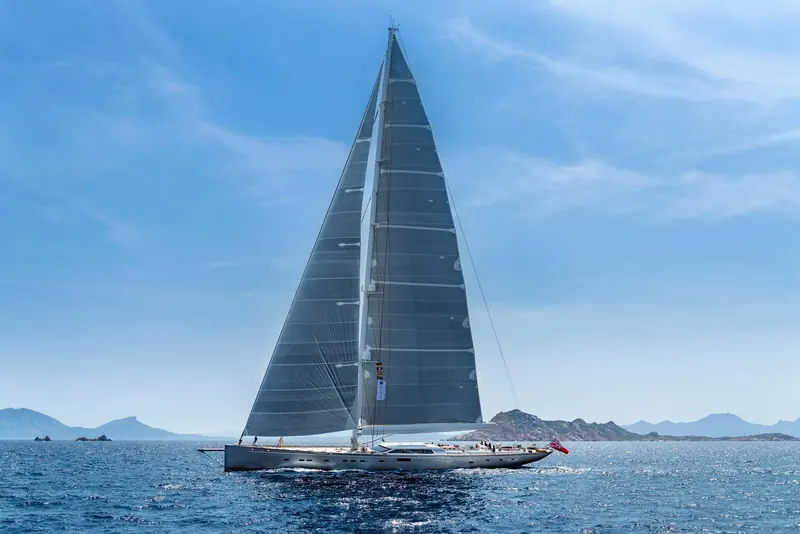
| Founders | Mark Tucker (creative director) and Julie Tucker (managing director) |
|---|---|
| Founded | 2000, based in the UK (Hampshire); Mark Tucker previously at Camper & Nicholsons (Yachts) Ltd and Ken Freivokh Design |
| Team | reported at 12 to 15 people across separate interviews, including the founders' children and design director Steve Rice |
| Disciplines | interior design and exterior styling only; naval architecture is always a separate, independent office on every project |
| Pink Gin VI, 54 m Baltic 175, delivered 2017: interior and exterior styling by Design Unlimited, naval architecture by Judel-Vrolijk & Co; World Superyacht Award, Sailing Yacht of the Year, 2018 | |
| The same hull, sold in 2023 and renamed Ravenger: Design Unlimited returned for a 2023-2024 refit to a Scandinavian brief for the new owner; World Superyacht Award, Best Refit, 2 May 2025 | |
| WinWin, 33.04 m Baltic, delivered August 2014, naval architecture by Javier Jaudenes: World Superyacht Award, Sailing Yacht of the Year, 2015, plus a ShowBoats Design Award the same year | |
| Mirage, 53 m Feadship launched 1979, three-year refit: World Superyacht Award, Best Refitted Yacht, 2016 | |
| Shemara, 65 m Vosper Thornycroft launched 1938: Design Unlimited reworked the general arrangement and interior layout during her 2010-2014 refit; the decorative interior scheme itself is credited to Studioilse | |
| Production and semi-custom relationships: Sunseeker, Arksen and Windy, plus one-off work for ARES, Balance Catamarans, Vitters, Brenta, Baltic and YYachts | |
| Design fee | not published. Market band for a yacht designer's fee is 1 to 5 per cent of build cost, project management a further 2 to 4 per cent, both outside the yard's quoted price, per the SuperYachtReview price guide updated March 2026 |
A husband and wife studio, not a brand
Mark and Julie Tucker founded Design Unlimited in 2000, after Mark had worked as an interior design specialist at Camper & Nicholsons (Yachts) Ltd and then as an associate partner at Ken Freivokh Design. Mark is creative director, Julie is managing director, and interviews given across the studio's history describe a team of somewhere between 12 and 15 people, small enough that the founders still sit in the same room as the work.
The studio has stayed a family business in a literal sense. Recent interviews describe the Tuckers' own children now working inside it, alongside long-serving staff such as Sarah Ussher, who runs operations and travel, and Sophie Porteous and Victoria Primrose, who source craftspeople globally for FF&E. For an owner, that continuity matters more than it sounds: a 25-year-old practice run by its founders, with a next generation already inside it, is a different proposition to a studio built around one name with no succession plan at all.
Interior and exterior, never naval architecture
No. The studio's stated scope is interior design and exterior styling, general arrangement and deck layout, and it has never offered naval architecture as an in-house service. On Pink Gin VI, the 54-metre Baltic that is the studio's best-known project, the naval architecture came from Judel-Vrolijk & Co; on WinWin it came from Javier Jaudenes. Design Unlimited draws the shape an owner sees and lives in, and somebody else signs off the numbers that make the shape safe to build.
This is a genuine trade-off against a studio like Nuvolari Lenard, which keeps naval architecture in-house specifically so the stylist and the engineer are answerable to each other in the same office. Design Unlimited's owners get a specialist naval architecture office on every project rather than one generalist doing both jobs, at the cost of an extra relationship to manage and, on a large or unusual hull, an extra set of drawings to reconcile. Either model works. An owner should know which one he is buying before he signs anything.
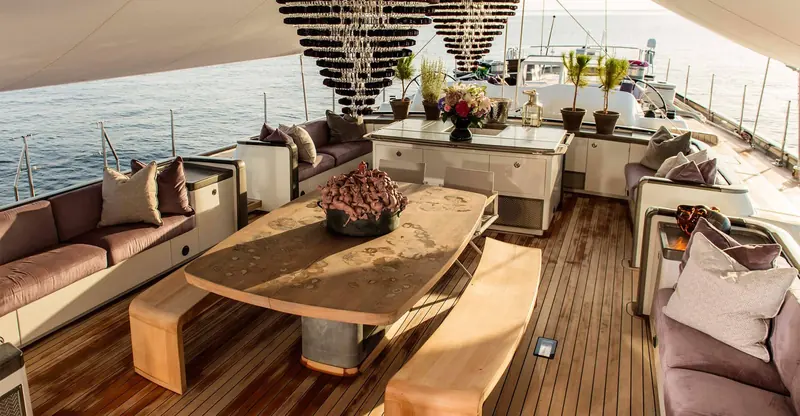
The same 54-metre Baltic sloop won a World Superyacht Award as Pink Gin VI in 2018 and won another as Ravenger in 2025, under two owners and two completely different briefs, both from Design Unlimited.
Refit is where the studio has built its reputation
Refit and restoration of existing yachts, alongside new-build sailing yachts, is the studio's clearest specialism, and both disciplines are harder than they look from a brochure. Mirage, a 53-metre Feadship launched in 1979, took three winter seasons to refit while still being expected to charter and cruise in summer, renewing roughly 90 per cent of the yacht and adding a gymnasium and a spa pool behind an eight-cabin interior where every stateroom carries its own art-movement theme. It won Best Refitted Yacht at the World Superyacht Awards in 2016.
Shemara, a 65-metre Vosper Thornycroft launched in 1938, is the harder case to describe honestly. Design Unlimited reworked her general arrangement and interior layout across a refit that ran from 2010 to 2014 and rebuilt the superstructure in aluminium, replaced her masts with carbon replicas and gave the hull a new underwater profile with a keel and a bulbous bow. The decorative interior scheme itself is credited by Boat International to the London studio Studioilse, working from Design Unlimited's layout. Where two sources split a credit like that, the honest answer is to report both halves rather than claim the whole.
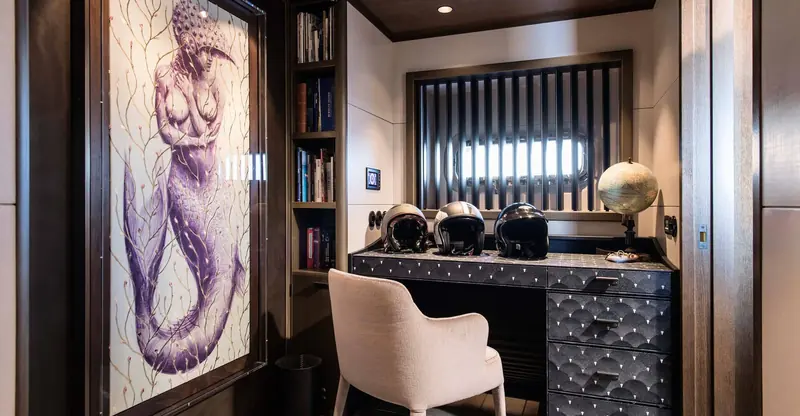
Both founders sail, and it shows in the sailing-yacht work
Mark and Julie Tucker are both sailors, and the studio designs for a boat's actual behaviour at sea rather than only for how a saloon photographs at the dock. Interviews describe the studio designing storage and ergonomics around a 15-degree heel angle, and around the restricted volume a sailing hull gives an interior compared with a motor yacht of the same length. Sojana, Bliss, Ran, Escapade, Visione, Pink Gin V and Hamilton, the first WallyCento, are named among its sailing-yacht credits alongside WinWin and Pink Gin VI.
Mark Tucker has been candid that owners commissioning a sailing yacht are often more conservative than motor yacht owners in the same bracket, telling one interviewer that many clients "don't really dare to be bold" once the boat is going to be raced or passage-made rather than only displayed. The studio's job in that setting is as much persuasion as drawing: making the case for a bolder finish to an owner who is, not unreasonably, thinking about how the interior survives a wet rail and a hard tack.
Pink Gin VI, and the record that has not moved since 2017
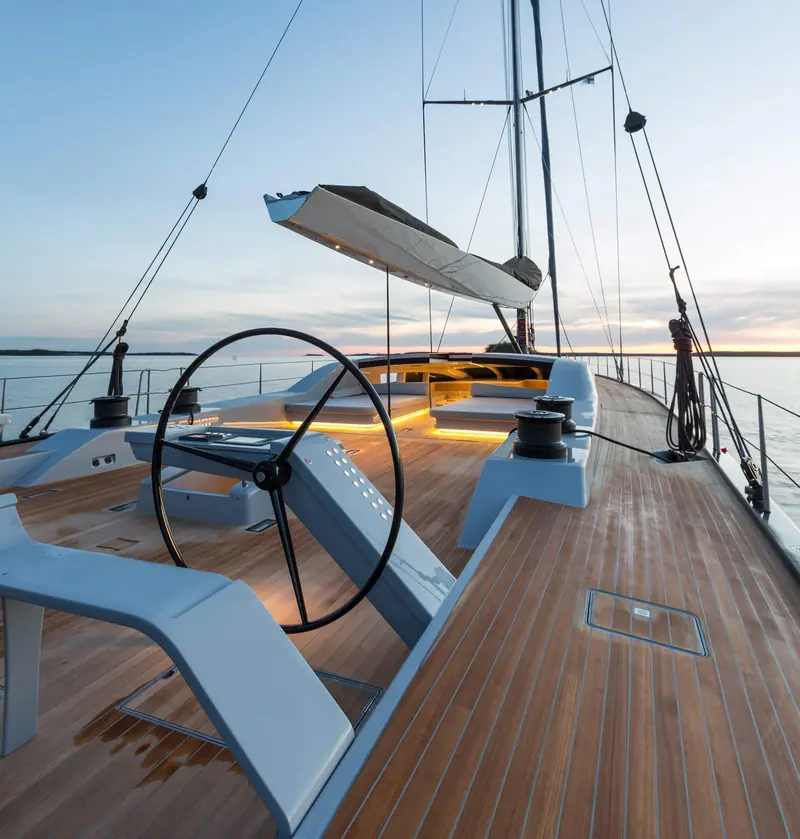
Pink Gin VI is a 54-metre Baltic 175 sloop delivered in 2017 that remains, as of 2026, the largest carbon-fibre sloop-rigged sailing yacht ever built, with interior and exterior styling by Design Unlimited over Judel-Vrolijk naval architecture. She won Sailing Yacht of the Year and the 50-metre-and-above sailing category at the World Superyacht Awards in 2018, the fifth consecutive year a Baltic-built yacht had won a WSA award. Mark Tucker called it "a deserved reflection of the great team that designed and built her" at the time, crediting the yard as much as his own studio.
A record like largest carbon sloop is a genuine, checkable fact and also a depreciating one: someone will eventually build a bigger one, and when they do this specific superlative stops being news. What does not depreciate is the delivered object and the award attached to it, which is why this entry leans on it rather than on the studio's own description of its work. Nine years on, the yacht is still the reference point every trade story about Design Unlimited opens with.
One hull, two owners, two names, two awards
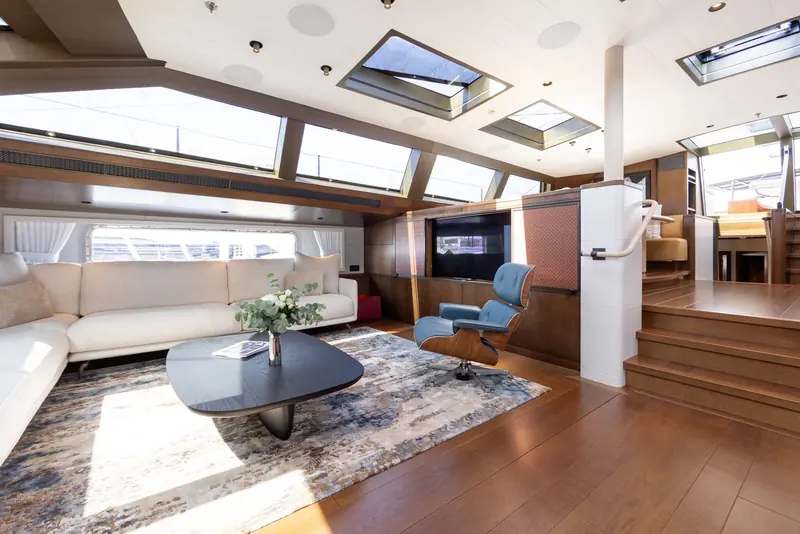
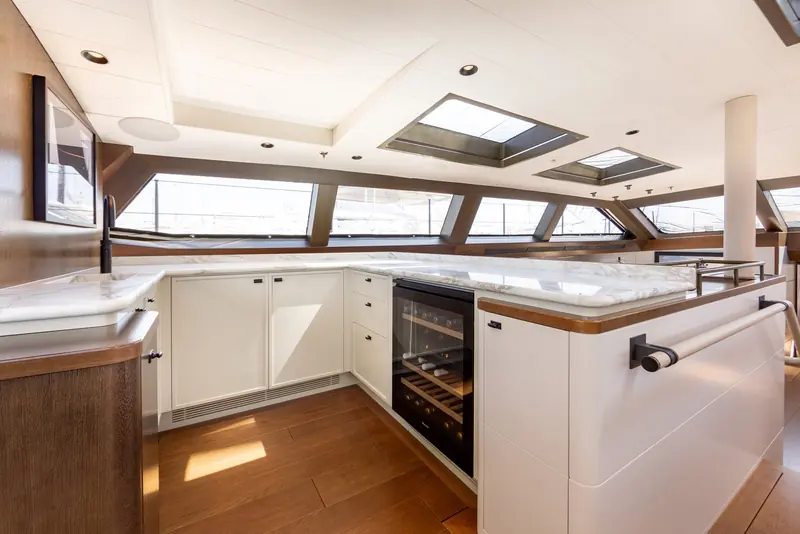
She was sold in 2023, renamed Ravenger, and returned to Baltic Yachts for a nine-to-ten-month refit that Design Unlimited carried out to a completely different brief, and the refit won its own World Superyacht Award in 2025. The new owner's brief was explicitly Scandinavian: a minimalist, functional interior in place of the original's jewel-toned, more maximalist palette, built around pale oak, natural stone and neutral leathers. Design Unlimited reconfigured the two-level saloon, swapped a piano area for a breakfast bar, and restyled the owner's cabin, while the exterior styling for this phase was led by the owner's team with Finnish designer Jarkko Jamsen.
This is the single most useful fact in this entry for a prospective client to sit with. The same studio was trusted, seven years and one change of ownership apart, to design two interiors on the same hull that could not look more different from each other, and both were good enough to win a World Superyacht Award. That is a stronger proof of range than any number of concept renderings, because a rendering never has to survive being lived in, sold, and rejudged by an independent panel a second time.
Production work sits alongside the custom projects
No, the studio also styles production and semi-custom ranges for Sunseeker, Arksen and Windy, plus one-off work for smaller builders including ARES, Balance Catamarans, Vitters, Brenta, Baltic's smaller models and YYachts. A production brief is a different discipline to a 54-metre one-off: the interior has to appeal broadly enough to sell in numbers, be tooled economically, and survive a dealer network rather than one demanding owner.
The benefit flows in both directions. A studio that has to make a production interior work at a fixed cost develops a sharper sense of which upgrades on a custom project are genuinely worth the money, and a studio that only ever draws one-offs can lose that discipline entirely. For an owner choosing between studios of similar reputation, one that also has to answer to a production accountant is, on balance, more likely to tell him honestly when an idea is expensive for no real gain.
How a commission runs, and what it costs
Design Unlimited does not publish a fee scale, and neither does any studio at this level; the market band, published by SuperYachtReview and updated March 2026, is 1 to 5 per cent of build cost for design plus 2 to 4 per cent for project management, both sitting outside the yard's own quoted price. Because the studio does not offer naval architecture, an owner should expect a second, separate fee and a second contract with whichever naval architecture office is engaged alongside it, a cost that is easy to overlook when comparing quotes between studios that bundle the two disciplines and studios, like this one, that do not.
One interview with Mark Tucker describes the studio's process as starting from listening rather than presenting: understanding how an owner actually intends to use the boat before a single sketch is shown. On refit work specifically, the studio has described the early stage of a project as discovering "old interiors under the bulkheads", meaning the practical survey work of finding out what state the existing joinery, wiring and structure are really in before any design decision gets made. An owner budgeting for a refit should assume that survey phase will move his numbers, not fix them.
Recognition, and who it does not suit
Four World Superyacht Awards across three different projects since 2015, plus a 2015 ShowBoats Design Award for WinWin, is a genuinely strong record, but the studio is a poor fit for an owner who wants one office to own the naval architecture as well as the styling. It is also not the right choice for an owner chasing the emphatic, sculptural exterior that studios such as Nuvolari Lenard build a reputation on; Design Unlimited's own language, and its award citations, run toward restraint, function and materials rather than a profile designed to be recognised from a mile away.
It suits, precisely, the two kinds of client its case studies describe: an owner building or buying a serious sailing yacht who wants a studio that has actually raced and cruised the kind of boat it is drawing, and an owner taking on a refit who wants a studio comfortable with what an existing hull can and cannot be made to do, rather than one that would rather start again on a blank sheet.
A studio with its succession already inside it
Unlike a studio built around one irreplaceable name, Design Unlimited's own recent interviews describe the founders' children already working inside the practice, which is the closest thing to a stated succession plan that any studio in this directory has put on the record. No standard marine design contract obliges a studio to name a successor, and the ITIC standard trading conditions for naval architects, the closest thing the industry has to a template, are silent on it entirely, so this is worth noting as a point in the studio's favour rather than assuming it protects an owner automatically.
It does not remove the need to ask. An owner signing a multi-year design agreement, especially for a refit that could run three winters like Mirage did, should still ask in writing what happens to the project if either founder is unavailable for an extended period, who has authority to approve a change on their behalf, and whether the drawing set is his in native format if the relationship ends. The presence of a next generation inside the studio makes those questions easier to answer well; it does not make them unnecessary to ask.
What is not published, and what a buyer should ask for directly
The studio publishes no fee scale, no standard contract terms, and no public account of how a project is priced when a refit's survey phase uncovers problems the original quote did not anticipate, which is the single most common way a refit budget moves. Nor does it publish, or does any peer studio publish, what happens contractually if a client cancels after concept but before a yacht building agreement is signed, beyond the general industry norm that the concept fee is retained.
This research also found no independently attributable owner testimony describing what it is like to commission Design Unlimited from the client's side; the record consists of trade press interviews with the Tuckers themselves, yard press releases, and awards-panel citations. That is not unusual for a studio operating at this level of confidentiality, but it means a prospective client should ask a broker or a yard for a direct reference from a previous owner rather than relying on the trade coverage alone.
Información práctica
| Design fee | not published by the studio; market band is 1 to 5 percent of build cost plus 2 to 4 percent for project management, both outside the yard's quoted price, per the SuperYachtReview price guide updated March 2026 |
|---|---|
| Naval architecture | not offered in-house; every named project pairs Design Unlimited's interior and exterior styling with an independent naval architecture office (Judel-Vrolijk & Co on Pink Gin VI, Javier Jaudenes on WinWin), so budget for a separate fee and a separate contract |
| How to commission | direct approach to the studio ([email protected]) or through a broker or yard; process begins with understanding intended use before any design work, per Mark Tucker's own account |
| Refit budgeting | the studio's own description of refit work as discovering what is 'under the bulkheads' signals that a survey phase can move a quoted budget; Mirage's refit ran three winter seasons and Ravenger's ran nine to ten months, a useful range for scoping a timeline |
| What is not published | fee scale, standard contract terms, and cancellation or termination clauses; no independently attributable owner testimony was found describing the commissioning experience from the client's side |
| Production alternative | owners who want the studio's styling at a production price point can access it through Sunseeker, Arksen or Windy models rather than commissioning a full custom project |
Lo que cuentan armadores y tripulaciones
No independently attributable owner testimony found
press coverage of Pink Gin VI, Ravenger, Mirage and Shemara repeats quotes from Mark and Julie Tucker themselves, from Baltic Yachts' own press office, and from World Superyacht Awards judging panels, but this research found no on-the-record quote from a private yacht owner describing what it was like to commission Design Unlimited
Yotters research desk
Lo bueno y lo que conviene vigilar
Puntos fuertes
- A proven range, not a proven stylethe same hull, Pink Gin VI, was restyled seven years later as Ravenger to an entirely different brief for a new owner and won a second, separate World Superyacht Award, which is a harder thing to demonstrate than a single recognisable look
- Founders who sail the boats they designMark and Julie Tucker's own sailing experience shows in specific, checkable design decisions around 15-degree heel angles and storage, not just in the marketing copy
- A stated succession plan, unusually for this directorythe founders' children are already working inside the studio, which no standard design contract requires and which most peer studios have not put on the record
A tener en cuenta
- No in-house naval architecturean owner must engage and pay a second, independent naval architecture office on every project, which is an extra relationship and cost easy to miss when comparing quotes against a studio that bundles both
- No independently attributable owner testimonythe public record is trade press interviews with the founders and awards-panel citations; a prospective client should ask for a direct reference from a previous owner rather than relying on published coverage
- Credit on at least one flagship project is shared, not soleBoat International credits the decorative interior scheme on the 1938 Vosper Thornycroft Shemara to Studioilse, working from a general arrangement and layout by Design Unlimited, a split worth understanding before assuming full authorship
Para quién es: A buyer or owner commissioning a sailing yacht or planning a refit who wants a studio that does the interior and styling only, and pairs happily with an independent naval architect rather than bundling the two.