SEABOB (Cayago)
| Categoria | slitta acquatica elettrica individuale |
|---|---|
| Costruttore | Cayago, Germania |
| Fondazione | 2007 |
| Prodotti di punta | SEABOB F5 e F5 S |
| Generazione più recente | F9, disegnata da Studio F. A. Porsche (lo studio di design Porsche) |
| Trasmissione | idrogetto elettrico ricaricabile, senza scarico né elica esposta |
| Posizionamento | ampiamente considerato il toy acquatico di lusso per definizione |
| Superseded F5 generation | 2.5 kW to 4.5 kW and 29 kg to 35 kg, still the machine in most yacht toy lockers |
| Charging | about four to six hours on the standard charger, about one to one and a half hours on the quick charger |
| Prices from Cayago's September 2025 EMEA list: F9 at EUR 9,285 net of VAT and F9 S at EUR 12,380 net | |
| Warranty | 24 months from transfer including the battery, with an annual inspection at an authorised facility |
| Depth | Cayago's own data sheet, read July 2026, gives a depth-sensor safety cut-off at 3.0 m and an electronic control system settable to a maximum of 25 m, and publishes no top speed for the F9 or F9 S |
| Flag reach | Part A Chapter 14 of the Red Ensign Group Yacht Code covers the United Kingdom, the Cayman Islands, Gibraltar, the Isle of Man and the other British Overseas Territories and Crown Dependencies, so a Cayman-flagged yacht is inside the same chapter MGN 681 interprets |
| Cayman Islands Shipping Registry | no separate lithium battery shipping notice in its published notices as of July 2026, so REG Yacht Code Chapter 14 plus a vessel-specific risk assessment is the operative standard |
| Marshall Islands | the 2026 edition of Yacht Code MI-103, effective 1 January 2026, introduces specific rules for spaces used to store or charge lithium-ion powered toys and tenders |
| Malta | a Transport Malta Commercial Yachting Notice of 22 June 2022 and Information Notice 45 of 7 September 2022, both written as strong recommendation, with the Commercial Yacht Code 2025 Revision 1 as the surveyed document |
| IMO | no mandatory instrument covering portable lithium battery powered craft aboard yachts as of July 2026 |
| Class | DNV's Battery (Safety) notation triggers only above 50 kWh aggregate installed capacity. Lloyd's Register LR-GN-052 of 10 June 2025 is advisory guidance, not a rule |
| Certified charging locker | no marine manufacturer publishes a price. EN 14470-1 Type 90 industrial cabinets listed at EUR 3,270 net (asecos ION-CHARGE 90, July 2026) and GBP 4,571.04 net or GBP 5,485.25 gross (asecos ION-CORE-90, United Kingdom, July 2026) |
| The SEABOB battery is integrated and does not come out. No spare pack appears on Cayago's EMEA list of September 2025 or on the Maltese dealer list of May 2026, and no replacement price is published | |
| MCA Safety Bulletin 35, updated 15 November 2024: a container marketed as fully MGN 681 compliant was found not able to comply fully, and the MCA noted that no international standard governs these products | |
Il costruttore tedesco Cayago
Il SEABOB è costruito da Cayago, azienda tedesca fondata nel 2007 per sviluppare mezzi acquatici ad alte prestazioni. Fin dall'inizio si è concentrata su un'unica idea: una slitta elettrica potente che il nuotatore tiene e guida nell'acqua. Cayago è stata fra le prime aziende a portare la propulsione elettrica in questo tipo di toy acquatico personale. Il SEABOB è diventato il suo prodotto simbolo e ha dato al marchio uno status quasi iconico sugli yacht. L'azienda ha continuato ad affinare il progetto per più di un decennio.
Cayago posiziona il SEABOB come un prodotto ingegnerizzato di alta gamma e non come un semplice gioco da piscina. Qualità costruttiva, materiali ed elettronica sono calibrati su acquirenti che si aspettano lo stesso standard degli yacht che li trasportano. Quella concentrazione sull'ingegneria ha tenuto il marchio davanti agli imitatori più economici. Il nome SEABOB è ormai usato quasi come sinonimo dell'intera categoria. La base produttiva tedesca fa parte di quella reputazione.
L'F5 e la nuova generazione
Il nucleo della gamma è da tempo l'F5 e il più potente F5 S, slitte affilate che portano un pilota sopra e sotto la superficie. Questi modelli hanno fissato lo standard prestazionale della categoria e sono una presenza comune davanti alle plancette degli yacht. Una variante più estrema, l'F5 SR, ha aggiunto velocità per i più appassionati. Più di recente Cayago ha introdotto una nuova generazione, l'F9, disegnata con lo studio di design Porsche. La gamma copre utenti che vanno dal nuotatore occasionale a chi vuole il massimo delle prestazioni.
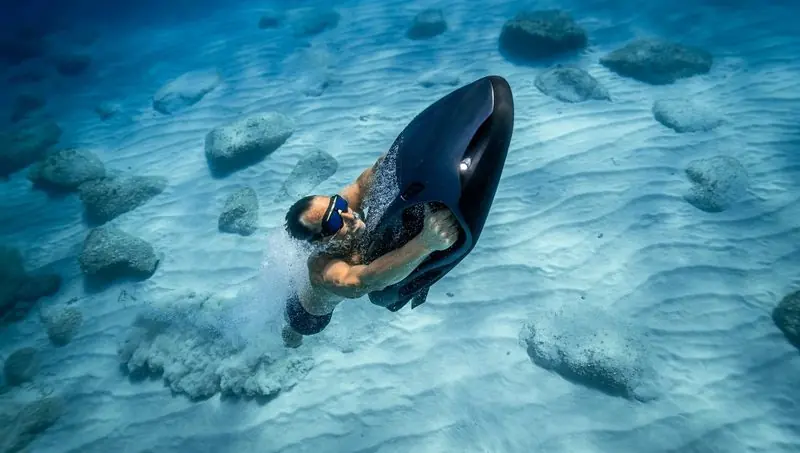
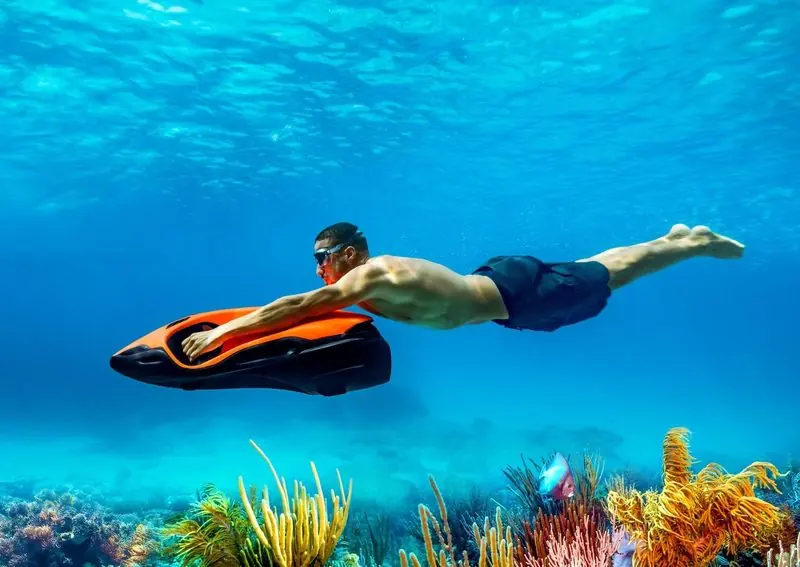
Il SEABOB funziona aspirando acqua attraverso un getto e spingendo avanti il pilota, con il controllo affidato a un'impugnatura semplice e all'inclinazione del corpo. Può correre in superficie come una tavola o scendere sotto per un nuotatore con la maschera. Modelli diversi offrono potenza e caratteristiche di immersione diverse. Le versioni più recenti portano batterie ed elettronica aggiornate su un formato collaudato. Cayago ha anche esplorato edizioni speciali con partner del mondo dell'auto.
La slitta elettrica diventata il toy scontato davanti a ogni plancetta di poppa.
Trazione elettrica e controllo intelligente
Al cuore del SEABOB c'è un potente idrogetto elettrico alimentato da una batteria ricaricabile. Non c'è benzina, non c'è scarico e non c'è elica esposta al pilota. Il sistema dosa l'erogazione della potenza, così che un principiante possa andare piano e un esperto accelerare con decisione usando la stessa macchina. Il galleggiamento è tarato perché la slitta torni naturalmente verso la superficie, il che aggiunge un margine di sicurezza. È questa miscela di potenza e controllo a separare il SEABOB da un semplice scooter subacqueo.
Tenere tutto questo affidabile in acqua salata è un compito ingegneristico serio. L'elettronica deve essere sigillata, la batteria gestita e la trasmissione protetta dalla corrosione. La lunga concentrazione di Cayago su un solo prodotto le ha permesso di affinare questi dettagli lungo molti anni-modello. Il risultato è un toy che risulta veloce e vivace e resta comunque gestibile per ospiti che non ne hanno mai usato uno. Quell'accessibilità è gran parte del suo successo sugli yacht da charter.
Il primo in acqua dalla plancetta
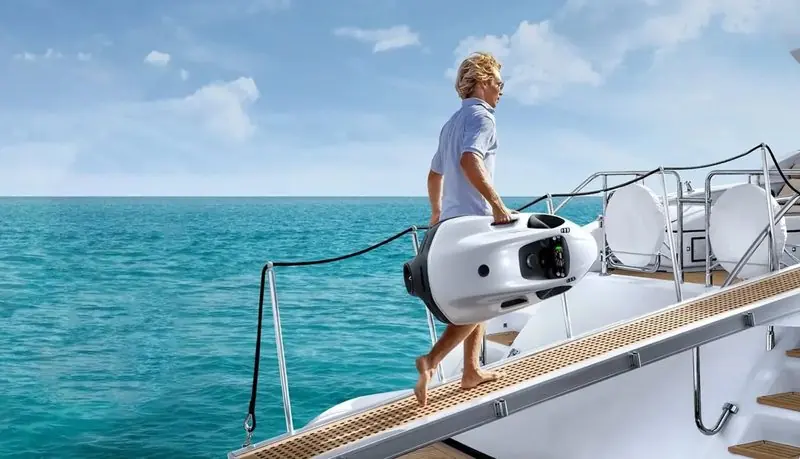
Su uno yacht all'ancora, il SEABOB è spesso il primo toy a finire in acqua. Gli ospiti lo usano per esplorare una baia o per nuotare più veloce di quanto potrebbero mai fare da soli, scivolando lungo una barriera con la maschera. Si presta a un'ampia gamma di età e capacità, il che lo rende ideale per un gruppo misto a bordo. L'equipaggio può consegnarne uno con un briefing breve e lasciare che gli ospiti se lo godano in sicurezza. Quella facilità d'uso spiega perché quasi ogni yacht ne porta almeno uno.
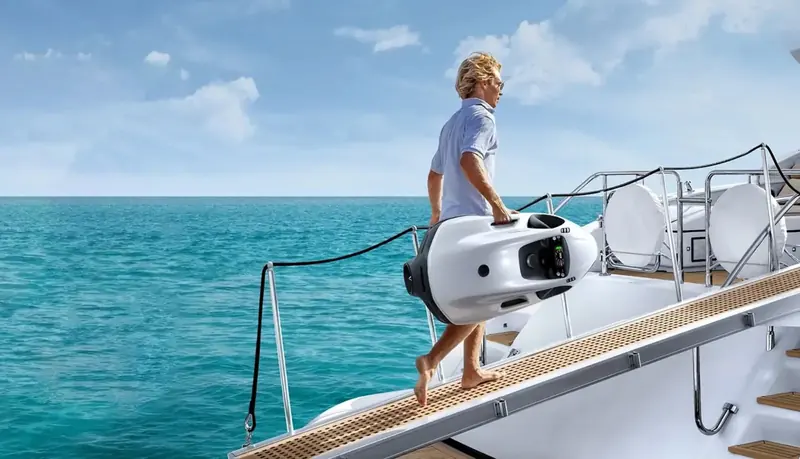
La slitta entra ordinatamente nell'armadio dei toys e si ricarica dalla rete di bordo. La trasmissione elettrica pulita permette di usarla vicino ai bagnanti e alle spiagge senza fumi e senza un'elica pericolosa. Per le famiglie è una delle preferite, perché possono usarla sia i bambini sia gli adulti. Il SEABOB è diventato parte dell'immagine standard di una giornata all'ancora. Pochi toys acquatici sono altrettanto associati alla vita di bordo.
Il toy acquatico di lusso per definizione
Il SEABOB ha raggiunto una posizione che quasi ogni costruttore può solo invidiare: essere la scelta data per scontata nella propria categoria. Quando uno yacht elenca i propri toys, un SEABOB c'è quasi sempre. La miscela di prestazioni, sicurezza e finitura del marchio ne ha fatto il metro su cui si misurano gli altri. L'associazione con il design Porsche sul modello più recente rafforza quell'immagine premium. Cayago ha trasformato un'invenzione di nicchia in una parte attesa dell'esperienza in yacht.
Per gli armatori, il richiamo è che il SEABOB semplicemente funziona e fa la sua figura. È un toy che gli ospiti riconoscono e apprezzano senza istruzioni, e che si riflette bene sullo yacht. La trazione elettrica si adatta anche allo spostamento del settore verso attrezzature più silenziose e più pulite. L'investimento costante di Cayago in nuovi modelli mantiene la gamma attuale. Il SEABOB resta il toy acquatico che definisce la categoria che ha creato.
The SE63 for Lamborghini
Cayago has built a licensed special edition with Automobili Lamborghini, and it is a different machine. The SE63 runs a 6.3 kW motor at 162 TP, nearly three times the plain F9, weighs 35 kg, runs about 60 minutes and is quoted at 35 km/h, roughly 19 knots, with the optional rear-mounted Performance Board fitted. Production started in the second quarter of 2026 with deliveries from that summer.
The 63 refers to 1963, when Ferruccio Lamborghini founded the car company. A figure of 63 knots circulates on social media and on review aggregators and appears nowhere in Cayago's technical documentation. The SE63 is allocation only and priced on application, in six Lamborghini finishes not offered on the standard machines.
What it costs, and when that was quoted
Cayago's EMEA list of September 2025 puts the F9 at EUR 9,285 net of VAT and the F9 S at EUR 12,380 net. A Mediterranean dealer publishing Maltese gross figures in May 2026 showed EUR 10,956.30 for the F9 and EUR 14,608.40 for the F9 S with 18 percent VAT applied. Every regional number moves with the tax rate and the exchange rate, so the net figure is the one to compare.
The options are not trivial against the base price. The same 2026 list showed Battery Capacity Plus at about EUR 847 gross, the driving stability system at about EUR 490 on the F9, a lifting dock at about EUR 1,095, a rack at about EUR 348, a bag at about EUR 352 and a cover at about EUR 99. Add the quick charger and a spare battery and a well-equipped F9 S lands close to EUR 20,000.
Lithium aboard, and which flags it actually binds
The Maritime and Coastguard Agency issued MGN 681 (M) Amendment 1 on 19 December 2025, covering fire safety, stowage and charging of small electrically powered craft and their lithium-ion batteries aboard yachts. Under it, lithium-ion batteries may only be charged aboard inside a certified container or space, any spare or removed battery above 100 Wh must sit in a dedicated cabinet built to EN 14470, EN 16121 or EN 16122, and from 1 January 2027 those containers on UK-registered vessels must carry UK type approval from a nominated body. The reach is wider than the initials suggest, because MGN 681 sits on Part A Chapter 14 of the Red Ensign Group Yacht Code, and the Red Ensign Group is not only the United Kingdom. The Cayman Islands, Gibraltar, the Isle of Man and the other British Overseas Territories and Crown Dependencies register under the same code, so a Cayman-flagged yacht is already inside Chapter 14. The Cayman Islands Shipping Registry goes further than the Code. Guidance Note 06/2023, read July 2026, annexes the United Kingdom's MGN 681(M) on the fire safety and storage of small electric powered craft and strongly recommends it be followed on every yacht that carries them, so a surveyor works to Chapter 14, that note and a vessel-specific risk assessment together.
The two flags outside the Red Ensign Group have moved separately and unevenly. The Republic of the Marshall Islands rewrote Yacht Code MI-103 with a 2026 edition effective 1 January 2026, and that edition introduces specific rules for spaces used to store or charge lithium-ion powered toys and tenders, so an RMI yacht now has a code requirement of its own rather than a borrowed one. Malta moved earlier and more softly. Transport Malta's Merchant Shipping Directorate issued a Commercial Yachting Notice on battery charging and storage aboard commercial yachts dated 22 June 2022, and Information Notice 45 on lithium-ion battery fires dated 7 September 2022, both framed as strong recommendation, with the firm requirement being that any suspect or defective pack is landed immediately and that deviations from the Commercial Yacht Code need the administration's approval. A Maltese yacht is surveyed against the Commercial Yacht Code, at its 2025 revision, not against MGN 681. The practical answer for an owner buying three SEABOBs is that the charging arrangement should be built to the strictest of the three, because flags change hands more often than garages get rebuilt.
Warranty, service and the alternatives
Cayago gives 24 months from transfer, batteries included and without a separate cycle limit, registered to the original purchaser. The warranty requires an annual inspection at an authorised facility and excludes use outside normal use, which is the clause that matters to anyone chartering the yacht. Declare the charter profile to Cayago before delivery, because those cases are assessed individually. Opening or modifying the machine voids it outright.
The rivals are the electric surfboards and the foils, not other sea scooters, because they compete for the same platform time and the same charging locker. A SEABOB works for a guest who cannot ride anything, at any age, with five minutes of instruction, which is where Awake, Fliteboard, Lift Foils and JetSurf all lose. It also does not get anyone out of the water, and after twenty minutes some guests want to stand up.
What class and the IMO add, and what they do not
Nothing at the International Maritime Organization binds a water toy today. The IMO's work on lithium-ion batteries has run through the Maritime Safety Committee's review of alternative fuels and new technologies, where MSC 109 added swappable traction battery containers to the list under review and identified nineteen regulatory gaps, eleven of which were confirmed for further work, and MSC 110, sitting from 18 to 27 June 2025, closed the review of regulatory barriers. None of that has yet produced a mandatory instrument reaching a 1.2 kWh sled in a yacht garage, and an owner told that the IMO requires something should ask which instrument.
Class arrives at the same place from a different direction. DNV's Battery (Safety) notation becomes mandatory where installed battery capacity exceeds 50 kWh in aggregate, which is more than forty times an F9 S pack, so a locker full of toys never triggers it. What the societies have produced is advice rather than rule. Lloyd's Register published LR-GN-052, Guidance Notes on Lithium-Ion Battery Powered Crafts and Vehicles carried on Yachts, on 10 June 2025, addressed to designers, builders and operators. DNV, Lloyd's Register, RINA, Bureau Veritas and ABS formed a Yacht Safety and Environmental Consortium in 2024. The obligation a yacht is actually surveyed against still comes from the flag, not from class and not from the IMO.
What the certified charging space costs
No manufacturer of a marine lithium charging locker publishes a price. The active-suppression systems yacht suppliers sell against MGN 681, the RACLAN boxes and the modular RAMBSS, and the passive ZARGES BatterySafe cases, were all quotation only in July 2026. The published prices that do exist are for shore-side industrial cabinets built to EN 14470-1 Type 90, which is one of the standards MGN 681 names for spare-battery stowage. A German supplier listed an asecos ION-CHARGE 90 with pull-out shelves at EUR 3,270 net of VAT in July 2026, and a United Kingdom supplier listed the taller asecos ION-CORE-90 at GBP 4,571.04 net or GBP 5,485.25 gross. Those figures set the order of magnitude for a box, not the cost of a compliant installation.
The SEABOB makes the problem harder than an eFoil does, because the battery does not come out. The ION-CHARGE 90 has an internal envelope of 470 by 452 by 582 mm and shelves rated at 25 kg, which suits a removable eFoil pack and will not take a sea sled. On a SEABOB the certified space has to be a compartment designed into the yacht rather than a cabinet bought and bolted down, and that is a refit drawing and a yard bill rather than a purchase order. One warning belongs alongside any quotation. In Safety Bulletin 35, updated 15 November 2024, the MCA found that a lithium storage container marketed as fully compliant with MGN 681 was not able to comply fully, stated that no international standard governs these products, and advised that any certification a manufacturer claims should be viewed with caution.
Informazioni pratiche
| New price (net) | F9 EUR 9,285 and F9 S EUR 12,380, per Cayago's EMEA list of September 2025 |
|---|---|
| Gross Mediterranean price | F9 EUR 10,956.30 and F9 S EUR 14,608.40 with 18 percent VAT, a Maltese dealer list read May 2026 |
| Main options | Battery Capacity Plus about EUR 847 gross, quick charger about EUR 1,752 gross, driving stability system about EUR 490 on the F9 |
| Running cost | the pack is integrated and does not come out, so a failure out of warranty is a specialist rebuild with no published price |
| Storage and charging | from 1 January 2027 UK-flagged yachts need a type-approved certified locker; shore-side EN 14470-1 cabinets run EUR 3,270 to about GBP 5,485 gross and are sized for a removable eFoil pack, not a SEABOB, so plan a built-in compartment |
| Warranty | 24 months from transfer including the battery, with an annual inspection required and cover void for undeclared charter use or for opening the unit |
| What is not published | no top speed for the F9 or F9 S, no spare battery on any dealer list, and no price anywhere for a certified charging locker built for the integrated pack |
Richiedi un preventivo per SEABOB (Cayago).
Indicaci il modello e dove deve arrivare. La redazione ottiene un'offerta scritta dal costruttore o da un rivenditore autorizzato, la confronta con i prezzi pubblicati in questa pagina e ti risponde via email. Senza impegno e senza costi.
- 01Un'offerta scrittaNella tua valuta, con IVA, consegna e tempi indicati, non una cifra da catalogo.
- 02Consegnato dove si trova lo yachtIn marina, in cantiere o al tuo indirizzo, con i documenti che una batteria al litio o un sollevamento con gru richiedono.
- 03IndipendenteYotters non è legato a nessun rivenditore, quindi l'offerta viene confrontata prima di arrivarti.
Cosa riferiscono armatori ed equipaggi
No independently attributable owner or crew testimony found
trade coverage repeatedly describes the SEABOB as the first toy named when a captain lists what is in the locker, but no publication found in this research names an owner, captain or crew member willing to be quoted on the record about the F9 specifically
Yotters research desk
Cosa convince e cosa va valutato
Punti di forza
- Any guest can ride itfive minutes of briefing suits a nervous teenager and a confident diver alike, which is where eFoils and jet boards lose most guests
- Nine kilos lighter than the F5the F9 S drops from about 35 kg to 25.9 kg, turning what used to be a two-person lift off the swim platform into a one-person job
- Positive buoyancy is a real safety marginletting go of the throttle stops the motor and floats the rider back to the surface rather than leaving him stranded below
Da valutare
- One charge, one sessionthe integrated battery cannot be swapped, so a standard F9 gives about 40 minutes of riding and then a four to six hour wait before the next guest can use it
- No published top speedCayago confirms thrust in its own TP units but has never given a knots figure for the F9 or F9 S, so a buyer cannot compare it directly against a rival sea scooter on speed
- The certified charging locker is an unbudgeted refit itemno marine supplier publishes a price for a locker sized to a non-removable SEABOB pack, and the MCA's Safety Bulletin 35 found at least one product marketed as MGN 681 compliant was not able to comply fully
A chi si rivolge: Armatori e ospiti charter che vogliono un toy acquatico elettrico, veloce e sicuro, che chiunque a bordo possa usare.