Lake Michigan & the Great Lakes
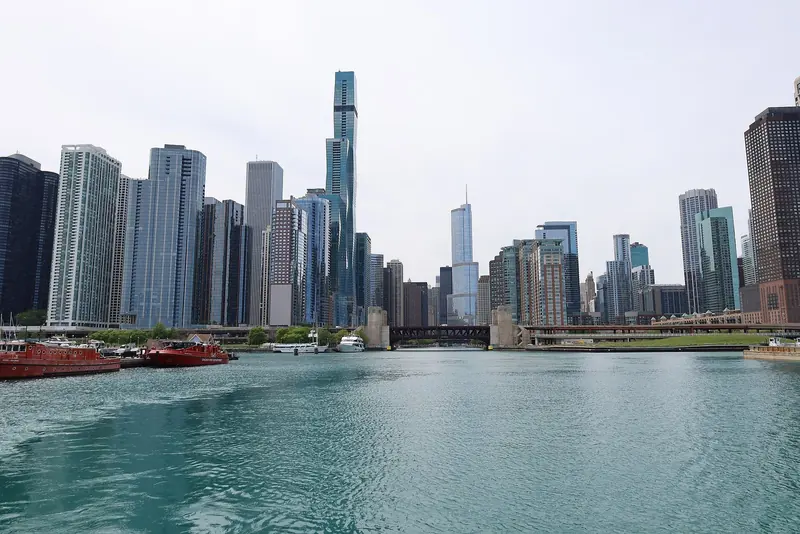
| Location | Lake Michigan, the only Great Lake entirely within the United States, bordered by Illinois, Indiana, Wisconsin and Michigan, about 500 km long |
|---|---|
| Water | fresh, not salt; no barnacles, reduced marine growth and corrosion versus a saltwater season |
| Season | broadly May to October; the lake closes to normal navigation through the winter ice |
| Connections | south via the Chicago Sanitary and Ship Canal to the Illinois River and the Mississippi system; east via the other Great Lakes and the St Lawrence Seaway to the Atlantic (Seaway max draft about 8 m for standard commercial traffic) |
| Chicago harbours (Chicago Park District / Westrec Marina Management): Burnham (1,126 slips, boats 28 to 100 ft-plus), Belmont, DuSable, Diversey, Montrose, 31st Street | |
| 2025 Chicago harbour fees | USD 3.50/ft for 30-60 ft, USD 6.00/ft for 61 ft and over, minimum 30 ft, charged on the longer of slip length or true LOA |
| Chicago Yacht Club Race to Mackinac ('the Mac'): run annually since 1898, 289 nm, full length of Lake Michigan; 2026 cruising division starts Friday 10 July, racing division Saturday 11 July, roughly 3,000 sailors | |
| Mackinac Island | motor vehicles banned since 6 July 1898; M-185, the island's state highway, is the only US state highway closed to motor vehicles; about 500 year-round residents, roughly 14,500 seasonal visitors; transport by foot, bicycle and horse-drawn carriage only |
| Mackinac Bridge vertical clearance | 155 ft at the centre of the main span, 135 ft at the edges of the 3,000 ft navigation channel |
| US-Canada Great Lakes border crossing | Small Vessel Reporting System; I-68 permit USD 16/person or USD 32/family, valid 1 year, phone-in reporting; NEXUS also accepted; vessels 30 ft or longer must supply a US decal number |
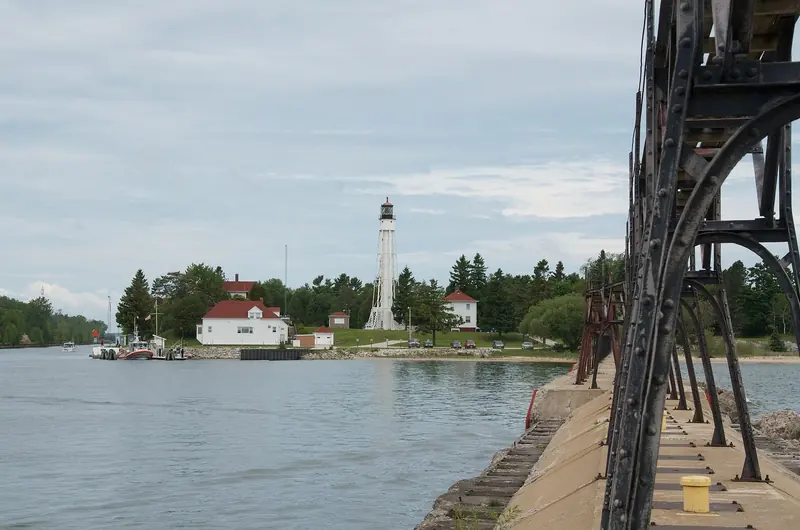
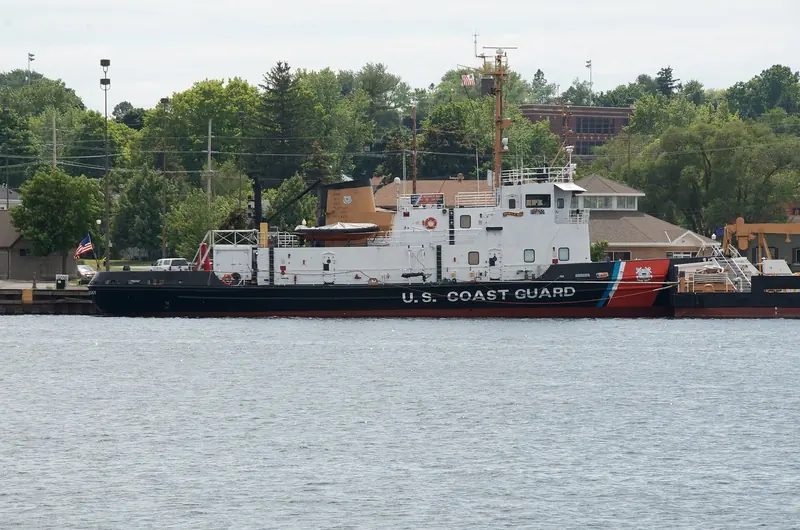
| Door County, Wisconsin | Sturgeon Bay Ship Canal (twin lighthouses) lets boats bypass the peninsula tip; working shipyard and US Coast Guard presence at Sturgeon Bay |
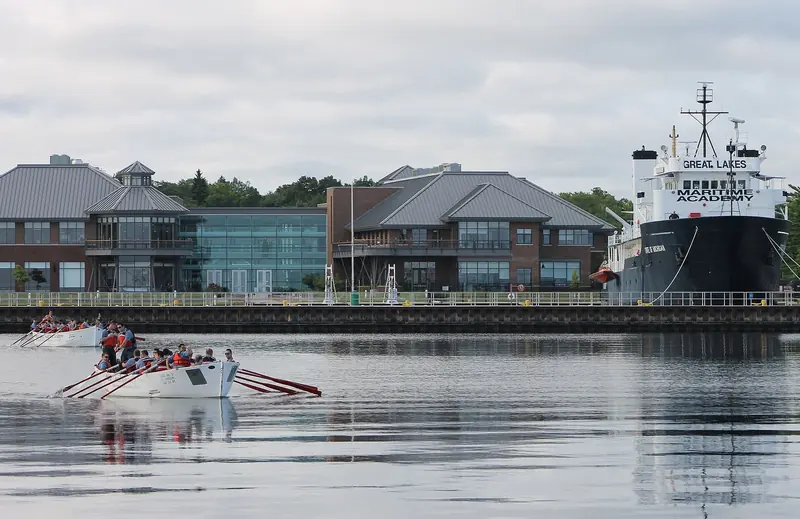
| Grand Traverse Bay, Michigan | West Arm marketed locally as the Caribbean of the Midwest for water clarity; home port of the Great Lakes Maritime Academy training ship State of Michigan, based at Traverse City |
| Airports | Chicago O'Hare (ORD) and Midway (MDW) for big-jet/business aviation with dedicated FBOs; Chicago Executive Airport as a congestion alternative; Cherry Capital Airport (TVC) for Traverse City |
A freshwater sea with its own rules
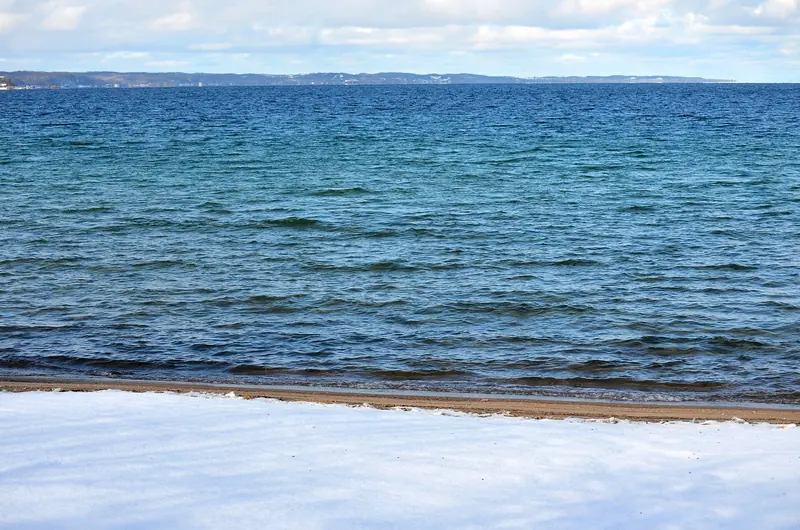
Lake Michigan is roughly 500 kilometres long and the only one of the five Great Lakes lying entirely within the United States, bordered by Illinois, Indiana, Wisconsin and Michigan. Being fresh water changes practical maintenance in a hull's favour: no barnacles, and far less of the corrosion and marine growth a saltwater season imposes, though a boat moving between the Lakes and the ocean has to manage the reverse transition. The season itself is bounded by ice rather than by hurricane risk; the lake is broadly cruisable from May through October, with the shoulder months of May and October colder and quieter than the July to September core.
Two connections make the Great Lakes a genuine crossroads rather than an inland lake system. South, the Chicago Sanitary and Ship Canal links Lake Michigan through the Illinois River to the Mississippi, the route the Great Loop boaters and any yacht heading for the Gulf of Mexico actually uses. East, the other four Great Lakes and the St Lawrence Seaway connect all the way to the Atlantic, though the Seaway's own locks are sized for commercial shipping (a published maximum draft around 8 metres for standard traffic) rather than built with a private yacht in mind, and a sailing yacht's air draft through the Chicago River's drawbridges is the more immediate constraint for a boat working the southern end of the lake.
Chicago: the biggest harbour on the lake
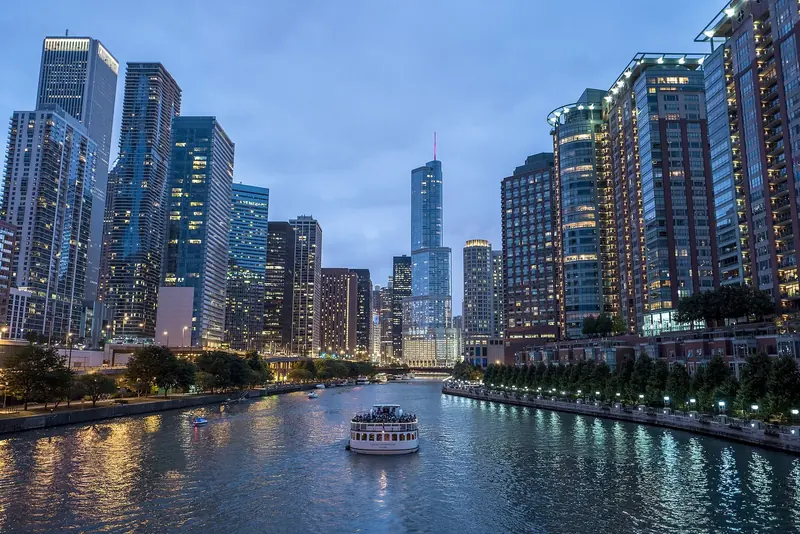
Chicago runs its harbours through the Chicago Park District, managed by Westrec Marina Management, across facilities including Burnham, Belmont, DuSable, Diversey, Montrose and 31st Street. Burnham Harbor, the largest, holds 1,126 slips plus mooring cans and star docks and takes boats from 28 feet up to 100 feet and above, with transient docking available. Published 2025 harbour fees run USD 3.50 per foot for boats 30 to 60 feet and USD 6.00 per foot for boats 61 feet and over, charged on whichever is longer, the slip or the boat's true overall length including bow pulpit and swim platform, with a 30 foot minimum length applied across the harbours.
The Chicago River itself, running into the lake through downtown, is a working waterway rather than a marina approach: a mast-up sailing yacht has to plan around a series of drawbridges, and the skyline view from the water, especially after dark from the lakefront harbours, is the single most photographed reason any owner puts Chicago on a Great Lakes itinerary at all.
Mackinac Island banned cars in 1898 to stop them frightening the horses, and the ban has simply never been lifted since.
The race that defines the season
The Chicago Yacht Club Race to Mackinac, universally known as the Mac, has run since 1898, which makes it older than Mackinac Island's own car ban, announced the same year. The 2026 race starts the cruising division on Friday 10 July and the racing division on Saturday 11 July, sending a fleet of roughly 3,000 sailors up the full 289 nautical mile length of Lake Michigan to finish at Mackinac Island, with support from Arnold Transit Company, the ferry operator that has served the island since 1878 and has sponsored the race. It is freshwater ocean racing in every meaningful sense except the water itself, and it is the single event that most defines the July calendar on the lake.
Around the race week, Chicago's harbours and the marinas up the western shore run at their fullest of the year; an owner planning a Chicago-based July visit should treat Mac week as the lake's equivalent of a Mediterranean regatta week and plan a berth accordingly.
Mackinac Island: the finish line, and the point
Mackinac Island sits at the meeting point of Lakes Michigan and Huron, and its roughly 500 year-round residents and 14,500 seasonal visitors get around entirely by foot, bicycle or horse-drawn carriage. Michigan's own M-185, the state highway that circles the island, is the only state highway in the United States where motor vehicles are not allowed at all; the ban covers cars, scooters, ATVs and golf carts alike, with narrow exceptions for emergency vehicles and, in winter, snowmobiles. It has held since 6 July 1898, when local carriage operators petitioned the village council to prohibit the horseless carriages that were spooking their horses, and it has simply never been reversed.
For a yacht, this makes Mackinac one of the few genuinely car-free destinations reachable in the developed world, with the historic Fort Mackinac overlooking the harbour and the island's Victorian-era hotels and cottages preserved partly because the same restriction that keeps cars off also slowed the pace of redevelopment. The Mackinac Bridge nearby, connecting Michigan's Upper and Lower Peninsulas, has a published vertical clearance of 155 feet at the centre of the main span and 135 feet at the edges of its 3,000 foot navigation channel, the figure any boat transiting the Straits of Mackinac under the bridge needs before anything else.
Crossing the border without leaving the lakes
Lake Michigan itself sits entirely within the United States, but a Great Lakes season commonly runs into Lakes Huron, Erie or Ontario, which do share a border with Canada, and a captain planning the wider region needs the border process in place regardless. The I-68 permit lets pre-approved boaters phone US Customs and Border Protection on arrival rather than present in person, costs USD 16 per person or USD 32 for a family, and is valid for a year; NEXUS membership works the same way for pre-cleared travellers. Boats can also report through the CBP ROAM smartphone app or by calling the Small Vessel Reporting System hotline, available 24 hours, and any vessel 30 feet or longer must supply a US decal number when reporting. Nobody may leave or board the boat, and no baggage or goods may move on or off it, until CBP has granted release.
The system is built for exactly this kind of casual, frequent lake-hopping between two friendly countries and is markedly lighter than an ocean check-in process; the discipline it demands is procedural, not bureaucratic; call ahead, wait for release, and keep everyone aboard until it comes.
Up the coast: Door County and Grand Traverse Bay
North of Chicago, Wisconsin's Door County peninsula and Michigan's Grand Traverse Bay give the lake its quieter, prettier cruising ground. Door County's Sturgeon Bay is cut through by a ship canal marked by twin lighthouses, letting boats skip the long run around the peninsula's tip, and Sturgeon Bay itself is also home to a working shipyard and a regular US Coast Guard cutter presence. Grand Traverse Bay, around Traverse City on the Michigan side, is clean enough that local tourism marketing calls its West Arm the Caribbean of the Midwest, and the bay hosts the Great Lakes Maritime Academy's training ship State of Michigan, based out of Traverse City.
Both regions run on classic Great Lakes summer timing, busiest in July and August, with autumn colour along the Boardman River in Traverse City and the wooded shoreline around Door County drawing a second, shorter season into October before the water turns cold and the marinas start hauling out for winter.
Getting people there
Chicago O'Hare (ORD) and Chicago Midway (MDW) both handle general and business aviation for the southern end of the lake, with several dedicated FBOs at each serving private jets directly into the city; Chicago Executive Airport in the northern suburbs is the common alternative for owners avoiding O'Hare's commercial congestion. Further north, Cherry Capital Airport (TVC) serves Traverse City directly, and regional strips serve Door County and the Straits of Mackinac area, with a final short hop or ferry needed to reach Mackinac Island itself, which has no vehicle traffic and a small airfield of its own for light aircraft only.
This is a genuinely different access model from a Mediterranean or Caribbean season: Chicago gives full big-jet infrastructure at one end of the lake, and the cruising ground gets progressively more remote and small-aircraft-dependent the further north and away from the city an owner goes, ending at an island guests reach by boat or a light plane regardless of how they arrived at the mainland.
Who this is actually for
Lake Michigan and the wider Great Lakes suit an owner based in or visiting the American Midwest who wants a genuine yachting season without crossing an ocean: a real offshore race in the Mac, a car-free island destination with more than a century of continuous history behind the restriction, a major city skyline cruise in Chicago, and quieter, cleaner northern bays in Door County and around Traverse City, all inside fresh water that is kinder to a hull than a saltwater season.
It asks for real planning around things a coastal season does not: the ice-bound off season, drawbridge air draft through the Chicago River, the border-crossing paperwork if the itinerary reaches into Canadian-adjacent lakes, and an access model that runs from full business-jet infrastructure at Chicago to a car-free island reachable only by boat or light aircraft at the northern end of the same lake.
На берегу, подъезд и бронирование
| Getting there by air | Chicago O'Hare (ORD) and Midway (MDW) for full business-jet infrastructure and dedicated FBOs; Chicago Executive Airport as a lower-congestion alternative in the northern suburbs. Cherry Capital Airport (TVC) serves Traverse City directly for the northern lake. Mackinac Island itself has only a small light-aircraft airfield; most arrivals come by ferry. |
|---|---|
| Berthing in Chicago | Chicago Park District harbours (Westrec-managed): Burnham (1,126 slips, to 100 ft-plus), Belmont, DuSable, Diversey, Montrose, 31st Street. 2025 published fees: USD 3.50/ft for 30-60 ft, USD 6.00/ft for 61 ft and over, 30 ft minimum, billed on the longer of slip length or true LOA. |
| Crossing to Canadian-adjacent lakes | Use the Small Vessel Reporting System: I-68 permit (USD 16/person or USD 32/family, 1-year validity, phone-in on arrival) or NEXUS; report via CBP ROAM app or the 24-hour hotline; vessels 30 ft or over must supply a US decal number. No one leaves or boards, and no goods move, until CBP grants release. |
| The Chicago to Mackinac Race | Chicago Yacht Club Race to Mackinac, run since 1898, 289 nm. 2026: cruising division starts Friday 10 July, racing division Saturday 11 July. Berths in Chicago and around Mackinac are tightest in the days either side. |
| Mackinac Island logistics | No motor vehicles of any kind (cars, scooters, ATVs, golf carts) since 6 July 1898; arrival and transport around the island are entirely by boat, ferry, bicycle or horse-drawn carriage. Plan guest logistics accordingly. |
| Best season | May to October, July and August the warmest and busiest; the lake is not navigable through the winter ice, and marinas across the region hold a genuine haul-out season rather than a year-round berth culture. |
| What is not published | Transient dockage rates and availability for a large yacht at Door County and Grand Traverse Bay marinas, and exact Chicago River drawbridge air-draft clearances at low water; both are confirmed directly with the harbourmaster or a local agent. |
Что сообщают владельцы и экипажи
Chicago's own harbour fee schedule charges by true length, not just slip length
The Chicago Park District's published 2025 rate sheet bills a boat on whichever is longer, the assigned slip or the vessel's actual overall length including the bow pulpit and swim platform, a detail worth checking before booking a slip sized to the boat's nominal LOA.
Chicago Park District / Westrec Marina Management, 2025 Harbor FeesMackinac Island's car ban was a direct response to horses being frightened, not an early environmental policy
Local carriage operators petitioned the village council in 1898 specifically because early automobiles were spooking their horses; the resulting ban on 6 July 1898 has simply never been reversed, and now covers scooters, ATVs and golf carts as well as cars.
Mackinac Island historical recordA Great Lakes border crossing is built around a phone call, not an office visit
Boaters holding a pre-approved I-68 permit or NEXUS membership report their US arrival by phone, sometimes up to four hours in advance, and no one may leave or board the vessel, and no goods may move, until CBP grants release over that same call.
US Customs and Border Protection, Great Lakes reporting guidanceThe Mackinac Bridge's clearance numbers differ from centre span to channel edge
The bridge authority publishes 155 feet of vertical clearance at the centre of the main suspension span but only 135 feet at the edges of the 3,000 foot navigation channel, a real difference for a tall mast that a captain should confirm against the intended track through the Straits, not assume from the headline number.
Mackinac Bridge Authority
Сильные стороны и что учесть
Сильные стороны
- A real offshore race that never leaves fresh waterThe Chicago Yacht Club Race to Mackinac has run every year since 1898, covers 289 nautical miles up the full length of Lake Michigan, and draws about 3,000 sailors, giving the lake a genuine, historic distance-racing culture without an ocean anywhere in it.
- A finish line with no cars, for over a centuryMackinac Island's ban on motor vehicles has held since 6 July 1898 and covers everything from cars to golf carts; it is one of the only genuinely car-free destinations left in the developed world, reachable directly by boat.
- Full business-jet infrastructure at one end of the cruising groundChicago O'Hare and Midway give dedicated-FBO, big-jet access most Great Lakes destinations cannot offer, putting a major-city yachting base within the same itinerary as small-town northern bays.
- A genuinely lighter border process than an ocean crossingThe I-68 and NEXUS-based Small Vessel Reporting System lets a boat cross into Canadian-adjacent lakes with a phone call rather than an in-person clearance, at a cost of USD 16 to 32 per crossing party.
На что обратить внимание
- A hard winter close, not a shoulder seasonThe lake is broadly unusable from roughly November to April; a season here is bounded by ice in a way no Mediterranean or Caribbean ground has to plan around, and haul-out is a genuine annual event, not an occasional precaution.
- Chicago River air draft is a real constraint for a mast-up boatThe drawbridges through downtown Chicago mean a sailing yacht has to plan its river transit around bridge openings rather than treat the harbour approach as open water.
- The cruising ground thins out fast north of ChicagoFull business-jet infrastructure and 1,126-slip harbours exist at the southern end of the lake; Door County, Grand Traverse Bay and Mackinac Island run on a smaller, more local marina and airport network with much less publicly available large-yacht data.
- Mac week fills every berth on the lakeThe days around the Chicago to Mackinac Race in July are the tightest booking window of the year in both Chicago and around Mackinac Island, and need to be planned for well ahead, the same as any major regatta week elsewhere.
Для кого: An owner based in or visiting the American Midwest who wants a genuine offshore-race-and-cruising season without crossing an ocean, and who will plan around a real winter lay-up, Chicago River drawbridge air draft, and a Canadian border process if the itinerary extends beyond Lake Michigan itself.