The Aland Islands & the Turku Archipelago
| Region | Baltic Sea between Sweden and mainland Finland; Aland an autonomous Finnish province, the Turku archipelago (Archipelago Sea) on the Finnish mainland immediately to its east |
|---|---|
| Aland | about 6,757 islands and skerries of at least 0.25 ha plus roughly 20,000 smaller rocks; population 30,836 at end of 2025, Mariehamn 11,957 (ASUB) |
| Autonomous since a 1920 Act confirmed by the League of Nations in 1921; demilitarised under the 1856 Aland Convention, reconfirmed and neutralised by a ten-state convention in 1921; Swedish the sole official language | |
| Outside the EU VAT and excise area since Finland's 1995 EU accession (Protocol 2) while inside the EU customs union, the legal basis for duty-free ferry retail | |
| Archipelago Sea | the world's largest archipelago by island count, its core protected since 1983 as the 500 sq km Archipelago National Park |
| Season | guest harbours open mid-May to late September, real cruising window closer to June-August; wider Baltic ice season typically October/November to April further north |
| Getting there | Mariehamn Airport (MHQ), Finnair to Helsinki and PopulAir to Stockholm-Arlanda and Turku, 42,308 passengers in 2025; Viking Line and Tallink Silja Stockholm-Turku/Helsinki ferries via Mariehamn or Langnas; Eckero Linjen's dedicated 2-hour Grisslehamn-Eckero crossing |
A Different Archipelago West of Stockholm's Own
Aland is roughly 6,757 islands and skerries of at least a quarter of a hectare, plus an estimated 20,000 smaller rocks and islets, all administered as a single autonomous Finnish province with a population of 30,836 at the end of 2025, of whom 11,957 live in the single town of Mariehamn (Alands statistik- och utredningsbyra, ASUB). The Turku archipelago immediately to its east, more properly the Archipelago Sea, is reckoned the largest archipelago in the world by island count, and its core is protected as the 500 square kilometre Archipelago National Park established in 1983 (Visit Turku).
Stockholm's archipelago, covered on this site as its own entry, is plain Swedish territory under Swedish law throughout. Aland is not: it is Finnish sovereign territory administered under its own autonomy act, demilitarised, Swedish-speaking by law and outside the European Union's tax area, four facts that change how an owner buys fuel, clears a border and reads a chart, not just where the boat happens to be that week.
An Autonomous Province, Demilitarised Since 1856 and Neutralised Since 1921
The 1856 Aland Convention, an appendix to the treaty ending the Crimean War, barred permanent fortification or military bases on the islands. When Sweden and the newly independent Finland both claimed Aland after 1917, the League of Nations Council awarded sovereignty to Finland in June 1921 on condition of a binding autonomy act, which Finland had already legislated in 1920, and a fresh international convention, signed by ten states that October, which reconfirmed the 1856 demilitarisation and added neutralisation, meaning Aland must be kept out of any armed conflict. Swedish is the islands' sole official language under that same settlement, and Aland has flown its own blue, yellow and red Nordic-cross flag since 1954.
The status is not a museum piece. Finland joined NATO in April 2023 without touching it. Its foreign ministry states plainly that it respects Aland's demilitarisation while reserving the right, under the treaty's own Article 7, to defend Aland's neutrality if attacked, and the 2024 US-Finland defence cooperation agreement pointedly excludes Aland from its fifteen listed facilities. A March 2026 survey found 73 per cent of Alanders want to keep demilitarisation even as opinion on the Finnish mainland shifts, and a Finnish National Defence University officer floated a two-stage exit plan in late 2025 (The Northern Voices). None of it has reached parliament as legislation, according to Aland's own MP Mats Lofstrom, but a cruising owner should know the status is being actively discussed, not settled history.
Aland is a Finnish province where Swedish is the only official language, no soldier may be stationed under a treaty dating to 1856, and the ferry's own gift shop is legally outside the European Union's tax area.
Outside the EU Tax Area, Inside the Customs Union
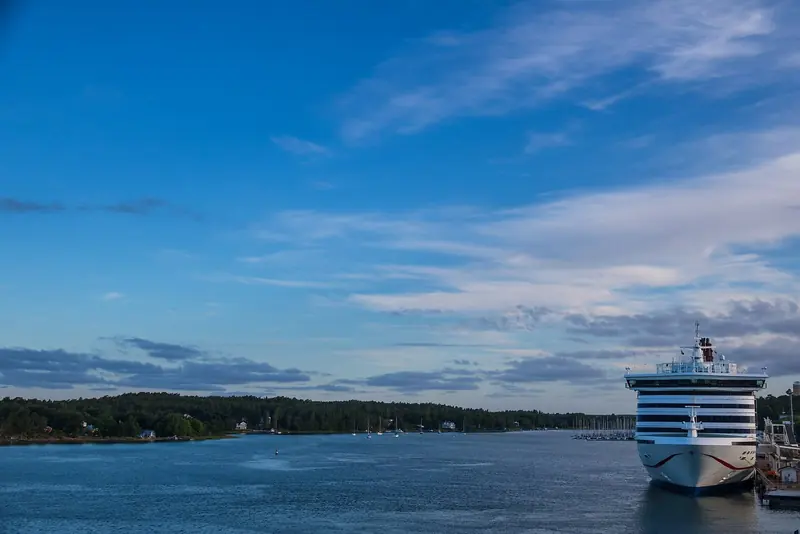
EU law banned duty-free sales on ferries sailing entirely within the Union in 1999, but a ship calling at an Aland port is, for tax purposes, leaving and re-entering the EU's fiscal area on that call, so the exemption survives. That is why Viking Line and Tallink Silja route their big Stockholm-Turku and Stockholm-Helsinki ferries through Mariehamn or Langnas rather than sailing direct, and why the onboard shops carry a genuine tax-free range rather than the duty-paid retail an ordinary EU ferry is limited to (Nordic Cooperation, Info Norden; Tallink).
For a yacht owner the same carve-out applies to a smaller boat clearing in or out of an Aland port: goods and fuel bought there sit outside the EU's VAT and excise system even though Aland is otherwise Finnish and Schengen territory, so provisioning in Mariehamn genuinely differs from provisioning in Stockholm or Turku, not just by price but by which tax regime the receipt is written under. It is a narrow, specific exemption, not a general low-tax zone, and it does not extend to real property, income tax or anything outside turnover and excise duties.
Getting There: A Small Airport and the Ferries That Pay For It
Mariehamn Airport (MHQ), in Jomala 3 km from town, carried 42,308 passengers in 2025, up 6.3 per cent on 2024, with Finnair flying to Helsinki and PopulAir to Stockholm-Arlanda and Turku (Finavia; Flightconnections). It is a regional airport built for a population of 31,000, not a gateway, and the timetable thins hard outside the June-August season.
The volume route is the ferry: Viking Line and Tallink Silja between them run multiple daily sailings on the roughly 10.5 hour Stockholm-Turku crossing, most calling at Mariehamn or Langnas specifically to keep their duty-free trading rights, and Eckero Linjen runs a dedicated Grisslehamn-Eckero service, about 2 hours each way, built for exactly this Aland Sea crossing and its tax-free shop rather than for through traffic to mainland Finland (Viking Line; Eckero Linjen). A cruising boat crossing the Aland Sea itself, from the Swedish coast, is typically a 5 to 6 hour sail in a fair breeze (Yachting World).
Mariehamn's Harbours
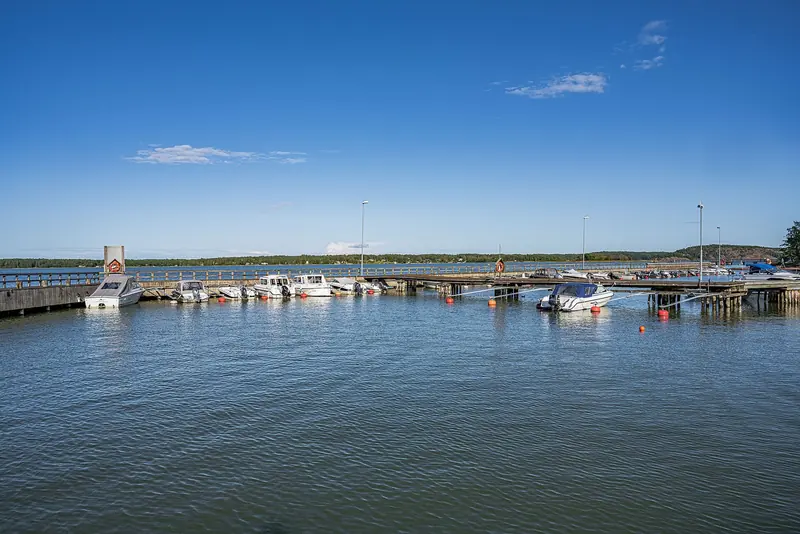
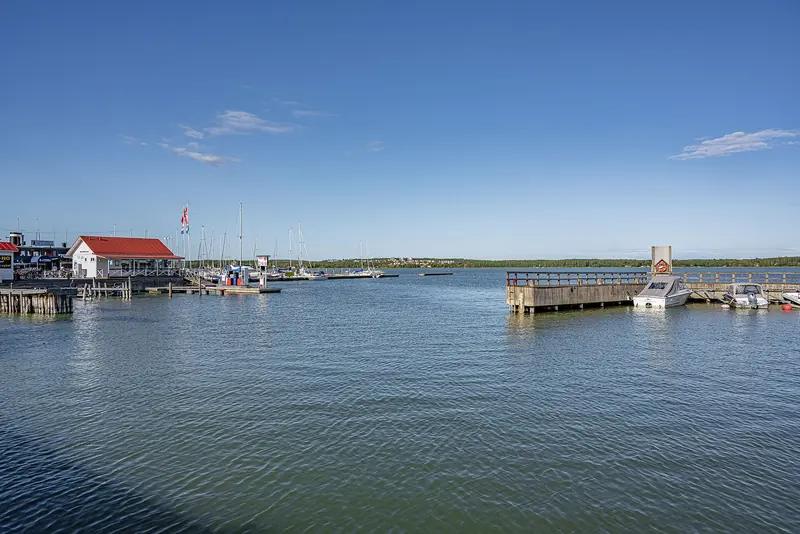
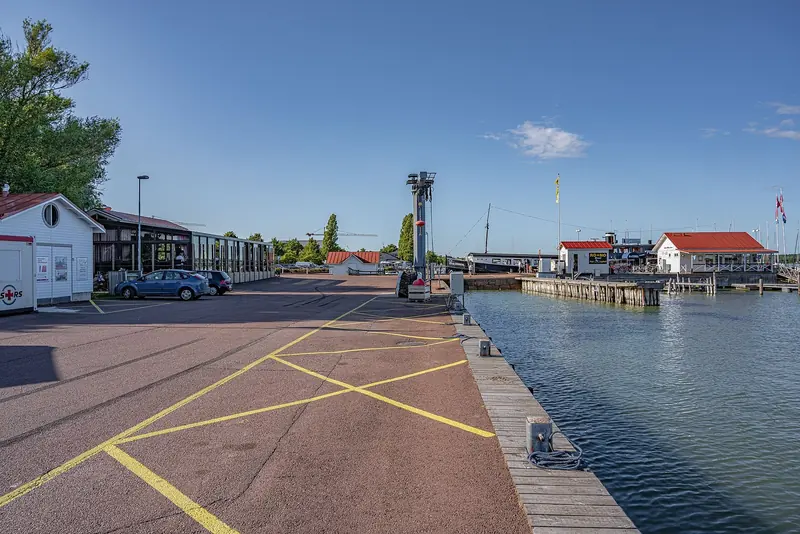
The Western Harbour (Vastra Hamnen) takes about 15 ferry sailings a day and roughly 2.5 million passenger movements a year across Sweden, Estonia and mainland Finland routes, with a 9.2 metre charted depth and a 200 metre channel width; the museum ship Pommern, a 1903 four-masted barque, is moored there as part of the Aland Maritime Museum (Wikipedia). The yacht harbours sit apart from that commercial traffic: ASS, run by the Alandic sailing society, on the west side, and MSF, Mariehamns Seglarforening, Aland's largest guest harbour at around 300 berths, two blocks from the town centre on the east side (Visit Aland; Sailors.tips).
Both are working guest harbours in the Scandinavian sense, water, electricity, showers, laundry, waste pump-out and a small shop selling fuel, charts and basic groceries, rather than a superyacht refit base, and there is no equivalent of a Mediterranean haul-out yard on the islands, so an owner needing serious technical work still plans around Turku or Helsinki. Up to 30 large passenger ferries a day moving through the same channel is a real wake hazard worth respecting on the approach (YACHT, Boote-Magazin).
Mooring to the Rock: How Baltic Sailors Actually Anchor
Where there is no jetty, boats moor directly to the rock: an anchor dropped astern, the bow or stern walked in to the granite and tied off to a fitting or a tree, a technique locals call mooring into a naturhamn. A rock hook or grapnel and enough long shorelines are treated as essential kit, and a stern anchor is described in the standard cruising guide as a must for it, provided the boat is never left on a lee shore (Sail in Finland). Rodhamn, ten nautical miles from Mariehamn and a pilot station from the 1820s until 1928, is the best known of these natural harbours and was named Finland's Guest Harbour of the Year in 2023.
Where there is a jetty, Finnish and Alandic practice is bow-to, tied to a shared stern buoy rather than a full box berth, and a harbour is considered full once every jetty space is taken, not once a second row starts rafting up, so tying alongside another boat without asking is read as trying to claim the whole space (Sail in Finland). None of the seventeen Aland guest harbours or their Turku-side equivalents take bookings for a transient yacht: you arrive, you find a space or you do not, and you pay a harbourmaster or an honesty box, the same loose, no-reservation culture Sweden and Finland share across the whole Baltic (Visit Aland; YBW Forum).
Thousands of Skerries: the Real Navigation Challenge
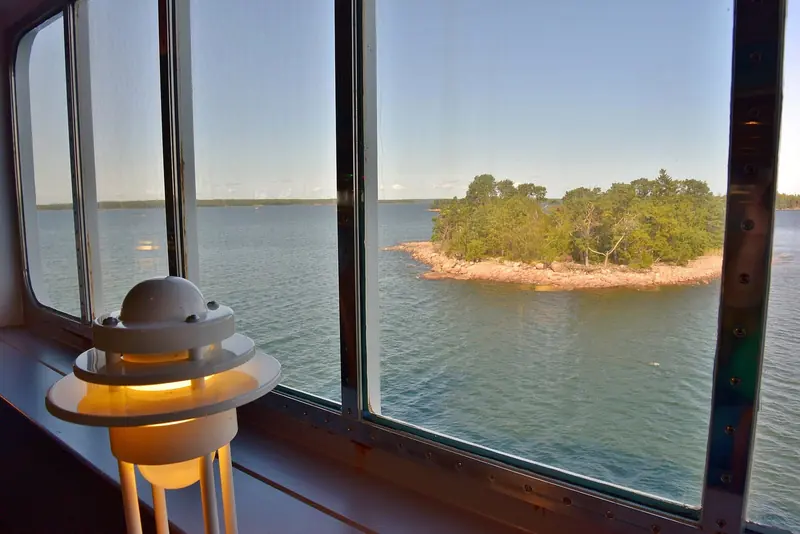
Traficom publishes a dedicated Finnish chart portfolio built for pleasure boating, and the standard advice among experienced Baltic cruisers, including on the YBW forum, is that an electronic chartplotter should not be a boat's only chart because pleasure craft typically lack the backup systems bigger ships carry; local apps such as SailMate and Skippo, and the Swedish Hydrographica folios, are commonly used alongside them. Finnpilot Pilotage, the state pilotage company, and Fintraffic's Archipelago VTS, on VHF channel 71 and on watch around the clock, cover the Turku archipelago approaches, one of six VTS areas covering the whole Finnish coast (Fintraffic; Finnpilot).
Draught is the real limiter, not distance: forum members reported a 2.0 metre draught already constraining route choice on Sweden's south coast, and a 2.3 metre draught drew immediate warnings about which natural harbours and inter-island passages would simply be closed to a boat that deep. A shallow, lifting-keel or bilge-keel boat sees far more of both archipelagos than a deep-fin cruiser does, worth knowing before choosing what to bring (YBW Forum).
The Turku Archipelago: Finland's Own Skerry Coast
Where Aland is a single autonomous province, the Archipelago Sea is simply southwest Finland: same law, same currency, same tax area as Turku and Helsinki, bilingual Finnish and Swedish rather than Swedish-only. The Archipelago Trail is a roughly 250 kilometre signposted route, about 120 km using the Rymattyla shortcut, linking the main islands, Kustavi, Inio, Naantali and Turku among them, by bridges and small car ferries, and it works as well from the water as from a car (Wikivoyage).
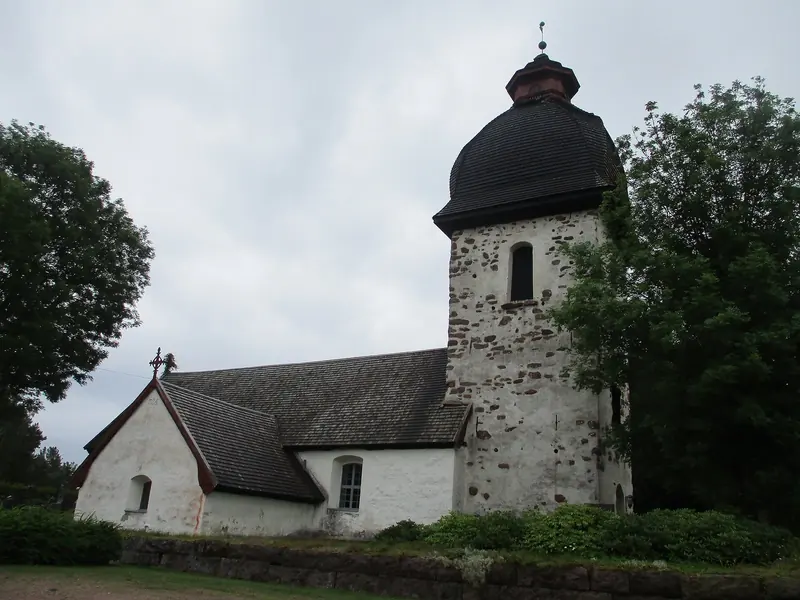
Naantali's old-town guest harbour is the archipelago's best-known stop, deep and unrestricted enough to take large sailing yachts, with Kultaranta Marina alongside it; Kustavi, under an hour from Naantali by road and a natural stepping-off point for the outer islands, runs three separate small guest harbours at Vuosnainen, Parattulanlahti and Lootholma (Visit Naantali; Explore Archipelago). The Archipelago National Park, established in 1983 over 500 square kilometres of the outer islands, protects the wildest part of the ground and is the reason the Archipelago Sea, not Aland, carries the region's UNESCO biosphere designation.
A Short, Intense Season, Then Ice
Guest harbours across Aland run full service from mid-May to late September, but locals and repeat visitors both single out June and September as the better combination of decent weather and empty anchorages, since mid-June to August is when the harbours are busiest; average summer air temperatures sit around 15 to 19 degrees C with a typically moderate southerly breeze (YACHT, Boote-Magazin). Ice formation in the Baltic normally begins in the northern Gulf of Bothnia and inner Gulf of Finland in October or November, and the melt does not clear the Bothnian Sea and Gulf of Finland until into April even in a mild winter, so a boat left afloat through winter near these latitudes is at real risk (Finnish Meteorological Institute).
Aland and the southern Archipelago Sea sit far enough south that they are not routinely locked in for the whole winter the way the Bothnian Sea is, but every serious operator still hauls out: there is no year-round afloat-berthing culture here the way there is in the Mediterranean, and the practical season for actually being aboard and cruising, as opposed to the harbours simply being open, runs closer to ten or twelve weeks than to six months.
What It Costs, Fuel and Support, and What Is Not Published
Basic Finnish guest harbours charge as little as EUR 10 to 25 a night; a 40-foot yacht at an Aland guest harbour with electricity included runs closer to EUR 30 to 40 (YACHT, Boote-Magazin; general Finnish guest-harbour pricing). Fuel, groceries, charts and basic chandlery are sold from small shops at the main guest harbours, including ASS in Mariehamn, but there is no bunkering directory or published diesel price comparable to what a Mediterranean marina network runs, and Aland's tax-free status applies to what is sold across the ferry counter, not automatically to every fuel pump on the quay.
What is genuinely not published: there is no haul-out or refit yard on Aland itself, so any serious technical work means a passage to Turku or Helsinki, and no site, including the harbourmasters' own pages, lists current per-metre or per-boat-length guest harbour tariffs in one place, so every price above should be read as a recent range, not a rate card. The tax-free retail angle is real and legally distinct, worth genuinely more than a curiosity to an owner provisioning drinks and tobacco through Mariehamn, but it does not extend to VAT relief on marine parts, engine work or a haul-out, which are ordinary Finnish VAT transactions like anywhere else in the country.
На берегу, подъезд и бронирование
| Getting there | Mariehamn Airport (MHQ), Finnair to Helsinki and PopulAir to Stockholm-Arlanda and Turku, 42,308 passengers in 2025; or the Stockholm-Turku/Helsinki cruiseferries (Viking Line, Tallink Silja) calling at Mariehamn/Langnas, and Eckero Linjen's dedicated Grisslehamn-Eckero crossing, about 2 hours. |
|---|---|
| Berthing at Mariehamn | ASS marina in the Western Harbour and MSF, Aland's largest guest harbour at around 300 berths, on the east side two blocks from town; both are Scandinavian-style guest harbours, not a superyacht refit base. |
| Guest harbour cost | Roughly EUR 10-25 a night at basic Finnish guest harbours, closer to EUR 30-40 for a 40-foot yacht with electricity at an Aland guest harbour; pay-as-you-go on arrival, no advance booking for a transient yacht. |
| Mooring style | Bow or stern to bare rock with a stern anchor and long shorelines where there is no jetty (a naturhamn); bow-to a shared stern buoy where there is one. A rock hook and a buoy hook are treated as essential kit. |
| Navigation and pilotage | Well buoyed but rock-dense; Traficom's pleasure-boating chart portfolio, backed-up electronic charts, and Fintraffic's Archipelago VTS on VHF 71, are all treated as standard, not optional. Draught over about 2 m closes off natural harbours and shortcuts. |
| Season | Guest harbours open mid-May to late September; real cruising window June to August, with June and September the quieter, still-good weeks. Winter lay-up is standard; the wider Baltic ices over further north from around October/November to April. |
| Legal status | Autonomous, demilitarised and neutralised Finnish province, Swedish the sole official language, outside the EU VAT/excise area though inside the EU customs union; status under live political discussion in 2025-2026 but unchanged. |
| Technical support | No haul-out or refit yard on Aland itself; serious work means Turku or Helsinki. No consolidated fuel-price or chandlery directory exists for either archipelago. |
| What is not published | No site publishes current per-metre guest harbour tariffs for Aland or the Turku archipelago in one place, and no fuel-price comparison exists; every price here is a recent range, not a rate card. |
Что сообщают владельцы и экипажи
Mooring bow or stern to bare granite is the whole point, not a workaround
Sailing his 35-foot yawl Arcturus from Stockholm through the archipelago, Andy Schell described the trip as a chance to explore rather than a mission to get the boat from A to B, with the boat tucked into snug rock coves rather than marina berths for most of the cruise.
Andy Schell, Yachting WorldFirst-time visitors describe the scenery and silence as close to disbelief
A cruiser identified only as Lisa, quoted arriving in the Aland archipelago, asked whether it was all real or whether they were extras in a film, and called the days and nights there marvellously silent and magnificent.
Cruiser Lisa, quoted in YACHT / Boote-MagazinA buoy hook and a stern anchor are treated as essential, not optional, kit
The standard cruising guide to Finnish waters calls a buoy hook one of the most valuable purchases a visiting boat can make, and insists a stern anchor is a must for rock mooring, provided the boat is never left on a lee shore.
Sail in Finland (cruising guide)Draught over about two metres genuinely closes off natural harbours and inter-island shortcuts
Responding to a forum member planning to bring a 7.4-foot-draught boat, an experienced Baltic cruiser warned that deep draught restricts access to natural harbours and passages between islands and skerries, particularly around southern Finland and the Stockholm archipelago.
YBW Forum member BabaYaga
Сильные стороны и что учесть
Сильные стороны
- A genuinely different jurisdiction, not just a different viewAutonomy, demilitarisation since 1856 and neutralisation since 1921, Swedish as the sole official language, and a position outside the EU's VAT and excise area are concrete legal facts that change how an owner clears in and buys fuel, not just the scenery out the window.
- Two archipelagos, one cruise, no long passage between themAland and the Turku archipelago sit back to back, roughly 70-80 nautical miles from Stockholm or Turku to Mariehamn, so a single itinerary covers two distinct skerry cultures without a long open-water leg.
- A working duty-free retail economy that keeps the ferries running and the archipelago servicedThe Aland tax carve-out is a real, still-legal exemption, not folklore, and it is the specific reason the big Stockholm-Turku and Stockholm-Helsinki ferries stop at Mariehamn at all.
На что обратить внимание
- A ten to twelve week working seasonGuest harbours nominally run mid-May to late September, but the genuinely good cruising window is closer to June through August, and harbours are thin or closed outside it.
- No haul-out or refit yard on Aland itselfAny serious technical work means a passage to Turku or Helsinki; there is no on-island equivalent of a Mediterranean refit base.
- No consolidated, published pricing for berths or fuelAn owner has to phone ahead or simply turn up; nothing online consolidates current guest-harbour tariffs or diesel prices the way a Mediterranean marina network does.
- The demilitarised status is under live political pressureFinnish mainland opinion and at least one defence-academic proposal in late 2025 have argued for reconsidering Aland's demilitarisation; nothing has changed, but a long-term owner should not assume the current settlement is permanent.
Для кого: An owner who has done the Mediterranean and Stockholm's own archipelago and wants a genuinely different Baltic jurisdiction next, thousands of granite skerries to gunkhole among, a real tax-free ferry economy at Mariehamn, and who will accept a ten to twelve week working season, no on-island refit yard and a legal status that is currently being argued over on the Finnish mainland.