The Galapagos Islands
| Location | Ecuadorian archipelago in the Pacific, roughly 1,000 km (about 600 miles) west of mainland Ecuador, straddling the equator |
|---|---|
| UNESCO status | the Galapagos Islands were the first site ever inscribed on the UNESCO World Heritage List, in 1978 |
| National Park entrance fee | USD 200 per foreign adult as of August 2024 (doubled from USD 100, the first increase since 1998), USD 100 for a child, reduced rates for Ecuadorian and regional nationals |
| Transit Control Card (TCC/INGALA) | USD 20 per person, arranged online in advance of a domestic flight or vessel arrival |
| Yacht entry | requires an AUTOGRAFO, a government authorisation issued by Ecuador's Ministry of Defense, with agents recommending the paperwork start around 60 days ahead |
| A licensed local yacht agent is mandatory to represent any private vessel with Ecuadorian authorities and to arrange the cruising permit, itinerary and provisioning | |
| A certified naturalist park guide must be aboard for any visit to a National Park protected site; visits are restricted to pre-approved sites on a fixed itinerary, not free cruising | |
| Ports of entry | Puerto Baquerizo Moreno on San Cristobal and Puerto Ayora on Santa Cruz are the principal check-in ports; Puerto Villamil on Isabela has limited infrastructure; Baltra holds the only official fuelling station and the main international airport |
| Pre-arrival requirement | a valid fumigation certificate and a clean hull certificate from the yacht's last port, to prevent introducing invasive species |
| Emergency permit | up to 72 hours dockage for a genuine mechanical or medical emergency, subject to a Navy inspection and the harbourmaster's judgement on arrival |
| Season | December to May is warmer and wetter, 27 to 32 C, with the strongest marine wildlife activity; June to November is the cooler, drier garua season, 21 to 27 C, with an hour or so of light drizzle most days |
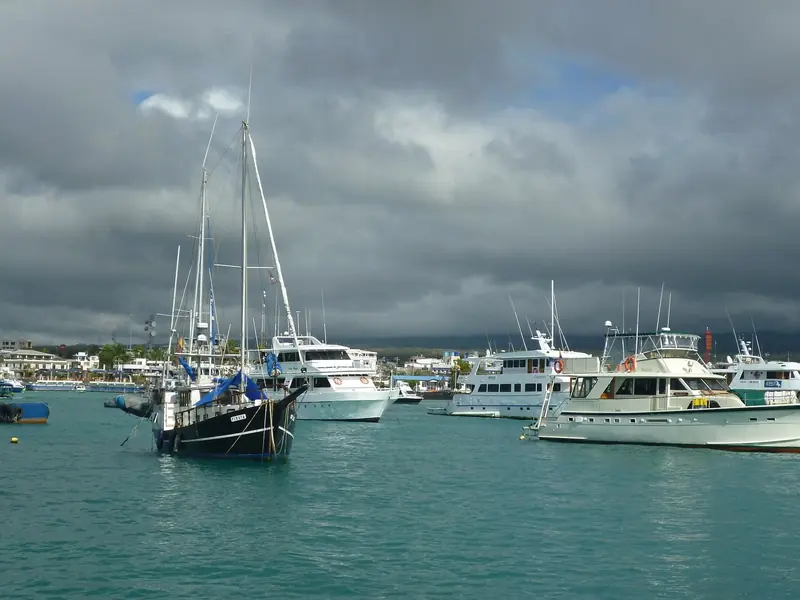
| Anchorages, not slips | there is no full-service superyacht marina in the Galapagos; vessels anchor off the main ports, with limited berthing arranged through specialised local agents |
An Archipelago That Will Not Let You Just Anchor
Nowhere else on a superyacht's itinerary does the paperwork start this early or bind this tightly. The AUTOGRAFO, the yacht's entry authorisation, is issued by Ecuador's Ministry of Defense, and specialist agents recommend starting the process around 60 days before arrival, submitting crew and guest passport copies, the yacht's registry certificate showing pleasure-yacht status, and proof of P&I insurance. A licensed local yacht agent is not optional; Ecuadorian regulation requires one to represent the vessel, and in practice the agent is also who assembles the cruising itinerary, books the mandatory naturalist guide and handles provisioning that a foreign crew cannot easily arrange alone.
The National Park Authorization that follows is what actually lets anyone off the boat. It is mandatory to have a certified naturalist park guide aboard for the duration of any visit to a protected site, and the itinerary itself has to be pre-approved rather than improvised; a yacht cannot simply choose a bay that looks interesting and send a tender ashore. Two firms doing this work repeatedly in industry listings are Galapagos Yacht Services, led by Johnny Romero, and Sea Masters Galapagos, both of which quote permit costs against the specific yacht rather than a fixed public price list, because vessel size, itinerary and documentation complexity all move the number.
What It Actually Costs to Get In
The two fees every visitor pays are public and fixed. The Transit Control Card, run through INGALA, costs USD 20 a person and is now registered online ahead of arrival rather than bought on the spot. The National Park entrance fee is USD 200 per foreign adult, USD 100 for a child, with reduced rates for Ecuadorian and regional nationals; it doubled from USD 100 in August 2024, the first increase since 1998, with the Galapagos National Park Directorate citing conservation funding and community programmes as the reason, against a backdrop of a record 330,000 visitors in 2023.
What is not a fixed public number is everything around those two fees. AUTOGRAFO processing, agent fees, the naturalist guide's day rate and the cruising permit itself are all quoted per yacht rather than published on a rate card, which both Galapagos Yacht Services and Sea Masters Galapagos state plainly on their own sites; an owner should treat any online figure for those costs as indicative at best and get a written quote against the actual vessel before budgeting a transit.
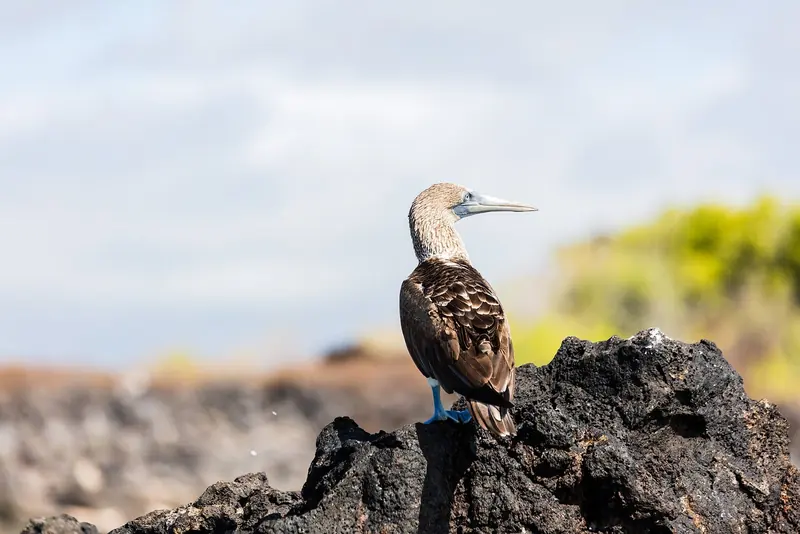
A blue-footed booby will let you stand a metre away and not move. A giant tortoise can live past 100. Neither exists anywhere else, and neither can legally be visited without a licensed guide standing beside you.
Four Ports, and Almost No Marina
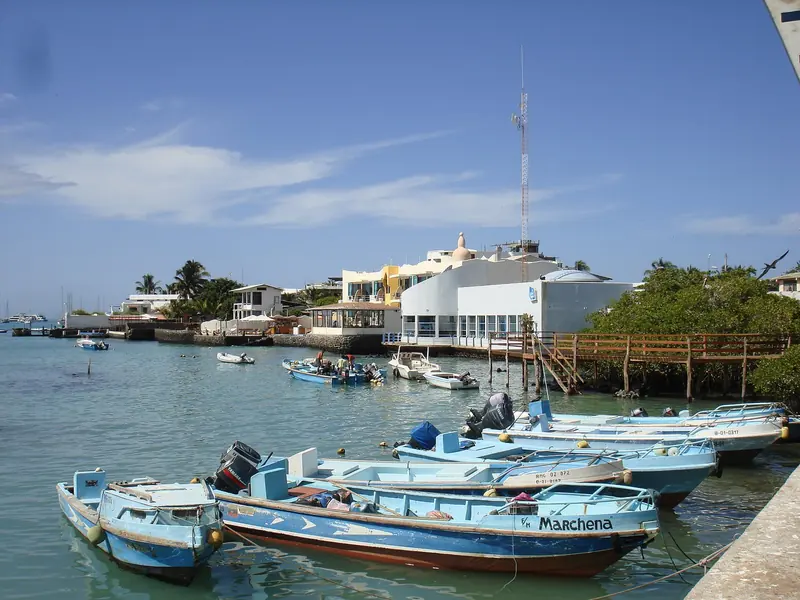
Four ports do the work of the whole archipelago, and none of them is a marina in the sense an owner would recognise from the Mediterranean or the Caribbean. Puerto Baquerizo Moreno, on San Cristobal, is usually the first landfall for a yacht entering the islands and a principal port of entry, with an open, sometimes rolly anchorage in 8 to 20 metres over sand, and it hosts the port authority and key government offices along with direct flights to Guayaquil and Quito. Puerto Ayora, on Santa Cruz, is the busiest harbour and the main provisioning centre, better protected than San Cristobal but still subject to surge, and it has no airport of its own; everyone reaches it by ferry from Baltra.
Puerto Villamil, on Isabela, is the quiet option: a shallow, reef-protected anchorage that rewards careful eyeball navigation and can see swell break across its entrance in strong conditions, with limited provisioning and technical support, so a visit there needs real advance planning. Baltra is different again: no town, but the archipelago's only official fuelling station and its main airport, making it the practical hub for crew changes and fuel even though nobody anchors there for the scenery. A specialised local firm, listed by Dockwalk under the name Yachtgala and sharing contact details with Galapagos Yacht Services, arranges what limited berthing access exists for a superyacht in this otherwise anchor-only archipelago.
Marine Iguanas, Giant Tortoises and a Reason for the Rules
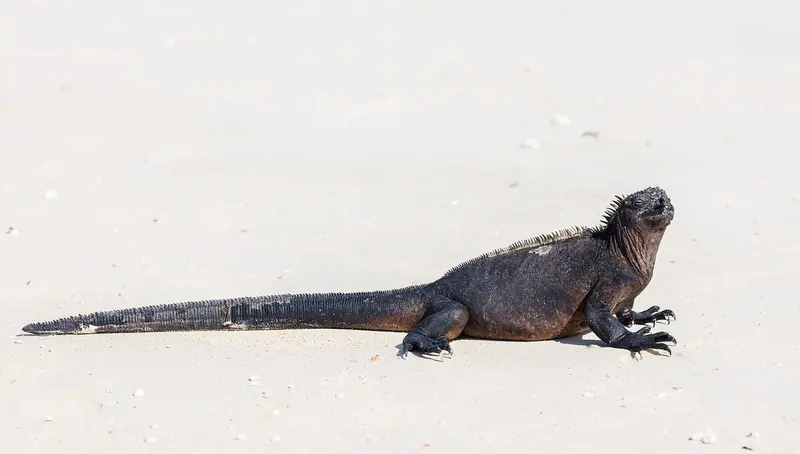
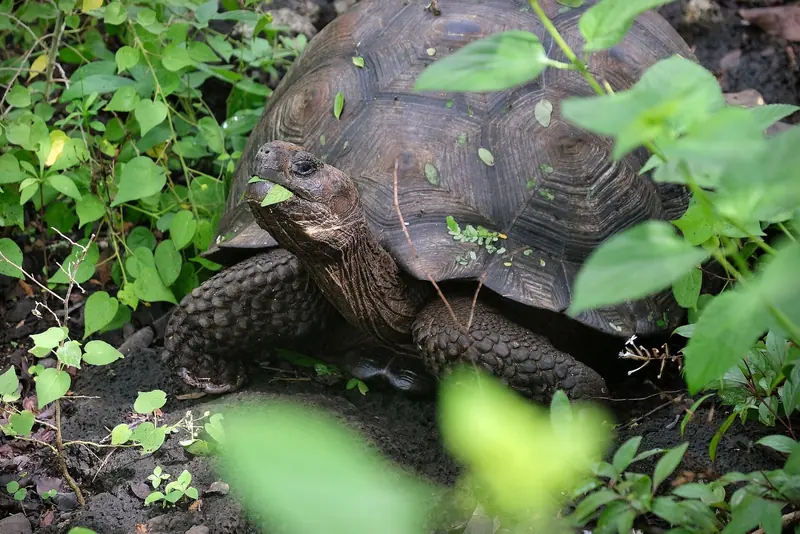
The marine iguana is the headline act: the only lizard on the planet that forages in the sea, diving to graze algae off submerged rocks before hauling out to bask on black lava. Galapagos giant tortoises, the animal that gave the islands their name, can live past a century and once numbered in the hundreds of thousands before whalers and pirates reduced them to a few thousand by taking them aboard as a living, shipboard food source; a captive breeding and repatriation programme run through the Charles Darwin Research Station has been rebuilding populations on several islands for decades. Blue-footed boobies, flightless cormorants found nowhere but Isabela and Fernandina, and thirteen or more species of Darwin's finch round out a list of species that gave Charles Darwin the observations behind On the Origin of Species after his 1835 visit aboard the Beagle.
What strikes most first-time visitors harder than any single species is the behaviour. None of these animals treats a person as a threat, because the islands never had native land mammal predators for them to evolve a fear response against; a blue-footed booby will stand its ground a metre from a tripod, and a marine iguana will bask on a path rather than move for a boot. That tameness is also exactly why the rules exist. An archipelago where the wildlife has no instinct to flee is one where careless tourism could do outsized damage fast, which is the practical argument behind the guide requirement, the fixed visitor sites and the fee that funds the Park Directorate's conservation work, rather than bureaucracy for its own sake.
Two Very Different Seasons, and When to Actually Go
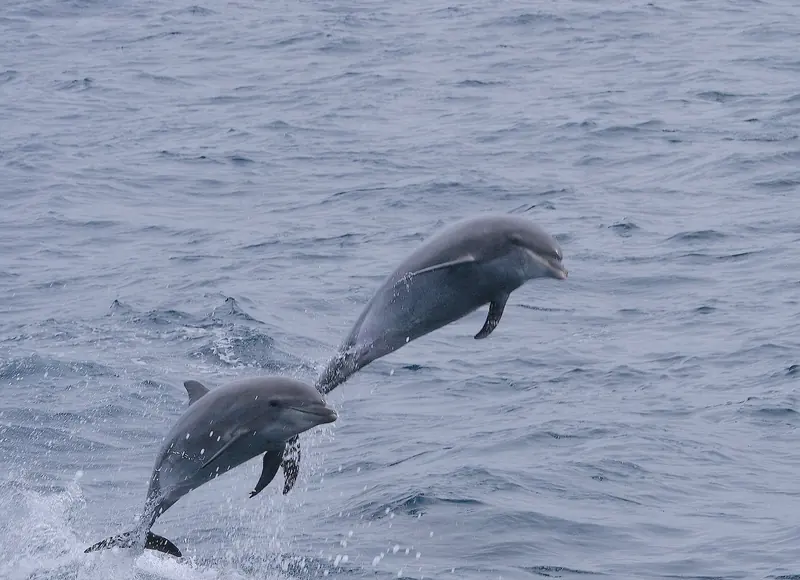
The warm season, December through May, brings clear skies and water temperatures that reward snorkelling and diving, with air temperatures of 27 to 32 C, and it is generally rated the stronger window for marine wildlife encounters, including the sea lion and ray activity that draws divers specifically. The garua season, June through November, takes its name from the Spanish for a fine mist, and it delivers noticeably cooler air at 21 to 27 C with an hour or so of light drizzle most days rather than sustained downpours; several cruising guides note it as the better season for seeing the archipelago's seabird colonies at their most active.
Neither season is a reason to avoid the islands, and the difference is smaller than the same seasonal split would mean in, say, the Caribbean hurricane belt. What genuinely matters more than the calendar month is lead time: because the AUTOGRAFO and National Park Authorization both take weeks to arrange and a fixed, pre-approved itinerary has to exist before arrival, the practical planning question is not which month is prettiest but which month the agent, the guide and the permits can actually be lined up for.
What Is Not Published, and the Honest Downside
This is the honest trade an owner makes for the wildlife. Nothing about the itinerary is improvised: the naturalist guide, not the captain or the owner, effectively sets where the yacht goes and when, because visits are confined to pre-approved sites and timed slots designed to spread pressure across the park rather than concentrate it. There is no walking off to find a quieter beach, and there is no full-service superyacht marina anywhere in the islands to fall back on if plans change; every port is an anchorage first; Puerto Villamil in particular has limited technical support if something goes wrong mechanically.
The costs that matter most to a large-yacht budget, agent fees, the naturalist guide's day rate and the cruising permit itself, are also the ones no operator publishes as a fixed number; both Galapagos Yacht Services and Sea Masters Galapagos ask for a quote against the specific vessel and itinerary rather than listing a rate card, and Yotters could not find an independent, general figure for what those services typically cost a superyacht end to end. An owner should build in real lead time, expect to pay for expertise rather than a fixed fee, and treat the guide's itinerary as the plan rather than a suggestion.
На берегу, подъезд и бронирование
| Getting there | Fly into Guayaquil or Quito on mainland Ecuador, then a domestic flight to Baltra (the main gateway, with a ferry link to Santa Cruz) or San Cristobal. There is no direct long-haul service to the islands themselves. |
|---|---|
| Permits and lead time | AUTOGRAFO entry authorisation from Ecuador's Ministry of Defense, recommended to start around 60 days ahead; National Park Authorization with a mandatory naturalist guide and a pre-approved itinerary; a licensed local agent is required to represent the vessel throughout. |
| Fixed fees | National Park entrance: USD 200 per foreign adult, USD 100 per child. Transit Control Card (INGALA/TCC): USD 20 per person, registered online before arrival. Agent, guide and permit fees are quoted per yacht, not published. |
| Ports and anchoring | Puerto Baquerizo Moreno (San Cristobal) and Puerto Ayora (Santa Cruz) are the main ports of entry; Puerto Villamil (Isabela) has limited infrastructure. Baltra holds the only official fuel dock. There is no full-service superyacht marina anywhere in the archipelago; limited berthing access is arranged through specialised local agents. |
| Before you arrive | A valid fumigation certificate and a clean hull certificate from the yacht's last port are required, to guard against invasive species reaching the park. |
| Emergency stop | Up to 72 hours dockage is available for a genuine mechanical or medical emergency, subject to a Navy inspection and the harbourmaster's decision on arrival. |
| What is NOT published | No fixed, public rate exists for agent fees, the naturalist guide's day rate or the cruising permit itself; every operator quotes against the specific yacht and itinerary. How many superyacht-scale berths, if any, exist archipelago-wide is not published either. |
Что сообщают владельцы и экипажи
What a private yacht actually needs, according to the firms that arrange it
Sea Masters Galapagos states plainly that a superyacht owner's private cruise needs two permits, the AUTOGRAFO from the Ministry of Defense and a National Park Authorization with a mandatory naturalist guide aboard, and that a valid fumigation certificate and clean hull certificate are required from the yacht's last port before arrival.
Sea Masters GalapagosWhy the fees exist, from the regulator itself
The Galapagos National Park Directorate, alongside the Galapagos Governing Council and Ecuador's Ministry of Tourism, framed the August 2024 doubling of the park entrance fee as funding conservation initiatives, infrastructure upgrades and community programmes against a record 330,000 visitors the previous year.
Galapagos National Park Directorate
Сильные стороны и что учесть
Сильные стороны
- Wildlife found nowhere else on the planetThe only sea-going iguana on Earth, giant tortoises that can live past a century, and seabirds with no fear of people are unique to the islands and were the direct inspiration for Darwin's theory of evolution.
- The conservation regime actually worksAs the first site ever inscribed on the UNESCO World Heritage List in 1978, the islands remain close to their pre-human ecological state precisely because of the permit, guide and fixed-itinerary system that makes visiting them slower and more expensive than almost anywhere else.
- The on-site check-in bureaucracy is well precedentedSpecialist agents including Galapagos Yacht Services and Sea Masters Galapagos handle this transit for yachts routinely; an owner is not solving a novel problem, just paying for expertise that already exists.
- Two genuinely different seasons, both goodWarmer months from December to May suit divers and snorkellers; the cooler garua season from June to November suits seabird activity, so there is no true bad time to visit, only a different emphasis.
- A fixed, published pair of government feesThe USD 200 park fee and USD 20 transit card are public, fixed and simple to budget, even where the surrounding agent and guide costs are not.
На что обратить внимание
- The owner does not set the itinerary, the guide doesVisits are confined to pre-approved sites on a fixed schedule with a mandatory naturalist guide aboard; there is no improvising a stop at a quieter beach the way a Mediterranean or Caribbean cruise allows.
- The real costs are not published anywhereAgent fees, the naturalist guide's day rate and the cruising permit itself are quoted per yacht by every operator Yotters found, with no independent figure available to budget against in advance.
- There is no full-service marina anywhere in the islandsEvery port is an anchorage first; Puerto Villamil in particular has limited technical support, so a mechanical problem away from Puerto Ayora or Baltra can mean a long wait for the right part or expertise.
- The paperwork takes real lead timeAgents recommend starting the AUTOGRAFO process around 60 days before arrival, ruling out a spontaneous stop the way an owner might add one almost anywhere else in the Pacific.
- The park fee just doubled, with no guarantee it stops thereThe August 2024 increase from USD 100 to USD 200 was the first change since 1998, but it shows fees here can move sharply and without much notice.
Для кого: An owner willing to hand the itinerary to a licensed local agent and a naturalist guide, budget real money and weeks of lead time for permits, and accept an archipelago with almost no marina infrastructure of its own, in exchange for wildlife encounters and a UNESCO-protected ecosystem no other cruising ground on Earth can match.