Bauer Kompressoren
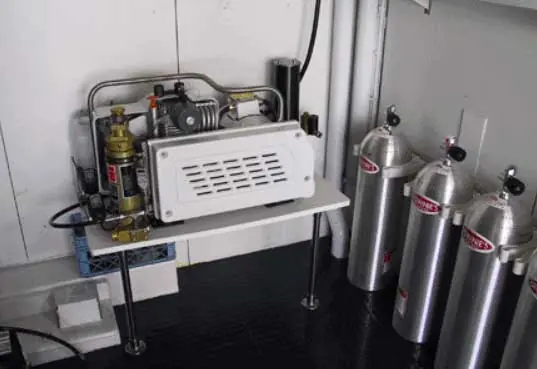
| Category | high-pressure breathing-air compressors for diving, marine and safety use |
|---|---|
| Founded | 1946 in Munich by Hans Bauer, who began building compressors in the cellar of the family home on Wolfratshauser Strasse |
| Family roots | the Bauer family's industrial history goes back to 1888, when Johann Bauer founded a workshop for agricultural machinery in Bavaria |
| Ownership | still family owned and managed, now in its third generation, with 22 subsidiaries and 15 independent branches worldwide |
| Export share | about 90 percent of production, and the company states it holds roughly 70 percent of the world breathing-air supply market |
| US arm | Bauer Compressors Inc, founded in Norfolk, Virginia in 1976, now a 115,000 sq ft plant with branch offices in Los Angeles, San Francisco and Detroit |
| Yacht-relevant range | JUNIOR II (100 l/min), CAPITANO (140 l/min), OCEANUS (140 l/min, the model built specifically for boats), MARINER (200 to 320 l/min) and the stationary VERTICUS (450 to 550 l/min) |
| OCEANUS base price | USD 9,814.95 for the gasoline or single-phase electric unit, from Darley, a US dealer, read September 2026 |
| OCEANUS EU price | EUR 8,499 including tax (EUR 7,023.97 excluding VAT) for the three-phase electric drive, from Lucas Divestore, read September 2026 |
| OCEANUS with a full yacht package | USD 16,901 to USD 17,945 installed, per Practical Sailor's nine-compressor comparison table |
| Certification | breathing air to EN 12021:2014 and CGA/ANSI Grade E on every model in the range |
| Filter cartridge cost | a Bauer Junior Triplex P21 cartridge lists at EUR 45.00, and its working life runs from 10 hours at 20C down to 3 hours at 40C |
| VERTICUS weight and footprint | 408 kg for the 450 l/min unit and 416 kg for the 550 l/min unit, each about 120 x 79 x 153 cm |
| Cheapest alternative in the Practical Sailor comparison: the Mantus at USD 2,550, against Bauer's USD 17,945 at the top of the range | |
From a Bavarian Blacksmith's Shop to the World's Breathing-Air Standard
The family's industrial history reaches back further still, to 1888, when the Bavarian blacksmith Johann Bauer founded a workshop for agricultural machinery. It was Hans Bauer who took the family firm into compressors, starting in the cellar of the family home on Wolfratshauser Strasse in Munich in 1946, building small single-stage units suited to a broke post-war economy before the company grew into industrial and breathing-air applications.
Eight decades later the business is still privately owned by the Bauer family, run today by the third generation, with 22 subsidiaries and 15 independent branches around the world and an export share of about 90 percent. Its American arm, Bauer Compressors Inc, was founded in Norfolk, Virginia in 1976 and has grown into a 115,000 sq ft plant with branch offices in Los Angeles, San Francisco and Detroit. The company states it holds roughly 70 percent of the world market in breathing-air supply, a figure that is its own and not independently audited, but the scale behind it is real: firefighters, navies and dive operators worldwide fill cylinders on Bauer equipment.
What a Yacht Actually Needs From a Compressor
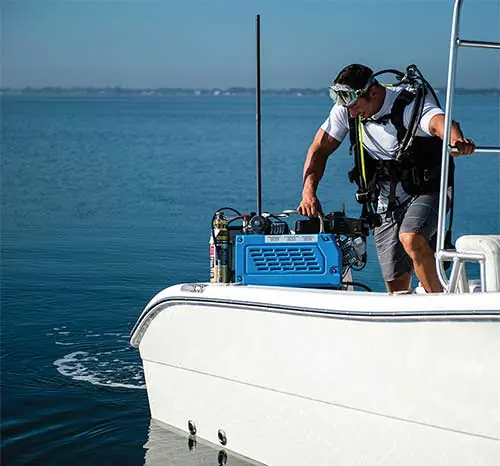
Most of Bauer's range is built for a fixed dive shop or a fire station, and a boat asks for something different: corrosion resistance, a compact footprint and electrics that survive salt air and a rolling deck. The OCEANUS answers that directly. It runs a three-stage compression design to a working pressure Bauer's European listing puts at 225 or 330 bar and the American Yachting Package version quotes to 5,000 psi, about 345 bar, delivering 140 litres a minute either way, enough to refill a single AL80 cylinder from empty in roughly 14 minutes.
The Yachting Package adds NEMA 4 protection for the electrical enclosure, an automatic condensate drain with its own muffler and separator and stainless steel fittings throughout, on top of the stainless frame and non-corrosive coolers every OCEANUS carries. It is, in the words of one American dealer's own marketing, built for offshore and tropical environments rather than a temperate dive centre car park, and it is the model most yacht installers reach for first.
A filter cartridge rated for ten hours at 20C is rated for three at 40C, which is exactly the climate most yacht dive programmes actually run in.
The Range and What Each Step Up Costs
The JUNIOR II is the smallest unit in the catalogue, at 100 l/min, sized for a tender or a cruising sailboat with limited space rather than a superyacht dive programme. The CAPITANO steps up to 140 l/min in a petrol or three-phase electric format weighing about 95 to 102 kg, built, in Bauer's own description, for daily intensive use at workshops, emergency services or dive centres rather than occasional recreational fills. The MARINER is the mobile all-rounder above that, offered as 200, 250 or 320 l/min variants on an aluminium chassis, weighing 115 to 154 kg depending on configuration, and it is the model most often seen doing double duty as a dive-centre workhorse ashore as well as aboard.
Bauer does not publish list prices for any of these on its own site, which is standard practice for German industrial compressor makers selling through a dealer network. Real numbers exist through that network: Darley, a US dealer, prices the OCEANUS from USD 9,814.95 for the gasoline or single-phase electric base unit; Lucas Divestore in the Netherlands prices the three-phase electric OCEANUS at EUR 8,499 including tax. Neither figure includes the Yachting Package or installation. Practical Sailor's own nine-compressor comparison, published after weighing Bauer against eight rivals, puts a fully yacht-packaged Bauer OCEANUS at USD 16,901 to USD 17,945 all in, the highest figure on its table.
The Stationary VERTICUS, for a Bigger Platform
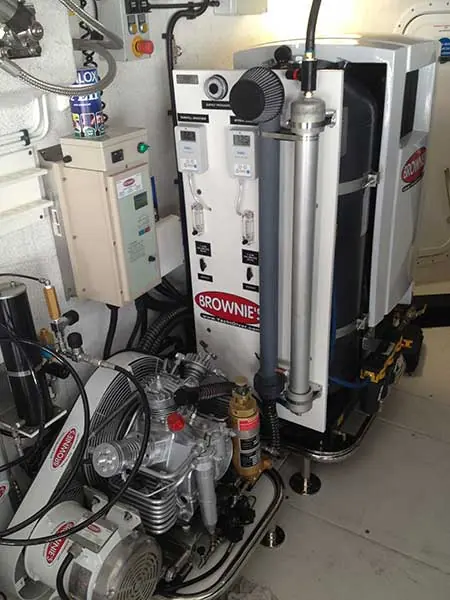
Above the portable range sits the VERTICUS, a stationary unit built to be plumbed permanently into a compressor room rather than wheeled to where it is needed. The V 450/420 delivers 450 l/min at 1,320 rpm from an 11 kW motor; the V 550/420 delivers 550 l/min at 1,150 rpm from a 15 kW motor. Both weigh over 400 kg and occupy a footprint of about 120 by 79 cm, rising to 153 cm tall, which puts them well beyond anything a 24 to 40 metre yacht is likely to carry and squarely into expedition or dive-support-vessel territory.
What the VERTICUS buys over a portable unit is automation and oversight rather than raw output alone. B-CONTROL MICRO gives it a colour-screen control system, B-CLOUD and an optional 4G or WiFi B-LINK module put its operating data on a phone or a shoreside office, and the optional B-DETECTION PLUS i gas sensor continuously checks CO, CO2, O2, humidity and VOCs against EN 12021:2014 with an automatic shutdown on a fault. A Super Silent enclosure is available where the compressor room sits close to guest or crew accommodation, since the standard cabinet is not built with noise as the first priority.
Purification, and the Consumable an Owner Does Not See Coming
Compression alone does not make breathing air. Every model in the range pairs its compressor block with a Triplex purification cartridge, sized P21 up to P81 depending on the unit: a P21 cartridge, standard on the JUNIOR II, OCEANUS and smaller CAPITANO and MARINER units, is rated for 140 cubic metres of processed air before it needs changing, while the P61 fitted to the VERTICUS is rated for 2,400 cubic metres and the largest P81 option for 5,200. All of them remove oil, water and CO2 to EN 12021:2014, and the standard only holds if the cartridge is changed on schedule.
That schedule is where the real running cost lives, and it is temperature-driven in a way that punishes exactly the climates a yacht dive programme usually operates in. A Bauer Junior Triplex P21 cartridge is rated for 10 hours of operation at 20C, but that falls to 8 hours at 25C, 5 hours at 30C and just 3 hours at 40C, per the maker's own published table. A single cartridge lists at EUR 45.00 through a European dive retailer, which sounds modest until a boat running daily fills through a Caribbean or Red Sea summer is changing cartridges every few days rather than every few weeks.
Power, Drive and Where It Actually Lives Onboard
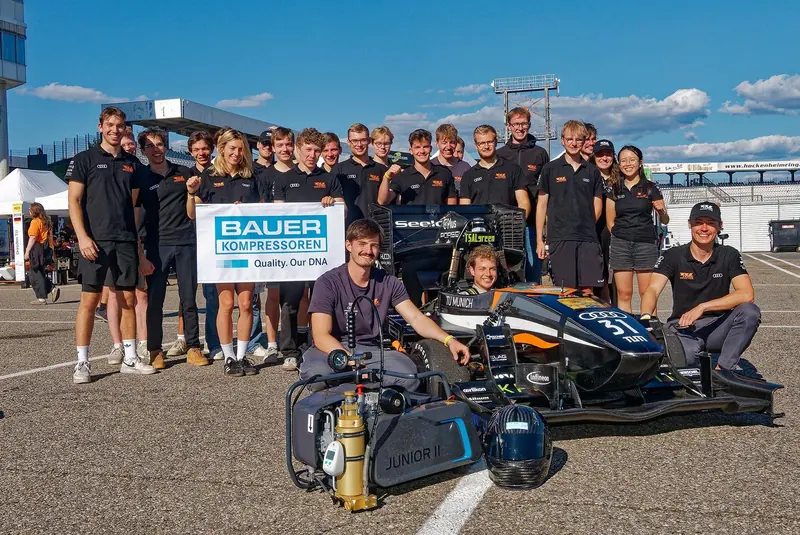
Every portable model in the range is offered as either a petrol engine or a three-phase electric motor, and the MARINER II-D adds a Hatz diesel option built for continuous duty. A yacht with reliable three-phase power aboard almost always specifies electric: the CAPITANO 140-E draws 3 kW against the 140-B's 4 kW petrol engine, and it needs no fuel stored aboard and no exhaust routed out of a compartment. A petrol or diesel unit earns its keep on a tender, a support boat, or anywhere the compressor has to run without the main vessel's power on.
Installation location is as much a diving-safety decision as an engineering one. Forum advice from owners who have actually fitted these units is consistent on the point: run the intake somewhere it draws genuinely clean air, not the same compartment as a generator or an engine, because the compressor cannot filter out carbon monoxide it has already ingested. A lazarette or a dedicated dive locker with its own ventilation is the usual answer, and Bauer's own intake telescope accessory exists specifically to relocate the intake away from a contaminated engine room.
What It Changes for Guests and Crew
Without a compressor aboard, diving from a yacht means either carrying a finite stock of pre-filled cylinders or running a tender ashore to a dive shop, both of which put a hard ceiling on how much diving actually happens on a cruise. A compressor removes that ceiling. Guests and crew fill cylinders at anchor, in whatever remote spot the itinerary has reached, and a dive can happen because someone felt like it rather than because a shop was open and reachable that day.
It also changes what the crew can offer as a programme rather than an occasional activity: a proper dive locker with its own compressor, cylinder storage and nitrox capability is now a standard fitting on serious expedition and explorer yachts, and it is one of the features charter guests specifically ask brokers about. The equipment is what makes the promise of a dive-focused itinerary actually deliverable rather than aspirational.
What Owners and Installers Actually Report
On the YBW cruising forum, an owner posting as Billyo, who runs a petrol-driven Bauer OCEANUS, reports prioritising ventilation and a long intake hose above everything else in the installation, and flags that filters are expensive and deplete quickly in tropical conditions, recommending a reusable filter housing as the practical fix. Another poster on the same thread, duncan99210, notes that every compressor of this type needs bleeding regularly while running, because the interstage coolers condense water continuously, and that commercial air certification brings its own separate requirements beyond simply owning the equipment.
Practical Sailor's own reporting on fitting a dive compressor found the same split. Andrew Trent warned in the piece that many compressors depart on a voyage with good intentions and come home neglected, with used-gear outlets along the US south-east coast full of rusted, trashed units sold cheap by owners who stopped maintaining theirs. Kraken Yachts' own designers, by contrast, recommend simply housing the compressor low in the stern lazarette from the start, specifically so the dive cylinders never have to be walked across the deck. The Councills, who cruise and write as Sailing Blown Away, make the opposite point for a specific cruising ground: airfills are available at many French Polynesian islands, so a compressor is not a strict necessity everywhere a dive-minded owner might cruise.
Against the Alternatives, and Who Should Fit One
Practical Sailor tested and compared nine compressor models for boat use, and the spread is wide: the American-made Mantus at USD 2,550 sat at the bottom, with Italy's Coltri Icon LSE 50 and LSE 100 at USD 2,175 to USD 3,995, Germany's own Bavaria Fun 2 at USD 3,100 for the electric version, Italy's Nardi Atlantic at USD 5,189 and Germany's L&W LW 100 E1 at USD 5,999, against the fully yacht-packaged Bauer OCEANUS at USD 16,901 to USD 17,945. Fill times across the nine ranged from 16 to 67 minutes per AL80 cylinder, and Bauer's position at the top of the price table is not matched by a proportional lead in raw fill speed.
What the price buys is the certification, the support network and the parts availability that come with the largest name in the category, plus the yacht-specific engineering the OCEANUS carries as standard rather than as an aftermarket adaptation. An owner cruising close to Bauer's own dealer and service network, and who wants one name to call for warranty and parts anywhere from the Mediterranean to the Caribbean, gets real value for that premium. An owner on a tighter budget, or cruising in waters where a Coltri or Nardi dealer is the more realistic service option, has genuine, far cheaper alternatives that do the same basic job of turning ship's power into a full dive cylinder.
Практическая информация
| Equipment prices, from dealers rather than Bauer itself | Bauer does not publish list prices. Real dealer prices for the yacht-relevant OCEANUS: USD 9,814.95 for the gasoline or single-phase electric base unit from Darley (US, read September 2026), and EUR 8,499 including tax for the three-phase electric drive from Lucas Divestore (Netherlands, read September 2026). Neither includes the Yachting Package or fitting. |
|---|---|
| The yacht package moves the price a long way | Practical Sailor's nine-compressor comparison puts a fully yacht-packaged Bauer OCEANUS at USD 16,901 to USD 17,945 installed, against a base unit price under USD 10,000. The Yachting Package itself adds NEMA 4 electrical protection, an automatic condensate drain with muffler and separator and stainless steel fittings throughout. |
| The filter cartridge is the real recurring cost | A Bauer Junior Triplex P21 cartridge lists at EUR 45.00 through a European dive retailer, and its rated working life runs from 10 hours of operation at 20C down to 8 hours at 25C, 5 hours at 30C and just 3 hours at 40C, per the maker's own published table. A boat filling cylinders daily through a tropical summer is buying cartridges far more often than the equipment price alone suggests. |
| What each purification size actually processes | P21 (standard on the OCEANUS, JUNIOR II and smaller CAPITANO/MARINER units): 140 cubic metres between changes. P31: 600 cubic metres. P41: 1,550 cubic metres. P61 (standard on the VERTICUS): 2,400 cubic metres. P81, the largest option: 5,200 cubic metres. |
| Alternatives cost a fraction of a fitted Bauer | Practical Sailor's comparison table: Mantus (USA) USD 2,550, Coltri Icon LSE 50/100 (Italy) USD 2,175 to USD 3,995, Bavaria Fun 2 (Germany) USD 3,100, Nardi Atlantic (Italy) USD 5,189, L&W LW 100 E1 (Germany) USD 5,999. Fill times across all nine models ranged 16 to 67 minutes per AL80 cylinder. |
| Soft-start and installation extras | Practical Sailor puts a soft-start circuit for an electric-drive unit, which reduces the inrush current on start-up, at roughly USD 800 to USD 900, a cost that applies on top of the compressor and is easy to miss when comparing equipment prices alone. |
| The maintenance routine that keeps the warranty valid | Per Practical Sailor: check the oil weekly and change it on a schedule that runs from 50 to 2,000 operating hours depending on the model; run the compressor for 20 minutes a week even when nobody is diving, to keep seals and rings lubricated; check the condensate trap before and after every use; and keep the boat's heel under about 5 degrees while the unit runs. |
| What is NOT published | Bauer publishes no list prices anywhere on its own site for any model in the range, no independent third-party fill-speed test beyond what dealers and reviewers have measured themselves, and no bearing or long-run overhaul cost. The 70 percent breathing-air market share the company cites is its own figure, not an independently audited one. |
Что сообщают владельцы и экипажи
Ventilation and intake placement matter more than the compressor itself
An owner running a petrol-driven Bauer OCEANUS reports prioritising ventilation and a long intake hose above everything else in the installation, and warns that filters are expensive and deplete quickly in tropical conditions, recommending a reusable filter housing as the practical fix.
YBW Forum (Billyo)Every compressor of this type needs regular bleeding, whatever the brand
Bleeding is required regularly while the unit runs, because the interstage coolers condense water continuously, and commercial air certification brings its own separate requirements on top of simply owning the equipment.
YBW Forum (duncan99210)Neglect, not mechanical failure, is the compressor's real enemy on a long voyage
Many compressors depart on a voyage with good intentions and come home neglected, and used-gear outlets along the US south-east coast are full of rusted, trashed units sold cheap by owners who stopped maintaining theirs.
Practical Sailor (Andrew Trent)Where the compressor lives in the boat is a deliberate design choice
The recommendation is to house the compressor low in the stern lazarette from the outset, specifically so the dive cylinders never have to be carried across the deck to reach it.
Practical Sailor (Kraken Yachts designers)A compressor is not a strict necessity on every cruising ground
Airfills are available at many French Polynesian islands, which means a boat cruising that specific ground can dive without carrying its own compressor at all, unlike a more remote expedition itinerary.
Practical Sailor (The Councills, Sailing Blown Away)
Сильные стороны и что учесть
Сильные стороны
- It is purpose-built for a boat, not adapted from a shop unitThe OCEANUS carries a stainless frame, non-corrosive coolers and, in its Yachting Package form, NEMA 4 electrical protection and an automatic condensate drain designed for salt air and a moving deck from the start, rather than a land-based compressor with marine parts bolted on afterward.
- The range scales from a tender to a dive-support vesselA JUNIOR II at 100 l/min suits a cruising boat with limited space; a VERTICUS at up to 550 l/min, remotely monitored through B-CLOUD, suits an expedition yacht running two dive teams at once. Almost no other maker covers that full span under one brand and one service network.
- Certification and standards compliance are built in, not optionalEvery model in the range delivers breathing air to EN 12021:2014 and CGA/ANSI Grade E as standard, which matters directly to guest and crew safety and is the first thing a charter management company or insurer will ask about.
- Eight decades of scale behind the parts and service networkFounded in 1946 and still family owned, with 22 subsidiaries and 15 independent branches worldwide plus a dedicated US operation in Norfolk, Virginia since 1976. A compressor stopped on the far side of an ocean is a real problem, and Bauer's network is built to reach it.
- The purification range is genuinely sized to the equipmentA P21 cartridge processing 140 cubic metres suits the small portable units, and a P81 processing 5,200 cubic metres suits the VERTICUS, so an owner is not stuck buying an oversized or undersized filter for the compressor actually fitted.
На что обратить внимание
- It is the most expensive name in its own comparison tablePractical Sailor's own nine-model test put a yacht-packaged Bauer OCEANUS at USD 16,901 to USD 17,945, against a Mantus at USD 2,550 and a Nardi Atlantic at USD 5,189, without a proportional lead in fill speed over the cheaper units on the same table.
- The filter cartridges are a real, climate-driven running costA EUR 45.00 P21 cartridge rated for 10 hours at 20C falls to just 3 hours at 40C, exactly the temperature range most yacht dive programmes actually operate in, which turns a modest per-cartridge price into a frequent, ongoing cost in the tropics.
- Bauer publishes nothing on price itselfEvery figure in this entry comes from a dealer, not from Bauer's own site, which means a buyer has to shop the dealer network rather than compare list prices directly, and figures can vary meaningfully between regions as the Darley and Lucas Divestore prices already show.
- Owner reports flag neglect as a real failure mode, not just mechanical wearPractical Sailor's Andrew Trent reported used-gear outlets full of rusted, trashed compressors from owners who stopped maintaining theirs mid-voyage, a pattern that has nothing to do with the equipment's engineering and everything to do with a system that needs weekly attention even when nobody is diving.
- Installation is not a plug-and-play jobForum owners are consistent that intake placement away from engine or generator exhaust is a genuine safety requirement, not a preference, and getting it wrong risks contaminating the breathing air the compressor exists to keep clean.
Для кого: Owners and captains fitting a real dive programme to a yacht, from a portable OCEANUS on a 24 metre boat to a stationary VERTICUS on an expedition or dive-support vessel running more than one team at once.