Teledyne FLIR Marine
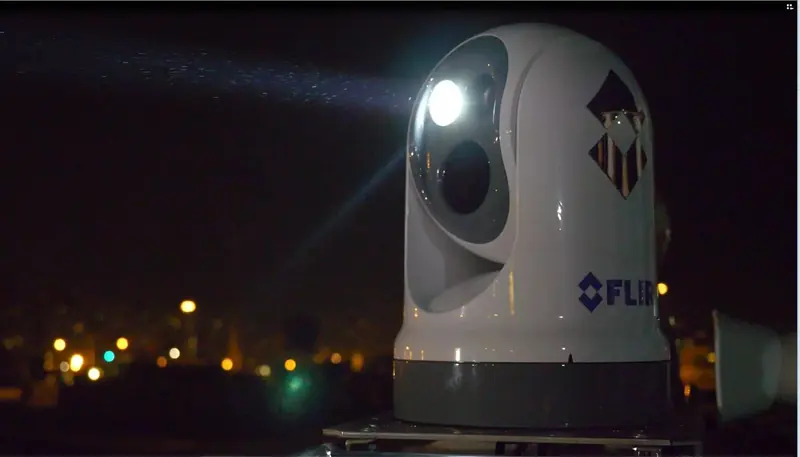
| Category | pan-and-tilt thermal and low-light cameras for night navigation, collision avoidance and surveillance on boats and yachts |
|---|---|
| Founded | 1978 as FLIR Systems in Oregon, developing airborne infrared imaging systems |
| Key acquisitions | Agema of Sweden in 1998, Inframetrics in 1999, Indigo Systems in 2003 |
| Parent company | acquired by Teledyne Technologies in 2021 for approximately USD 8 billion; now trades as Teledyne FLIR |
| Marine range | at least eleven fixed-mount models from the MD series and M232 up to the M500 and M560, plus handheld and mast-mounted units |
| Entry price | FLIR M232, 320 x 240 thermal resolution, listed at USD 3,095 |
| Mid-range price | FLIR M300C, ultra-low-light HD camera with 30x optical zoom and thermal-grade housing, listed at USD 8,195 |
| Flagship price | FLIR M400XR listed between USD 83,899 and USD 89,995 depending on dealer |
| M400XR detection range | 12.78 nautical miles for a 30 ft vessel, 3.79 nm for a NATO 2.3 m target, 1.57 nm for a person in the water |
| Warranty | 2 years standard, extendable to 3 years on marine camera systems |
| Integration | outputs to Raymarine Axiom, Garmin, Furuno and Simrad multifunction displays as well as analog and HD-SDI video |
From Airborne Military Sensors to a Boat's Helm
FLIR's first products were airborne thermal imaging systems built for military and industrial customers who could absorb the cost of hand-built infrared detectors. The company grew through acquisition rather than only internal development: Hughes Aircraft's industrial infrared group came in 1990, the Swedish pioneer Agema, whose own history reached back to the first commercial infrared scanner in 1965, in 1998, Massachusetts-based Inframetrics in 1999, and detector maker Indigo Systems in 2003. Each deal brought sensor technology and manufacturing scale that eventually made a thermal core cheap enough to put on a recreational boat rather than only a helicopter or a naval vessel.
The 2021 sale to Teledyne Technologies, valued at about USD 8 billion, folded FLIR into a much larger imaging and instrumentation group, but the marine range kept operating under the FLIR brand with its own dedicated site and dealer network. For a buyer today the practical effect is a company with more financial depth behind its warranty and a still-recognisable badge on the camera housing.
What a Pan-and-Tilt Thermal Camera Actually Does
The range runs from fixed-view MD-series units with no moving parts, through the M232 entry pan-and-tilt camera with a 320 x 240 thermal sensor and 360-degree continuous pan, up through the M300 and M400 families that add a genuine ultra-low-light HD visible camera alongside the thermal core, gyro stabilisation to keep the image steady in a seaway, and an LED spotlight slaved to the same joystick. The M400XR adds video tracking, radiometry and a firefighter mode over the plain M400, and the flagship M500 and M560 step up to a cryogenically-cooled mid-wave infrared sensor with far longer detection range and a laser rangefinder on the M560, aimed at commercial and superyacht security use rather than weekend cruising.
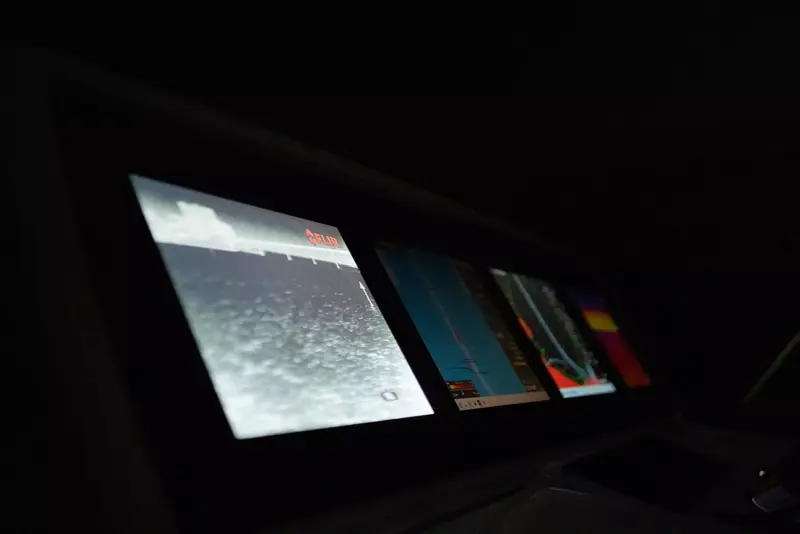
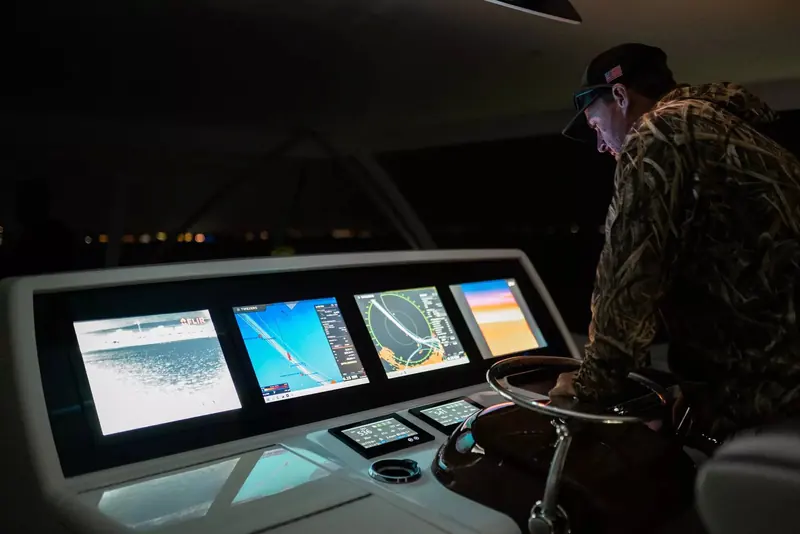
Every model outputs to the boat's own multifunction display over the same network that already carries chartplotter and radar data, so on a Raymarine, Garmin, Furuno or Simrad system the thermal feed becomes one more window rather than a separate standalone monitor. FLIR markets Marine Video Analytics, an onboard object-detection layer, as an added feature on the mid-range and above, which draws attention to a moving contact automatically rather than relying on a person watching the screen continuously.
The performance of a $15,000 camera is night and day over a $3,000 one, and owners who have run both say so without being asked.
A Second Job: Watching for a Fire Before There Is Smoke
The MTMS is not a navigation camera; it stares at one space continuously, reading temperatures from minus 10 to 150 degrees Celsius with a stated sensitivity of about 0.1 degree Celsius, fine enough to catch the early heat rise of a battery cell going into thermal runaway rather than waiting for a smoke detector to trigger. FLIR positions it directly against the rise in lithium-ion e-bikes, e-foils and tender batteries stored in yacht toy garages, a storage pattern that did not exist on most boats a decade ago and that insurers and yards have both flagged as a growing fire risk.
The pitch is time: a temperature-based alarm can fire minutes before a smoke-based system would, in a compartment where a fire has very little room to grow before it reaches fuel, tenders or the hull itself. Trade coverage of the lithium battery fire trend, including reporting from Boat Industry and the security-industry title GIT-SECURITY, has treated thermal monitoring as one of the more credible early-detection responses being adopted by yards and refit specialists rather than a novelty add-on. It is a genuinely different product from the pan-and-tilt navigation cameras that make up the rest of the range, aimed at owners and captains who store lithium-powered toys aboard rather than at anyone choosing a camera purely for running at night.
What the Range Actually Costs
The M232, FLIR's smallest and cheapest pan-and-tilt marine camera with a 320 x 240 thermal sensor, was listed at USD 3,095 through a US chandlery in 2026. The M300C, which adds a genuine ultra-low-light HD colour camera with 30x optical zoom to the thermal sensor and gyro stabilisation, listed at USD 8,195. At the top, the M400XR, FLIR's long-range multi-sensor system with video tracking and radiometry, was seen priced between USD 83,899 and USD 89,995 depending on dealer. Every one of those figures is hardware only, before a marine electrician's time to run cable, mount the dome and integrate it with the helm display.
FLIR publishes no retail price at all for the M500 or M560, its two flagship cooled-sensor cameras aimed at commercial security and long-range detection rather than recreational cruising; both are quoted through the dealer network on request. The gap between the cheapest and most expensive fixed-mount camera in the current range is roughly thirtyfold, and owners who have used both ends are consistent that the difference in usefulness tracks the price gap closely rather than being a case of diminishing returns.

Is a FLIR Camera Actually Worth It?
One long-time FLIR seller and installer posting on The Hull Truth called it "the very best in night vision" available for boats, while recommending the mid-range M324 as an option that "won't break the bank and you still have the FLIR quality" for an owner not ready to spend flagship money. Another owner running a Mariner-series unit on a flybridge reported "it works great at night or in fog," and a separate poster with a handheld FLIR called the heat-signature image "amazing, and very useful," rating it well ahead of second-generation image-intensifier night vision goggles.
The same forum carries the harder-edged warning that shapes how to read every other comment: "the deal with a FLIR camera is you really need to spend some serious coin to get a model that is useful," with one poster stating flatly that "the performance of a $15k camera is night and day over a $3k camera," and entry-level fixed models dismissed by another as "really worthless" because camera angle is critical to whether the image is usable at all. A separate account described a FLIR unit that "never worked" on one boat while performing fine on others, a reminder that installation and aiming, not just the model chosen, decide whether the camera earns its keep. The common thread across every account, favourable or not, is that a FLIR camera buys a genuine safety margin, in the words of one supporter, "that half second extra to bring the throttles back," but only once the buyer has matched the model to the boat and the budget to the model.
Buying, Installing and Warranty
Every camera in the range needs a clear line of sight, a network or coax run back to the helm depending on model, and for the pan-and-tilt units a joystick or software control integrated with the multifunction display; FLIR itself markets a growing list of compatible displays from Raymarine, Garmin, Furuno and Simrad rather than a single proprietary screen. FLIR's stated marine warranty is two years, extendable to three, a shorter period than some competing electronics categories but consistent with the rest of the thermal-imaging market where the sensor itself, not the housing, is the expensive part to replace.
Because FLIR sells through dealers rather than direct to the public, pricing varies by several hundred dollars between retailers for the same model, and the flagship M500 and M560 are quoted only after a dealer consultation. For an owner comparing options, that means getting at least two quotes on the exact model and mount configuration before committing, since the installation labour and cable run can add meaningfully to the sticker price on a larger boat with a longer run from mast to helm.
Практическая информация
| Entry price | The FLIR M232, the smallest and cheapest pan-and-tilt marine thermal camera in the current range with a 320 x 240 thermal sensor, was listed at USD 3,095 through a US marine electronics retailer in 2026. |
|---|---|
| Mid-range price | The FLIR M300C, which pairs the thermal sensor with a genuine ultra-low-light HD colour camera, 30x optical zoom and gyro stabilisation, listed at USD 8,195. |
| Flagship price | The FLIR M400XR, with video tracking, radiometry and long detection ranges, was seen priced between USD 83,899 and USD 89,995 depending on dealer. FLIR publishes no price for the M500 or M560 above it; both are quoted only through a dealer. |
| What the flagship claims to see | FLIR's own published figures for the M400XR give a detection range of 12.78 nautical miles for a 30 ft vessel, 3.79 nm for a NATO-standard 2.3 m target, and 1.57 nm for a person in the water. These are the manufacturer's own figures under stated test conditions, not an independent trial. |
| Warranty | FLIR states a standard two-year warranty on its marine cameras, extendable to three years. |
| Installation is not trivial above the entry model | A pan-and-tilt camera needs a clear mounting location with an unobstructed view, a cable run back to the helm, and integration with a compatible multifunction display (Raymarine, Garmin, Furuno or Simrad) for joystick control and video display. FLIR sells only through dealers, so installation is normally quoted alongside the hardware rather than done as a separate DIY job. |
| The gap between cheap and useful, in owners' own words | Multiple owners on The Hull Truth describe entry-level fixed cameras as of limited real-world use because mounting angle and resolution matter enormously, with one stating plainly that a camera around USD 15,000 performs in a different class from one around USD 3,000. Buyers on a tight budget are better served by a lower expectation of what the camera will show than by assuming any FLIR camera performs like the flagship. |
| What is NOT published | FLIR does not publish a retail price for its two most capable fixed-mount cameras, the M500 and M560, or an independent third-party test of its claimed detection ranges. Every range figure quoted for the line is the company's own, under conditions FLIR itself defines. |
Что сообщают владельцы и экипажи
The mid-range camera earns real enthusiasm, the entry model does not
A long-time FLIR seller and installer called it "the very best in night vision" and recommended the mid-range M324 as a camera that "won't break the bank and you still have the FLIR quality," while other posters on the same forum dismissed the cheapest fixed-mount cameras as "really worthless" for serious use because mounting angle is critical to whether the image is usable.
The Hull Truth (owner forum)Spend determines whether the camera actually helps
One experienced poster summarised the whole range in a single line: "the deal with a FLIR camera is you really need to spend some serious coin to get a model that is useful," adding that "the performance of a $15k camera is night and day over a $3k camera."
The Hull Truth (owner forum)Real-world results vary by boat and installation, not only by model
One owner reported a FLIR unit that "never worked" on one boat while performing fine when fitted to others, and a separate flybridge owner running a Mariner-series unit said simply, "it works great at night or in fog."
The Hull Truth (owner forum)
Сильные стороны и что учесть
Сильные стороны
- A genuine, well-documented safety margin at night and in fogThermal imaging shows a swimmer, a channel marker, a log or another vessel as a heat signature regardless of ambient light, which owners consistently describe as buying real reaction time rather than a novelty feature, in one poster's words "that half second extra to bring the throttles back."
- A wide range that can be matched to the budget and the missionFrom a USD 3,095 entry camera to a flagship approaching USD 90,000, an owner can choose a model scaled to how often and how seriously they run at night, rather than a single one-size offering.
- Deep pockets and a long corporate history behind the warrantyA company with roots to 1978 and, since 2021, the balance sheet of Teledyne Technologies behind it is unlikely to disappear and leave a marine camera unsupported, unlike some smaller thermal-imaging entrants.
- Integrates into the helm display the owner already hasOutput to Raymarine Axiom, Garmin, Furuno and Simrad multifunction displays means the thermal feed sits alongside chartplotter and radar rather than needing its own dedicated monitor and control head.
- Marine Video Analytics reduces the need for a dedicated watchkeeperAutomatic object detection on the mid-range and above draws attention to a moving contact on the thermal feed, which matters most on a short-handed boat where nobody can watch a screen continuously.
На что обратить внимание
- The cheap end of the range disappoints a buyer who expects flagship performanceOwners on The Hull Truth call entry-level fixed cameras "really worthless" for serious use because mounting angle and resolution limit what they can actually show, a sharp contrast to the enthusiasm those same forums show for the mid-range and above.
- A genuinely useful camera costs several times the entry priceOne experienced poster put it plainly: "the performance of a $15k camera is night and day over a $3k camera." A buyer working to a tight budget risks spending real money on a camera that does not deliver the safety margin FLIR is known for.
- No published price for the two most capable modelsThe M500 and M560, the cameras with the longest range and the most advanced sensors, carry no public price at all, so an owner cannot compare them against a competing thermal system without first engaging a dealer.
- Results depend heavily on installation, not just the model boughtOne owner reported a FLIR camera that "never worked" on one boat while performing fine on others with the same model, underlining that aim, mounting height and clear sightlines decide the outcome as much as the specification sheet does.
- Every detection-range figure is the manufacturer's ownFLIR's headline detection ranges, including the 12.78 nm figure for a 30 ft vessel on the M400XR, are published under the company's own test conditions with no independent verification cited alongside them.
Для кого: Owners who run at night, in fog or in low-light conditions often enough that a searchlight and a spotter are not enough margin, and who are prepared to spend toward the middle or top of the range rather than the cheapest fixed camera to get a genuinely useful image.