Webasto Marine
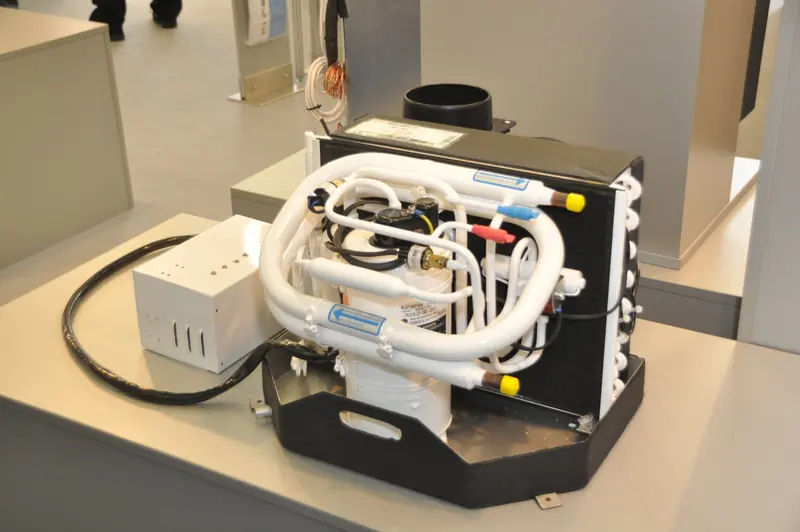
| Category | marine diesel forced-air heaters, hydronic (wet) heating systems and self-contained/chiller air conditioning, sold as Webasto Marine, a market division of Webasto Group |
|---|---|
| Parent | Webasto Group, headquartered in Stockdorf near Munich, Germany; founded 1901 by Wilhelm Baier as a bicycle-spoke and sheet-metal parts maker, entered vehicle sunroofs in the 1930s-50s |
| Ownership | privately held, still controlled by the founding families, not publicly traded |
| Group scale (2025) | roughly EUR 3.8 billion revenue, about 13,100 employees, 50-plus locations in over 25 countries; roof systems is the largest segment (about 79 percent of revenue, roughly EUR 3.0 billion), Thermo Management (heating and cooling, including marine) about 13 percent (roughly EUR 500 million), battery systems about 8 percent |
| Marine heating range | Air Top Evo 40/55 forced-air (4-5.5 kW, replacing the older Air Top 3500/5500), Thermo Pro 50/90 and Thermo Top Pro 120/150 hydronic heaters (1.8 kW up to 15 kW) |
| Marine AC range | BlueCool self-contained units (S-Series) and chiller/central systems (C-Series, V-Series, A-Series), 6,000 to over 1,000,000 BTU/h across the catalog; BlueComfort Premium combines a BlueCool chiller with a diesel water heater under one controller |
| Refrigerants | BlueCool C-Series historically used R407C; newer V-Series units use R410A and the VX-Series uses R32 |
| New small forced-air heater kit (Air Top Evo 55, 1.5-5.5 kW): commonly listed around $2,680-$2,780 for the complete 12V kit | |
| New hydronic heater kit (Thermo Pro 90, 9.1 kW): dealer listings run roughly $2,300-$5,100 depending on kit contents (basic kit versus a full Surewire/multicontroller kit) | |
| New self-contained AC/chiller unit (BlueCool C16, 16,000 BTU/h): dealer prices commonly $2,470-$4,130 depending on configuration and reversing/heat option | |
| Warranty | 2 years or 2,000-3,000 operating hours on marine heaters (whichever comes first); installation through an Authorised Webasto Partner can extend heater coverage to a 3-year onboard warranty |
| Distribution | regional master distributors and certified dealer networks rather than a single global storefront, for example PLC Marine World S.A. as exclusive Mexico distributor (named August 2025) running over 30 certified dealers from a Merida warehouse; UK network runs close to 200 dealers |
| Corporate refrigeration adjacency | Indel Webasto Marine, a 1965-origin joint venture between Webasto and Italy's Indel B, makes marine fridges, freezers and water heaters (Isotherm, Isotemp, Frigonautica brands) under a separate US arm, Indel Webasto Marine USA, based in Fort Lauderdale, Florida - a related but distinct business from the Webasto-branded heating/AC line covered here |
| Direct competitor on diesel heating | Eberspacher (sold in North America as Espar, now branded Eberspaecher Climate Control Systems), a similarly sized private German family company founded 1865 in Esslingen, with 2025 group revenue over EUR 5.0 billion and about 10,400 employees |
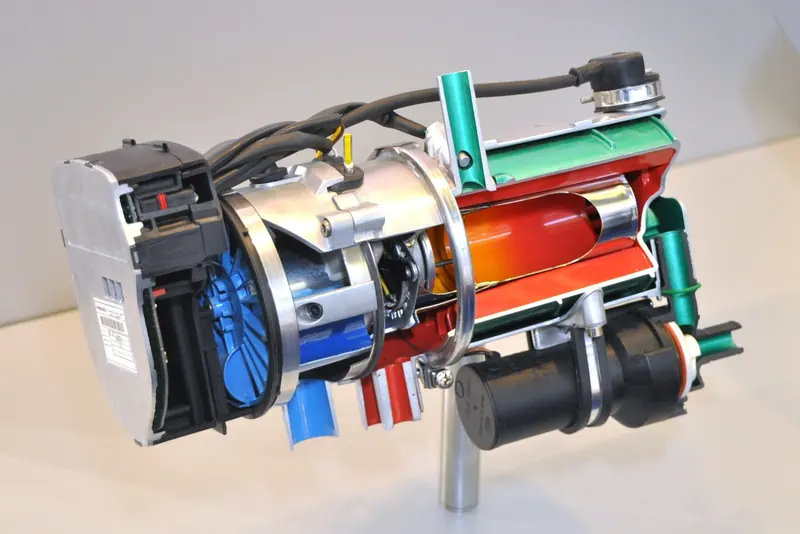
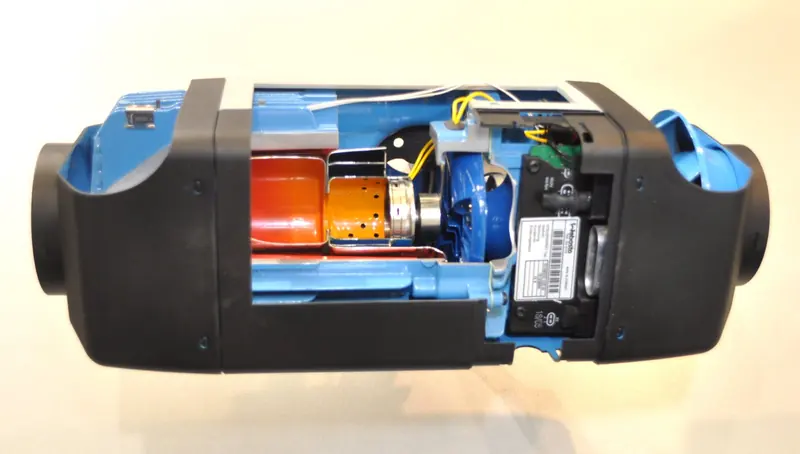
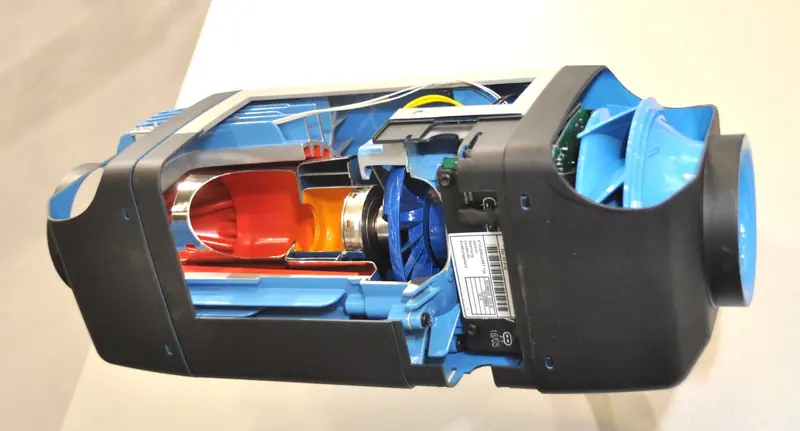
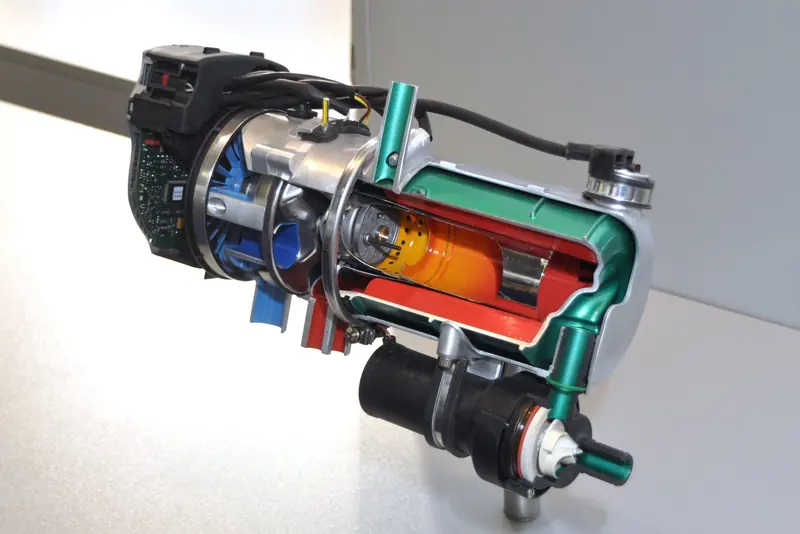
| Webasto's forced-air heaters use a ceramic glow-plug ignition and centrifugal blower; hydronic units heat a coolant loop that runs to cabin fan-heaters and can double as a water heater | |
| Documented recurring failure modes on owner forums: raw-water/impeller-independent fuel pump ticking (normal but sometimes intrusive), soot buildup in the combustion chamber from partial-load running, glow plug wear and flame-sensor faults causing lockouts | |
| Practical Sailor's own boat-heating buyer's guide has covered the Webasto Air Top line and the Eberspacher-badged Espar Airtronic D2/D4 side by side | |
What Does Webasto Marine Actually Make?
The forced-air line, currently the Air Top Evo 40/55, is a diesel burner in a sealed housing that draws in cabin air, heats it directly across a heat exchanger and pushes it back out through ducting to one or more outlets; Webasto rates the 55 model at 1.5 to 5.5 kW and states a fuel burn of about 0.18 liters per hour at low output rising to roughly 0.61-0.67 liters per hour at full boost. The hydronic line runs the opposite way: a diesel burner heats a closed loop of coolant or antifreeze, which is then pumped to one or more fan-coil units around the boat and can also feed a hot-water calorifier, with the Thermo Pro 90 spanning 1.8 to 9.1 kW and the Thermo Top Pro 120/150 covering larger boats up to 12 or 15 kW.
On the cooling side, BlueCool covers everything from small self-contained units mounted in one cabin (the S-Series) to central chilled-water systems that feed multiple air handlers around the boat (C-Series, V-Series and the larger A-Series), with a stated range across the whole catalog of 6,000 to over 1,000,000 BTU/h, the top end aimed at superyachts rather than production boats. BlueComfort Premium ties a BlueCool chiller and a diesel water heater together under one panel so a boat gets heating and cooling from a single interface, and the DeLuxe variant adds an integrated water boiler and extra fan-coil zones; Webasto recommends the chiller-compatible version of its 12 kW hydronic heater specifically for that combined installation because it does not need its own separate coolant pump.
How Does Webasto Marine Fit Into the Much Bigger Webasto Group?
Webasto Group was founded in 1901 near Stuttgart as a bicycle-spoke and sheet-metal workshop by Wilhelm Baier, moved to Stockdorf outside Munich and built its name on retractable sunroofs from the 1930s onward before adding vehicle heating in the 1970s; it remains privately owned by the founding families rather than listed on any exchange. By 2025 the group employed around 13,100 people at more than 50 locations and reported roughly EUR 3.8 billion in revenue, of which roof systems supplied about 79 percent (roughly EUR 3.0 billion), battery systems about 8 percent and Thermo Management, the segment that contains marine heating and cooling alongside vehicle heating and cooling, about 13 percent (roughly EUR 500 million).
Marine is therefore a sliver of a sliver: it shares the Thermo Management engineering base and the Webasto brand with truck and RV heaters, but it does not get its own reported revenue line, and Webasto's own investor materials barely mention boats. That matters for a buyer mainly in terms of support depth and priority: the underlying combustion and refrigeration technology is shared with a much larger automotive business (which funds the R&D), but marine-specific service, dealer training and spare-parts stocking runs through a comparatively small regional distributor network, for example PLC Marine World S.A. in Mexico or the roughly 200-dealer UK network, rather than the tens of thousands of automotive service points Webasto's car business can call on.
Webasto Marine builds automotive-grade diesel heaters and variable-speed BlueCool air conditioning backed by one of the two dominant private German heating manufacturers, priced and supported through regional dealers rather than a published manufacturer price list.
How Do You Size a Webasto System to a Boat?
For heating, a single-cabin sailboat or small motorboat is typically served by the smallest Air Top Evo (4 kW) or a compact hydronic unit, while a 40-50 foot trawler or flybridge motoryacht with two or three heated zones usually needs the 5.5 kW forced-air unit or the 9 kW Thermo Pro 90 feeding two to three fan-coils; anything with four or more cabins, or a pilothouse plus saloon plus staterooms, moves up to the 12-15 kW Thermo Top Pro range. Forced-air heats a single space fastest and dries the air as it runs, which owners value in damp climates, while hydronic spreads heat more evenly to multiple rooms from one heater, can double as a domestic hot-water source and recovers waste heat from the main engine when underway, which forced-air cannot do.
For air conditioning, Webasto and its dealer network size self-contained BlueCool units per cabin using a rough 12,000-16,000 BTU/h figure per typical stateroom on a well-insulated fiberglass hull, adjusted upward for large windows, dark hulls, high ambient humidity and generator-only power budgets; a central BlueCool chiller system is usually justified once a boat has three or more zones, because a single compressor plant feeding several air handlers is quieter and more efficient than several standalone units each cycling independently. Neither Webasto's own site nor its dealers publish a single sizing chart by boat length, because insulation, glazing and layout vary too much between builders; every practical sizing quote found for this page came from a dealer walking through cabin-by-cabin heat load, not a boat-length lookup table.
How Does Webasto Compare to Eberspacher (Espar) on Diesel Heating?
Eberspacher, founded in 1865 in Esslingen and still privately held, reported group revenue over EUR 5.0 billion in 2025 against Webasto's roughly EUR 3.8 billion, and its Espar-badged Airtronic (forced-air) and Hydronic (wet) product lines mirror Webasto's Air Top and Thermo Pro ranges feature for feature; Practical Sailor's own boat-heating buyer's guide lists the Webasto Air Top and the Espar Airtronic D2/D4 side by side as the two mainstream forced-air choices for boats over 28 feet. On Sailboat Owners Forums' long-running Espar vs Webasto thread, Bellingham-based owner Les Blackwell reported nine trouble-free years on a Webasto forced-air unit and specifically credited two DIY fixes, isolating the fuel pump on flexible mounts and adding an exhaust muffler, for eliminating the ticking and drone that both brands' pumps and blowers produce; other posters in the same thread, including one using the screen name Newly Anonymous and marine electrician Maine Sail, framed the choice as forced-air versus hydronic first and brand second, since both jobs are handled competently by either maker.
Where forum opinion does draw a line is altitude performance and hydronic simplicity: threads on Expedition Portal and the Cape Dory Board note Espar's hydronic units tolerate higher altitude without extra sensors than Webasto's, a consideration that matters more for overlanders than boat owners, and both YBW Forum's Eberspacher-or-Webasto thread and Sailing Anarchy's Webasto/Espar installation thread land on the same conclusion: pick whichever brand your local diesel-heater installer already knows, because fitting quality affects reliability more than the brand badge does. On price, YBW Forum's dedicated fitting-costs thread found no consistent gap between the two brands for a professionally installed system, both running roughly GBP 1,200-1,500 for a basic single-outlet forced-air job in that thread's estimates, with ductwork complexity driving the variation far more than which name was on the box.
How Does Webasto BlueCool Compare to Dometic on Marine Air Conditioning?
Yotters covers Dometic Marine separately as a much broader climate and appliance brand; on air conditioning specifically, the BlueCool V-Series uses variable-speed brushless DC twin rotary compressors under continuous inverter control, which owners on The Hull Truth's Webasto-vs-Dometic sizing thread and Cruisers Forum's Webasto-vs-Dometic thread describe as running noticeably quieter than Dometic's fixed-speed self-contained units, with one Hull Truth poster who installed a Webasto FCF 16K unit reporting it was much quieter than the 30-year-old fixed-speed unit it replaced. Both brands build titanium-coil, corrosion-resistant hardware rated for raw-water cooling, and Cruisers Forum threads describe mixed reliability reports on both sides rather than a one-sided pattern: one owner cited three failed Dometic Turbo units with refrigerant leaks, another cited a Dometic unit failing under three years with repeated thermostat replacements against two trouble-free years on a Webasto unit installed at the same time, while other posters in the same threads report long-running trouble-free Dometic installations.
On price, a Webasto BlueCool C16 (16,000 BTU/h) chiller module commonly lists in the $2,470-$4,130 range depending on the reversing/heat option and voltage, which sits in the same band cited for comparable Dometic chilled-water modules of similar capacity; the practical differentiator in the forum record is less the sticker price than parts and service availability, since Dometic's much larger installed base in the US gives it a wider pool of technicians familiar with the product than Webasto's marine-specific network can match outside Europe.
How Much Does a Webasto Marine System Cost, New and Installed?
Webasto does not publish a retail price list on its own site for any marine product; every figure here comes from dealer and reseller listings gathered for this page. A complete 12V Air Top Evo 55 kit (1.5-5.5 kW forced-air) is commonly listed around $2,680-$2,780; a Thermo Pro 90 hydronic kit (9.1 kW) ranges from roughly $2,300 for a basic kit to about $5,100 for a full Surewire kit with a multicontroller and extra fan-coils; and a BlueCool C16 self-contained chiller module (16,000 BTU/h) lists at roughly $2,470-$4,130 depending on reversing-heat capability and voltage. None of these figures include the ducting, wiring, through-hull fittings, exhaust and mounting hardware a real installation needs beyond the base kit.
Installation labor is the least standardized number in this category: YBW Forum's dedicated fitting-costs thread put a basic single-outlet forced-air installation at roughly GBP 1,200-1,500 all-in (heater plus fitting) for a UK installer, while a Proptalk writeup on a US diesel-heater retrofit cited $2,000-3,000 for the heater, control and exhaust hardware alone plus additional labor when the installer had to redesign ducting runs, and simple single-outlet retrofits on a small boat have been quoted as low as $50-$1,000 for ducting work when most of the infrastructure already exists. Running costs track fuel burn directly: a forced-air unit at 0.18-0.67 liters per hour of diesel costs only a few dollars for an evening's heating at typical diesel prices, and Webasto's own literature does not publish a running-cost table, so every fuel-cost figure a buyer sees, including the ones in this report, is derived from the stated burn rate rather than quoted directly by the manufacturer.
How Reliable Are Webasto Marine Systems, and What Actually Goes Wrong?
YBW Forum's Webasto-problems thread and its separate noisy-Webasto thread describe fuel-pump ticking as a normal, expected characteristic of the solenoid dosing pump rather than a fault, with posters recommending flexible mounting, foam insulation and locating the pump away from cabins to cut the noise rather than treating it as a defect to fix; the same threads identify glow plugs, flame-detector probes and clogged combustion chambers coated in soot as the most common real failure points, with one poster recommending a full strip-and-clean with gasoline or thinner every two years to keep the combustion chamber from sooting up under partial-load running. Trawler Forum's own Webasto installation thread and Sailboat Owners Forums' Espar-vs-Webasto thread both carry reports of units running many years with only routine parts replaced, echoing the SailNet pattern where Les Blackwell reported nine years of trouble-free running on a forced-air Webasto once the pump and exhaust noise were addressed.
On the cooling side, the reliability picture from The Hull Truth's and Cruisers Forum's Webasto-vs-Dometic threads is mixed rather than one-sided: multiple posters report Webasto BlueCool units running quietly and trouble-free for several years, but this is not a brand immune to failure, and the same threads carry Dometic failures (refrigerant leaks, repeated thermostat replacement, dead units inside three years) that make clear neither brand has a monopoly on either reliability or complaints. No independent long-term reliability study of either brand's marine AC line was found for this page; every reliability claim here, on both heating and cooling, traces back to individually named forum threads rather than a manufacturer-run or third-party statistical test.
Is a Webasto Marine System the Right Choice for Your Boat?
For diesel heating specifically, the forum record treats Webasto and Eberspacher/Espar as close equals, so the deciding factor for most owners in Trawler Forum, YBW Forum and Sailboat Owners Forums threads ends up being which brand the local installer already knows and stocks parts for, not a clear performance edge either way; a buyer refitting in a region with a strong Webasto dealer network (much of Europe, and Webasto's growing Mexico and Latin America push) gets an easier ownership experience than one relying on a thin local bench. For air conditioning, BlueCool's variable-speed compressors are the strongest reason to pick Webasto over Dometic specifically for noise-sensitive owners, at a price that runs roughly level with comparable Dometic hardware rather than materially higher or lower.
The clearest caution for any buyer is that Webasto Marine is a small division of a much larger automotive parent, which means the products benefit from automotive-scale engineering and testing but marine-specific pricing, spare parts and service depend on a comparatively thin regional distributor network rather than a manufacturer storefront; nothing in this report came from a Webasto price list, because Webasto does not publish one, so every dollar figure here should be treated as a market snapshot from named dealers and forums, not an official quote, and a buyer should always get a current quote from a certified Webasto Marine dealer before budgeting a refit.
Практическая информация
| New heater price (forced-air, 1.5-5.5 kW) | Webasto does not publish retail prices. Dealer and reseller listings for a complete 12V Air Top Evo 55 kit run roughly $2,680 to $2,780; smaller Air Top Evo 40 kits list somewhat lower. |
|---|---|
| New heater price (hydronic, 9.1 kW) | A Thermo Pro 90 kit runs roughly $2,300 for a basic kit up to about $5,100 for a full kit with Surewire wiring and a multicontroller, per dealer listings gathered for this page; larger Thermo Top Pro 120/150 kits are quoted per configuration. |
| New AC/chiller price (16,000 BTU/h) | A BlueCool C16 self-contained chiller module lists at roughly $2,470 to $4,130 depending on voltage and reversing-heat capability, based on dealer listings; larger central BlueCool systems are quoted per project. |
| Installation cost | Reported professional installation runs from about GBP 1,200-1,500 (roughly $1,500-1,900) for a basic single-outlet forced-air heater job in the UK, up to $2,000-5,600 in US quotes when ducting, exhaust routing or a sound enclosure retrofit is required; a straightforward retrofit onto existing ducting has been quoted as low as $50-1,000. |
| Running cost | Webasto states a diesel burn of about 0.18 liters per hour at low output rising to 0.61-0.67 liters per hour at full boost on the Air Top Evo 55, which at typical marine diesel prices costs only a few dollars for an evening of heating; Webasto does not publish a running-cost table for its AC line, so electrical draw and generator runtime cost were not independently verified for this page. |
| What is not published | Webasto publishes no retail price list, no marine dealer-installed price and no independent long-term reliability study for either its heating or AC lines. Every dollar figure and every reliability claim in this report comes from named third-party dealers, resellers and forum threads, not a manufacturer figure. |
Что сообщают владельцы и экипажи
Nine years of trouble-free Webasto forced-air heating after two DIY noise fixes
Bellingham, Washington-based owner Les Blackwell reported nine years of reliable Webasto operation on Sailboat Owners Forums' Espar-vs-Webasto thread, crediting hanging the fuel pump on flexible mounts and adding an exhaust muffler for eliminating the pump-ticking and blower noise that both Webasto and Espar units can produce.
Sailboat Owners ForumsWebasto praised for quieter running than a 30-year-old fixed-speed AC unit
A poster on The Hull Truth's Webasto-vs-Dometic sizing thread reported installing a Webasto FCF 16K unit and finding it much quieter than the fixed-speed unit it replaced, in a discussion where other posters weighed noise and reliability trade-offs between the two brands.
The Hull TruthA Webasto AC unit outlasted a Dometic unit that failed within three years
In Cruisers Forum's Webasto-vs-Dometic thread, one sailboat owner reported their Dometic AC failed with bad electronics inside three years and needed two thermostat replacements, while a Webasto unit installed around the same time ran two years without issue; other posters in the same thread reported both good and bad experiences with each brand.
Cruisers ForumRecurring soot buildup and glow-plug wear identified as the real failure points, not pump ticking
Posters on YBW Forum's Webasto-problems thread, including one using the handle FlorealIII, recommend a full strip-and-clean of the combustion chamber with gasoline or thinner roughly every two years and identify glow plugs and flame-detector probes as the parts that actually fail, distinct from the fuel-pump ticking that is normal operation.
YBW ForumBoth Webasto and Espar rated similarly reliable, brand choice driven by installer familiarity
Threads on YBW Forum's Eberspacher-or-Webasto discussion and Sailing Anarchy Forums' Webasto/Espar installation thread converge on the same practical conclusion: both brands are dependable when properly installed, so buyers are better off choosing whichever brand their local diesel-heater installer already knows and stocks parts for.
Sailing Anarchy ForumsPractical Sailor lists Webasto Air Top alongside the Eberspacher-badged Espar Airtronic as the two mainstream forced-air options
Practical Sailor's boat-heating options guide covers the Webasto Air Top series (2,000-18,000 BTU) and the Espar Airtronic D2/D4 side by side with other diesel and kerosene heaters, treating them as the two primary forced-air diesel choices for boats over 28 feet.
Practical Sailor
Сильные стороны и что учесть
Сильные стороны
- Backed by a large, financially stable automotive parent with deep engineering resourcesWebasto Group's roughly EUR 3.8 billion 2025 revenue and 13,100 employees fund the combustion and refrigeration engineering that the small marine division draws on, giving marine buyers automotive-grade reliability testing behind a boat-scale product.
- BlueCool's variable-speed compressors run noticeably quieter than fixed-speed alternativesOwners on The Hull Truth and Cruisers Forum consistently describe Webasto BlueCool units, including one owner's direct comparison after replacing a 30-year-old fixed-speed unit with a Webasto FCF 16K, as quieter than the fixed-speed Dometic-class units they replaced.
- Wide product range covers small boats through superyacht-scale installations from one manufacturerThe heating range spans 1.8 kW to 15 kW and the BlueCool range spans 6,000 to over 1,000,000 BTU/h, letting a builder or owner stay with one brand from a small cruiser through a large yacht refit.
- Forum-documented long service life when properly installed and maintainedMultiple named posters, including Les Blackwell on Sailboat Owners Forums, report multi-year trouble-free operation on Webasto forced-air heaters once known noise and combustion wear items are addressed.
- BlueComfort Premium genuinely unifies heating and cooling under one control panelCombining a BlueCool chiller with a diesel water heater under a single controller, with an optional integrated water boiler in the DeLuxe version, removes the need for two separate control systems that many boats otherwise carry.
На что обратить внимание
- No published retail pricing anywhere in the product lineEvery price in this report was sourced from third-party dealers and resellers because Webasto's own site lists no prices, forcing every buyer to shop for a quote rather than compare a published list.
- Marine is a small, thinly resourced division inside a much larger automotive companyMarine sits inside a Thermo Management segment that is only about 13 percent of group revenue, and regional distribution runs through comparatively small certified-dealer networks (roughly 30 dealers in a newly announced Mexico market, about 200 in the UK) rather than a large dedicated marine sales and service organization.
- Recurring wear-item complaints on forced-air heaters: soot, pump noise, glow plug and sensor faultsYBW Forum threads document combustion-chamber soot buildup requiring a strip-and-clean roughly every two years, fuel-pump ticking that requires isolation mounting to quiet and glow-plug or flame-sensor failures as the most common repairs.
- Mixed reliability reports on BlueCool AC units, not uniformly positiveThe same Hull Truth and Cruisers Forum threads that praise BlueCool's quiet running also carry direct owner comparisons where a Webasto unit outlasted a Dometic unit that failed within three years, which cuts both ways: it shows Webasto is not immune to being the weaker unit in a side-by-side either, and sample sizes in these threads are small.
- No direct manufacturer boat-length or cabin sizing chartNeither Webasto's own marketing nor its dealer network publishes a simple boat-length-to-kW or BTU sizing table, so a buyer must go through a dealer's cabin-by-cabin heat-load calculation rather than size a system from a published chart.
Для кого: Boat owners and refit yards who want proven diesel forced-air or hydronic heating, or quiet variable-speed marine air conditioning, from a large automotive-grade manufacturer, and who are comfortable sourcing an installed quote through a certified dealer rather than a fixed retail price.