VPLP's Tyrena Would Be the Largest Sailing Catamaran Ever, at 76m
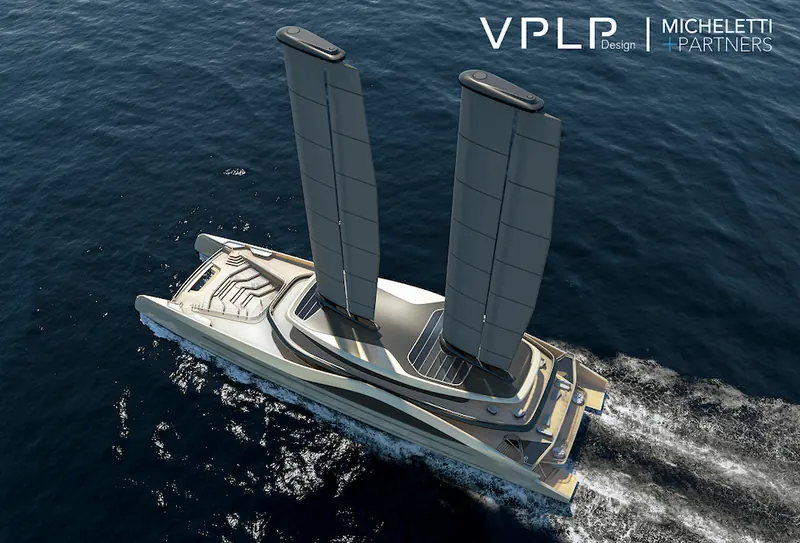
What exactly is Tyrena, and could it really be built?
Tyrena is a 76-metre wind-assisted sailing catamaran that VPLP Design and Micheletti+Partners unveiled as a design study at the 2026 Monaco Yacht Show, and until a client signs, it stays paper rather than a yard order.
The two studios presented Tyrena at Port Hercule during the show's run from 23 to 26 September, sizing her at 76 metres length overall on a 22-metre beam, built in aluminium. At that length VPLP says she would become the largest sailing catamaran ever put forward for construction, well past the 44-metre Hemisphere that has held the informal record for over a decade. The naming split is clean: VPLP Design, the French firm behind four decades of offshore racing and cruising multihulls, took the naval architecture, performance and part of the exterior, while Milan's Micheletti+Partners, known for applying automotive and civil architecture principles to yacht interiors, handled the layout and interior language.
None of that makes Tyrena real yet. No yard has been named, no price has been published, and VPLP's own material is candid that the boat is waiting for the owner who would let 76 metres of wind-assisted catamaran become an actual build. What makes it worth an owner's attention regardless is where it sits: wind-assist has spent the last decade proving itself on yachts under 55 metres and on commercial ships. Nobody has yet put a serious design in front of the market above 70 metres, which is exactly the gap Tyrena is aimed at.
Does the wing technology actually have a track record, or is it unproven?
Tyrena's twin rigid wing-sails are the same automated OceanWings system that has already logged two years of commercial service on the cargo ship Canopee, not an unproven concept dressed up in a render.
OceanWings are automated, rigid, aircraft-style wing-sails that rotate through 360 degrees to trim themselves to the wind, tracing back to VPLP's America's Cup work on USA 17's rigid wing in 2010. The technology's proving ground has been Canopee, a 121-metre cargo ship built to carry Ariane rocket components across the Atlantic, fitted with four OceanWings each over 36 metres tall. Two years of service data now exist: 99.6 percent system availability, average savings of roughly 1.3 tonnes of fuel per wing per day, and on the best transatlantic crossings, savings of 25 to 50 percent against a comparable unassisted run, with the ship logging speeds up to 13.7 knots under sail contribution alone.
Tyrena carries two wings rather than Canopee's four, but on a hull drawn around them from the first line, rather than retrofitted onto an existing cargo design. VPLP's own figures for the yacht are in the same band Canopee has already proven at sea: 12 knots cruising under sail alone in breezes above 17 knots, and up to 40 percent lower fuel burn in hybrid running. That is the case an owner is actually being asked to evaluate, a propulsion system with a working commercial history, scaled down and purpose-built rather than a laboratory number.
What does 76 metres of catamaran actually buy, compared with a monohull?
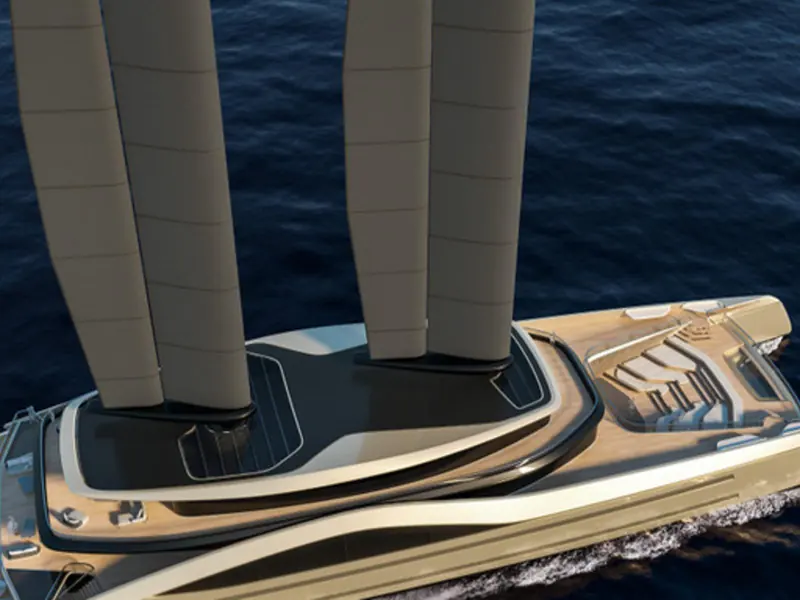
The 22-metre beam gives Tyrena the equivalent living and deck area of a 130-metre monohull motor yacht, arranged as a spread of distinct pavilions rather than one stacked superstructure.
Micheletti+Partners built the interior around Mediterranean architectural references rather than the usual owner's-deck-then-guest-decks stack: a Roman atrium, a Greek peristyle courtyard, an Italian masseria's thick, shaded rooms, each pitched as a separate, protected sanctuary that still opens onto open sea views because the platform is wide enough to allow it. The centrepiece is a multi-deck feature the designers call the Vertical Garden, combining natural light, planting and water reflections through several levels of the boat. Exterior details follow the same brief: printable solar panels laid into upper surfaces, adjustable ventilation flaps modelled on fish gills for passive cooling, hull windows cut with a wave-motion graphic, a moveable aft platform called Aperio that lowers to the waterline, and an acoustic amphitheatre built around an infinity pool with an underwater viewing tunnel.
The target buyer, by VPLP and Micheletti's own description, is a motor yacht owner who wants space, comfort, privacy and big outdoor decks, not someone chasing a sailing identity. That framing matters for the pitch: the wings trim themselves, so nothing about running Tyrena day to day asks an owner to behave like a sailor. The boat is positioned as a motor yacht that happens to sail, not a sailing yacht an owner has to learn.
What would an owner actually be giving up for the fuel savings?
A catamaran hull trades the single, deep, symmetrical volumes of a monohull for a wider but shallower one, and the wind savings only hold when there is genuine sailing breeze, not in a flat calm.
The strong case is real. The beam delivers monohull-equivalent living space on a shorter overall length. The propulsion is not a first-of-kind gamble, it is the same system with two years and 99.6 percent uptime behind it on Canopee. Dropping cruising speed from 15 to 12 knots under hybrid power very nearly quadruples range, from 6,400 to 23,400 nautical miles, a genuine option for an owner who wants to cross oceans without refuelling stops. And because the wings are automated, none of this asks the owner to change how they use the boat.
The weak case is just as real and none of it is hidden in the announcement. As unveiled, Tyrena is a design study: no yard, no client, no price, and therefore no delivery date to plan around. The 40 percent fuel figure and the zero-emission ocean crossings both depend on breeze above roughly 17 knots; in a flat calm the wings do nothing and the engines alone carry the load, so the headline savings are a best case, not a guarantee. A 76-metre catamaran is also a harder resale than a 76-metre monohull today, since brokerage listings and buyer familiarity at that length still run heavily toward single-hull yachts. And Canopee's two-year record, real as it is, comes from a cargo ship's steady ocean-crossing duty cycle; a yacht's pattern of shorter hops, more manoeuvring and more time at anchor has not yet been proven against the same wings at the same scale.
Is Tyrena the first wind-assisted yacht, or does it follow a real track record?
Tyrena is not VPLP's first wingsail yacht, it is the largest attempt yet to combine a working wingsail platform with true megayacht scale, a combination nobody has previously put in front of the market above 70 metres.
VPLP has been building toward this for over fifteen years. Evidence, a wingsail cruising catamaran of roughly 48 metres, already sails on OceanWings-family technology and has done so since the mid-2010s, giving the studio a real yacht-scale data point well before Canopee validated the system at commercial scale. Other studios have moved in the same direction from different angles: wind-assisted expedition and explorer concepts have appeared from rival design houses in the same window as Tyrena's unveiling, and the wider hybrid-sail conversation at Monaco this year covered everything from retrofit kite systems to fully rigid wings.
What none of those projects has done is put a 70-metre-plus wingsail design in front of buyers with two years of commercial operating data standing behind the propulsion choice. Evidence proved a small wind yacht works. Canopee proved OceanWings works at serious scale. Tyrena is the first attempt to claim both at once, at a size that would make her, if built, the largest sailing yacht afloat. Whether that closes the gap between concept and yard order is now a question for whichever owner decides to answer it.
What is good, and what to watch
Strong points
- Real living spaceThe 22-metre beam gives Tyrena the equivalent of a 130-metre monohull's interior and deck area on a 76-metre length overall.
- Propulsion with a track recordThe OceanWings system has logged two years and 99.6 percent uptime on the cargo ship Canopee, not a first-of-kind gamble.
- A genuine range optionTrimming 3 knots of cruising speed under hybrid power nearly quadruples range, from 6,400 to 23,400 nautical miles.
- No sailor identity requiredThe wings trim themselves, so VPLP and Micheletti are pitching this at motor yacht owners, not people who want to actively sail.
What to watch
- No client, yard or priceAs unveiled, Tyrena is a design study. Nobody has ordered it and no builder has been named.
- Savings need real windThe 40 percent fuel figure and the zero-emission crossings both assume sailing breeze above 17 knots. In a flat calm the wings do nothing and the engines alone do the work.
- Catamaran resale is a thinner marketAt superyacht length, monohulls still dominate brokerage listings and buyer familiarity; a 76-metre cat is a harder resale than a 76-metre monohull today.
- Commercial-scale proof, not yacht-scale proofCanopee validated the wings on a cargo ship's steady ocean-crossing duty cycle. A yacht's shorter hops, heavier manoeuvring and more time at anchor have not been proven against the same wings at the same scale.
Practical detail
| Length overall | 76 metres |
|---|---|
| Beam | 22 metres |
| Construction | Aluminium hull and superstructure |
| Propulsion | Twin automated OceanWings rigid wing-sails, hybrid diesel-electric |
| Cruising speed under sail alone | 12 knots in breezes above 17 knots |
| Fuel savings, hybrid mode | Up to 40 percent |
| Range, 15 knots hybrid | 6,400 nautical miles |
| Range, 12 knots hybrid | 23,400 nautical miles |
| Interior/deck area equivalent | Comparable to a 130-metre monohull motor yacht |
| Naval architecture | VPLP Design (Southampton, founded 1983) |
| Interior architecture | Micheletti+Partners (Milan, founded 1987) |
| Builder / yard | Not yet named |
| Price | Not published |
| What is not published | No client, no build slot and no independent naval architecture certification exist yet; every figure here is the design studios' own estimate |
Questions this story answers
What happened?
VPLP Design and Micheletti+Partners have unveiled Tyrena, a 76-metre wind-assisted catamaran concept that would be the largest sailing yacht ever built if a client signs for it. The pitch to an owner is blunt: the living space of a 130-metre monohull, propulsion already proven at sea on a commercial ship, and up to 40 percent off the fuel bill whenever the wind cooperates.
What is good about it?
Real living space. The 22-metre beam gives Tyrena the equivalent of a 130-metre monohull's interior and deck area on a 76-metre length overall.
What should an owner or buyer watch?
No client, yard or price. As unveiled, Tyrena is a design study. Nobody has ordered it and no builder has been named.
Who reported this?
VPLP Design, Micheletti+Partners, Top Yacht Design, Figaro Nautisme, Multicoques Mag, OceanWings two-year Canopee report.
We do this for everyone who loves this world. The people who have spent their lives in it, and the people just discovering it. Yotters exists so that what we learn belongs to all of them.
Nobody pays us for this. No ads, no sponsors, nothing for sale. We just believe the world is a little better when knowledge is shared instead of kept.
If it gave you something today, tell us to keep going. Follow us, leave a like, or write a positive comment. We read every one, and they are what keeps us going.