Lake Como & Lake Garda
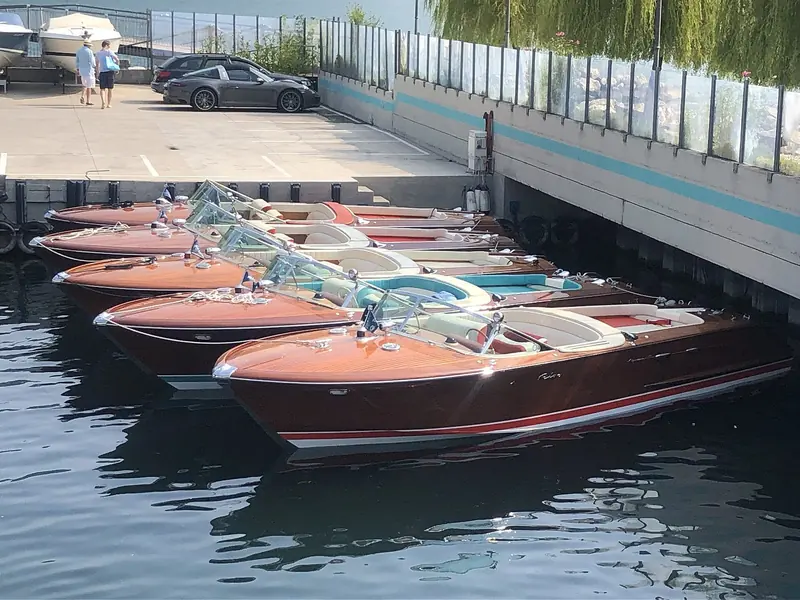
| Lake Garda is Italy's largest lake at 369.98 square kilometres, 51.6km long and up to 16.7km wide, with a maximum depth of 346m | |
| Lake Como is Italy's third-largest lake at 146 square kilometres but its deepest, reaching 425m, the fifth-deepest lake in Europe | |
| Neither lake has any sea access; a yacht reaches either only by road transport and a marina crane, never under its own power | |
| Italian law requires a Category A pleasure-boat licence for any engine over 30kW (40.8hp) on either lake; below that threshold a rental needs no licence | |
| Lake Garda's daytime speed limit is 20 knots, dropping to 5 knots at night and 3 knots within harbour approaches | |
| The northern arm of Lake Garda, north of Limone on the west shore and north of Malcesine on the east, is closed to motorboats and reserved for sailing and windsurfing | |
| Riva's founding shipyard sits in Sarnico, on Lake Iseo, roughly 50 miles from Lake Garda and outside the Como/Garda basin entirely; the Ferretti-owned yard still builds the 8m to 20m range there, including around 20 Aquariva a year | |
| Riva opened its first Italian charter base, the Private Deck at the Eriolario Yacht Club in Lezzeno near Bellagio on Lake Como, in June 2023, its second worldwide after Mykonos | |
| The Cadenazzi family has built wooden boats on Lake Como since 1904, one of a cluster of local yards, with Riva, Cranchi, Abbate, Matteri, Molinari, Colombo and Posca, that supplied the Como-built hydroplanes which swept the 1953 Orange Bowl Regatta | |
| George Clooney bought Villa Oleandra in Laglio, on Lake Como, in 2002 for around USD 10 million and keeps a Riva at its private boathouse | |
| Villa d'Este in Cernobbio opened as a hotel in 1873 inside a villa built in 1568 for Cardinal Tolomeo Gallio; its 25-acre garden and floating lake pool are protected as a national monument | |
| Torbole, at Lake Garda's northern tip, runs on the Peler wind from the north in the morning and the Ora from the south in the afternoon, a pattern regular enough that local schools teach roughly 4,000 beginners a year each | |
| The Centomiglia, a roughly 100-nautical-mile course around the whole lake starting from Bogliaco, has run every September since 1951 and is the longest-running offshore regatta on inland water in Europe | |
| A Riva Aquarama charter on Lake Garda runs to roughly EUR 1,290 for a three-hour morning session or EUR 1,390 for an afternoon, with fuel typically adding EUR 250 to 450 | |
| A Boesch wooden runabout rents for around CHF 4,800 a day on Lake Como, the Swiss-built alternative that has supplied Alpine lakes for over a century |
A Freshwater Yachting Ground With No Sea Behind It
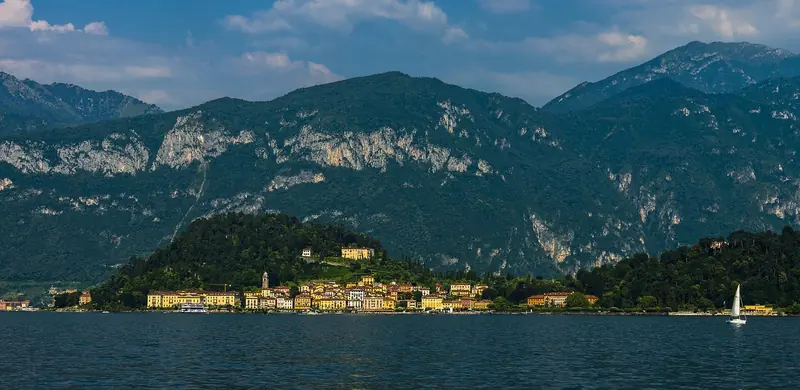
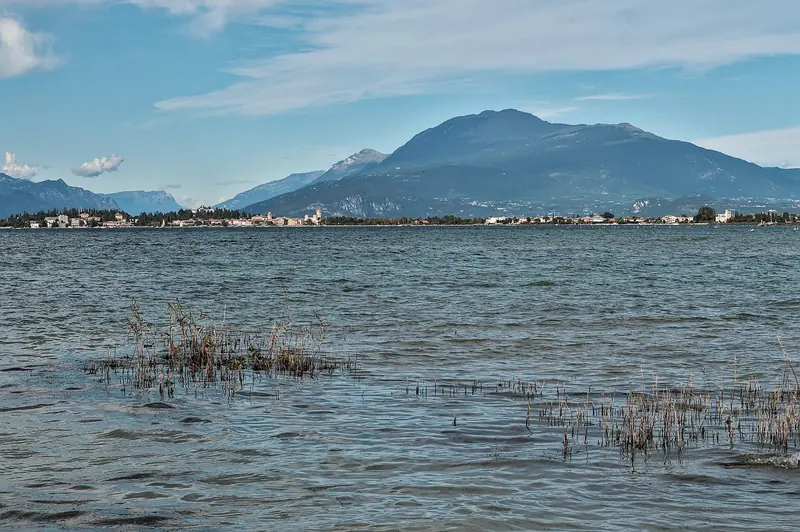
Como and Garda sit forty minutes apart by road across Lombardy and the Veneto, but they read as different countries on the water. Como is the narrow one, an inverted Y carved by the Adda glacier, never more than 4.5km wide over its 46km length, and the deepest lake in Italy at 425m. Garda is the broad one, Italy's largest lake at 370 square kilometres, 51.6km long and up to 16.7km across, shaped like a wine bottle that narrows sharply at its northern end between mountains that fall almost straight into the water. Both are ringed by peaks, both are a little over an hour from a major airport, and both have been developed for tourism since the nineteenth century, but the scale difference shapes everything else that follows: Como is intimate and villa-scaled, Garda is big enough to carry a real sailing fleet, a real wind system and a much bigger day-tripper economy.
Neither lake behaves like the sea-cruising grounds already covered on this site. There is no passage-making, no tidal planning, no offshore leg between anchorages; a day on the water means a short hop between towns a few miles apart, tied up for lunch, and home before the evening thermal drops. That is precisely the point for the buyer this page is written for: Como and Garda are not competing with the Balearics or the Ligurian Riviera for range, they are competing with them for a completely different kind of ownership, closer to a lake house with a private dock than a yacht with a season's itinerary.
The Riva Myth, and Where the Heritage Actually Sits
Pietro Riva opened his boatyard at Sarnico on Lake Iseo in 1842, and the firm never moved: the Ferretti Group, which bought Riva in 2000, still builds the 8m to 20m range there today, from the Iseo and Rivamare up through the Aquariva Super, at a rate of around 20 Aquariva a year alongside the 56' Rivale, 66' Ribelle and 68' Diable. Alberto Galassi, the group's chief executive, has described the Aquarama the yard is still measured against as "the most beautiful boat ever built, unsurpassed in beauty and design, a work of art one never gets tired of looking at", and traced the durability of the range to "industrial choices made by Carlo Riva" himself. None of that history happened on Como or Garda. It is a common enough mix-up, helped along by every tour operator on both lakes selling a "Riva boat ride", that the distinction is worth being precise about before anything else on this page.
What Como and Garda actually have is a working population of Riva boats and a home-grown rival tradition. Riva itself opened its first Italian charter base, the Private Deck at the historic Eriolario Yacht Club in Lezzeno, a few kilometres from Bellagio, in June 2023, only its second in the world after Mykonos; Stefano de Vivo, the Ferretti Group's chief commercial officer, framed it as giving "those who do not own a yacht the opportunity to live an authentic Riva experience." Alongside it, Lake Como has bred its own boatbuilding families since well before Riva existed as a name anyone outside Italy knew: Cadenazzi has built wooden boats on the lake since 1904, one of a cluster including Cranchi, Abbate, Matteri, Molinari, Colombo and Posca whose Como-built three-point hydroplanes, running Alfa Romeo and Ferrari V12 engines, swept the top places at the 1953 Orange Bowl Regatta in Miami.
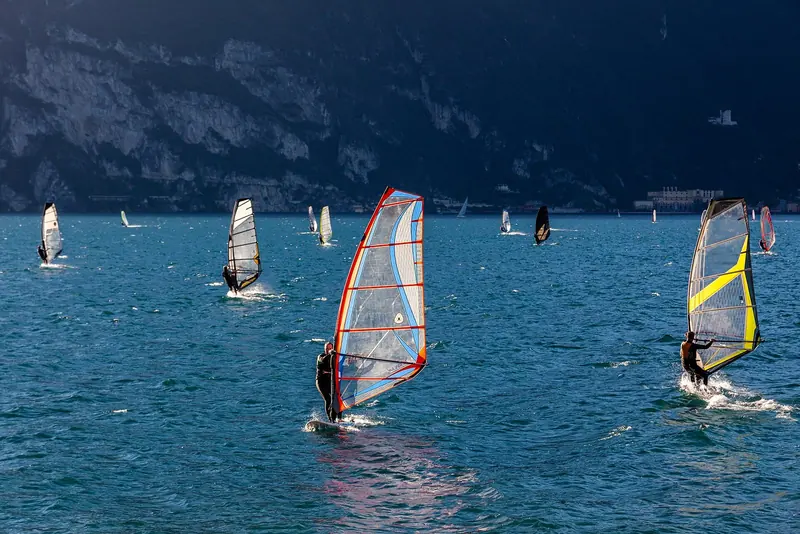
Six windsurfing schools at Torbole each teach around 4,000 students a year on a lake that has no connection to the sea at all.
Villa Culture Is the Real Draw on Como
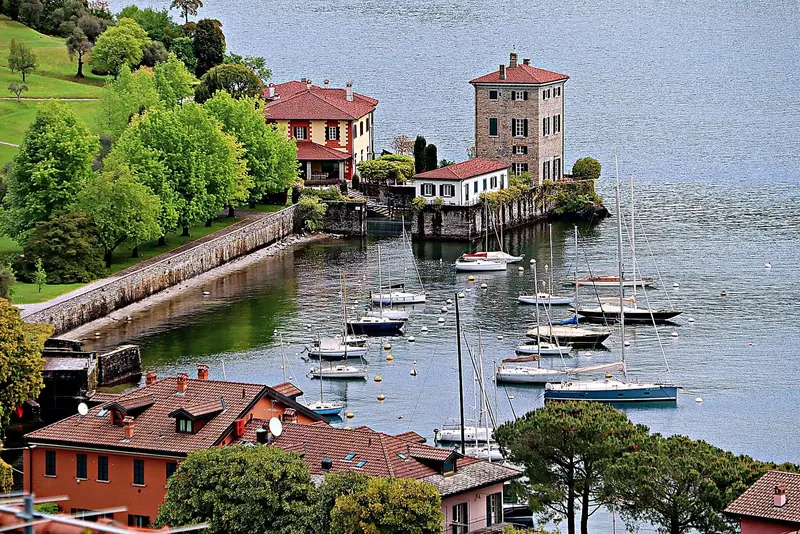
Villa d'Este in Cernobbio was built in 1568 as the summer residence of Cardinal Tolomeo Gallio and passed through a ballerina, a Napoleonic general and a self-styled queen before opening as a hotel in 1873; its 25-acre garden and lakeside floating pool are protected as a national monument, and its guest list has run from Queen Beatrix of the Netherlands to Robert De Niro and its Laglio neighbour George Clooney. Waterfront villas elsewhere on the lake trade at EUR 10,000 to 15,000 per square metre, with the largest lakefront estates running from EUR 3 million past EUR 10 million, and an antique mansion with its own boat dock and park can reach EUR 5 million to 15 million on its own.
Clooney bought Villa Oleandra in Laglio in 2002 for roughly USD 10 million, and it now carries the boathouse and private dock that put his Riva on the water whenever he is in residence. He was not the start of it. Tullio Abbate, whose family boatyard at Mezzegra has served the lake since 1873, in a shed that was once a textile mill making tennis rackets and skis, put the point bluntly: "Here we have been used to hosting celebrities a good thirty years before Clooney arrived... I am a man of the lake and I will never leave this corner of the world." His yard's client list before Clooney ran to Formula 1 drivers including Michael Schumacher, Ayrton Senna and Alain Prost, footballers Diego Maradona and Gianluca Vialli, and Princess Caroline of Monaco. On Como, in other words, the boat is downstream of the villa; the yacht dock is a feature of the real estate, not the other way round.
Garda's Wind Is the Whole Business at the North End
The pattern is almost clockwork: cold alpine air drains down the lake from the north as the Peler each morning, then reverses by early afternoon into the Ora, a warm thermal wind blowing up from the south as the land heats, funnelled hard through the narrow gap between Torbole and Riva del Garda. Vasco Renna, who runs one of the town's windsurfing concessions, remembers the pre-windsurfing era when "the tour buses would bring the old people and they would sit on the beaches until 1:00pm, then the wind would blow them back to their hotel rooms"; his school alone now teaches "about 4,000 beginning students a year", one of roughly six schools doing similar numbers along the same stretch of shore, in what local operators call the spawning ground of European windsurfing.
The sailing side of Garda is just as serious and considerably older. Circolo Vela Gargnano, founded in the winter of 1950, launched the Centomiglia the following year, a roughly 100-nautical-mile course that starts and finishes at the port of Bogliaco and has run every September since, now billed as the longest-running offshore regatta on inland water in Europe. Fraglia Vela Malcesine, on the lake's northeastern shore since 1947, has since built a clubhouse Gianni Testa, one of its officers, called a gift to the town of "immense architectural, tourist, sports, and economic value." Set against Como's quiet villa scene, Garda is the louder, bigger, more athletic half of this pairing, and the two lakes are genuinely not interchangeable for a buyer choosing between them.
No Sea Access Means the Logistics Are the Story
There is no waterway connecting either lake to open water, so a hull goes in by trailer and comes out the same way; operators such as Rappydrive on Garda advertise slipway or crane hauling and boat transport by land alongside their charter business as a routine, unremarkable part of lake life. What that costs for a given boat is not published anywhere found in researching this page, and every marina and transport operator quotes it per job rather than off a rate card, which is worth knowing before assuming a figure exists to compare. The practical ceiling this puts on hull size is soft rather than legal, set by what a road-legal trailer and a marina's own crane can lift, and it keeps both lakes' fleets running overwhelmingly to day-boat and weekend-cruiser sizes rather than anything resembling a coastal motor yacht.
Once on the water, Italian national law does the rest of the constraining. Any engine over 30kW (40.8hp) requires a Category A pleasure-boat licence, a threshold low enough that most performance boats fall on the licensed side of it, while charter operators keep smaller craft below it specifically to rent without one. Lake Garda then caps speed at 20 knots by day and 5 at night, with a further 3-knot limit approaching any harbour and a 300-metre no-motor strip off most of the shoreline reserved for small sail, oar, pedal and surf craft; the lake's northern arm, above Limone and Malcesine, is closed to motorboats outright and reserved for sailing and windsurfing. Navigazione Laghi, the state body that runs the scheduled ferry network across Como, Garda and Maggiore, sits above all of this for public transport but has no jurisdiction over a private leisure boat's licensing or speed, which stays a matter of Italian national navigation law applied lake by lake.
Two Very Different Sets of Towns
Bellagio sits at the point where Como's two southern branches meet, its harbour at the Porto di Pescallo lined with sailboats below villas including Villa Melzi's lakeside gardens, and it is reachable from most of the lake's other towns, Cernobbio, Laglio, Menaggio, Varenna, by a short ferry hop rather than a real passage. The whole southern half of the lake behaves this way: small, walkable towns a few minutes apart by water, each with a handful of restaurant docks and none of them built to handle a large boat for more than a lunch stop.
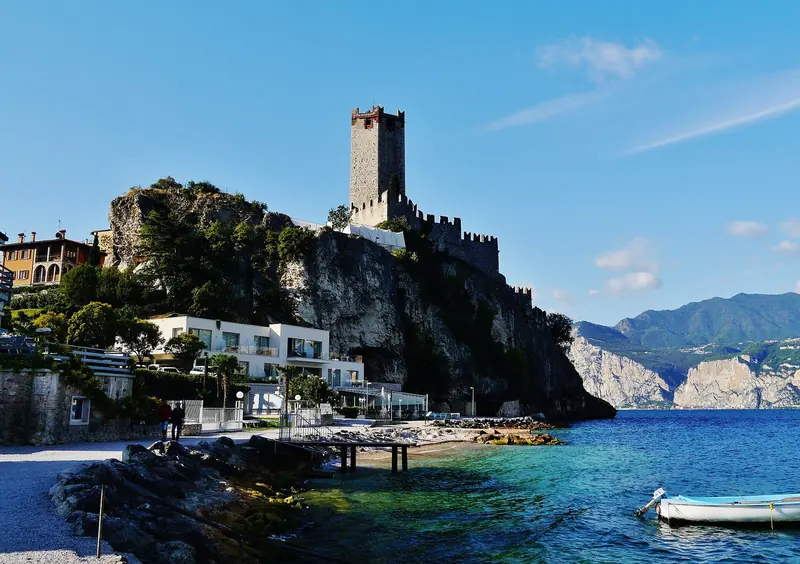
Garda's towns run to a bigger scale. Sirmione sits on a peninsula in the lake's south with a medieval walled old town and a marina of around 100 berths taking boats up to roughly 65 feet; Malcesine, on the northeastern shore, is built around the Castello Scaligero on its rock and a cable car up Monte Baldo that starts a few minutes' walk from the marina; Riva del Garda anchors the windsurfing scene at the northern tip. All three carry substantially heavier tourist traffic in July and August, coach parties and ferry crowds included, than anything Como's villa towns see, which is worth an owner weighing honestly against Garda's bigger fleet and better wind: more boat, more wind, and considerably more company on the dock.
Marinas, Charter and What Actually Gets Published
Marina di Bogliaco, on Garda's western shore since 1987, holds up to 100 boats within the Alto Garda Park and is the closest thing either lake has to a flagship yacht harbour, sitting at the start of the Centomiglia course; like almost every marina researched for this page, it does not publish a current rate card, and the one figure found in the wider search, EUR 85 a night from a 2017 visitor account, is too old to repeat as a current price. General estimates for Garda mooring put a night anywhere from EUR 20 to 150, a range wide enough to be closer to no answer than a real one, and Como's marinas at Menaggio, Domaso and elsewhere follow the same pattern of quoting on request rather than posting a tariff.
Charter pricing is the one part of this market that is genuinely open. A Riva Aquarama with skipper on Lake Garda runs to roughly EUR 1,290 for a three-hour morning session or EUR 1,390 for an afternoon, with fuel adding a further EUR 250 to 450 on top, and Boesch's Swiss-built wooden runabouts rent on Como for around CHF 4,800 a day. Riva's own Private Deck at Lezzeno sells the same idea as a standing offer rather than a one-off booking, a fleet available without ownership, which is arguably the most honest read of what this whole pairing of lakes is selling: a taste of the Riva and villa lifestyle at day-charter prices, for anyone not ready to solve the road-transport problem of getting a hull of their own onto an Alpine lake.
على البر والوصول والحجز
| Getting there | Como is about an hour from Milan's Malpensa, Linate or Bergamo airports; Garda is about 25 minutes from Verona and under an hour from Bergamo or Brescia. Neither lake is reachable by boat from the sea. |
|---|---|
| Getting a boat onto the lake | By road trailer and a marina crane only; there is no waterway connection to open water. Transport and crane-in costs are quoted per job, not published, on either lake. |
| Licence and speed limits | An engine over 30kW (40.8hp) requires an Italian Category A pleasure-boat licence on both lakes. Lake Garda caps speed at 20 knots by day, 5 at night, 3 near harbours, with a 300m no-motor strip off most shoreline and the entire northern arm closed to motorboats. |
| Season | Charter operators, marinas and windsurfing schools run April to October; the Ora and Peler winds at Torbole are most reliable in this window, weakest in winter. |
| Berthing | Marina di Bogliaco on Lake Garda holds up to 100 boats; like the other marinas on both lakes it quotes on request rather than publishing a rate card. General Garda mooring estimates run EUR 20 to 150 a night, wide enough to treat as indicative only. |
| Charter | A Riva Aquarama with skipper on Lake Garda runs roughly EUR 1,290 to 1,390 a session plus EUR 250 to 450 fuel; a Boesch wooden runabout on Lake Como runs around CHF 4,800 a day; Riva's own Private Deck at Lezzeno (Lake Como) rents its fleet without ownership. |
| Marina cross-reference | No Lake Como or Lake Garda marina yet has its own Yotters marina entry; Marina di Bogliaco is the standout candidate for one given its size and its role as the Centomiglia's start line. |
| What is not published | Road-transport and crane-in costs for getting a yacht onto either lake, current berth rates at almost every marina on both lakes, and any current, verifiable price for a Marina di Bogliaco mooring beyond a single 2017 visitor account. |
ما يذكره الملاك والأطقم
Riva's own charter push treats the lakes as a taste of ownership, not a substitute for it
"The Riva Destinations give those who do not own a yacht the opportunity to live an authentic Riva experience."
Stefano de Vivo, Chief Commercial Officer, Ferretti GroupThe Aquarama is still the boat every conversation about the brand returns to
"The most beautiful boat ever built, unsurpassed in beauty and design, a work of art one never gets tired of looking at."
Alberto Galassi, Chief Executive Officer, Ferretti GroupComo's boatyards hosted the wealthy for decades before Clooney arrived
"Here we have been used to hosting celebrities a good thirty years before Clooney arrived... I am a man of the lake and I will never leave this corner of the world."
Tullio Abbate, Cantiere Tullio Abbate, MezzegraTorbole's wind-school business runs on a genuinely reliable thermal pattern, not luck
"I remember when I was a little boy, the tour buses would bring the old people and they would sit on the beaches until 1:00pm. Then the wind would blow them back to their hotel rooms... We teach about 4,000 beginning students a year."
Vasco Renna, windsurfing school operator, TorboleMalcesine's sailing club sees its own clubhouse as an investment in the whole town
"Step by step, we've managed to gift the Malcesine community a structure of immense architectural, tourist, sports, and economic value."
Gianni Testa, Fraglia Vela Malcesine
نقاط القوة وما يستدعي الانتباه
نقاط القوة
- Genuine wooden-boat and villa culture, not built for touristsCadenazzi, Abbate, Matteri, Molinari and Colombo have built and restored boats on Como since 1904, and Riva's own charter arm chose Lezzeno, near Bellagio, for its first Italian base in 2023 over anywhere on the Italian coast.
- One of Europe's most reliable thermal wind systems, on demand every afternoonThe Peler and Ora run predictably enough at Torbole that local schools plan around roughly 4,000 beginner students a year each, a regularity few coastal venues can promise.
- Real yacht-club racing heritage, not just charter tourismThe Centomiglia has circled Lake Garda from Bogliaco every September since 1951, the longest-running offshore regatta on inland water in Europe.
- A villa market with its own economy independent of the charter fleetLakefront villas in Bellagio and Cernobbio with private boathouses and hydraulic lifts trade from roughly EUR 5 million to 15 million, a market Riva's Ferretti-Group owners have now built a charter base to serve rather than compete with.
ما يستدعي الانتباه
- No sea access at all, so every boat arrives and eventually leaves by roadA yacht reaches either lake only by trailer and a marina crane; no operator researched for this page publishes a standard transport or crane-in cost, and it has to be quoted per boat.
- A hard power ceiling for anyone without an Italian boating licenceItalian law caps a licence-free engine at 30kW (40.8hp) on both lakes, ruling out casual bareboat use of anything with real performance.
- Low, tightly policed speed limits that keep the boating slow and localLake Garda allows 20 knots by day and 5 at night, with a 300-metre no-motor zone off most of the shoreline, a world away from open-water cruising speeds.
- Heavy peak-season crowding at the marquee townsBellagio and Sirmione carry substantial day-tripper ferry and coach traffic through July and August, and Torbole's beaches fill with thousands of windsurfing beginners a year on top of the resident fleet.
لمين هو: An owner who wants a day boat, a villa and Alpine scenery rather than blue-water range, or a buyer drawn to Riva and Boesch wooden-boat culture over a coastal marina berth.