Oman & the Musandam Peninsula
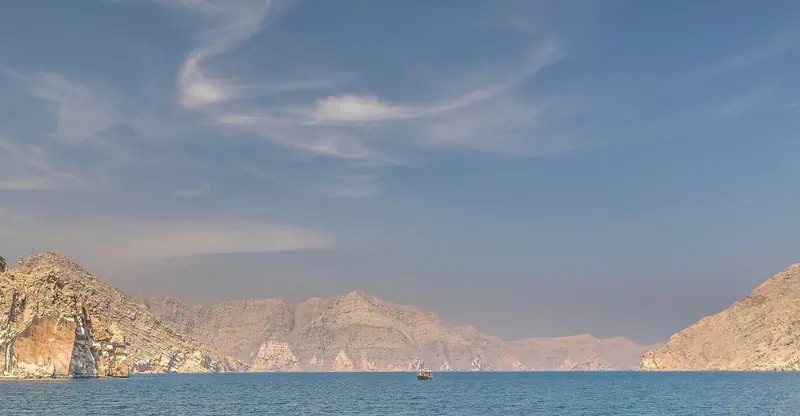
| Region | the Musandam exclave at the Strait of Hormuz plus about 1,000 miles of Omani coast from Muscat to Salalah |
|---|---|
| Musandam is separated from the rest of Oman by the United Arab Emirates and controls the southern side of the Strait of Hormuz | |
| Dubai to Musandam is 60 to 80 nautical miles, a comfortable overnight or a long day | |
| The khors are steep sided drowned river valleys, deep enough to anchor close under the walls | |
| Khor Ash Sham runs about ten miles inland, with fishing villages on the shore that have no road access | |
| Telegraph Island in Khor Ash Sham held a British telegraph relay station in the 1860s | |
| Khasab is the port of entry for Musandam, with a protected basin about 10 m deep and berths of 60 m, 90 m and 300 m | |
| The port authority at Khasab is the Asyad Group. Dibba on the east side is the other entry point | |
| Official guidance is that vessels over 30 net tons must appoint an agent, and smaller craft need not | |
| Marina Bandar Al Rowdha near Muscat has 220 wet berths, 184 dry berths and 65 jet ski berths | |
| Other marinas | Jumeirah Muscat Bay, Barr Al Jissah, Musannah, Sohar, Sur, Duqm and the Salalah Rotana Resort marina |
| There is no superyacht marina in Oman. Khasab's 300 m berth is commercial quay rather than a marina berth | |
| The Daymaniyat Islands, about 30 miles north west of Muscat, are a protected marine reserve with the best coral in northern Oman | |
| Access, landing and diving at the Daymaniyat Islands are regulated by the environment ministry, with landing restricted in the turtle nesting season | |
| Bandar Khayran, just south east of Muscat, is a maze of inlets giving sheltered anchoring within an hour of the capital | |
| Season | October to April. The south west monsoon runs from June to September |
| The khareef monsoon fog and drizzle turns the Dhofar mountains around Salalah green and closes that coast to small craft | |
| In season, expect 24 to 30 degrees, light mornings, an afternoon sea breeze and water around 24 to 27 degrees | |
| The shamal reaches Musandam as a northerly and can make the Strait of Hormuz uncomfortable | |
| The Strait of Hormuz carries very heavy commercial traffic in a separation scheme | |
| The shipping industry bodies withdrew the Indian Ocean High Risk Area designation with effect from 1 January 2023 | |
| Muscat has the Sultan Qaboos Grand Mosque, the Royal Opera House, the Mutrah souq and two Portuguese forts over the old harbour | |
| Inland, Nizwa's fort and market, the Jebel Akhdar mountains at about 2,000 m and the Wahiba sands are a day trip | |
| Oman is conservative and courteous | modest dress ashore, alcohol in licensed hotels, and discretion with photography |
Two countries in one, geographically
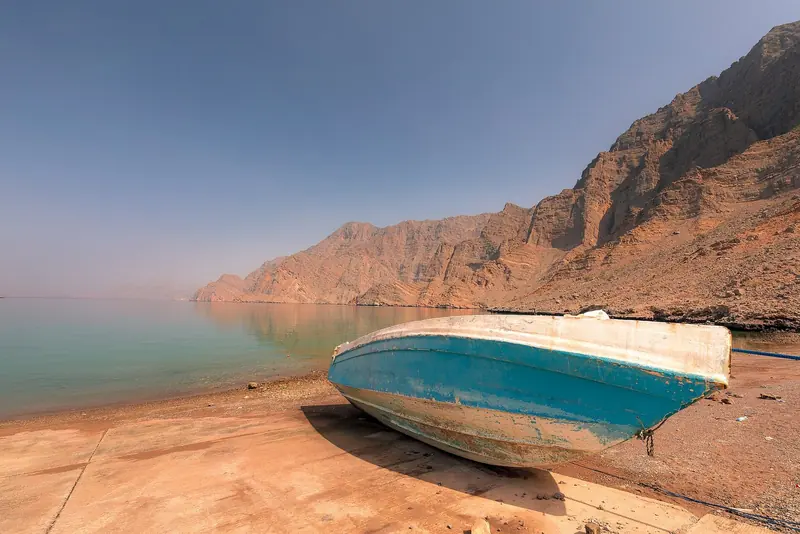
Oman has two coasts and they behave differently. Musandam, at the northern tip, is an Omani exclave separated from the rest of the country by the United Arab Emirates, controlling the southern side of the Strait of Hormuz. It is a mass of bare rock cut by khors, steep sided inlets that look like fjords and are in fact drowned river valleys, with water deep enough to anchor close under the walls. From Dubai it is 60 to 80 nautical miles, which makes it a comfortable overnight or a long day.
The main coast begins south of the UAE and runs about 1,000 miles down the Gulf of Oman and the Arabian Sea to Salalah near the Yemeni border. Muscat sits at the northern end of it, with the Daymaniyat Islands offshore, Bandar Khayran's inlets just to the south east and Sur further on. This is open ocean coast rather than gulf water, with swell, real depth and a monsoon, and it is a different proposition from a weekend in Musandam.
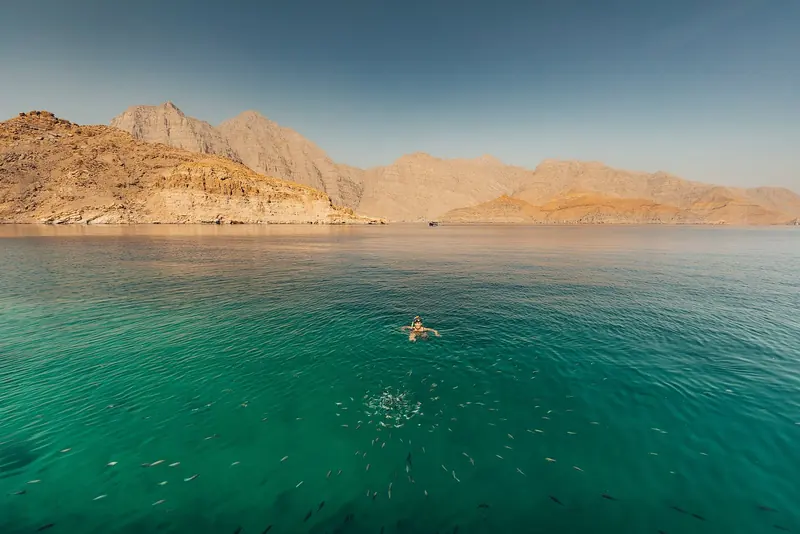
Musandam, and why the Gulf fleet comes here
Khor Ash Sham is the largest of the inlets and the one most boats use, running about ten miles inland between mountain walls with fishing villages on the shore that have no road to them. Telegraph Island in the middle of it held a British telegraph relay station in the 1860s and is now a snorkelling stop and the origin, according to local lore, of the phrase about going round the bend. Dolphins work the entrance most mornings. There is nothing else there, which is the point.
The reason this matters is arithmetic. Everything a yacht does in Dubai and Abu Dhabi happens inside built water. Musandam is the nearest place where a boat can lie at anchor under a mountain with nothing man made in sight, and it is a night's run away. That is why the Gulf's charter fleet works this coast in winter and why an owner keeping a boat in Dubai should plan Musandam into the season rather than treat it as an excursion.
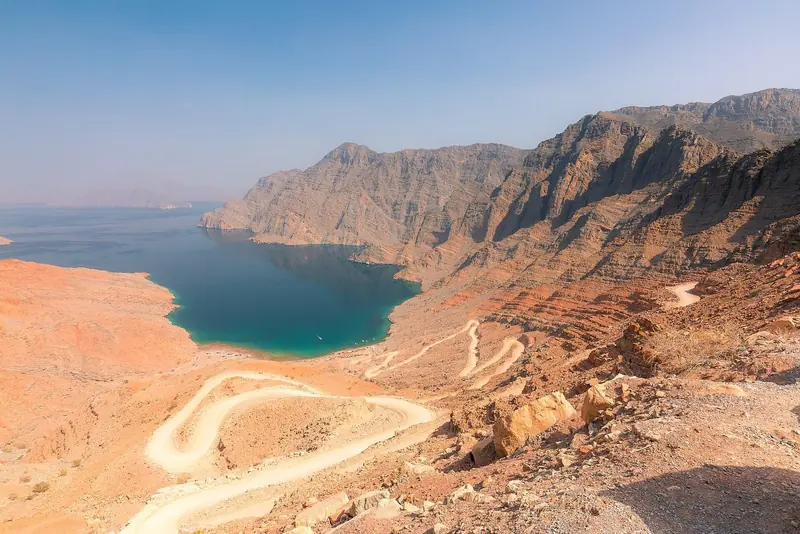
Sixty miles from Dubai Marina, a mountain wall falling into deep water with a fishing village that has no road to it.
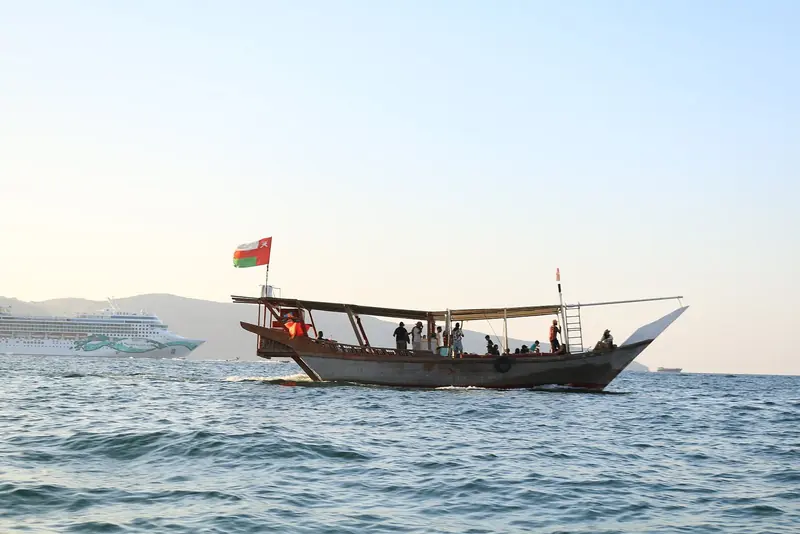
Getting in, and the agent question
Khasab is the port of entry for Musandam and the practical place to clear. Its harbour basin is protected and around ten metres deep, with berths of 60, 90 and 300 metres, and the port authority is the Asyad Group. Dibba, on the east side of the peninsula, is the other entry point and is the one used by boats coming down the UAE's east coast. Clearance in Oman is a formal process and it is not the informal arrangement some Gulf itineraries assume.
The guidance an owner should plan around is that vessels over 30 net tons are required to use an agent, while smaller craft are not. In practice almost every yacht in this bracket appoints one, because the agent handles the clearance, the crew and guest lists and the movement notifications, and because Oman is a country where doing the paperwork properly in advance is markedly cheaper than explaining it afterwards. Confirm the current requirements through that agent rather than from a cruising guide.
Muscat, and the marinas
Marina Bandar Al Rowdha, just south east of Muscat, is the established yachting base in the country, with 220 wet berths, 184 dry berths and 65 jet ski berths, a boatyard and the services a visiting yacht needs. Jumeirah Muscat Bay Marina sits nearby in a resort setting. Beyond the capital the network is thin and spread out: Barr Al Jissah, Musannah, Sohar, Sur, Duqm, and the marina at the Salalah Rotana Resort at the far south west, with Khasab and Dibba serving Musandam.
None of this is superyacht infrastructure in the Mediterranean sense. Khasab's 300 metre berth is a commercial quay rather than a marina berth, and the Muscat marinas are sized for the local fleet. A large yacht in Oman anchors, uses commercial quay space by arrangement, and treats the marinas as places to land guests and take stores. That is a workable model here precisely because the anchorages are the reason to come.
The Daymaniyat Islands and the coast around Muscat
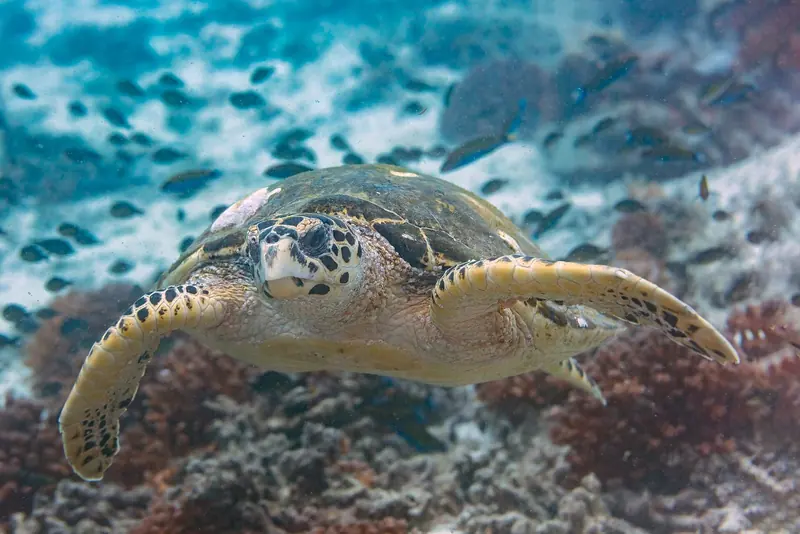
The Daymaniyat Islands, a group of nine small islands about 30 miles north west of Muscat, are a protected marine reserve and hold the best coral and the clearest water in northern Oman, with turtles, rays and reliable visibility. They are a nature reserve first and a cruising destination second: access, landing and diving are regulated by the environment ministry, landing is restricted during the turtle nesting season, and the current permit position should be confirmed before the day is planned.
Closer to the capital, Bandar Khayran is a maze of inlets and small bays a few miles south east of Muscat that gives sheltered anchoring within an hour of the city, and the coast between there and Sur has a string of beaches and headlands with almost nobody on them. Muscat itself is a low white city between mountains and sea that has deliberately refused high rise development, which makes it the most attractive capital on the Arabian peninsula from the water.
The monsoon decides the calendar
The season is October to April. From June to September the south west monsoon runs up the Arabian Sea and makes the southern Omani coast genuinely unusable, with strong onshore winds, big swell and, in Dhofar around Salalah, the khareef, a monsoon fog and drizzle that turns the mountains green and closes the coast to small craft. The northern coast and Musandam are less affected but the summer heat there is the same as the Gulf's, which is to say prohibitive.
In the season the weather is close to ideal: 24 to 30 degrees, light winds in the morning, a sea breeze in the afternoon, and water around 24 to 27 degrees. The shamal that blows down the Gulf reaches into Musandam as a northerly and can make the Strait of Hormuz uncomfortable. The Strait itself carries very heavy commercial traffic in a separation scheme, and crossing it or working near it is a matter of routine passage planning rather than adventure.
Security, in plain terms
Oman is one of the most stable and least troublesome countries in the region for a visiting yacht, and the practical questions are about the wider waters rather than about Oman itself. The Strait of Hormuz is a strategic chokepoint with a naval presence and periodic regional tension, and the Gulf of Aden and the southern Red Sea, several hundred miles further west, have their own risk picture that is not Oman's.
The shipping industry bodies withdrew the Indian Ocean High Risk Area designation with effect from 1 January 2023, which changed the insurance and routing position for vessels transiting these waters. That is a moving picture rather than a settled one, and an owner planning a passage beyond Oman towards the Red Sea or across the Indian Ocean should take current advice from his insurer and a security adviser rather than relying on either the old designation or its withdrawal.
Ashore
Oman is the cultural counterweight to the Gulf cities. Muscat has the Sultan Qaboos Grand Mosque, the Royal Opera House, the Mutrah souq along the corniche and two Portuguese forts over the old harbour, and it is a working capital rather than a resort. Inland, Nizwa's fort and market, the Jebel Akhdar mountains at 2,000 metres and the Wahiba sands are all within a day's drive, which gives guests a proper excursion programme that Dubai cannot match.
The country is conservative and courteous, and the expectations are straightforward: modest dress ashore outside resorts, discretion with alcohol, which is served in licensed hotels rather than generally, and the usual sensitivity about photographing people and official installations. Omanis are notably welcoming to visiting boats and the fishing communities in the khors are friendly rather than commercial about it, which is a large part of the appeal.
The honest downside, and what is not published
There is no yachting infrastructure of scale. No superyacht marina, no refit capacity, no chandlery of depth, and the fuel and stores come from Muscat or from across the border in the UAE. The distances on the main coast are long and the stops are few, so a Muscat to Salalah passage is a delivery rather than a cruise. Half the year is closed by heat or monsoon. And the clearance is a real process rather than a formality.
Checked in August 2026, no Omani marina publishes a superyacht rate card and none publishes a fuel price. The clearance guidance available publicly is thin and dated, with the 30 net ton agent threshold the clearest published rule. The Daymaniyat access and permit position is administered by the environment ministry and is not set out in a single public document a captain can rely on. All three should be settled with an Omani agent in writing before the boat leaves the UAE.
على البر والوصول والحجز
| Getting there | Muscat International serves the main coast with long haul and regional traffic and is about twenty minutes from Marina Bandar Al Rowdha. For Musandam, the practical routing is Dubai, which is 60 to 80 nautical miles away by sea and about four hours by road with a border crossing, or Khasab's small airport. Most Gulf based boats simply run across overnight. Salalah at the far south west has its own airport and is 1,000 miles from Muscat by sea, so it is a separate trip rather than an extension. |
|---|---|
| Clearing in | Khasab is the port of entry for Musandam and Dibba serves boats coming down the UAE east coast. On the main coast, Muscat is the usual clearance. The published guidance is that vessels over 30 net tons must appoint an agent while smaller craft need not, and in practice every yacht in this bracket uses one, because the agent runs the clearance, the crew and guest lists and the movement notifications. Confirm the current requirements through that agent rather than from a cruising guide. |
| Where the boat lies | Marina Bandar Al Rowdha south east of Muscat is the established base, with 220 wet berths, 184 dry berths, 65 jet ski berths and a boatyard, and Jumeirah Muscat Bay Marina sits nearby in a resort setting. Khasab's harbour basin is around ten metres deep with berths of 60, 90 and 300 metres, which are commercial rather than marina berths. Barr Al Jissah, Musannah, Sohar, Sur, Duqm and the Salalah Rotana marina fill in the rest of the coast. A large yacht anchors and lands guests rather than berthing. |
| Musandam, and what to do there | Khor Ash Sham is the main inlet, ten miles deep between mountain walls, with fishing villages on the shore that have no road to them and Telegraph Island in the middle, the site of a British telegraph relay station in the 1860s. Dolphins work the entrance most mornings. The water is deep close in, so anchoring is under the wall rather than in a bay. There is nothing ashore, no services and no fuel, so the boat arrives self sufficient from Dubai or Khasab. |
| The Daymaniyat Islands | Nine small islands about 30 miles north west of Muscat, protected as a marine reserve, holding the best coral and the clearest water in northern Oman with turtles and rays. Access, landing and diving are regulated by the environment ministry and landing is restricted during the turtle nesting season. There is no single public document a captain can rely on for the current permit position, so it is a question for the agent before the day is planned rather than on the morning. |
| The season and the monsoon | October to April. From June to September the south west monsoon runs up the Arabian Sea and makes the southern coast unusable, with strong onshore winds and heavy swell, and the khareef brings monsoon fog and drizzle to Dhofar around Salalah. The northern coast and Musandam are less exposed to the monsoon but share the Gulf's summer heat, which is prohibitive. In season expect 24 to 30 degrees, light mornings, an afternoon sea breeze and a sea around 24 to 27 degrees. |
| The strait, and security | The Strait of Hormuz carries very heavy commercial traffic in a separation scheme and is a strategic chokepoint with a naval presence and periodic regional tension, so a crossing is planned like any busy shipping lane. The shipping industry bodies withdrew the Indian Ocean High Risk Area designation with effect from 1 January 2023, which changed the insurance and routing position for these waters. Take current advice from the insurer and a security adviser for anything beyond Oman towards the Red Sea or across the Indian Ocean. |
| Ashore | Muscat has the Sultan Qaboos Grand Mosque, the Royal Opera House, the Mutrah souq along the corniche and two Portuguese forts over the old harbour, in a low white city that has refused high rise development. Inland, Nizwa's fort and market, the Jebel Akhdar mountains at around 2,000 metres and the Wahiba sands are all within a day. Dress modestly ashore outside resorts, expect alcohol in licensed hotels rather than generally, and be careful photographing people and official installations. |
| What is NOT published | Checked in August 2026, no Omani marina publishes a superyacht rate card and none publishes a fuel price. Publicly available clearance guidance is thin and dated, with the 30 net ton agent threshold the clearest published rule. The Daymaniyat access and permit position is administered by the environment ministry and is not set out in a single reliable public document. And no source states what commercial quay space at Khasab costs a visiting yacht, which is the number that decides a Musandam week for a large boat. |
ما يذكره الملاك والأطقم
The agent threshold is the one clearance rule that is published
Official guidance for Oman is that vessels over 30 net tonnage are required to have an agent, while vessels under that are not. In practice yachts of any size in this bracket appoint one, because the agent handles clearance, crew and guest lists and movement notifications, and because the published cruising guidance for the country is thin enough that a captain arriving on his own reading of it is exposed.
Noonsite Oman clearance guidanceKhasab is a commercial port with yacht sized berths inside it
The harbour basin at Khasab is protected and around ten metres deep, with three berths of 60, 90 and 300 metres, under the Asyad Group as port authority. It is the port of entry for Musandam and the practical place for a visiting yacht to clear in, and its berths are commercial quay rather than marina berthing, which is the pattern for the whole country outside the Muscat marinas.
Asyad Group and Khasab port informationMuscat's marina is the only established yacht base in the country
Marina Bandar Al Rowdha, south east of the capital, provides 220 wet berths, 184 dry berths and 65 jet ski berths with a boatyard and the services a visiting yacht needs, and it is the only facility in Oman of that character. Jumeirah Muscat Bay Marina sits nearby in a resort setting, and the remaining marinas at Barr Al Jissah, Musannah, Sohar, Sur, Duqm and Salalah are spread along 1,000 miles of coast.
Marina Bandar Al Rowdha and Marine ProjectThe Daymaniyat Islands are a reserve first
The nine islands about 30 miles north west of Muscat are a protected marine reserve holding the best coral and the clearest water in northern Oman, with access, landing and diving regulated by the environment ministry and landing restricted during the turtle nesting season. Operators are consistent that the permit position must be checked at the time, and no single public document sets it out in a form a visiting captain can rely on.
Omani Ministry of Environment, as reported by regional charter operatorsThe published record on cost is empty
Checked in August 2026, no Omani marina publishes a superyacht rate card and none publishes a fuel price. No source states what commercial quay space at Khasab costs a visiting yacht, and no independent published owner or captain account of superyacht service standards in Oman could be found. Every commercial question here is answered by an agent's quotation rather than by anything an owner can check himself.
Yotters desk, checked August 2026
نقاط القوة وما يستدعي الانتباه
نقاط القوة
- The anchorage the Gulf does not haveSteep sided khors with deep water close to the wall, fishing villages with no road access, and nothing man made in sight, 60 to 80 miles from Dubai Marina.
- A genuine culture behind the coastMuscat's mosque, opera house, souq and Portuguese forts, with Nizwa, the Jebel Akhdar at 2,000 metres and the Wahiba sands within a day inland.
- A protected reef group within reach of the capitalThe Daymaniyat Islands, 30 miles north west of Muscat, hold the best coral and clearest water in northern Oman, with turtles and rays.
- Stable, courteous and straightforwardOne of the least troublesome countries in the region for a visiting yacht, with a formal but workable clearance process and notably welcoming coastal communities.
- Ideal winter weatherTwenty four to 30 degrees from October to April, light mornings, an afternoon breeze and a sea at 24 to 27 degrees, while Europe is closed.
ما يستدعي الانتباه
- No yachting infrastructure of scaleNo superyacht marina, no refit capacity and no chandlery of depth. Fuel and stores come from Muscat or from across the border in the UAE.
- Half the year is closedThe south west monsoon makes the southern coast unusable from June to September, and the northern coast shares the Gulf's prohibitive summer heat.
- The main coast is a delivery, not a cruiseA thousand miles from Muscat to Salalah with few stops in between, on an open ocean coast with swell and real depth.
- Clearance is a processVessels over 30 net tons must appoint an agent, and the publicly available guidance is thin and dated, so the position has to be settled in writing in advance.
- Nothing is publishedNo rate card, no fuel price and no reliable public statement of the Daymaniyat permit position or of what Khasab quay space costs a visiting yacht.
لمين هو: An owner already keeping a boat in the Gulf who wants somewhere real to take it, or one cruising between the Mediterranean and Asia who wants a stop with mountains, empty anchorages and a culture rather than a skyline.