Palau
| Location | an archipelago of over 300 islands in the western Pacific, about 550 nautical miles east of the Philippines and roughly 800 nautical miles south of Japan via Guam |
|---|---|
| The Rock Islands Southern Lagoon was inscribed as a UNESCO World Heritage Site (mixed natural and cultural criteria) in 2012 | |
| Port of entry | Malakal Harbour, Koror, monitored on VHF channel 16; sheltered by reef on three sides with anchorage and mooring for vessels of moderate draught |
| Vessel Entry Permit | a flat USD 50 fee at the Bureau of Immigration; US-registered vessels receive one year's validity, all others 30 days with USD 50 extensions |
| Pristine Paradise Environmental Fee (PPEF): USD 100 per person on arrival for all non-Palauan passport holders | |
| Water Vessel Tax | a flat USD 50 fee payable to Customs at check-in |
| Koror State Cruising Permit, required to leave Malakal Harbour for the Rock Islands: roughly USD 10 per foot of boat length up to a USD 80 maximum, valid 30 days, per the Royal Belau Yacht Club's own fee page; a separate firsthand account (Blue Water Sailing) instead reports a USD 20 per month yacht permit plus a USD 50 use permit, two different fee structures for what is nominally the same permit | |
| Rock Island Permit (per person) | USD 50 for 10 days excluding Jellyfish Lake, USD 100 for 10 days including it |
| Jellyfish Lake population | an estimated 30 million golden jellyfish (Mastigias papua etpisoni) at the 2005 peak, a two-year closure from roughly 2016 after a population crash linked to drought, and fewer than 5,600 individuals counted by 2025; Tripadvisor reviewers in January 2026 reported tours suspended for lack of jellyfish to see |
| Best cruising weather | December to May (northeast trade winds, driest); June to September brings the wettest, most unsettled westerly monsoon season; the shoulder months of May-June and October-November are generally calmest |
| Typhoon risk | July to October is the highest-risk window and November-December carries residual risk, though a direct hit on Palau itself is statistically infrequent; January to April is the safest window |
| Sam's Tours in Koror offers a guest mooring at roughly USD 50 per month with shore access to showers and trash disposal, per a firsthand 2013-vintage cruising account | |
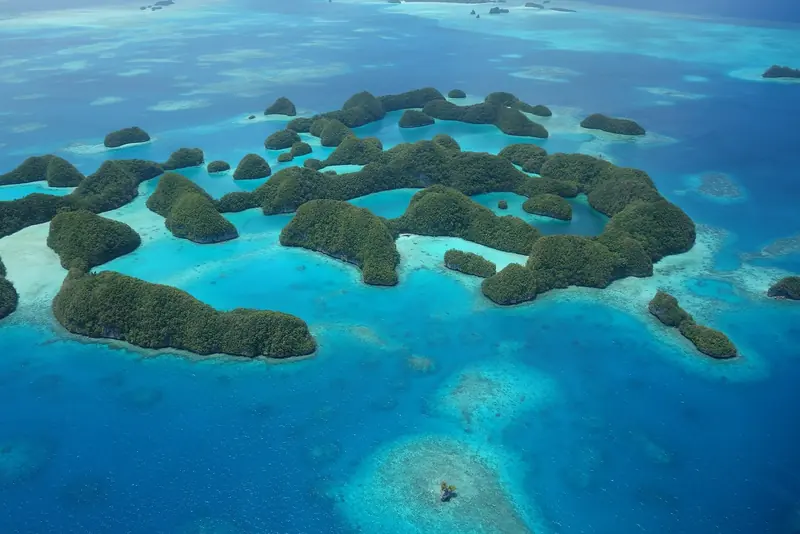
| Ngerukewid, 37 raised coral islands in the Rock Islands group, has been a closed wildlife preserve since 1956; landing is prohibited | |
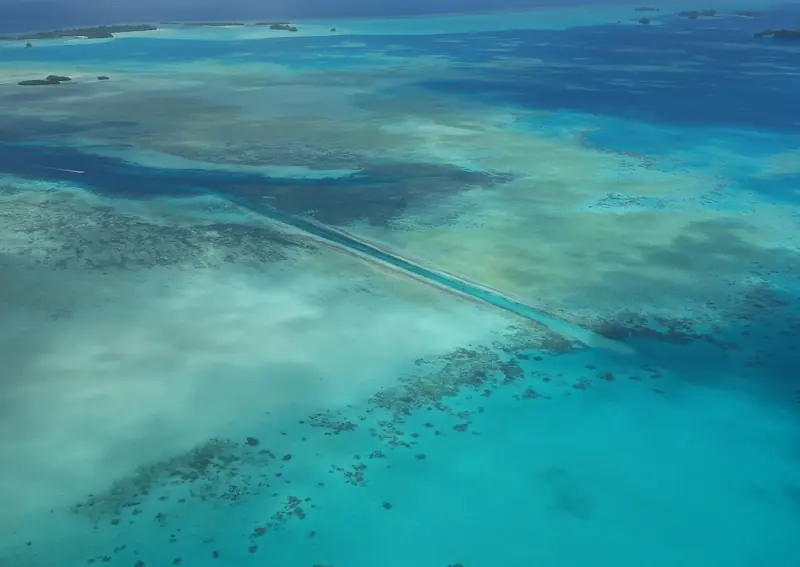
| German Channel, an artificial cut dredged through the barrier reef by the German colonial administration in the early 1900s, is both a working passage from the lagoon to open Pacific water and a well-known manta and shark dive site | |
| Peleliu, in the south of the group, was the site of a major and costly 1944 US-Japanese land battle; wrecked landing craft, tanks and bunkers remain and are a recognised wreck-diving and battlefield-tourism draw | |
| US citizens receive a one-year tourist visa on arrival at no charge; all other nationalities receive 30 days free, extendable twice at USD 50 per extension | |
What Palau Actually Is, Geographically
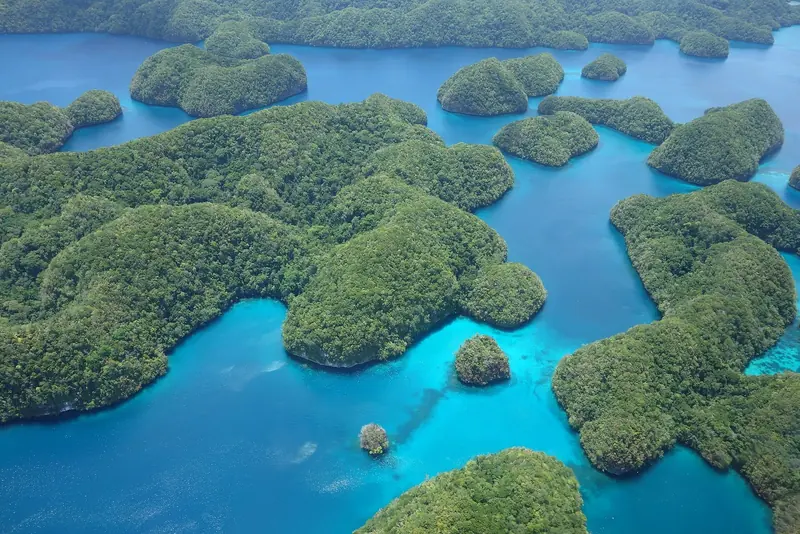
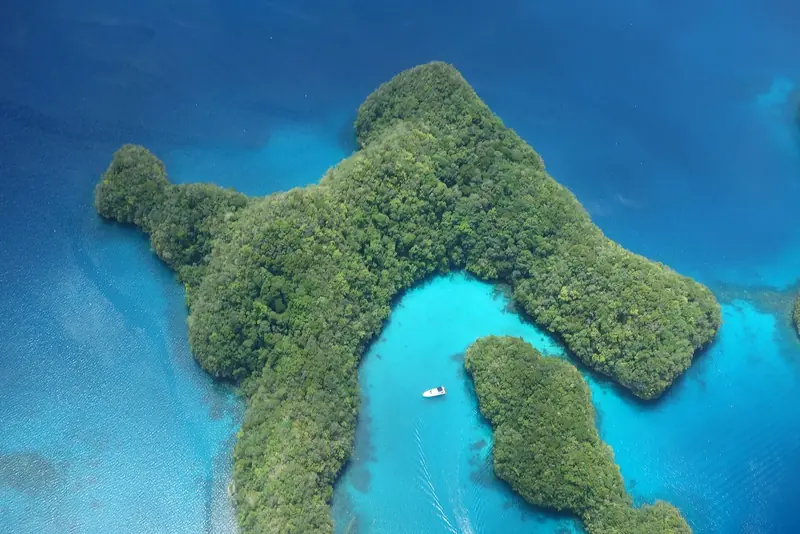
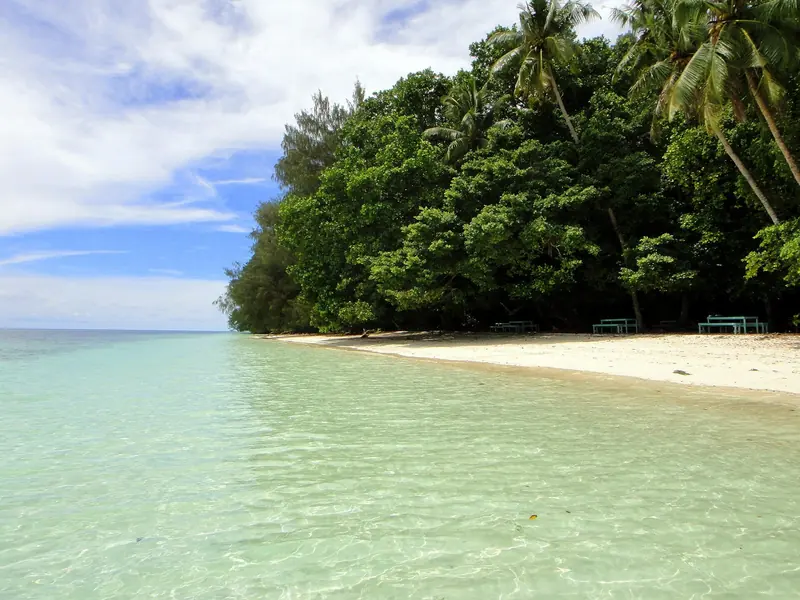
Most of what a visiting yacht actually sees and anchors among is the Rock Islands: several hundred small, uninhabited limestone islets, undercut at the waterline by centuries of bioerosion so that each one appears to float slightly above its own reflection, covered in dense green forest and separated by channels of water that shift from deep navy to reef-shallow turquoise within a boat length. The main population and the port of entry, Koror, sits at the northern edge of this cluster, with the state capital Ngerulmud a short distance away on Babeldaob, the largest island in the group.
The Rock Islands Southern Lagoon was inscribed as a UNESCO World Heritage Site in 2012 under mixed natural and cultural criteria, recognising both the reef and lagoon ecosystem and human sites within it, including rock art and the remains of former villages. For a cruising sailor the practical shape of the place is simple: one port of entry, a dense scatter of protected islets immediately south of it, and open Pacific water beyond the barrier reef in every other direction.
Getting There, And Why It Is Not A Casual Detour
Two broad routes bring cruising yachts to Palau: boats working west across Micronesia toward the Philippines often route through Yap and Palau in sequence, while others coming from further south or east make a more direct passage and continue north-west toward Guam, the Northern Marianas and on to Japan. Either way, Palau is a deliberate destination rather than something a yacht passes on the way to somewhere else, which keeps cruiser traffic here markedly lighter than in the Philippines or French Polynesia.
The passage planning question that actually matters is timing, not distance. December through May brings the driest, most settled weather under the northeast trade winds; June through September brings the wettest and least settled conditions under the westerly monsoon; and the shoulder months of May-June and October-November, when the wind direction is switching over, are generally regarded as the calmest windows for the passage itself and for time at anchor.
Jellyfish Lake held an estimated 30 million golden jellyfish in 2005. By 2025 the count had fallen below 5,600, and tours were reported suspended for lack of jellyfish in January 2026.
Checking In At Malakal, And What It Actually Costs
Malakal Harbour, immediately east of Koror, is sheltered by reef on three sides and offers anchorage or mooring for vessels of moderate draught close to the town's services. Clearance runs through the Bureau of Immigration, Customs and the Palau Maritime Authority: a Vessel Entry Permit is a flat USD 50, valid one year for US-registered vessels and 30 days (extendable at USD 50 each time) for everyone else. Every non-Palauan passport holder aboard pays a USD 100 Pristine Paradise Environmental Fee on arrival, and Customs separately collects a flat USD 50 Water Vessel Tax at check-in.
Visa treatment is generous by Pacific standards: US citizens receive a full year's tourist visa at no charge, and every other nationality gets 30 days free, extendable twice at USD 50 each. None of this is unusual or hidden - Noonsite and the Royal Belau Yacht Club both publish it clearly - but a crew of four should expect the arrival paperwork alone to run to several hundred dollars before a single night's mooring fee or Rock Island permit is added.
The Rock Islands: Permits, Restrictions And What Is Off-Limits
The Royal Belau Yacht Club's own published fee page states the Koror State Cruising Permit at roughly USD 10 per foot of boat length, capped at USD 80, valid for 30 days. A separately published firsthand cruiser's account instead describes a USD 20 per month yacht permit on top of a USD 50 use permit, which is a materially different fee structure for what is nominally the same document. Neither source carries a clear date stamp that resolves the conflict, so the practical answer is to confirm the current fee and structure directly with Koror State Rangers on arrival rather than budget from either figure with confidence.
Beyond the cruising permit, every person aboard needs a Rock Island Permit: USD 50 for 10 days, or USD 100 for 10 days including access to Jellyfish Lake. Some areas are closed outright rather than merely permitted: Ngerukewid, a group of 37 raised coral islands, has been a wildlife preserve since 1956 and landing there is prohibited, so the aerial view from a tender or the yacht itself is, by design, how most visitors will ever see it.
Jellyfish Lake: The Honest Current Picture
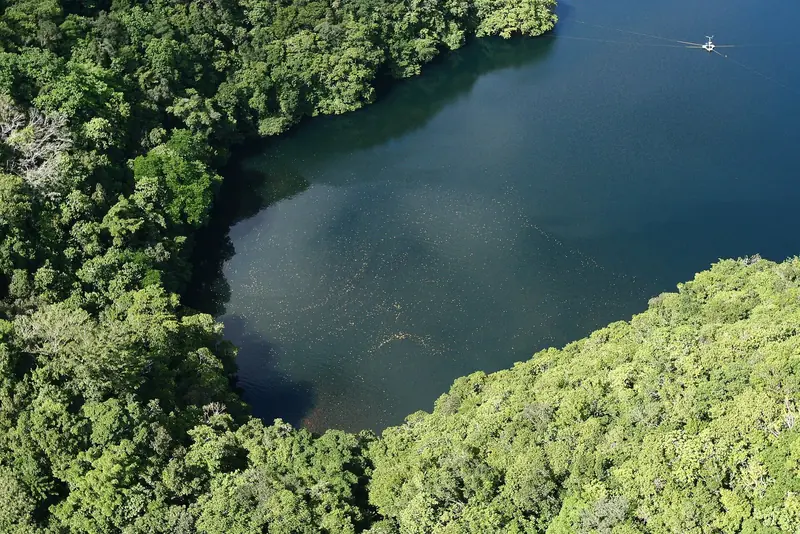
Ongeim'l Tketau, better known as Jellyfish Lake, on Eil Malk island, held an estimated 30 million golden jellyfish (Mastigias papua etpisoni) at its 2005 peak, a population dense enough that swimmers reported them gliding continuously against their bodies. A drought-linked crash led to a roughly two-year closure beginning around 2016 to let the population recover, and the lake reopened afterward - but recovery has been limited. By 2025 the counted population had fallen below 5,600, and multiple Tripadvisor reviewers dated April 2026 describe seeing only a few dozen jellyfish rather than a wall of them; one January 2026 reviewer reported that tours were not being run at all because there was almost nothing left to see, at an unchanged USD 100 permit price.
None of this makes the wider Rock Islands less worth visiting - it means one specific, heavily marketed attraction inside them is currently delivering a fraction of what its own reputation promises, at full price. A page that only repeated the historic 'millions of stingless golden jellyfish' description, without the 2025-2026 reviewer evidence, would be describing a lake that no longer exists in that form. Anyone weighing the Jellyfish Lake permit specifically should treat the current population, not the poster, as the honest baseline.
The Diving, Which Is Where Palau's Reputation Actually Comes From
German Channel, an artificial cut dredged through the barrier reef by the German colonial administration in the early 1900s to let vessels pass between the lagoon and open Pacific water without waiting on the tide, doubles as one of Palau's best-known dive sites, regularly drawing manta rays and grey reef sharks to its current-swept mouth. Ulong Channel and Siaes Corner, both named repeatedly in cruising guides and a firsthand account from a cruising couple who spent a season in Palau, are rated among the best drift dives either had experienced anywhere in the Pacific, for both the volume of fish life and the clarity of the water.
History adds a second, less-marketed layer south of the main Rock Islands group. Peleliu was the site of a major and costly 1944 battle between US and Japanese forces, and wrecked landing craft, tanks and bunkers remain in and around the island today, drawing wreck divers and battlefield visitors distinct from the reef-diving crowd further north. A yacht with time for both the Rock Islands and Peleliu sees two genuinely different sides of Palau in a single, short cruising ground.
Weather, Typhoon Season, And What One Cruising Couple Actually Rode Out
Palau's dry season, December through May, brings the calmest and most settled conditions under the northeast trade winds; June through September, the westerly monsoon season, is wetter and less settled. Typhoon risk is concentrated from July through October, tapering into November and December, with January through April considered the safest months in the wider region. Direct typhoon hits on Palau specifically are described as infrequent, but the surrounding waters see regular typhoon activity and Palau is not outside the belt.
Katie Thomsen's account for Blue Water Sailing of her and her husband's season in Palau is the clearest evidence available of what that risk looks like in practice: as Typhoon Haiyan approached in 2013, they secured their yacht in a Rock Islands anchorage with three shore lines and additional ground tackle, then rode out winds that built into the high thirties in knots overnight, with the typhoon passing in roughly 12 hours rather than the 24 originally forecast. It is a first-hand demonstration that the Rock Islands can function as real typhoon shelter for a well-prepared boat, not just a marketing claim about the anchorage's protection.
Provisioning And Daily Life In Koror
Sam's Tours, a Koror-based dive operator, has offered visiting yachts a guest mooring at around USD 50 a month, with shore access to showers and trash disposal - a firsthand account rates this as good value relative to marina fees elsewhere in the Pacific. The Royal Belau Yacht Club can also arrange a guest mooring for a visiting boat if contacted ahead of arrival, functioning more as a local cruisers' contact point and fee-and-permit resource than as a marina in the Mediterranean or Caribbean sense.
On land, a cruising couple's firsthand account rates Koror's supermarkets and hardware stores as more complete than most other Pacific island stops on their route, alongside working postal services - the ordinary infrastructure of a small but genuine town rather than a resort supply depot. Combined with the fishing licence available through Sam's Tours (USD 20 a month or USD 240 a year) and the Peleliu State permit for visiting the WWII battlefield sites (USD 30 for divers, USD 10 for land tours), Koror functions as a genuine base for an extended stay rather than a one-night stop before pushing on.
على البر والوصول والحجز
| Checking in | Malakal Harbour, Koror is the port of entry; call ahead on VHF channel 16. Clearance runs through the Bureau of Immigration, Customs and the Palau Maritime Authority. Budget USD 50 for the Vessel Entry Permit, USD 100 per person for the Pristine Paradise Environmental Fee, and USD 50 for the Water Vessel Tax, all payable at check-in, on top of any visa costs. |
|---|---|
| Cruising beyond Malakal | A Koror State Cruising Permit is required to take the boat out to the Rock Islands: about USD 10 per foot of length to a USD 80 cap, valid 30 days, per the Royal Belau Yacht Club. A separate published cruiser account instead describes a USD 20 per month yacht permit plus a USD 50 use permit, so confirm the current structure and price directly with Koror State Rangers rather than budgeting from either source alone. |
| Rock Island and Jellyfish Lake access | A Rock Island Permit costs USD 50 per person for 10 days, or USD 100 per person for 10 days including Jellyfish Lake. As of January 2026, at least one visitor reported the lake tour suspended entirely for lack of jellyfish to see, at the same USD 100 price - confirm current availability before paying. |
| Mooring and anchoring | Malakal Harbour offers anchorage or mooring for vessels of moderate draught, reef-sheltered on three sides. Sam's Tours in Koror has offered a guest mooring at around USD 50 per month with shore access to showers and trash disposal. The Royal Belau Yacht Club can arrange a guest mooring if contacted before arrival. Anchoring directly on coral in the Rock Islands is restricted in places to protect reef habitat. |
| Weather and timing | December to May brings the driest, most settled northeast trade winds; June to September is the wettest, least settled westerly monsoon season. May-June and October-November, when the wind direction switches, are generally the calmest windows. July to October carries the highest typhoon risk in the wider region, though a direct hit on Palau itself is statistically uncommon; a well-found yacht can shelter effectively inside the Rock Islands, as one cruising couple demonstrated through Typhoon Haiyan in 2013. |
| What is not published | Neither the exact current jellyfish count nor a firm reopening date for full Jellyfish Lake tours is published anywhere consulted for this page; the most recent reviews (January and April 2026) are the only source, and they describe a lake still far below its historic population. The Koror State cruising permit's exact fee structure is also inconsistently described between the Royal Belau Yacht Club's own page and a published cruiser's firsthand account - a discrepancy worth resolving with Koror State Rangers directly rather than assuming either figure. |
ما يذكره الملاك والأطقم
A cruising couple rode out Typhoon Haiyan in the Rock Islands and called the shelter genuinely effective
Katie Thomsen, writing for Blue Water Sailing about her and her husband's season in Palau, described securing their yacht with three shore lines and ground tackle in a Rock Islands anchorage as Typhoon Haiyan approached in 2013, then riding out winds in the high thirties (knots) that built through the night; the typhoon passed in roughly 12 hours rather than the 24 forecast. She also described a mooring in front of Sam's Tours in Koror at about USD 50 a month with showers and trash disposal, and rated Koror's supermarkets and hardware stores as more complete than most of the Pacific islands she had cruised.
Katie Thomsen, Blue Water SailingRecent visitors confirm the jellyfish are effectively gone, at a rising price
A reviewer visiting in April 2026, who had also seen the lake in 2015, described the earlier visit as overwhelming with jellyfish gliding constantly against his body, and the 2026 visit as down to only a few, smaller individuals. Another April 2026 visitor reported seeing about 30 jellyfish total and called it 'an extremely expensive day out for what we saw'. A January 2026 reviewer went further, reporting that tours were not being offered at all because there were almost no jellyfish left to see, at a permit cost of USD 100.
TripadvisorDiving is what earns Palau its reputation, not the lake
Cruising guides and dive operators consistently rank Palau's outer-reef sites - German Channel for mantas and sharks, Ulong Channel and Siaes Corner among them - as some of the best drift diving anywhere, a reputation the jellyfish lake's decline has not touched. Katie Thomsen's account independently rated the diving and the clarity and volume of marine life as the best she had seen anywhere she had cruised.
Blue Water Sailing / Southeast Asia Pilot
نقاط القوة وما يستدعي الانتباه
نقاط القوة
- A UNESCO lagoon that still delivers on the waterThe Rock Islands Southern Lagoon's 2012 UNESCO listing recognises exactly what a visiting yacht still gets: hundreds of undercut limestone islets, clear channels between them, and reef diving rated among the best in the world, none of which has been affected by the jellyfish lake's decline.
- A single, workable port of entryMalakal Harbour clears a yacht in through one office at one location, reef-sheltered on three sides, without the multi-port complexity or long anchorage queues reported in some other Pacific check-in points.
- Genuinely world-class diving, independently ratedGerman Channel, Ulong Channel and Siaes Corner are named repeatedly across cruising guides and a firsthand cruiser's account as diving that outranks most of the wider Pacific, entirely independent of the jellyfish lake's fortunes.
- A real, tested typhoon shelterA cruising couple's own account of riding out Typhoon Haiyan inside the Rock Islands, secured with shore lines, is a stronger data point than any brochure claim about the anchorage's protection.
- Modern conveniences in KororA firsthand cruising account rates Koror's supermarkets, hardware stores and postal service as more complete than most Pacific island stops, which matters for anyone provisioning mid-ocean rather than at the start of a passage.
ما يستدعي الانتباه
- The signature attraction has collapsedJellyfish Lake fell from an estimated 30 million jellyfish in 2005 to fewer than 5,600 by 2025, and reviewers in January 2026 reported tours suspended entirely for lack of jellyfish, at a permit price that had not fallen to match.
- Permit costs and structures are inconsistently publishedThe Koror State cruising permit is described one way by the Royal Belau Yacht Club (per-foot, one-time, 30-day) and another way by a published cruiser's account (monthly yacht permit plus a separate use permit). Neither source is obviously outdated, and a boat should confirm directly rather than budget from either alone.
- A real typhoon season, not a marketing footnoteJuly to October carries genuine typhoon risk in the wider region, and a cruising couple's own account of a direct approach by Typhoon Haiyan shows the risk is not theoretical, whatever the low frequency of confirmed direct hits on Palau specifically.
- It is a long way from anywhere elseAt roughly 550 nautical miles from the Philippines and a similar order of distance to Guam or Yap, Palau is not a convenient add-on to a wider Pacific itinerary; getting there and away is itself a significant passage-planning commitment.
- Access to the best sites is fee-layered and permit-heavyBetween the Vessel Entry Permit, the Pristine Paradise Environmental Fee, the Water Vessel Tax, the Koror State Cruising Permit and the per-person Rock Island and Jellyfish Lake permits, a boat and crew of four can be looking at several hundred dollars in fees before a single mooring fee is paid.
لمين هو: An owner or charter guest who wants world-class diving and a genuinely dramatic anchorage - kayaking and swimming between limestone islets undercut by the tide, in water clear enough to see the reef from the deck - and who checks in once at Malakal rather than island-hopping through multiple ports. Less suited to anyone chasing the specific jellyfish-lake photograph that made Palau famous, since the population that made it possible has collapsed, or to an owner unwilling to plan a passage and a season around a real typhoon window rather than a resort brochure's version of the weather.