The Azores
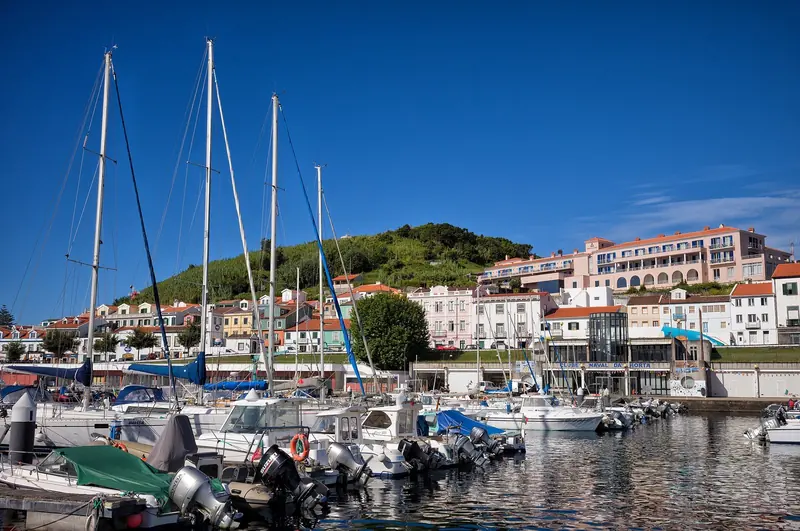
| Nine islands in three groups | Flores and Corvo in the west, Faial, Pico, Sao Jorge, Terceira and Graciosa in the centre, Sao Miguel and Santa Maria in the east |
|---|---|
| Roughly 1,000 yachts a year make landfall at Horta, and cruising guides note very few go on to cruise the rest of the chain | |
| Antigua to Horta is about 2,200 nautical miles, a 14 to 21 day passage | |
| The Faial-Pico channel is 4.5 nautical miles wide; Sao Miguel sits roughly 100nm southeast of the central island group and Terceira 90nm northwest of Sao Miguel | |
| Marina da Horta | 300 berths, peak-season hours 08:00-20:00, off-season 08:00-17:00 |
| Marina de Ponta Delgada (Portas do Mar): 640 berths, quadrupled under a harbour redevelopment | |
| Standard VAT in the Azores is 16 percent, cut from 18 percent in July 2021, against 23 percent on mainland Portugal | |
| A non-EU yacht importing through the Azores must moor for two to three working days to allow customs clearance | |
| EU temporary admission for a non-EU-flagged yacht runs 18 months, the same clock as anywhere else in the bloc | |
| ARC Europe 2026 | 36 boats left Sint Maarten on 9 May and sailed the roughly 1,800nm Bermuda-to-Faial leg into Horta |
| Peter Cafe Sport has operated in Horta since 1901 and has served as an informal poste restante for Atlantic sailors for more than a century | |
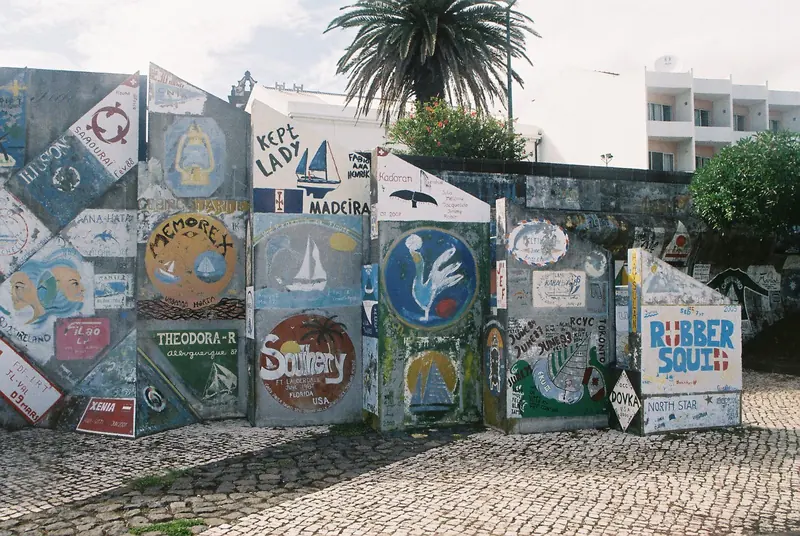
| Sailors have painted their boat's name on the Horta marina wall and breakwater for decades, on the belief that skipping it invites bad luck on the next passage | |
| The sweet spot for a Caribbean departure is late April to mid-May, landing crews in the Azores by late May or June | |
| Neither Marina da Horta nor Marina de Ponta Delgada publishes a berth rate; both direct enquiries to a phone call | |
A Waypoint the Ocean Chooses
The nine islands split into three groups a long way apart: Flores and Corvo far to the west, Faial, Pico, Sao Jorge, Terceira and Graciosa in the central cluster, and Sao Miguel and Santa Maria roughly 100 nautical miles further southeast. Horta sits on Faial at the western edge of the central group, across a 4.5 nautical mile channel from Pico's volcano, and it is the port almost every crossing crew already knows the name of before they have seen it. Roughly a thousand yachts a year make landfall here, most of them arriving from the Caribbean or Bermuda on the long leg home to Europe.
What keeps the number concentrated on one island is position, not choice. Horta is close enough to the rhumb line from the eastern Caribbean that turning off course to reach it costs almost nothing, and it is the last reliable fuel, chandlery and crew-change point before landfall in continental Europe or the UK. Sao Miguel, the largest island and home to the region's other real marina at Ponta Delgada, sits far enough east that most delivery crews never see it: cruising guides note that although hundreds of yachts call every year, very few actually cruise around the islands.

The Crossing That Ends Here
Antigua to Horta runs about 2,200 nautical miles direct, and passage times of 14 to 21 days are typical depending on waterline length and how cooperative the Atlantic decides to be that year. The route lives and dies by the Azores High, the clockwise-circulating block of high pressure that sits over or near the islands for most of the season: get the timing right and a boat rides its northern edge on a long reach most of the way; get it wrong and the same system can leave a boat becalmed for days or let a late-season low push up from the south.
The organised alternative is ARC Europe, which in 2026 saw 36 boats leave Sint Maarten on 9 May for Bermuda before the roughly 1,800 nautical mile leg on to Faial. Chris Eakin, skipper of Cadans, described the arrival: "I feel fantastic, to be honest I feel a little bit tearful actually. The weather was challenging with three gales blowing through, but we missed them all by being further south. We listened to the advice at the skippers' briefing and used the barometer for the first time, which worked really well." Even a well-timed, well-advised crossing still meets gales; good routing only decides how many.
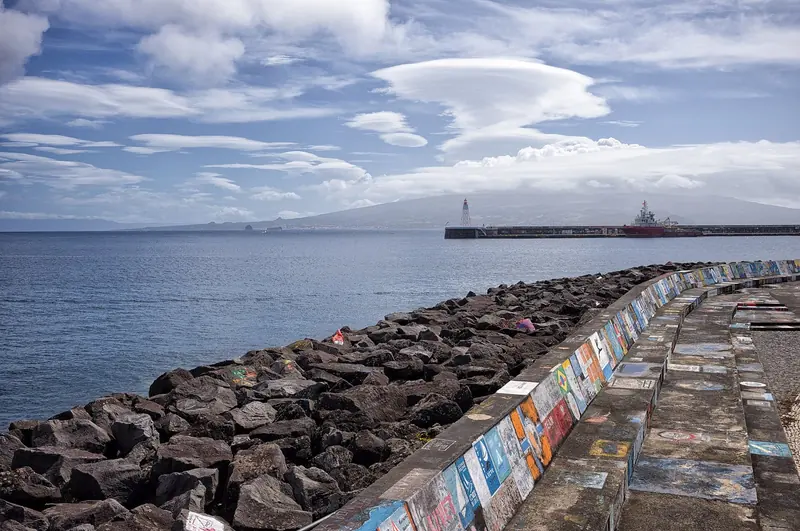
About a thousand yachts make landfall at Horta every summer, and the marina wall is the only thing the harbour asks of them in return.
Horta, the Port Every Sailor Already Knows
The marina itself is straightforward: 300 berths, power and water to every pontoon, showers, laundry, fuel, a weather forecasting service and a bar and restaurant on the terrace, open 08:00 to 20:00 in peak season and 08:00 to 17:00 outside it. Mid Atlantic Yacht Services keeps a chandlery stocked with the parts a boat that has just crossed an ocean actually needs, and cruiser reports single out The Sailing Workshop, run by Miguel and Pia, for engineering work that turns up when it says it will and gets finished tidily. For a boat with a real problem after 2,000 miles, Horta is close to the only serious option in the entire archipelago.
The tradition that makes the port famous costs nothing and is treated as compulsory anyway. Sailors have painted their boat's name across the marina wall and breakwater for decades, on the belief that a boat which leaves no mark risks a serious accident on its next passage; the result is a mosaic that now runs the length of the harbour. Jose Henrique Azevedo, who runs Peter Cafe Sport as his father did before him, put the appeal of the place in the fleet's own terms: "We would like to continue to be the central and popular meeting point for adventurers and sailors in the middle of the Atlantic." A common line among the crews who pass through puts it more bluntly: if you sail to Horta and do not visit Peter's, you have not actually been to Horta.
Sao Miguel and the Rest of the Chain
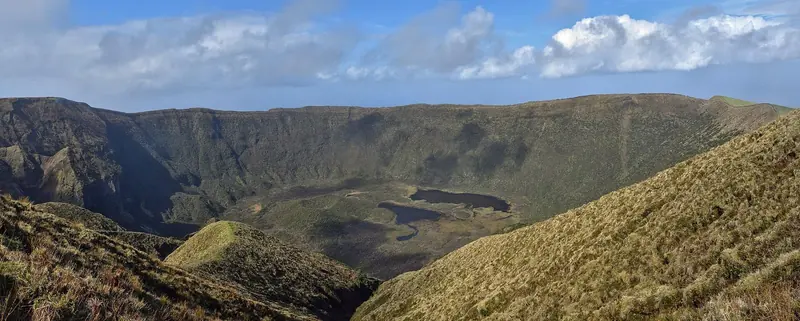
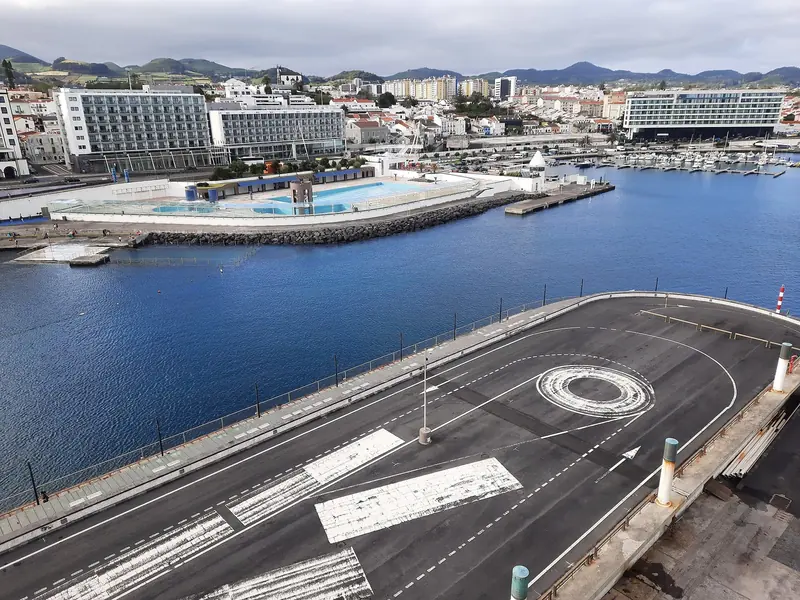
Ponta Delgada's marina quadrupled in size under the Portas do Mar redevelopment, which added a cruise pier, an open-air amphitheatre, shops and bars and a renovated seawater pool alongside the 640 berths, and it is the busier port for the cruise ships and ferries that call at Sao Miguel rather than for transiting sailing yachts. Terceira sits about 90 nautical miles northwest of Sao Miguel, and Faial's own Caldeira, the crater at the centre of the island, is a short taxi ride from the marina that most crews never take.
The pattern repeats across the group: real islands, real facilities in places, and almost nobody stopping to look. Whale and dolphin watching operates out of several islands, and Pico's volcano, the highest point in Portugal, stands directly across the channel from every berth at Horta. An owner with even a few extra days built into the schedule sees an entirely different Azores to the one described by a fuel stop and a mural wall; the difficulty is that most crossings are planned to the day, and a few extra days are exactly what a transatlantic passage rarely has spare.
The Customs Clock and the VAT Advantage
The Azores cut its standard VAT rate from 18 to 16 percent in July 2021, under a regional decree confirmed by Portugal's own tax authority, putting it level with Malta as one of the two lowest standard rates in the EU; the intermediate rate is 9 percent and the reduced rate 4 percent. For a private owner the practical use is temporary admission: a non-EU-flagged yacht gets the same 18-month clock in the Azores as anywhere else in the EU customs union, but if the choice is genuine importation rather than a passing stop, doing the paperwork through the Azores instead of the mainland cuts the VAT bill by roughly a third.
The catch is procedural rather than financial: the yacht has to be physically in the islands and moored for two to three working days while a Portuguese VAT number is obtained for the owning company, the customs survey and valuation are completed, and the Declaration of Importation is issued and kept aboard. Specialist agents based in Madeira and the Azores handle the paperwork end to end for owners who are importing rather than just crossing through, and the process changes nothing for a yacht that is simply passing on temporary admission and leaving again within its 18 months.
What a Berth Actually Costs, and What Nobody Publishes
This is not a gap in the research, it is the honest state of the information. Horta's marina office answers on +351 292 391 693 and Ponta Delgada's on +351 296 28 15 10, and both expect a call rather than a website booking for anything beyond the smallest boat. What is published is capacity and facilities: 300 berths at Horta with 220V power, water, showers and fuel to every pontoon, and 640 at Ponta Delgada with the wider Portas do Mar development around it. Fuel, laundry and provisioning at both compare favourably with the Caribbean on the strength of the lower VAT rate alone, even without a published tariff to compare against.
The absence of a public rate card matters more here than at a Mediterranean marina, because an Azores stop is rarely optional the way a Riviera one is. A crew that has just crossed an ocean and needs a berth for repairs or a crew change is not comparison-shopping between Horta and an alternative; there is no alternative within several hundred miles. Budgeting for the Azores leg of a crossing means calling ahead rather than reading a tariff, and building slack into the budget for whatever the marina quotes on the day.
The Weather That Sets the Calendar
Most transiting traffic passes through Horta between May and July, timed around the westbound Caribbean departure window and the outbound legs north to the UK or east to Iberia that follow it. Locally, the islands sit in the open Atlantic with no landmass to soften an approaching front, and a boat waiting on a weather window in Horta can lose the better part of a week to a system that never reaches the islands directly but closes the passage ahead regardless.
The professional routing available through organised rallies narrows the risk without removing it. ARC Europe's 2026 fleet used the skippers' briefing and barometer readings to route south and avoid three gales on the Bermuda-to-Faial leg, and still felt the weather closely enough that the arriving skipper called it "challenging." A private crew without that routing support is making the same call from forecasts alone, on a passage where the nearest safe harbour behind them may be several days astern.
The Honest Downside
The concentration that makes Horta so useful also makes it a single point of failure. A serious mechanical problem anywhere in the Azores means getting to Faial, because Mid Atlantic Yacht Services and The Sailing Workshop are close to the only marine trades in the entire archipelago; there is nothing resembling a Caribbean or Mediterranean refit yard anywhere in the chain. Seven of the nine islands have no yacht facilities to speak of, and the smaller central islands and the western pair, Flores and Corvo, see almost no cruising traffic at all.
The season itself is a narrow strip either side of the summer solstice, bounded on both ends by the Atlantic hurricane season to the southwest and by autumn gales setting in early at this latitude. And because almost every yacht that stops is mid-passage rather than on a dedicated Azores holiday, the islands' real appeal, the crater walks, the whale grounds, the hot springs on Sao Miguel, goes past most owners entirely. An owner who wants to see the Azores rather than merely clear customs there has to plan the extra days in deliberately, because the crossing schedule will not create them on its own.
على البر والوصول والحجز
| Season | Most transiting yachts pass through Horta May to July, timed around the late April to mid-May Caribbean departure window; a small minority cruise the wider chain outside those months |
|---|---|
| Getting there | Ponta Delgada's Joao Paulo II Airport on Sao Miguel is the main international gateway; Horta on Faial has its own airport with more limited connections, mainly within the archipelago |
| Berthing cost | Not published at either main marina. Marina da Horta (300 berths, +351 292 391 693) and Marina de Ponta Delgada / Portas do Mar (640 berths, +351 296 28 15 10) both quote by phone rather than posting a tariff |
| Customs and VAT | 16 percent standard VAT in the Azores versus 23 percent on mainland Portugal; EU temporary admission for a non-EU yacht runs 18 months; genuine importation through the Azores requires the yacht to moor 2-3 working days for customs clearance and a Portuguese VAT registration |
| Repairs and provisioning | Mid Atlantic Yacht Services (chandlery) and The Sailing Workshop (engineering, run by Miguel and Pia) at Horta cover most transatlantic repair needs; there is little comparable elsewhere in the chain |
| The crossing | Antigua to Horta is roughly 2,200 nautical miles, 14 to 21 days; ARC Europe runs an organised eastbound rally via Bermuda, about 1,800nm on to Faial |
| What is not published | Current berth rates at either main marina; both require a direct phone enquiry rather than offering an online tariff |
ما يذكره الملاك والأطقم
A skipper who crossed with ARC Europe 2026, on the routing and the weather that still got through
"I feel fantastic, to be honest I feel a little bit tearful actually. The weather was challenging with three gales blowing through, but we missed them all by being further south. We listened to the advice at the skippers' briefing and used the barometer for the first time, which worked really well."
Chris Eakin, skipper, S/Y CadansThe man who runs Horta's most famous stop, on why the fleet keeps coming back
"We would like to continue to be the central and popular meeting point for adventurers and sailors in the middle of the Atlantic," said the current operator of Peter Cafe Sport, who took the business over from his father. He also described the pull of the place for the sailors who first put it on the map: "They were often well-educated, not as destitute as we first thought, and, above all, had great stories to tell."
Jose Henrique Azevedo, owner, Peter Cafe Sport, Horta
نقاط القوة وما يستدعي الانتباه
نقاط القوة
- No other stop sits this close to the direct line homeHorta is close enough to the rhumb line from the eastern Caribbean that a diversion costs almost nothing in miles, which is why roughly a thousand yachts a year choose it without much alternative to weigh against.
- A genuine EU VAT advantage for anyone actually importingThe Azores' 16 percent standard VAT rate against 23 percent on mainland Portugal is a real saving for an owner completing a Union import rather than a passing crew on temporary admission.
- Landscape well beyond what the marina suggestsVolcanic craters, whale grounds and hot springs sit within a short taxi ride of Horta and Ponta Delgada alike, for the minority of crews who build the extra days into a crossing schedule to see them.
ما يستدعي الانتباه
- The Azores High does not guarantee calmEven ARC Europe's professionally routed 2026 fleet met three separate gales on the Bermuda-to-Faial leg and only avoided them by sailing further south than planned; a private crew without that routing support carries the same risk with less warning.
- Almost all marine infrastructure sits on one islandA serious repair anywhere in the chain effectively means getting to Faial, since Mid Atlantic Yacht Services and The Sailing Workshop are close to the only marine trades in the entire nine-island archipelago.
- Neither main marina publishes a berth rateMarina da Horta and Marina de Ponta Delgada both direct enquiries to a phone call rather than a tariff, so budgeting the Azores leg of a crossing means asking rather than reading.
- Most of the archipelago goes unseenCruising guides note that although hundreds of yachts call every year, very few actually cruise around the islands; seven of the nine see almost no yachting traffic at all.
لمين هو: An owner or delivery skipper crossing the Atlantic on their own hull, or anyone willing to trade a beach club season for hiking, whale watching and a volcanic crater above the anchorage.