The Ionian Islands
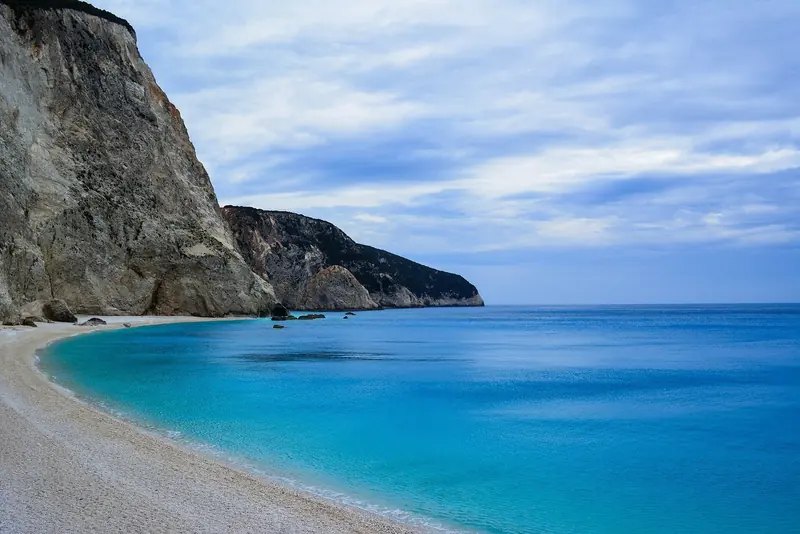
| Region | western Greece, from the Albanian border to the Peloponnese, Corfu to Zakynthos about 130 nautical miles |
|---|---|
| The core cruising ground is the southern cluster: Lefkada, Meganisi, Kalamos, Kastos, Ithaca and Kefalonia, mostly within 90 minutes of each other | |
| Wind | the maistro, a thermal north westerly of roughly 10 to 18 knots filling at midday and dying in the evening. There is no meltemi here |
| Season | late April to mid October, with May, June and September the best combination of weather and space |
| Main marina | D-Marin Gouvia on Corfu, 1,200 berths to 70 m and 5.5 m draft, 500 dry berths, 65 t and 75 t travel lifts, VHF 69 |
| Gouvia is about 7 km from Corfu airport and recently added 104 berths | |
| D-Marin Lefkas | about 620 berths but roughly 45 m maximum length and about 3.3 m draft, inside the Lefkada canal |
| The Lefkada floating bridge opens on the hour through the day, which sets the timetable for anything transiting the canal | |
| Cleopatra Marina at Preveza is the hardstanding and winter storage centre for the region | |
| Coming | LAMDA Corfu Marina, 410 berths for yachts to 140 m on about 39,400 sq m inside the Port of Corfu, west of the cruise pier |
| Concession terms | over EUR 89 million in fees across 40 years, an initial EUR 9.7 million, a 7.77 per cent annual revenue fee and over EUR 50 million of investment |
| It is the first large greenfield marina project in Greece in two decades | |
| TEPAI | EUR 16 a month from 7 to 8 m, EUR 25 from 8 to 10 m, EUR 33 from 10 to 12 m, and EUR 8 per metre per month above 12 m |
| That puts a 30 m yacht at EUR 240 a month and a 50 m at EUR 400, payable through the AADE eTEPAI portal | |
| Charter VAT | 13 per cent statutory for crewed charters over 48 hours, 24 per cent for short, static or bareboat arrangements |
| Foreign flags | the e-Charter Permission of 29 December 2023 lets a non EU flagged commercial yacht over 35 m with a non wooden hull charter for 21 plus 7 days a year |
| Legal basis | Law 4926/2022, which replaced the charter provisions of Law 4256/2014, as amended by Law 5111/2024 |
| Commercial yachts carry a maximum of 12 guests, with narrow flag specific exceptions | |
| Zakynthos National Marine Park | no entry or mooring in Zone A, no anchoring or mooring in Zone B, 6 knots in Zones B and C |
| Turtles | keep at least 15 m away and observe for no more than 15 minutes |
| Navagio beach is closed to landing through 31 October 2026, with boats held about 50 m off and no swimming in the bay | |
| Airports | Corfu, Aktion at Preveza, Kefalonia and Zakynthos, all heavily seasonal from May to October |
| Corfu Old Town is a UNESCO World Heritage site and the only substantial urban culture in the group | |
A chain you can work in short hops
The islands run down the western side of Greece from the Albanian border to the Peloponnese. Corfu sits at the top, Paxos and Antipaxos 30 nautical miles south of it, then Lefkada with the mainland shore of Preveza and Parga alongside, then the tight cluster of Meganisi, Kalamos, Kastos and Ithaca, with Kefalonia to the west and Zakynthos at the bottom. Corfu to Zakynthos is around 130 miles, so the whole ground is a comfortable delivery in a day and a half, and inside the southern cluster almost nothing is more than an hour and a half apart.
That middle section, from Lefkada down through Meganisi and Kalamos to Ithaca and the Kefalonia channel, is the best of it and it is the part most owners underestimate. The islands are close enough that lunch and dinner can be in different bays, high enough to give shelter in almost any wind, and green in a way the Aegean is not, because the Ionian takes real rain in winter. Corfu is the cultural anchor and the airport, and it is also the busiest and least interesting water in the group. The rewarding cruising starts about 40 miles south of it.
The maistro is why the season is longer
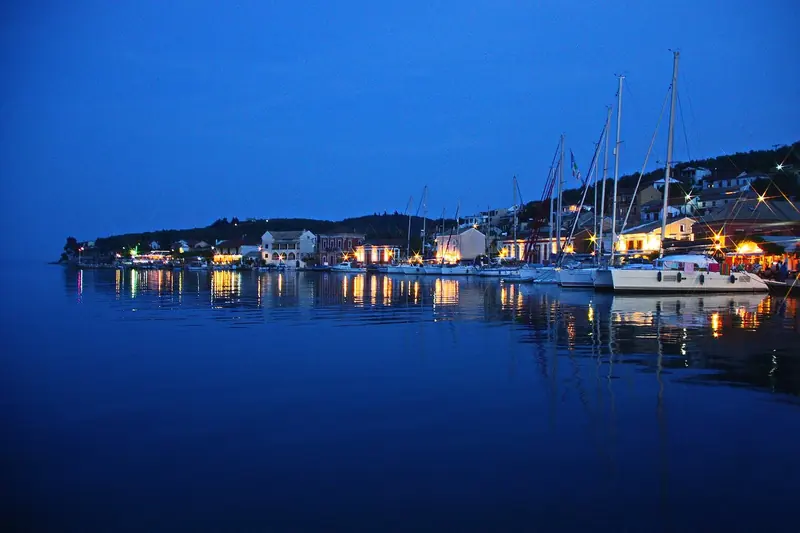
The defining wind is the maistro, a thermal north westerly that fills around midday, blows a steady 10 to 18 knots through the afternoon and drops away in the evening. It is predictable enough to plan the day around and gentle enough that guests who dislike heeling are still comfortable, which is the single biggest practical difference between here and the Cyclades. There is no meltemi in the Ionian. When the Aegean is shut down by 35 knots in August, boats here are sailing in fifteen.
The season runs from late April to the middle of October, and the shoulders are genuinely usable rather than a compromise. May and early June are warm, empty and green before the summer burns the hills brown. September is the connoisseur's month, with warm water, thinning traffic and reliable breeze. July and August bring the heat, the charter fleet and the only real crowding the region has. Winter is wet and windy, and the southerly sirocco that arrives with a front is the weather that decides where a boat can lie.
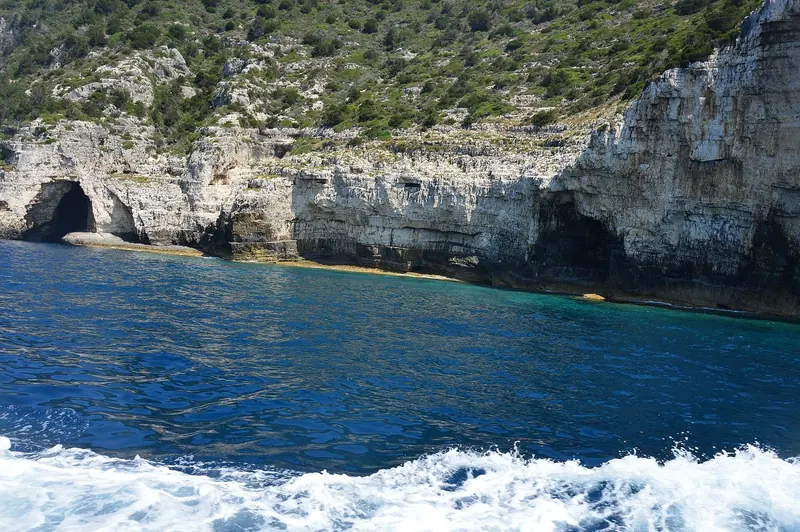
No meltemi, a month longer at each end of the season, and a marine park at the southern end that counts the minutes you spend near a turtle.
The islands worth spending the days on
Paxos is the first stop worth a night, small and low with olive groves and three harbours, Gaios, Lakka and Loggos, and the pale water of Antipaxos a mile south. Lefkada gives Porto Katsiki and Egremni on its exposed west coast, which are day anchorages in settled weather only, and Sivota on the south, a near landlocked inlet lined with tavernas that is one of the safest overnight spots in Greece. Meganisi next door hides Spartochori and a string of narrow bays that a large yacht can stern to in with a long line ashore.
Ithaca is the quiet one, with Vathy at the head of a long fjord and Kioni and Frikes on the north east coast. Kefalonia holds Fiskardo, the only village on the island the 1953 earthquake spared, which is the prettiest quay in the Ionian and the hardest to get into in August, plus Assos and the beach at Myrtos below the cliffs. Zakynthos at the southern end is a different proposition, busier, more package holiday than the rest, and wrapped around a national marine park that changes what a yacht may do there.
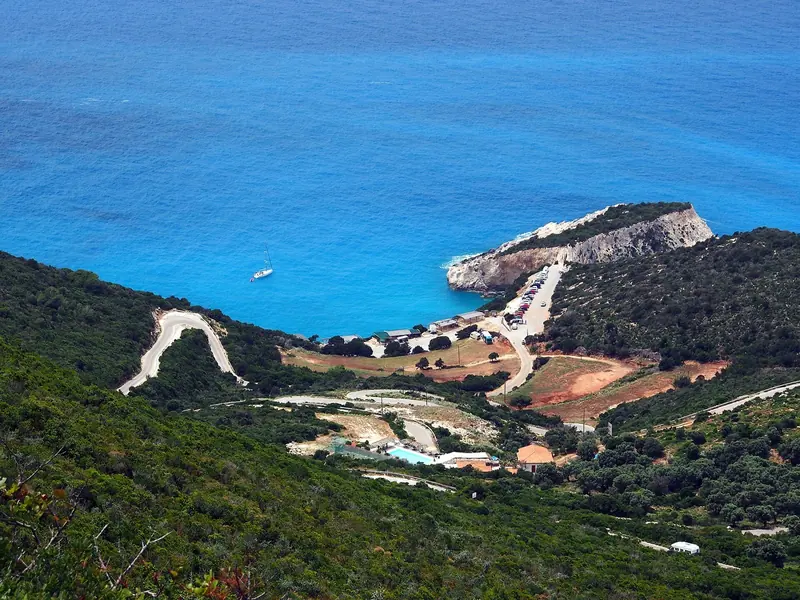
Zakynthos is a marine park, and the rules bite
The National Marine Park of Zakynthos protects the loggerhead turtle nesting beaches in the Bay of Laganas and is divided into zones. In Zone A no vessel may enter or moor at all. In Zone B mooring and anchoring are prohibited and the speed limit is six knots. Six knots also applies on approach to Laganas beach in Zone C. Boats must keep at least 15 metres from a turtle and may not observe one for more than 15 minutes. Collisions between boats and turtles are still being reported to the authorities each season by ARCHELON, the Greek sea turtle protection society, which is why the enforcement is tightening rather than relaxing.
Navagio, the shipwreck beach on the north west coast that appears on every poster of Greece, is closed. A landslide risk identified in 2022 has been carried forward by joint ministerial decision, and access is prohibited through 31 October 2026, with boats required to hold roughly 50 metres offshore and no landing, no approach to the wreck of the Panagiotis and no swimming in the bay. The clifftop viewing platform above it is open by road. An owner who has promised guests that beach should say so before they arrive rather than after.
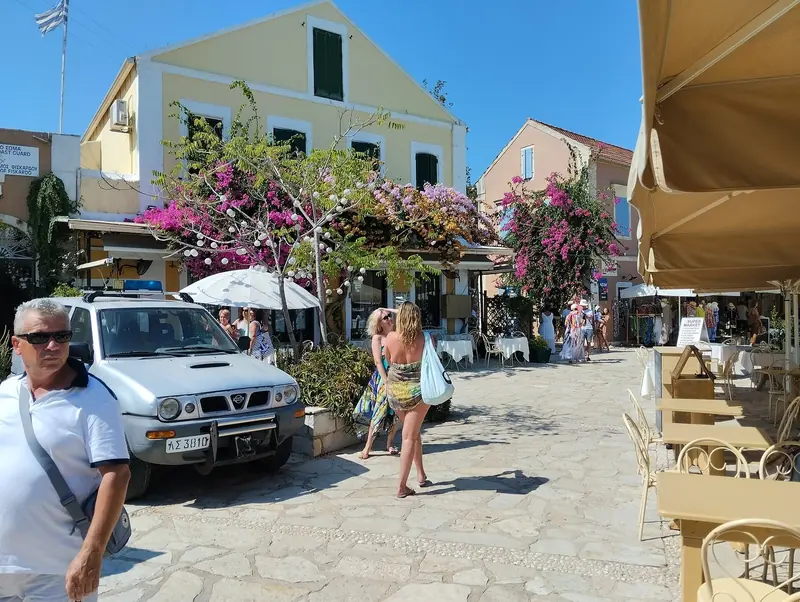
Where a large boat actually berths
Gouvia on Corfu is the biggest marina in Greece and the practical base at the northern end. D-Marin states 1,200 berths for vessels to 70 metres in up to 5.5 metres of draft, 500 dry berths, travel lifts of 65 and 75 tonnes, mobile cranes of 60 and 45 tonnes, a fuel station and a full technical trade, on VHF 69 and about seven kilometres from Corfu airport. A recent expansion added 104 berths. It is a working marina rather than a smart one, and it is where anything mechanical gets solved in the northern Ionian.
South of that the berthing shrinks fast. D-Marin Lefkas has around 620 berths but takes about 45 metres and roughly 3.3 metres of draft, which rules out a great many motor yachts, and it sits inside the Lefkada canal behind a floating bridge that opens on the hour from early morning until late evening. Cleopatra Marina at Preveza is the hardstanding and winter storage centre of the region. Everywhere else, Fiskardo, Kioni, Gaios, Sivota, Vathy, is a town quay: stern to, laid moorings or your own anchor, water and power of varying quality, and first come first served in August.
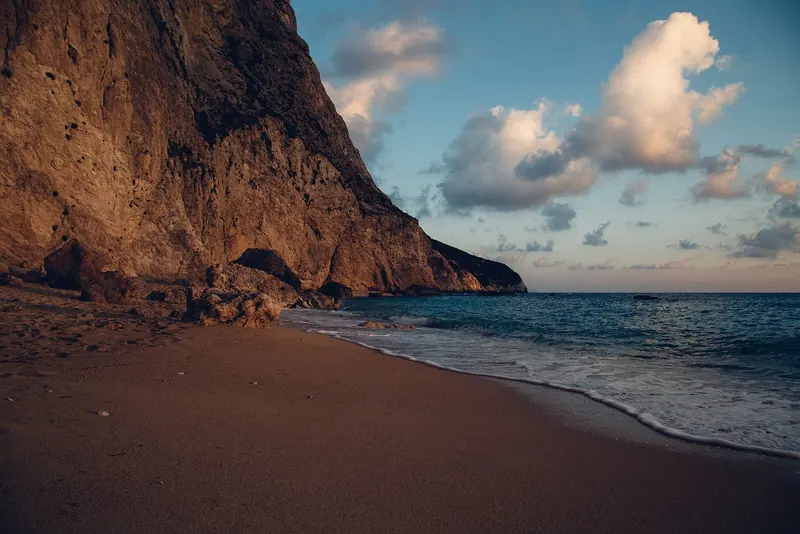
The 410 berth marina that will change the northern Ionian
In the largest greenfield marina project Greece has approved in two decades, the Hellenic Republic Asset Development Fund signed a sub concession with LAMDA Corfu Marina to build and operate a megayacht marina inside the Port of Corfu, west of the cruise pier. The design is 410 berths for yachts to 140 metres across a land area of about 39,400 square metres. LAMDA is expected to invest more than EUR 50 million in construction, against total fees of more than EUR 89 million over a 40 year concession, an initial payment of EUR 9.7 million and an annual revenue based fee of 7.77 per cent.
That matters because the northern Ionian and the southern Adriatic have had nowhere at this scale. Yachts working between Montenegro, Corfu and the Italian heel currently berth at Gouvia, at Corfu's commercial quay or across in Kotor and Brindisi. Until the marina opens, a 100 metre yacht in Corfu is negotiating a commercial berth rather than booking a marina slip. An owner planning a season here in the next two years should treat the project as a reason to check the schedule rather than as capacity he can rely on.
What Greece charges a yacht to be there
Every vessel over seven metres in Greek waters owes TEPAI, the monthly cruising fee, regardless of flag. The bands run at EUR 16 a month from seven to eight metres, EUR 25 from eight to ten, EUR 33 from ten to twelve, and above twelve metres it is charged at EUR 8 per metre per month, so a 30 metre yacht owes EUR 240 for each month it is in the country and a 50 metre owes EUR 400. It is paid through the AADE eTEPAI portal before the boat moves, or at customs on arrival, and it is checked.
Charter carries VAT on top. The statutory position is 13 per cent for a crewed charter of more than 48 hours, which covers any normal weekly booking, and 24 per cent for short, static or bareboat arrangements. In practice agents invoice below the headline where the yacht's certification and itinerary support a reduction, and 2026 rate sheets in circulation show effective figures between about 5.2 and 12 per cent depending on whether the boat is certified for international or Greek waters cruising. The reduction has to be evidenced by the licence and the itinerary, not assumed, and it is the agent's job to prove it.
Whether a foreign flag may charter here at all
Greece used to be closed to non EU flags for charter and it is now partly open. Under the e-Charter Permission introduced on 29 December 2023, a foreign flagged commercial yacht over 35 metres with a non wooden hull may start and finish charters in Greek waters for up to 28 days a year, structured as 21 days plus a 7 day extension, without holding a full Greek charter licence. The owning or operating company must not have a permanent establishment in Greece and must be registered for Greek VAT. The framework sits in Law 4926/2022, which replaced the charter provisions of Law 4256/2014, as further amended by Law 5111/2024.
Below 35 metres the old position still holds in substance, and a boat that wants to work the Ionian commercially needs an EU flag and a full Greek charter licence. The other rule that catches owners is the passenger limit: a commercially operating yacht carries a maximum of 12 guests, and the exceptions are narrow and flag specific. A group of 14 does not become legal by paying more, it becomes two boats. Both of these are questions to settle with a Greek agent before a season is planned around chartering the boat here.
Getting guests in
There are four airports on the ground and they divide it neatly. Corfu serves the north and sits seven kilometres from Gouvia. Aktion at Preveza is the airport for Lefkada, Meganisi and the middle of the chain and is about half an hour from Lefkas marina by road. Kefalonia serves Fiskardo and the Ithaca channel, and Zakynthos serves the south. All four run heavy seasonal European scheduled traffic from May to October and thin out sharply in winter, so an owner cruising in the shoulders should check that his guests' route still exists in April or late October.
The practical point is that the middle of the Ionian, which is the best cruising, is served by the smallest airport. Aktion is a former military field with limited handling, and a large private aircraft is usually better routed to Corfu or Athens with a road or helicopter transfer, or to Kefalonia. Road transfers along the chain are slow because the islands are separated by water, and the Lefkada canal bridge adds a wait. Plan guest changes at Corfu or Kefalonia and move the boat to meet them rather than the other way round.
Ashore, and the character of the place
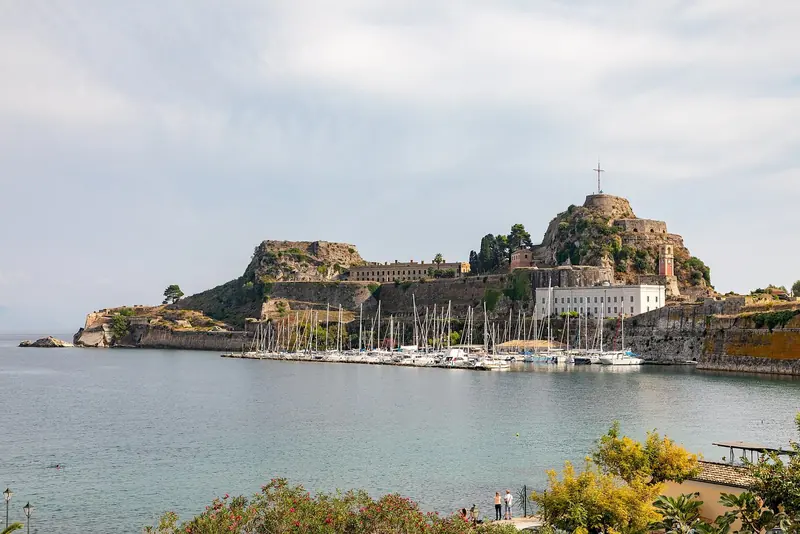
Corfu Old Town is a UNESCO World Heritage site and the only real urban culture in the group, Venetian in plan with two fortresses, arcaded streets and a British colonial layer on top of it. After that the Ionian is villages. Fiskardo is the smart one, with waterfront restaurants that book out in August, Gaios on Paxos is the prettiest small harbour, and Sivota, Kioni and Spartochori are quays lined with tavernas where the boat is the evening's arrival. Prices are a fraction of the Riviera and the food is honest rather than ambitious.
Guests who want a nightclub scene or serious shopping should be sent to Mykonos instead. What the Ionian gives is a swim before breakfast in flat water, an easy afternoon sail, and dinner fifteen metres from the passerelle. Provisioning is straightforward on Corfu, Lefkada town and Argostoli, and thin everywhere else, so a large yacht stores in Corfu or Preveza. Fuel is available at Gouvia and Lefkas and by truck at the bigger quays, arranged through an agent.
The honest downside, and what is not published
The Ionian is the largest bareboat and flotilla ground in Greece and in July and August that is visible. The quays at Fiskardo, Kioni and Sivota fill from mid afternoon, and a large yacht that arrives at six has nowhere to go but the anchor. Draft is the second constraint: Lefkas takes about 3.3 metres, many of the best small harbours less, and a 4 metre draft cuts the available berths in half. And the region has no yard for major structural work on a large hull, so anything serious goes to Italy or Athens.
Checked in August 2026, neither D-Marin Gouvia nor D-Marin Lefkas publishes a berthing tariff on its own website, and both quote through a booking enquiry, so an owner cannot price a season in the Ionian from public information the way he can at Porto Cervo. No marina in the group publishes a fuel price. The Corfu megayacht marina has published its concession terms but no berth rates and no confirmed opening date. And nothing published tells you how many metres of town quay at Fiskardo will be free on an evening in August, which is the number that decides the day.
على البر والوصول والحجز
| Getting there | Corfu airport serves the north and is about 7 km from Gouvia marina. Aktion at Preveza serves Lefkada, Meganisi and the middle of the chain and is roughly half an hour by road from Lefkas marina, but it is a small former military field with limited handling for large private aircraft. Kefalonia serves Fiskardo and the Ithaca channel and Zakynthos serves the south. All four are heavily seasonal, running full European schedules from May to October and very little in winter, so guest routings in April or late October need checking before they are promised. |
|---|---|
| Arriving by sea | Gouvia is on VHF 69, about seven kilometres from Corfu town, and is the northern entry point with fuel, lifts and the technical trade. Corfu, Argostoli, Zakynthos, Katakolon and Preveza are the ports where formalities can be completed. Anything transiting the Lefkada canal waits for the floating bridge, which opens on the hour through the day, and the canal itself is dredged but shallow by superyacht standards. From Italy the usual approach is Brindisi or Otranto to Corfu, about 45 to 70 nautical miles, and from Montenegro it is a day from Kotor. |
| What it costs to be in Greek waters | TEPAI is owed by every vessel over seven metres regardless of flag: EUR 16 a month at 7 to 8 m, EUR 25 at 8 to 10 m, EUR 33 at 10 to 12 m and EUR 8 per metre per month above 12 m. A 30 m yacht therefore pays EUR 240 a month and a 50 m EUR 400. It is paid in advance through the AADE eTEPAI portal or at customs on arrival, and it is checked at clearance. Port dues and any town quay charges sit on top and are collected locally, usually in cash. |
| Charter, VAT and the 12 guest rule | A crewed charter of more than 48 hours carries 13 per cent Greek VAT statutorily, and short, static or bareboat arrangements carry 24 per cent. Agents invoice below the headline where the yacht's certification and itinerary justify it, with 2026 rate sheets showing effective rates between roughly 5.2 and 12 per cent, but the reduction has to be evidenced rather than assumed. A commercially operating yacht may carry no more than 12 guests. A group of 14 is two boats, not a negotiation. |
| Whether your flag may charter | Since 29 December 2023 a non EU flagged commercial yacht over 35 metres with a non wooden hull may begin and end charters in Greece for up to 21 days plus a 7 day extension each year under the e-Charter Permission, provided the owning or operating company has no permanent establishment in Greece and is registered for Greek VAT. The framework is in Law 4926/2022 as amended by Law 5111/2024. Below 35 metres commercial operation still requires an EU flag and a full Greek charter licence. |
| Where you can berth, and the draft trap | D-Marin Gouvia takes 70 m in 5.5 m of draft across 1,200 berths with 65 t and 75 t travel lifts and a fuel station. D-Marin Lefkas has about 620 berths but roughly 45 m and 3.3 m of draft. Cleopatra at Preveza is the yard and storage centre. Everything else is a town quay, stern to, on your own anchor or a laid line, at Fiskardo, Kioni, Frikes, Vathy, Sivota, Gaios and Spartochori. A boat drawing more than four metres loses half of the good stops and should plan to lie off and use the tender. |
| The marine park, priced in rules rather than money | In the National Marine Park of Zakynthos, Zone A is closed to all vessels, Zone B prohibits anchoring and mooring and caps speed at six knots, and six knots also applies approaching Laganas in Zone C. Keep 15 metres from any turtle and no more than 15 minutes alongside it. Navagio beach is closed to landings through 31 October 2026 under a joint ministerial decision, with boats required to stay about 50 metres off, no approach to the wreck and no swimming in the bay. Confirm the position with a local agent before the day is planned. |
| Eating, and the evening | Fiskardo on Kefalonia is the smartest quay in the Ionian and books out in August. Gaios and Lakka on Paxos, Sivota on Lefkada, Kioni and Frikes on Ithaca and Spartochori on Meganisi are the taverna harbours where the boat berths stern to and dinner is fifteen metres away. Corfu Old Town, a UNESCO site, is the only real urban evening in the group. Provisioning at scale works at Corfu, Lefkada town and Argostoli and is thin everywhere else. Fuel is at Gouvia and Lefkas or by truck through an agent. |
| What is NOT published | Checked in August 2026, neither D-Marin Gouvia nor D-Marin Lefkas publishes a berthing tariff, both quoting through a booking enquiry, so a season in the Ionian cannot be priced from public information. No marina in the group publishes a fuel price. The Corfu megayacht marina has published concession terms but no berth rates and no confirmed opening date. Town quay charges are collected locally and vary by municipality with nothing posted in advance. And the number that actually decides an August evening, how many metres of quay at Fiskardo will be free at six o'clock, is published nowhere. |
ما يذكره الملاك والأطقم
The turtle rules are being enforced because the collisions have not stopped
ARCHELON, the Sea Turtle Protection Society of Greece, has continued to report boat strikes on loggerhead turtles inside the National Marine Park of Zakynthos and has publicly pressed for fines to be imposed, which is the reason the six knot limits, the 15 metre approach distance and the 15 minute observation cap are checked rather than posted and ignored. An owner running tenders in the Bay of Laganas should brief the crew on the zones before the boat arrives.
ARCHELON, the Sea Turtle Protection Society of GreeceNavagio is closed and the closure has been extended, not lifted
Landing at the shipwreck beach has been prohibited since a landslide risk assessment in 2022, and the prohibition has been carried forward by joint ministerial decision through 31 October 2026. Boats hold about 50 metres offshore, there is no approach to the wreck of the Panagiotis and no swimming inside the bay. Operators advise confirming the position 24 hours ahead because the rules have moved year to year.
Greek Ministry of Maritime Affairs, reported by Greek Trip Planner and Keep It GreeceGreece opened to large foreign flags, and the window is narrow
The e-Charter Permission launched on 29 December 2023 allows a non EU flagged commercial yacht over 35 metres, with a non wooden hull, to start and finish charters in Greek waters for 21 days plus a 7 day extension a year, without a full Greek charter licence, provided the operator has no permanent establishment in Greece and is registered for Greek VAT. Industry advisers describe it as the most significant liberalisation of Greek charter law since the 1990s, and it does not help a boat under 35 metres at all.
Boat International and Rosemont International Yacht SolutionsThe northern Ionian has been running without megayacht berthing
The Hellenic Republic Asset Development Fund signed the sub concession for a 410 berth megayacht marina inside the Port of Corfu with LAMDA Corfu Marina, taking yachts to 140 metres on about 39,400 square metres west of the cruise pier, against total fees above EUR 89 million over 40 years and more than EUR 50 million of construction investment. Until it is delivered, a 100 metre yacht in Corfu negotiates a commercial quay rather than booking a berth.
Hellenic Republic Asset Development Fund, reported by Boat International and Marina WorldNo berthing tariff exists to plan against
Checked in August 2026, neither D-Marin Gouvia nor D-Marin Lefkas publishes a rate card on its own site, both routing enquiries through a booking form, and no marina in the Ionian publishes a fuel price. There is no published owner or captain account of superyacht service standards at either marina. An owner pricing an Ionian season is relying on an agent's quotation and his own experience rather than on anything he can check.
Yotters desk, checked August 2026
نقاط القوة وما يستدعي الانتباه
نقاط القوة
- The gentlest reliable wind in GreeceThe maistro fills at midday at 10 to 18 knots and dies in the evening. There is no meltemi in the Ionian, so August here sails in fifteen knots while the Cyclades are shut down in thirty five.
- A longer season than the Aegean at both endsLate April to mid October, with May, June and September genuinely good rather than a compromise, and green hillsides in spring because the Ionian takes real winter rain.
- Short hops between very different islandsLefkada, Meganisi, Kalamos, Ithaca and Kefalonia sit within about ninety minutes of each other, so lunch and dinner can be in different bays without a passage plan.
- One serious marina with a full technical tradeD-Marin Gouvia takes 70 m in 5.5 m of draft across 1,200 berths, with 65 t and 75 t travel lifts, 500 dry berths, fuel and the mechanical trade of the northern Ionian, seven kilometres from an international airport.
- Real capacity is coming to CorfuLAMDA Corfu Marina is contracted to build 410 berths for yachts to 140 m inside the Port of Corfu, the first large greenfield marina project in Greece in twenty years, against more than EUR 50 million of investment.
ما يستدعي الانتباه
- Draft rules out a lot of the best of itLefkas takes about 3.3 m and the good town quays less. A yacht drawing over four metres loses half the stops and spends the fortnight at anchor with the tender running.
- It is the busiest bareboat ground in GreeceIn July and August the quays at Fiskardo, Kioni and Sivota fill from mid afternoon, and a large yacht arriving at six has nowhere to go but the hook.
- Nothing is published, so a season cannot be pricedNeither D-Marin marina posts a tariff, no fuel price is published anywhere in the group, and town quay charges vary by municipality and are collected in cash.
- The southern end is a marine park with teethZone A of the Zakynthos park is closed outright, Zone B forbids anchoring and caps speed at six knots, and Navagio is closed to landing through 31 October 2026.
- No yard for serious work on a large hullGouvia lifts to 75 tonnes and Preveza stores boats, but anything structural on a superyacht means Italy or Athens, with a delivery leg at each end.
لمين هو: An owner who wants a fortnight of easy, reliable sailing with guests who are not sailors, values green islands and taverna quays over a social address, and whose boat draws under about four metres or is content to lie at anchor.