Amalfi Coast & Capri
| Region | Tyrrhenisches Meer, Kampanien, Süditalien |
|---|---|
| Beste Saison | Mai bis Oktober, Höhepunkt Juli bis August |
| Wichtigste Häfen und Basen | Capri (Marina Grande), Salerno (Marina d'Arechi), Neapel |
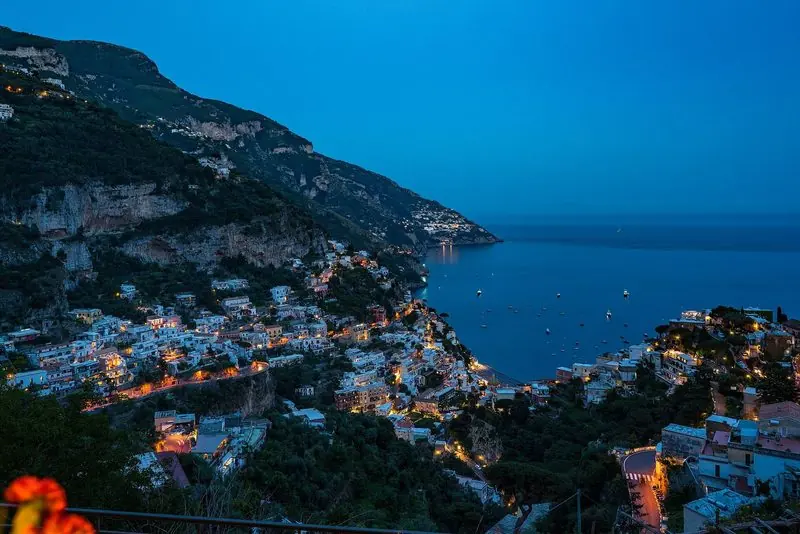
| Charakteristische Ankerplätze | vor Capri und unterhalb von Positano |
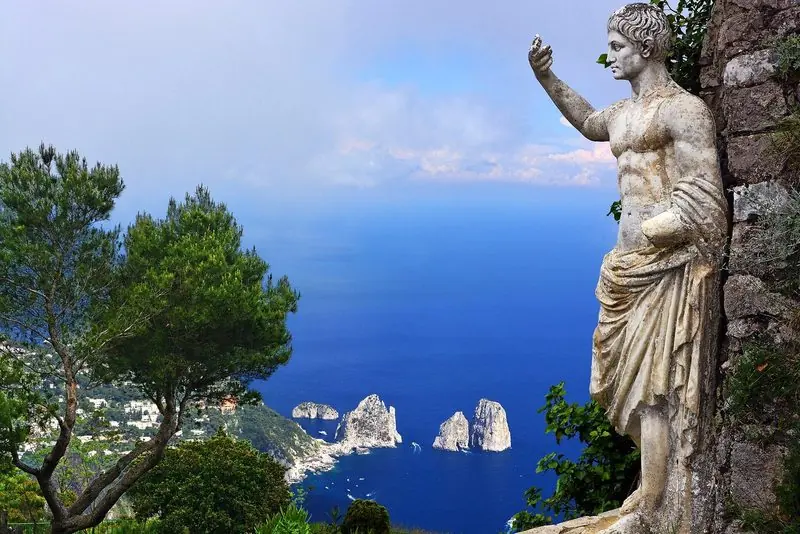
| Wahrzeichen | Faraglioni-Felsen, die Blaue Grotte, Ravello |
| Charakter | Tagesankern statt Liegeplatz in der Marina |
| Rechtsraum | Italien (EU), italienische Charter-Mehrwertsteuer fällt an |
| Zu beachten | südliche Dünung, die offene Ankerplätze unbrauchbar machen kann |
| Air access | Naples Capodichino is slot-restricted, Salerno Costa d'Amalfi reopened to private jets on 11 July 2024 with a 2,000 m runway |
| Defining weather risk | southerly and southwesterly swell, which closes the open anchorages within hours |
| Jurisdiction | Italy, EU, Italian charter VAT and paperwork |
| Blue Grotto access | small rowing boats only, and closed on any real swell |
| Capri berth 2026 | EUR 3,580 a day for a 55 m by 10 m hull from 16 May to 15 September, EUR 3,185 in the shoulder windows, VAT included at 10 per cent |
| A full month on the Capri counter rate at that band is EUR 110,980, which is more than the published Saint-Tropez August | |
| Capri extras | EUR 100 to EUR 200 for a pair of daily passenger calls alongside, EUR 150 to EUR 500 for a diver |
| Salerno and Naples publish no berthing rate card, and none was obtainable in July 2026 | |
| Temporary admission | 18 months for a non-EU flagged yacht in private use, starting automatically on entering EU territorial waters (ADM Circular 11/2026, 15 May 2026) |
| Commercial temporary admission | from Circular 11/2026 a charter yacht may operate under the regime by entering privately, exiting EU waters and re-entering commercially with form 71-01, the charter contract and log entries |
| Commercial operation requires formal authorisation from the Italian maritime authority, and a non-EU flag requires an Italian fiscal representative | |
| Charter VAT | 22 per cent on the hire, with the length-based flat reduction to 6.6 per cent for yachts over 24 m withdrawn on 1 November 2020 |
| Cabotage with paying guests between two Italian ports is reserved to EU flags under Regulation 3577/92 | |
| Nearest lift | Palumbo at Naples, a 520 tonne travel lift and floating docks to 100 m and 6,000 tonnes |
Eine Küste aus Klippen und Farbe
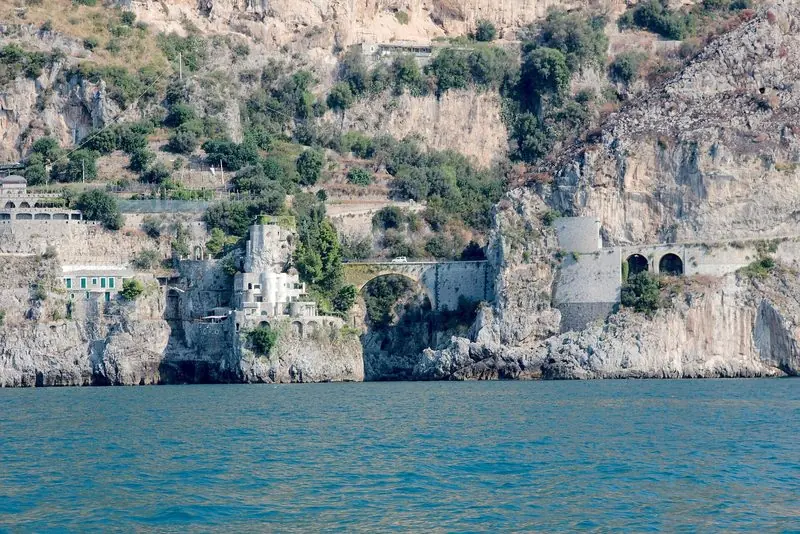
Die Amalfiküste zieht sich am Südrand der Sorrentinischen Halbinsel entlang, wo pastellfarbene Orte an steilen Klippen über dem Meer hängen. Positano und Amalfi ziehen Besucher aus aller Welt an, und die Insel Capri liegt einen kurzen Schlag vor der Küste. Der Reiz liegt in der Wucht der Landschaft und dem Gefühl, an einem Ort mit tiefer Geschichte anzukommen. Für eine Yacht bietet die Küste eine Folge bekannter Namen auf engem Raum. Vom Wasser aus gesehen ist die Landschaft der Grund, aus dem die meisten Eigner kommen.
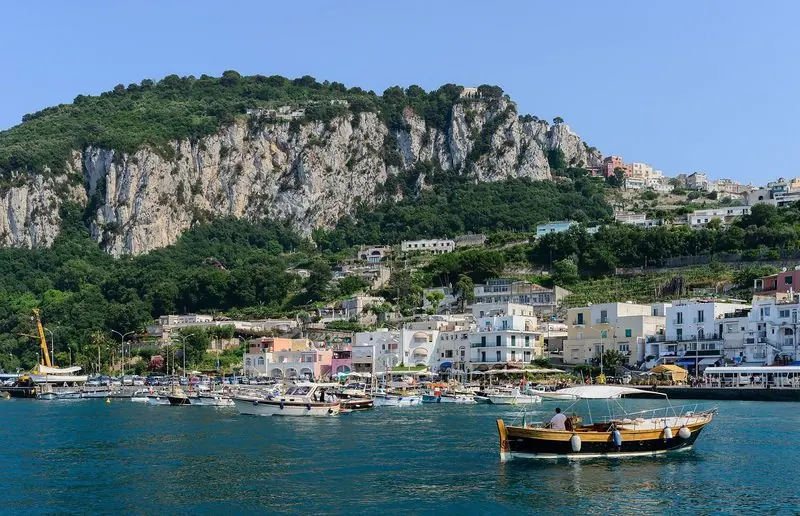
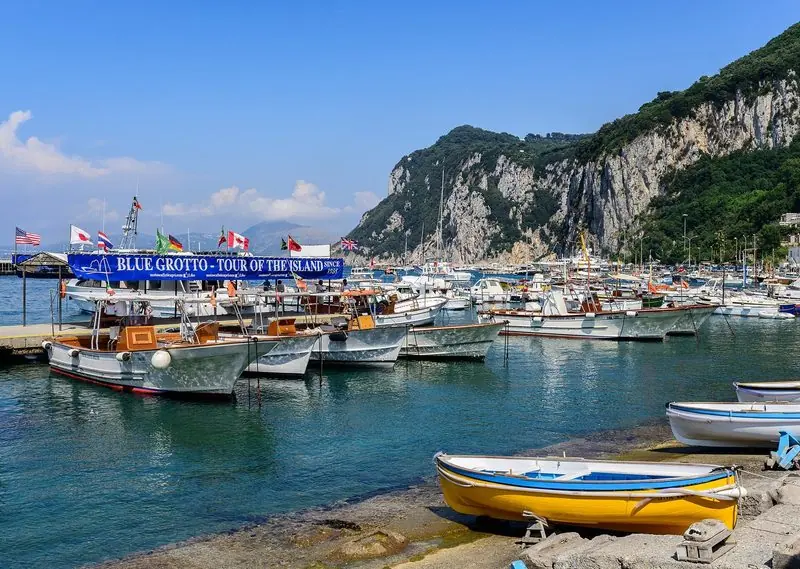
Capri ist der gesellschaftliche Ankerpunkt der Region. Ihre beiden kleinen Häfen, Marina Grande und Marina Piccola, liegen unterhalb eines Ortes mit Designerboutiquen und langen Mittagessen. Die Faraglioni-Felsen vor der Südküste sind das Wahrzeichen der Insel, und Tender fahren an ruhigen Tagen durch den natürlichen Bogen. Ischia und Procida in der Nähe bieten ein ruhigeres, stärker lokal geprägtes Gefühl für Eigner, die den Hauptkreislauf verlassen wollen. Neapel und die Ruinen von Pompeji liegen für einen Tag an Land in bequemer Reichweite.
Die Saison
Die Saison reicht von Mai bis Oktober, wobei die wärmsten und vollsten Wochen in den Juli und August fallen. Der Frühling bringt grüne Hänge und milde Tage, die eher zum Besichtigen als zum Baden passen. Der Hochsommer liefert warmes Wasser und lange Abende, dazu hohe Besucherzahlen in den Küstenorten. Der September ist unter Crews ein Favorit, weil das Meer warm bleibt und der Andrang nachzulassen beginnt.
Das Wetter ist hier über die Saison im Allgemeinen freundlich, doch die Küste ist nach Süden offen und kann ungemütlich werden, wenn eine südliche Dünung hereinläuft. Ankerplätze, die am Morgen ruhig sind, müssen am Nachmittag womöglich geräumt werden, wenn der Wind dreht. Weil so viel von der Erfahrung vom Liegen vor Anker abhängt, zählt eine beständige Vorhersage. Crews beobachten das Wetter genau und behalten Ausweichbuchten im Kopf.
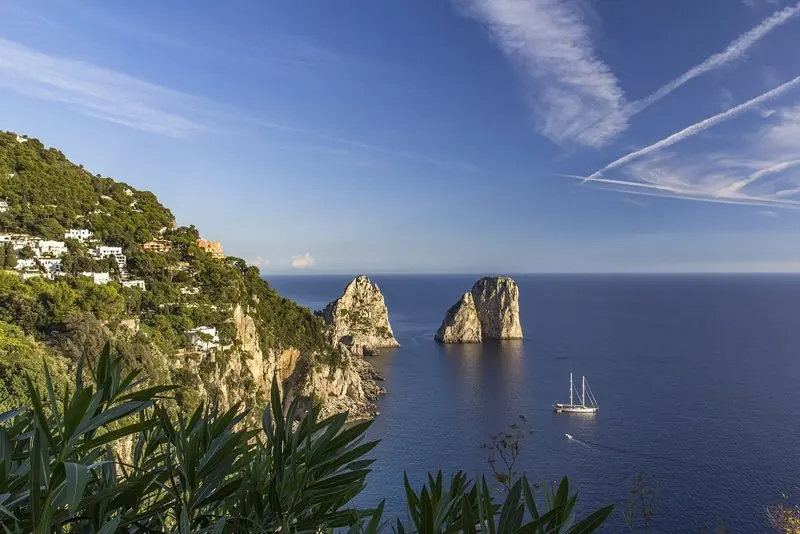
Eine Küste, die man am besten vom Wasser aus liest, wo der Ankerplatz die Adresse ist.
Wo man liegt
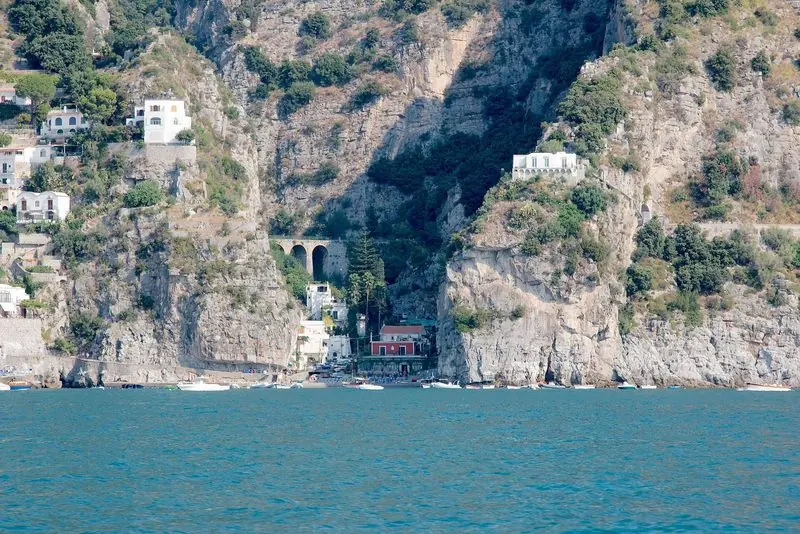
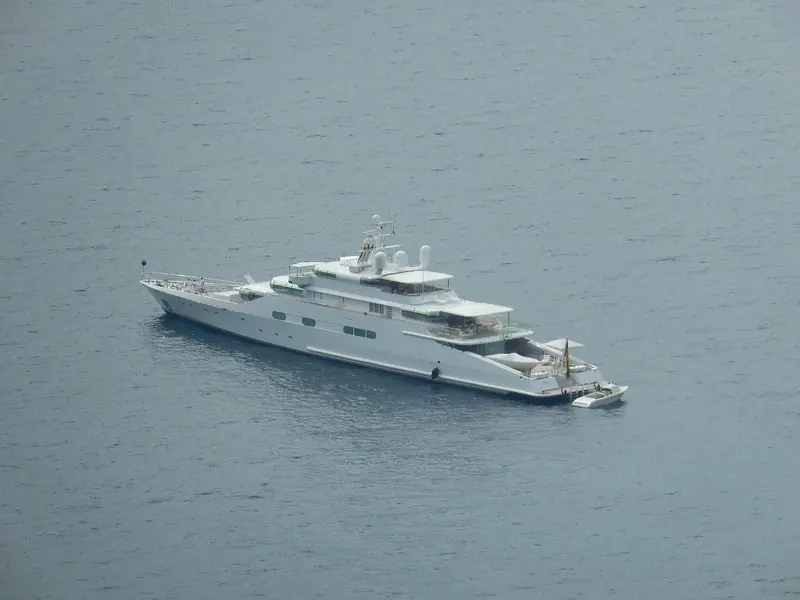
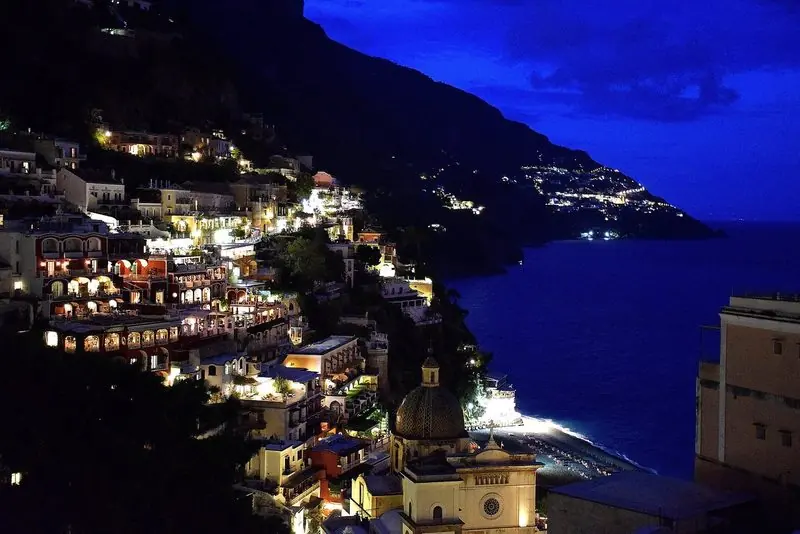
Dies ist eine Küste der Tagesankerplätze mehr als der Marinas. Vor Capri ankern Yachten je nach Wind nahe der Marina Grande oder im Lee der Insel, und Tender bringen die Gäste an Land. Positano bietet unter seinen gestapelten Häusern eine eindrucksvolle Kulisse für einen Tag vor Anker. Die Inseln Li Galli zwischen Positano und Capri geben einen ruhigeren Platz mit klarem Wasser. Amalfi und die Bucht von Nerano fügen weitere Möglichkeiten entlang der Küste hinzu.
Echte Liegeplätze für große Yachten sind entlang der Amalfiküste selbst rar. Viele Einheiten liegen an der Marina d'Arechi bei Salerno oder in den größeren Häfen um Neapel und befahren die Küste dann tagsüber. Capri hat begrenzten Längsseitsplatz, der sich schnell füllt und in Spitzenwochen hohe Preise erzielt. Für alles von Größe sind ein Agent und Planung im Voraus nahezu unerlässlich. Übernachten vor Anker ist üblich, wo die Bedingungen es zulassen.
An Land und auf dem Wasser
Die Zeit an Land dreht sich um die Orte und ihre Restaurants. Gäste fahren mit der Standseilbahn von der Marina Grande hinauf nach Capri, wandern die Wege zu den Gärten des Augustus und speisen auf Terrassen über dem Meer. Ravello liegt hoch über der Küste mit seinem Musikfestival und den bekannten Villengärten. Überall geht es steil bergauf, sodass Tender und vorbestellte Wagen einen großen Teil der Arbeit übernehmen. Lange Mittagessen und Abendspaziergänge geben den Takt vor.
Auf dem Wasser sind die Meereshöhlen und das Schwimmen die Höhepunkte. Die Blaue Grotte auf Capri wird mit kleinen Ruderbooten erreicht und hängt von ruhiger See und geringer Dünung ab. Rund um die Insel ist das Wasser tief und klar, ideal für ein Bad vom Heck zwischen den Besichtigungen. Tenderausflüge zu den Faraglioni und den kleineren Grotten füllen die Tage. Angesichts des Gedränges auf dem Wasser macht ein sorgfältiger Tenderbetrieb einen echten Unterschied.
Praktische Hinweise
Die wichtigste praktische Herausforderung ist der Platz. Liegeplätze sind wenige, teuer und früh gebucht, und das Ankern hängt vom Wetter ab, sodass Flexibilität hier in jeden Plan eingebaut ist. Größere Yachten operieren üblicherweise von Salerno, Neapel oder dem Golf von Gaeta aus und nehmen hin, dass die Amalfiküste ein Ort ist, den man am Tage besucht. Die Proviantierung gelingt am einfachsten von den Häfen des Festlands aus und nicht in den Dörfern an den Klippen.
Italien liegt in der Europäischen Union, und der Charterbetrieb bringt italienische Mehrwertsteuer und Papiere mit sich, die Eigner über einen örtlichen Agenten abwickeln sollten. Der Verkehr auf dem Wasser ist im Sommer dicht, mit Fähren, Ausflugsbooten und Tendern, die sich enge Ankerplätze teilen. Eine aufmerksame Brückenwache und disziplinierte Tendercrews halten den Betrieb sicher. Örtliches Wissen darüber, welche Bucht bei welchem Wind taugt, ist das Nützlichste, was eine Yacht hier mitführen kann.
Salerno's airport changed the logistics
Naples Capodichino is the main gateway and is heavily slot-restricted, which private aviation has complained about for years. Salerno Costa d'Amalfi reopened to private jets on 11 July 2024 after nearly eight years closed, with a runway extended to 2,000 metres that takes everything from very light jets to ultra long-range aircraft, and it sits minutes from Marina d'Arechi. That single change has made the Gulf of Salerno a far easier place to run guest rotations than it was.
Roads are the problem. The SS163 coast road between Sorrento, Positano and Amalfi is a single carriageway cut into the cliff, and in August a transfer that maps at forty minutes routinely takes two hours, with restrictions on when coaches and cars may run. Helicopter transfers to Capri, Ischia and the coastal pads are common and expensive. For anything on the water, the tender beats the car every time, and well-run boats simply never put guests in a vehicle on that road in high summer.
Nerano, Capri and the eating
The eating here is the best argument for the destination. Nerano is the pilgrimage, with Lo Scoglio and Maria Grazia both accessible by tender and both built around spaghetti alla Nerano and the local zucchini. On Capri, Il Riccio above the Blue Grotto holds a Michelin star, Da Paolino serves under a lemon grove, and La Fontelina and Da Luigi ai Faraglioni are beach clubs reached by tender or by a steep path. Da Adolfo west of Positano is a beach shack reached only by boat and it books out weeks ahead.
Inland, Ravello is the one excursion worth the car, with Villa Rufolo and Villa Cimbrone and their gardens on the clifftop, and its summer festival. The nightlife is thin by Riviera standards. Capri has the piazzetta, a handful of late bars and the Anema e Core taverna, and Positano closes early. Guests looking for clubs are in the wrong place.
Punta Campanella and the paperwork
The regulated water is the Punta Campanella marine protected area, which covers the tip of the Sorrentine peninsula including Nerano and Ieranto. It is zoned, free anchoring is prohibited in zones B and C, access to zone B needs authorisation from the managing authority, and anchoring where permitted runs from 08:00 to 20:00 and must be clear of Posidonia and set distances off the beaches. A set of extra restrictions the authority tried to impose on charter yachts, including permits, charges and mandatory active AIS, was struck down by the Campania regional administrative court in a ruling published in early 2025. The current ordinance is worth confirming before each season.
Italy is in the EU, and charter operations carry Italian VAT and a paperwork chain that no owner should attempt without a local agent. Support is concentrated on the mainland. Naples has the yards, the bunkering and the engineers, Salerno has the marina infrastructure, and Capri has neither in any meaningful sense. Provisioning is done from Naples or Salerno and run out by tender or by truck to the marina. Nothing technical gets fixed on the island.
The honest downside
This is a demanding coast to enjoy from a big boat. There is no berth, no shelter from the south, no support and no privacy, and in August the anchorage below Positano is a car park of yachts, tenders, tripper boats and jet skis with ferry wash crossing all of it. Tender operations are the hardest part, because the landing places are small public quays shared with commercial traffic and the beach clubs run tight arrival slots.
The other honest point is repetition. The famous sights are few and close together, and once a guest has seen Capri, Positano, the Faraglioni and Ravello, the coast has largely shown its hand. Owners who come back tend to do so for the food and for one particular anchorage, not for new ground. Anyone planning more than a week should build in Ischia, the Pontine islands or the Aeolians from the start.
What Capri charges, and what the mainland will not publish
Capri publishes and the number belongs near the top of the European table. Porto Turistico di Capri prices by hull box rather than by length alone, and for a cabined vessel in the 55 m by 10 m band the 2026 tariff is EUR 3,580 a day from 16 May to 15 September, EUR 3,185 in the shoulder windows of 1 to 15 May and 16 September to 15 October, and EUR 1,955 from mid October to the end of April. The 40 m by 7 m band is EUR 2,405 at the same peak and the band above 55 m is EUR 3,855. VAT is included at 10 per cent for cabined vessels. Two extras are worth budgeting because they are charged per event rather than per day: embarking and disembarking passengers runs EUR 100 to EUR 200 for a pair of daily alongside calls, and a diver is EUR 150 to EUR 500 depending on the job (Porto Turistico di Capri, tariffe 2026, retrieved 28 July 2026).
The mainland, which is where a large yacht actually sleeps, publishes nothing. Marina d'Arechi at Salerno and the Naples basins quote on application, and no rate card for either was obtainable in July 2026, so any season figure here would be a guess dressed as a fact. What can be stated is the shape of the trade. Thirty-one days on the Capri counter rate at the 55 m by 10 m band is EUR 110,980, for a harbour with around 30 transit berths, no yard, no bunkering at scale and no provisioning worth the name. That is more than the whole of August costs on the published Saint-Tropez tariff and roughly four times Monaco's published month for a comparable hull. Only Porto Cervo publishes a higher peak, at EUR 5,437 a day from 1 to 20 August 2026. The conclusion most owners reach is the arithmetic one, which is a contract at Salerno and Capri paid for by the night rather than by the month.
Whether a foreign flag may charter in Italian waters
The Italian answer changed in May 2026 and it is now among the clearer ones in the Mediterranean. A non-EU flagged yacht in private use enters temporary admission automatically on crossing into EU territorial waters, and the discharge period is 18 months under Article 217(e) of Commission Delegated Regulation (EU) 2015/2446, with eligibility under Article 212 turning on registration outside the EU customs territory in the name of a person established outside it and use by a person established outside it. Italian Customs restated the mechanics in ADM Circular 11/2026 of 15 May 2026: entry starts the clock, form 71-01 documents the arrival if the owner wants it documented, and satellite track, port papers or the log close the procedure on departure. The circular's substantive move is on the commercial side. A charter yacht may now operate under temporary admission during a charter, provided she enters privately, leaves EU waters and re-enters under commercial temporary admission with form 71-01, the charter contract and the log attached, which brings Italy close to the position France has long allowed for Cayman and Marshall Islands tonnage.
The rest is unchanged and it is where the cost sits. Commercial operation in Italy requires the yacht to be formally authorised for commercial use by the maritime authority, and a non-EU flagged vessel needs an Italian fiscal representative. Charter VAT is 22 per cent on the hire. The flat reductions keyed to hull length, which once cut a yacht over 24 m to an effective 6.6 per cent, were withdrawn on 1 November 2020, and any reduction now has to be evidenced as actual navigation outside EU waters under the Agenzia delle Entrate provision of 29 October 2020. Cabotage with paying guests between two Italian ports remains reserved to EU flags under Regulation 3577/92. Enforcement is by the Guardia di Finanza and it is real rather than notional, with the emphasis on undeclared ownership and on charters run without the authorisation. Above all of it sits the Punta Campanella marine protected area, where free anchoring is prohibited in zones B and C and zone B needs authorisation, and the nearest yard that can lift a hull of this size is Palumbo at Naples, which runs a 520 tonne travel lift and floating docks to 100 m and 6,000 tonnes.
An Land, Anfahrt und Buchung
| Getting there | Naples Capodichino is the gateway for the whole gulf and it is close in: the helicopter run to Capri is under 30 minutes, and operators publish transfer pricing from roughly EUR 1,900 a leg, with a six-seat Naples to Capri charter quoted from about EUR 2,400. From Rome the same flight is about an hour. By road and boat, agencies run car-plus-speedboat transfers out of Naples and Castellammare di Stabia across the gulf. Salerno serves the eastern end of the coast and Marina d'Arechi. |
|---|---|
| Arriving by sea at Capri | Porto Turistico di Capri, in Marina Grande, answers on VHF 71 and the channel is monitored around the clock. The office works 08:00 to 20:00 daily from 1 May to 15 October, and 08:00 to 14:00 from 16 October to 30 April with weekends closed. The office number is +39 081 8377602. Note the draft limit before you commit: the Darsena wet dock takes a maximum of 2.1 metres. |
| What a berth costs at Capri | This is one of the few marinas on the coast that publishes, and the figures explain its reputation. On the floating docks and the Calata di Riva Sud, with cabin and 10 per cent VAT, peak season runs 16 May to 15 September: a 12 m by 4 m berth is EUR 200 a day, 15 m by 4.5 m is EUR 305, 18 m by 5.2 m is EUR 435, 25 m by 5.5 m is EUR 740, 30 m by 6 m is EUR 1,210, 40 m by 7 m is EUR 2,405, 55 m by 10 m is EUR 3,580 and anything over 55 m is EUR 3,855. The shoulder discount is not evenly spread, and it favours the middle of the range rather than the top: 1 to 15 May and 16 September to 15 October take about 30 per cent off the 15 m and 18 m bands, about 24 per cent off 25 m, but only 9 to 11 per cent off 30 m and above, and 7 per cent over 55 m. Low season, 1 January to 30 April and 16 October to 29 December, runs 45 to 51 per cent below peak at the top of the range and 61 to 64 per cent below it in the 15 m to 25 m bands. Berths taken without cabin carry 22 per cent VAT and are published higher, but only up to 15 m by 4.5 m, above which no without-cabin rate is published at all. The Darsena wet dock is a separate schedule and a dearer one, so do not price a Darsena berth off the figures above. Water and electricity are metered on top rather than included. |
| How you actually reserve, and the extras nobody quotes you | From 1 May to 15 September a weekend booking carries a two-night minimum, so a Saturday night alone is not on offer in the season. Budget for the extras, which are real: embarking and disembarking guests requires vouchers at EUR 100 to EUR 200, and the RFID gate reader carries a EUR 100 deposit. One genuine concession at the top end, a yacht over 30 metres gets diver-assisted anchoring at no charge, but it has to be booked ahead at the office rather than asked for on arrival. Published notice periods for it vary between the marina's own pages, so confirm the lead time when you book. |
| Where you may and may not anchor | The single most expensive mistake on this coast. The Punta Campanella Marine Protected Area covers the waters off the Sorrentine peninsula and round to Positano, taking in Sorrento, Sant'Agnello, Vico Equense, Massa Lubrense, Piano di Sorrento and Positano, and it is zoned. Zone A, which takes in the Vervece and Vetara rocks, is closed to navigation, swimming and fishing outright. Outside Zone A the working rule is simpler than the zoning suggests: free anchoring is prohibited across the reserve, not merely in Zone B, and you take a designated mooring instead, with motorboat access in the stricter zones needing prior authorisation from the managing body. Anchoring on posidonia is banned throughout and buoy fields have been laid where anchoring used to happen; a buoy runs about EUR 40 to EUR 55 a day for a 42 ft catamaran, a single rental-platform figure we could not corroborate, so treat it as an order of magnitude rather than a quote. Rangers patrol daily through the season, so this is enforced rather than advisory. Ischia and Procida sit under a second protected area, Regno di Nettuno, with its own zoning. Read both zoning maps before you plan a night at anchor, not after. |
| What is not published | Amalfi and Positano do not post a tariff. Figures circulate on charter sites quoting per-metre rates for both harbours, but we could not corroborate them against a second independent source and are not repeating them. Both are quote-on-application through the harbour or an agent, and in Positano much of what looks like a harbour is a roadstead rather than a berth. We have checked Amalfi and Positano and no others, so read this as two harbours that do not publish rather than a claim about the whole coast. Assume Capri's published table is the best available proxy for what this water charges in August, and get a written quote before you arrive. |
| The shape of the season | Peak pricing at Capri starts on 16 May and ends on 15 September, and the shoulder bands on either side, 1 to 15 May and 16 September to 15 October, are where the value is, most of all if you are in the 15 m to 25 m range where the discount is around a quarter to a third rather than the single figures the largest berths get. The marina also keeps a peak rate over 30 December to 1 January, which tells you something about who is there at New Year, and note that its own table shows 1 January inside both the peak and the low band, so confirm which applies before you book that night. |
Was Eigner und Crew berichten
Berths inside the protected area mean buoys, not anchors, and the rules are enforced
Anchoring within the Punta Campanella reserve is restricted to designated mooring buoys, reported at about EUR 40 to EUR 55 a day for a 42 ft catamaran, with rangers patrolling daily through the season. Single-sourced from a rental platform, so the rule is solid but the price is indicative.
SeaRadarA European marina cost survey places Capri among the most expensive
Marina Grande is listed in a European most-expensive-marinas survey, with roughly 300 berths and a recommendation to book well ahead rather than arrive on spec. This is a single trade title rather than a consensus of surveys.
BootePer-metre rates quoted for Amalfi and Positano could not be verified
Figures for both harbours appear on charter and booking sites but neither harbour publishes a tariff and no second independent source corroborated them, so no price is stated here. Confirm in writing with the harbour or your agent before arrival.
Yotters deskNo owner or crew testimony was found for this coast, and none is invented here
Everything above is trade or platform reporting rather than a named owner, captain or crew speaking. We are recording that gap rather than dressing operator copy up as owner experience. Berth pricing at Capri comes from the marina's own rate card, which is quoted in the practical block where it belongs.
Yotters desk
Was gut ist und worauf zu achten ist
Stärken
- Nowhere else packs this much into so few milesCapri, Ischia, Procida, the Sorrentine peninsula and the Amalfi shore all sit inside one gulf. Passages are an hour or two at most, so the boat is a way of moving between places worth being rather than a means of covering distance.
- Capri's tariff is unusually legible once you have itA full length-banded table with season dates, VAT treatment and the extras named, so a 40 m berth in August can be budgeted at EUR 2,405 a day before you commit, and the shoulder and low bands can be compared band by band rather than guessed at.
- It is genuinely well connected for a place that feels remoteUnder 30 minutes by helicopter from Naples Capodichino, about an hour from Rome, with car-and-speedboat transfers as the fallback. Guests can join and leave mid-charter without losing a day to travel.
- The buoy fields make a busy coast workableBecause the reserve laid moorings where anchoring used to happen, there is a defined place to spend the night in water that would otherwise be first-come-first-served, and the posidonia and the water clarity inside Punta Campanella are still what people come for.
Worauf zu achten ist
- It is among the most expensive water in EuropeEUR 3,855 a day for a berth over 55 metres at Capri in peak season, before metered water and power, before the EUR 100 to EUR 200 guest vouchers. The shoulder seasons are materially cheaper but the peak is the peak.
- Anchoring is restricted, zoned and actively policedFree anchoring is prohibited in Zone B of Punta Campanella, posidonia is off limits throughout, Zone A is closed altogether, and rangers patrol daily in season. The flexible anchor-out week that works in Croatia or Greece does not work here.
- Draft rules some yachts out of the obvious berthThe Darsena wet dock at Capri takes 2.1 metres maximum. That is not a large number for a displacement yacht, and it needs checking against your own figure before the marina is treated as an option.
- Most of the coast will not tell you the price in advanceAmalfi and Positano publish nothing. You are negotiating through an agent against demand you cannot see, in the one month when demand is highest, and the numbers circulating online for both harbours could not be independently verified.
- The weekend minimum removes a useful optionFrom 1 May to 15 September a weekend at Capri means two nights or none. For a boat working a tight itinerary that is a real constraint rather than a formality.
Für wen: Eigner, die dramatische Landschaft und italienischen Stil suchen und bereit sind, tagsüber zu fahren und eine größere Yacht in einem Hafen auf dem Festland zu stationieren.