Obsidian
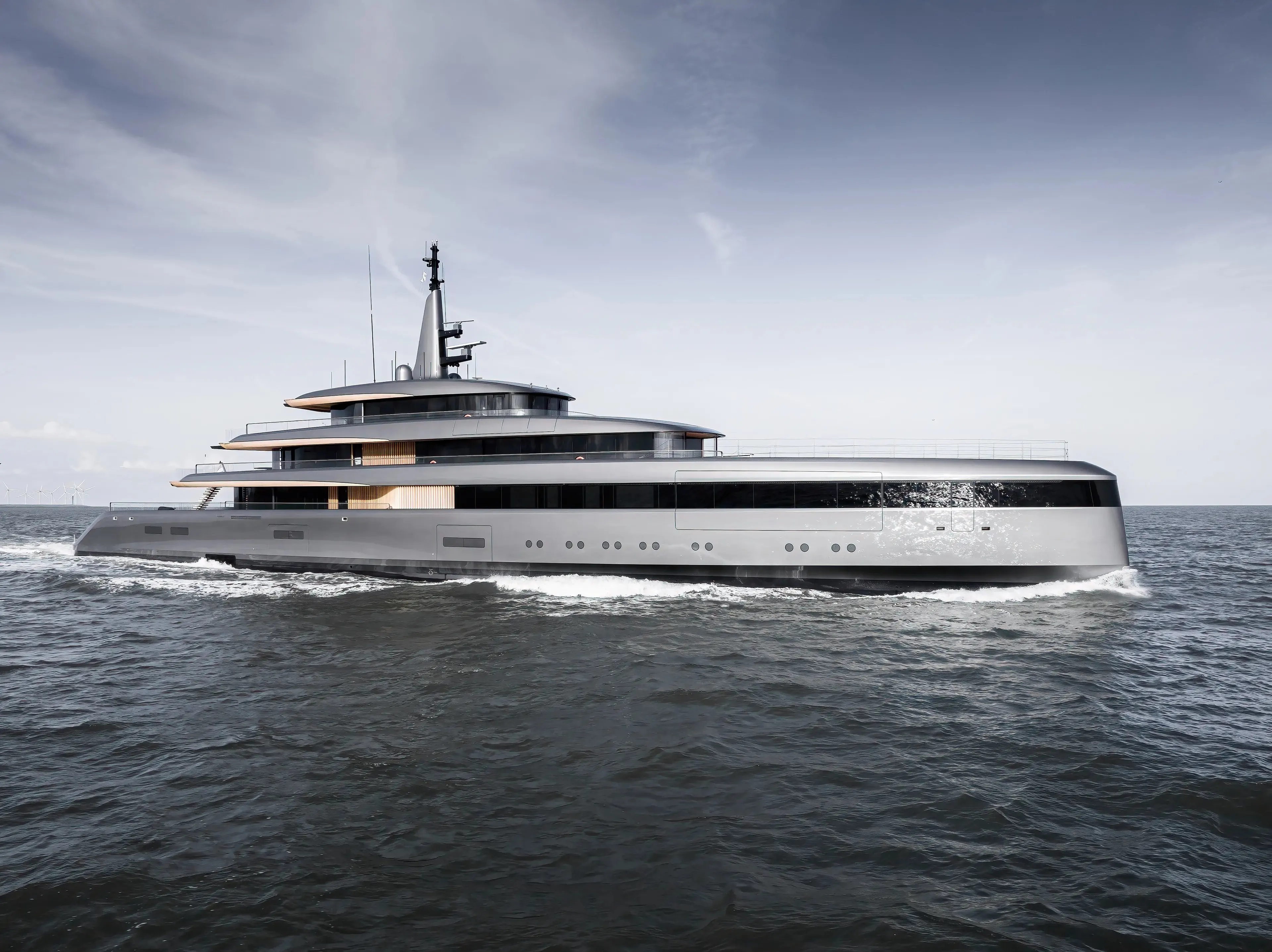
| LOA | 84,2 m |
|---|---|
| Entregado | 2023 |
| Constructor | Feadship (De Voogt Naval Architects) |
| Diseño | RWD con MONK Design (exterior e interior) |
| Propulsión | híbrido diésel-eléctrico FAED, propulsores contrarrotativos Veth (sin ejes ni timones) |
| Banco de baterías | unos 4,5 MWh (560 módulos) |
| Autonomía solo con baterías | unas 35 nm a 10 nudos |
| Combustible | apto para biocombustible HVO, alrededor de un 90 por ciento menos de CO2 frente al combustible fósil |
Una nueva referencia para navegar más limpio
El Obsidian fue la primera entrega de Feadship de 2023 y llegó con una misión clara: elevar el estándar de reducción de carbono en un yate grande a medida. Con 84,2 metros se construyó siguiendo una directriz explícita del armador de recortar emisiones a lo largo de toda su vida operativa. El astillero lo presentó como la declaración inaugural de una nueva generación, dentro de su objetivo declarado de construir superyates neutros en carbono en 2030. Demuestra que un encargo ambiental serio y el lujo Feadship completo pueden convivir.
Las cifras que hay detrás de esa afirmación son sustanciales. Analizado con la herramienta sectorial YETI, se estima que el Obsidian opera con alrededor de un 27 por ciento menos de impacto ambiental total que un yate similar botado cinco años antes con combustible fósil, y cerca de un 60 por ciento menos cuando navega con biocombustible. Feadship le atribuye además más de un 30 por ciento menos de impacto que su propio primer híbrido, el Savannah. Esas cifras dan a la historia de sostenibilidad un esqueleto medible. El Obsidian se diseñó para que se le juzgue por las pruebas y no por las intenciones.
Estilo RWD con la conciencia limpia
El exterior es obra del estudio británico RWD, desarrollado en colaboración con MONK Design, y lleva su eficiencia sin alardes. El perfil es suave y moderno, moldeado para reducir la resistencia y para acompañar a los sistemas de bajas emisiones de debajo. Suprimir los ejes de propulsión y los timones dio a los arquitectos navales más libertad con la forma del casco, porque desaparecen los apéndices que normalmente añaden resistencia. Esa forma de obra viva más limpia contribuye directamente a la eficiencia del yate.
Por encima de la flotación, el diseño libera un espacio poco común para los invitados. Sin la disposición de maquinaria de un yate convencional, la distribución pudo reorganizarse para dar más sitio a las zonas de vida. Las cubiertas anchas y el acristalamiento generoso mantienen el interior conectado con el mar y con el entorno. Los espacios exteriores están montados para un uso relajado en climas distintos. El conjunto enseña cómo un encargo ambiental puede moldear el aspecto y el ambiente de un yate en positivo.
Un Feadship de nueva generación construido en torno a la reducción de carbono, sin ejes de propulsión y sin timones.
Espacio liberado por una ingeniería inteligente
Dentro, RWD llevó el diseño hasta los espacios de invitados, que se benefician directamente de la ingeniería inusual del yate. La ausencia de ejes y timones y la propulsión eléctrica compacta permitieron distribuir el alojamiento con más libertad de lo habitual. El Obsidian ofrece siete camarotes, con unos volúmenes que resultan generosos para un yate de 84 metros. El tono interior es contemporáneo y cálido, en línea con el estilo exterior. Los materiales nobles y la carpintería de Feadship dan a las salas la profundidad que se espera a este nivel.
La marcha silenciosa del yate moldea la experiencia interior tanto como cualquier acabado. Como el banco de baterías puede sostener la carga hotelera en el fondeo durante muchas horas, los invitados disfrutan de noches quietas y silenciosas sin un generador zumbando de fondo. Esa calma es un lujo en sí misma y un producto directo del diseño de la propulsión. Los espacios de vida están dispuestos para la comodidad en estancias largas a bordo. El resultado es un interior moderno que resulta ligero, abierto e inusualmente apacible.
El Advanced Electrical Drive de Feadship
El Obsidian está construido en torno al programa Advanced Electrical Drive de Feadship, un híbrido diésel-eléctrico con un gran banco de baterías de litio de unos 4,5 megavatios hora repartidos en 560 módulos. Eso es aproximadamente cuatro veces y media el almacenamiento eléctrico del Savannah, el primer híbrido del astillero, y funciona a 1.000 voltios frente a los 560 de aquel yate. Cuatro generadores de velocidad variable basados en motores Caterpillar C32 modificados alimentan el sistema. La propulsión y el gobierno corren a cargo de un par de propulsores contrarrotativos Veth, que eliminan tanto los ejes como los timones.
En la práctica, el sistema da al Obsidian una capacidad eléctrica real. Puede cubrir unas 35 millas náuticas a 10 nudos solo con baterías, y sostener sus cargas hoteleras en el fondeo entre 10 y 15 horas en silencio. Sus generadores pueden funcionar con biocombustible HVO de segunda generación, que según el astillero recorta las emisiones de carbono alrededor de un 90 por ciento frente al combustible fósil. Juntas, estas soluciones atacan las emisiones desde varios frentes a la vez. La ingeniería es la razón por la que el Obsidian puede respaldar sus afirmaciones ambientales.
Un encargo de armador que movió el mercado
El Obsidian existe porque su armador lo pidió, y fijó una directriz de reducir las emisiones de carbono que dio forma a todo el proyecto. Feadship no ha dado el nombre del armador, en línea con su discreción habitual. Lo que el yate demuestra es que la demanda de superyates más limpios viene de los propios clientes y no solo de los reguladores. Ese giro importa para todo el sector, porque el apetito del armador marca lo que desarrollan los astilleros. El Obsidian convirtió un valor personal en un barco que navega.
Como señal de mercado, el Obsidian pesa mucho más allá de sus propias cubiertas. Enseña que un buque insignia full custom puede perseguir mejoras de eficiencia serias sin renunciar a la comodidad ni al estilo, lo que redefine lo que un comprador puede pedir con razón. Feadship ha usado las lecciones de su construcción para orientar proyectos posteriores en el camino hacia su objetivo de 2030. Para el armador que sopesa un encargo nuevo, es la prueba de que sostenibilidad y deseo se pueden especificar juntos. Es probable que su influencia dure más que la novedad de su tecnología.
Motores y sistemas
| Propulsion and hybrid-electric plant | Diesel-electric hybrid, Feadship's FAED system. Four custom variable-speed generators, two larger and two smaller, based on modified Caterpillar C32 diesel engines with permanent-magnet alternators feed a 1,000-volt DC system and a 4.5 MWh battery bank of 560 modules, housed in a chilled room amidships on the tank deck, up from 560 volts and roughly a quarter the storage on Feadship's previous hybrid, Savannah. Actual thrust and steering come from twin Veth CRP contra-rotating propeller electric azimuth thrusters rated a combined 4,000 kW, with no conventional shafts or rudders at all, a genuinely unusual configuration for a yacht this size. |
|---|---|
| Top speed | 17 knots. Consistent across Boat International, YachtCharterFleet, YachtBuyer and Y.CO. |
| Cruising speed | 12 knots. The hull was specifically tank-tested and optimized around this cruise speed rather than top speed, per Feadship's own CEO. |
| Range | Sources disagree: YachtCharterFleet and YachtBuyer both state 5,500 nautical miles at 12 knots; CharterWorld states more than 8,000 nautical miles at 12 knots. Both figures are reported here as a stated conflict rather than resolved, since neither source cites underlying fuel-consumption data. |
| Battery-only endurance | Approximately 35 nautical miles at 10 knots on battery power alone and 10 to 15 hours of fully silent hotel and house-load operation at anchor with generators off. |
| Fuel tankage | 255,000 litres. |
| Fresh water | 52,400 litres. |
| Stabilisers | Described only generically as capable underway and at anchor; no brand or model is published in any source found. |
| Hull, naval architecture and construction | Feadship De Voogt Naval Architects; steel hull, aluminium superstructure, teak decks. Carbon fibre is used for the aft deck overhangs specifically so they need no support pillars, offsetting some of the added weight of the battery bank and electrical system. The engine room is built on a single level, an unconventional layout for a project this size, requiring the thrusters, generators and batteries to be distributed rather than grouped in one central machinery space. |
| Tenders | Twin custom electric-powered tenders built by Tenderworks, served by four fast-charging stations built into the yacht's profile, among the first primary tenders on a yacht this size to be fully electric rather than diesel. |
| Guest amenities: beach club, pool, wellness | Beach club and pool area on the sun deck, a gym and a jacuzzi. An Aqua Lounge with large underwater-level windows doubles as a cinema or classroom space. A bow observation lounge has floor-to-ceiling double-curved glass. These amenity details are drawn from brokerage and trade-press coverage rather than a single authoritative deck plan, so treat specific room functions as broadly but not precisely sourced. |
| Classification | Lloyd's Register 100A1 SSC Yacht Mono, G6, LMC UMS, Hybrid Power notation. |
Lo que cuentan armadores y tripulaciones
Feadship's CEO frames Obsidian as a deliberate break from top-speed thinking toward efficiency-first design
"We'd better start building something that has no impact!" "This is the first boat that I have sold that has been tied to cruising speed." "Being on board is like nothing you have experienced. It is almost completely flat." These are first-hand yard statements from the builder's own CEO, promotional in nature but genuine and specific about the design philosophy.
Henk de Vries, CEO, Feadship, quoted in SuperyachtNews.comThe build team says the energy-saving measures are too numerous to easily list, a first-hand but promotional statement from the project's own manager
"There are so many points of energy savings integrated on this yacht that it is hard to count." Jansen led the build project and is describing peak-load shaving, waste heat recovery and HVAC redesign carried out after trials showed 60 percent of onboard energy going to hotel load.
Mark Jansen, Project Manager, Feadship, quoted in Feadship's own press release and reproduced by YachtWorld and Marine Industry NewsFeadship's own CEO acknowledges the carbon-reduction ambition has a real fuel-flexibility cost
De Vries states that running on methanol instead of diesel or HVO requires double-walled tanks and piping that eat into usable tank volume and estimates roughly a 50 percent range reduction versus diesel or HVO operation if methanol were used. This is a rare instance of the yard itself naming a hard tradeoff rather than only listing benefits.
Henk de Vries, CEO, Feadship, quoted in SuperyachtNews.com
Lo bueno y lo que conviene vigilar
Puntos fuertes
- A genuine step-change in yacht hybrid-electric architecture, not an incremental updateA 4.5 MWh battery bank of 560 modules running at 1,000 volts DC, versus the 560-volt system on Feadship's previous hybrid Savannah, roughly 4.5 times the electrical storage of its own prior flagship hybrid, giving 35nm of pure-battery cruising at 10 knots and 10 to 15 hours of fully silent operation at anchor.
- Contra-rotating electric thrusters replace shafts and rudders entirely, a rare configuration at this sizeTwin Veth CRP electric azimuth thrusters, developed jointly with Feadship using CFD analysis of the drive legs and propellers to cut drag and vibration. Removing shafts and rudders is a structurally different propulsion layout from almost every other yacht in this size class.
- The carbon-reduction claims are backed by a documented, if modelled, methodology rather than marketing language aloneEnvironmental performance, 27 percent less impact than a comparable five-year-old fossil-fuel yacht and 60 percent less on HVO, is calculated using Feadship's own Yacht Environment Transparency Index, developed with the Water Revolution Foundation and since taken up industry-wide as a joint industry project.
- HVO biofuel compatibility is a working decarbonization path today, not a future promiseSea trials were run on hydrotreated vegetable oil, a drop-in renewable diesel substitute, giving a claimed 90 percent carbon emissions cut versus fossil diesel on the same generators, with no engine redesign required.
A tener en cuenta
- The headline environmental figures are projections, not measured in-service resultsThe 27 percent and 60 percent environmental-impact reduction numbers come from the YETI model's operational-profile predictions, based on fleet AIS data, not from metered performance after two-plus years in service. A buyer should treat them as engineering estimates rather than audited outcomes.
- The efficiency-first hull is explicitly optimized for 12-knot cruising, not for speed or performance flexibilityFeadship's own CEO says this is the first yacht he has sold that was tied to cruising speed rather than top speed. Top speed of 17 knots is modest for an 84m yacht. The hull's efficiency gains come partly at the cost of high-speed performance headroom.
- Contra-rotating azimuth thrusters are a newer, more mechanically complex configuration with a thin service track record at this sizeCoaxial contra-rotating drive arrangements are inherently more complex and maintenance-intensive to install and service than a conventional single-propeller shaft line, a point acknowledged in general marine engineering literature, even though Veth markets the units as designed for easy field maintenance. As a first-generation application on a yacht this size, long-term serviceability and parts or support depth outside Veth's own network is unproven.
- Ownership, build price and running costs are not officially published and the figures circulating are thinly sourcedNo broker or the yard has published a sale price. A widely repeated $180 million figure and a roughly $20 million annual running-cost estimate trace back to aggregator sites, not to Feadship, Boat International or any brokerage listing, all of which explicitly list price as unavailable. The same class of source names Karel Komarek as owner; this is single-sourced speculation, not confirmed by the yard or by Boat International or SuperYacht Times. It is treated here as unverified.
Información práctica
| Asking/build price | Not officially published by Feadship or any brokerage. Boat International, YachtBuyer, Yacht Harbour and Y.CO all list price as unavailable or on request. A $180 million figure and an approximate $20 million annual running-cost estimate circulate on yacht-spotter aggregator sites but are not independently confirmed and should be treated as unverified estimates. |
|---|---|
| Ownership and sale history | Obsidian was delivered new to her first owner in 2023 and no resale has been recorded. A single aggregator source names Czech billionaire Karel Komarek as owner; this is not confirmed by Feadship, Boat International or SuperYacht Times. That same source also carried inconsistent specs elsewhere on the same listing, which weakens confidence in the claim. |
| Charter availability | Not available for charter. YachtCharterFleet's own listing states the yacht is not for charter and confirms she is privately owned and operated. |
| Delivery date | Launched April 2023, delivered 31 July 2023. Some trade outlets date the delivery news to August 2023, likely reflecting when the story broke rather than the handover date itself, a minor discrepancy worth noting rather than resolving. |
| What is not published | No confirmed sale or build price, no confirmed owner identity, no audited real-world fuel or emissions performance data beyond the YETI model projections, no disclosed annual running costs, no stabiliser brand or model and no guest or owner testimonials about time actually spent aboard. |
Design
| Diseño exterior | RWD (Redman Whiteley Dixon), in collaboration with MONK Design |
|---|---|
| Arquitectura naval | Feadship - De Voogt Naval Architects |
Para quién es: El armador que quiere un yate grande a medida con una huella ambiental realmente menor, respaldada por cifras medibles y no por declaraciones.
Precio orientativo: Valor estimado en aprox. Estimación no oficial, sin precio publicado por el constructor.