Falmouth Harbour Marina (Antigua)
| Ubicación | Falmouth Harbour, costa sur de Antigua, en 17 00.75 N 061 46.73 W, en la carretera principal de English Harbour |
|---|---|
| Gestor | Antigua Slipway Ltd, el astillero familiar instalado en English Harbour desde 1966. La marina nació en 1994 |
| Amarres | 30 de popa y 30 de costado, en pantalanes anchos de hormigón con acceso rodado |
| Eslora máxima | 330 ft, unos 100 m, la cifra que la Antigua and Barbuda Yachting and Marine Association publica referida al buque. Los 535 ft de la web de la marina, y los 525 ft o 160 m de los directorios, son la longitud del muelle superyate construido en la ampliación de 2022, no un máximo de eslora |
| Calado máximo | 20 ft, unos 6,1 m, coincidente en todas las fuentes y la cifra que de verdad manda |
| Corriente en muelle | 110 V, 208, 220 y 380 V trifásica según la asociación del sector, con 400 V añadidos en la web de la marina. El amperaje no está publicado. La electricidad se cuenta a USD 0,60 el kWh |
| Agua | agua dulce en los amarres, contada a USD 0,15 el galón estadounidense. Duchas en tierra USD 2 por persona |
| Conectividad | wifi de fibra óptica gratuito en toda la marina. Vigilancia 24 horas, aparcamiento, retirada de residuos, pantalán para auxiliares y almacenamiento de contenedores servido por grúa |
| Combustible | gasóleo de muy bajo azufre libre de impuestos y aranceles en el amarre, hasta 1.000 litros por minuto, diario en temporada alta y en días laborables en temporada baja, nocturno a petición. Precio no publicado |
| VHF | canal 10. Oficina de la marina +1 268 460-6054 |
| Tarifa de amarre, leída en agosto de 2026 sin año de temporada en la página: invierno del 1 de noviembre al 31 de mayo, de popa USD 3,50 por pie y día y de costado USD 6,50; verano del 1 de junio al 31 de octubre, de popa USD 2,55 y de costado USD 4,65. Las tarifas mensuales son más bajas en ambas franjas | |
| Situación aduanera | English Harbour es puerto de entrada, con Aduana, Inmigración y Autoridad Portuaria en un mismo edificio, a un paseo por encima del cerro desde la marina. Despacho en línea por eSeaClear |
| Parque nacional | las dos radas están dentro del Nelson's Dockyard National Park, y las tasas de la Autoridad de Parques Nacionales son obligatorias además del amarre y de las tasas de la Autoridad Portuaria. Las entradas de visitante sí están publicadas, a US$15 el día y US$100 el pase de temporada que caduca al terminar la temporada náutica, EC$10 para vecinos y residentes. El cargo sobre el propio buque no está publicado en ninguna parte |
| Muelles vecinos | Nelson's Dockyard Marina, 30 amarres de popa sobre muertos de proa, gestionada por la Autoridad de Parques Nacionales en el VHF 68; la antigua Antigua Yacht Club Marina, hoy Antigua Superyacht Marina and Resort; y Catamaran Marina, hasta 200 ft y 15 ft de calado |
| Varada | el varadero de raíles de Antigua Slipway admite 200 toneladas, hasta 150 ft de eslora total por 40 ft de manga por 14 ft de calado. Bailey's Boatyard tiene un travelift de 70 toneladas y un elevador Ascon de 80; Jolly Harbour tiene travelifts de 75 y 85 toneladas y admite catamaranes de hasta 33 ft de manga; Shell Beach llega a 25 toneladas. Nada en la isla puede izar un superyate |
| Aeropuerto | V.C. Bird International (ANU) en la costa norte, a unos 21,7 km y de 35 a 45 minutos por carretera, con vuelos de largo radio diarios a Norteamérica, servicio todo el año al Reino Unido y asistencia a aviación privada. El único enlace con la Europa continental, Condor desde Fráncfort, es estacional |
Dos radas, cinco muelles y quién gestiona cada uno
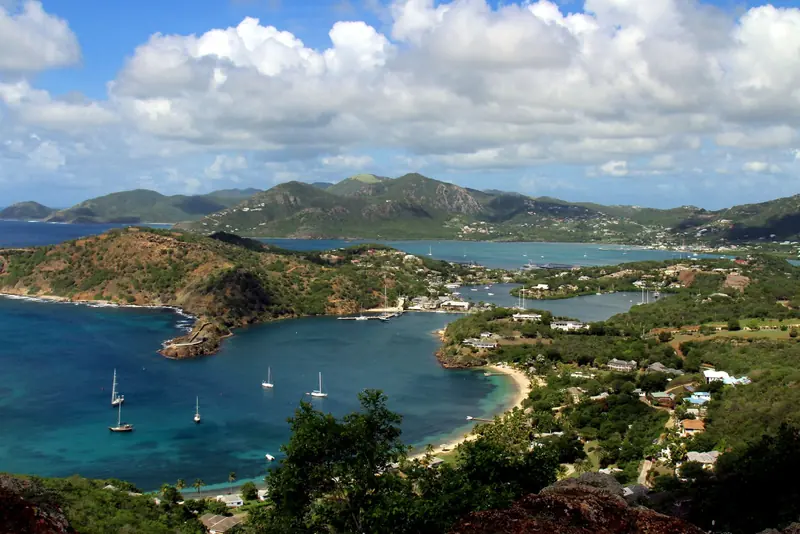
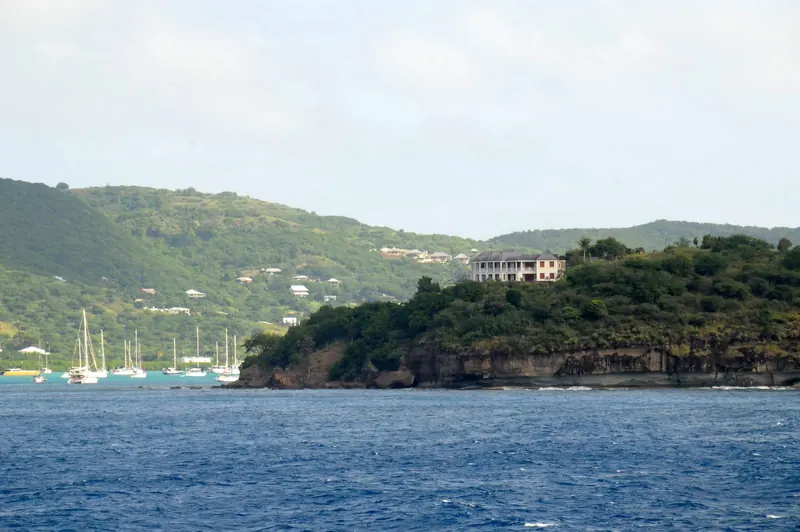
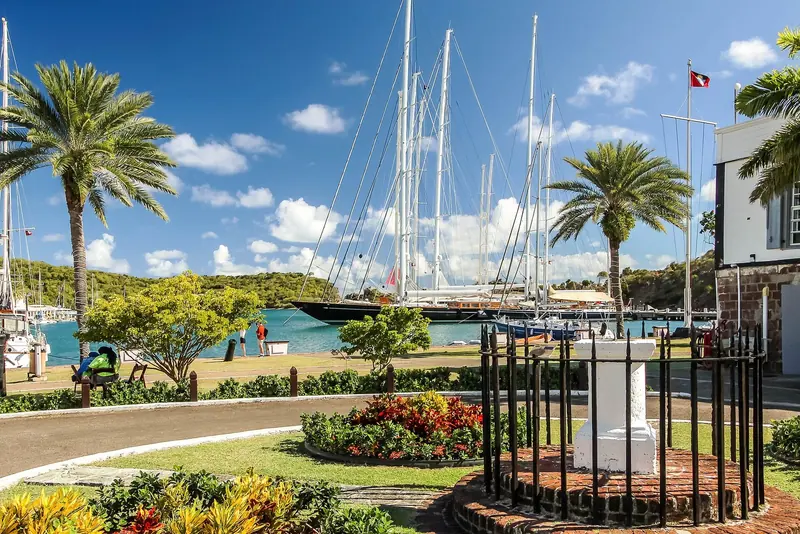
Falmouth Harbour es una bahía natural en herradura de la costa sur de Antigua, en 17 00.75 N 061 46.73 W. El pueblo y el puerto de Falmouth están en la orilla norte, y English Harbour, la ensenada más profunda y más famosa, se abre justo al este. Las separa una lengua de tierra baja que se cruza a pie en un cuarto de hora, y entre las dos reúnen cinco explotaciones de amarre distintas bajo cuatro gestiones diferentes. Falmouth Harbour Marina, la mayor, está en la carretera principal de English Harbour, en el lado este de Falmouth Harbour, y la explota Antigua Slipway Ltd, el astillero familiar instalado en English Harbour desde 1966. La marina en sí nació en 1994, y la asociación del sector la describe como la mayor marina para megayates de la isla y la más veterana de las modernas.
Al lado, también en Falmouth, está la marina conocida durante años como Antigua Yacht Club Marina, arrasada por un incendio el 2 y el 3 de octubre de 2023 durante la tormenta tropical Philippe y reconstruida desde entonces con el nuevo nombre de Antigua Superyacht Marina and Resort, con otro complejo cuya obra debe arrancar en el verano de 2026. Antigua Slipway mantiene además su propio muelle y su propio pantalán de combustible en English Harbour, junto al astillero: es la quinta explotación de amarre y la que más veces se cae de las listas. En el extremo norte de Falmouth Harbour opera Catamaran Marina, un negocio familiar que admite yates de hasta 200 ft con 15 ft de calado. Y al otro lado del cerro, en English Harbour, la marina que hay dentro de Nelson's Dockyard la gestiona la Autoridad de Parques Nacionales, un ente público sin ánimo de lucro creado por la ley de parques nacionales de 1984, que reinvierte sus ingresos en restauración, conservación y arqueología. Ese es el reparto que conviene entender antes de reservar: se elige entre un muelle superyate comercial, una marina resort reconstruida, un muelle de astillero, un pequeño pantalán familiar y un organismo estatal de patrimonio, todos dentro de un mismo parque nacional, y cada uno de ellos suma a la factura las tasas de la Autoridad de Parques Nacionales.
La marina, y la eslora anunciada que en realidad es un muelle
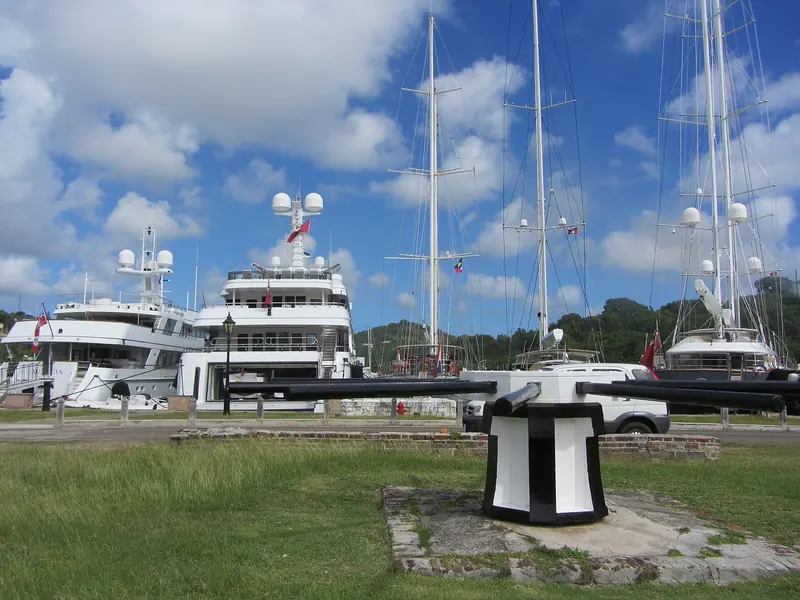
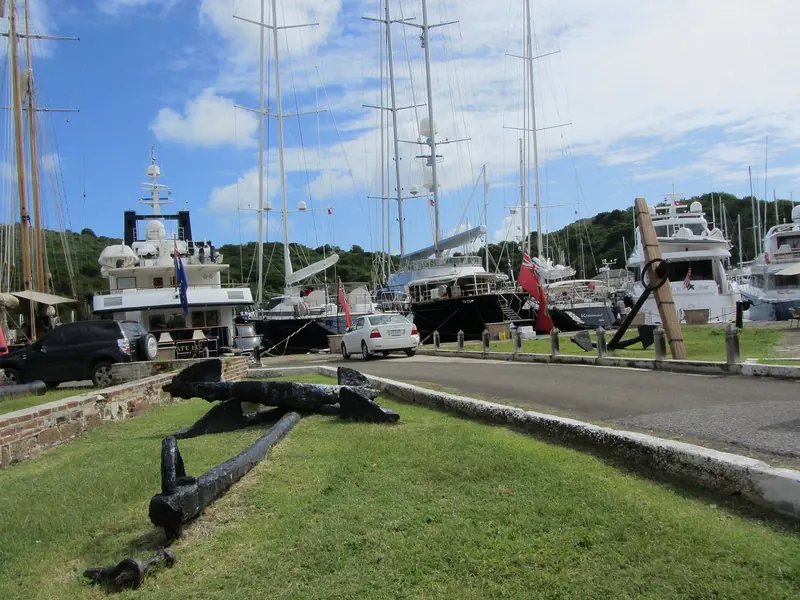
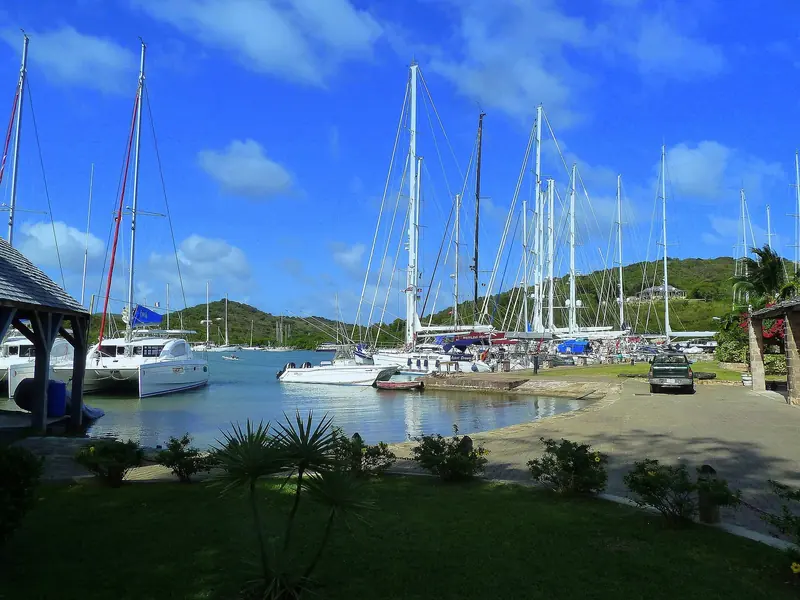
Falmouth Harbour Marina tiene treinta amarres de popa y treinta de costado, en pantalanes anchos de hormigón con un acceso rodado apto para camiones de casi cualquier tamaño, algo que pesa más de lo que parece cuando hay que cargar un refit o preparar un cambio de chárter. Según la asociación del sector hay electricidad a 110 V y a 208, 220 y 380 V trifásica, y la web de la marina añade 400 V; su propio formulario de solicitud de amarre ofrece monofásica de 120 V, monofásica de 220 V y trifásica de 380 V. El amperaje no lo publica nadie. En los amarres hay agua dulce, wifi de fibra óptica gratuito en todo el recinto, vigilancia 24 horas, aparcamiento, retirada de residuos, un pantalán para auxiliares y almacenamiento de contenedores servido por grúa. La marina escucha el canal 10 de VHF.
La eslora máxima parece una discrepancia sin resolver y no lo es, y el armador de un yate muy grande necesita saber por qué antes de planificar una temporada. La web de Falmouth Harbour Marina dice 535 ft, unos 163 m, y repite la cifra en sus propias preguntas frecuentes. La Antigua and Barbuda Yachting and Marine Association, la patronal del sector, indica que se puede atender a yates de hasta 330 ft, unos 100 m, tanto de popa como de costado. Las dos cifras no miden lo mismo. All At Sea, al informar de la ampliación que la COVID había retrasado, describe el nuevo muelle superyate de hormigón hecho a medida como de 535 ft de largo por 20 ft de ancho, sobre pilotes hincados unos 40 ft en el fondo. Los 535 ft son la longitud del muelle, no la de un barco. Los 525 ft que recoge Yachting Pages son ese mismo paramento redondeado al revés, impresos allí como amarres de hasta 160 metros, y la prensa antiguana informó de esa misma inauguración. Queda por tanto 330 ft como única cifra publicada que describe un buque, y es la cifra con la que se planifica; 535 ft es la cantidad de hormigón a lo largo de la cual la marina puede alinear una flota. En lo que todas las fuentes coinciden es en el calado: 20 ft, unos 6,1 m, y esa es la cifra que de verdad lo va a detener. Quien pase de unos 100 m debería tratar el titular de la web como una conversación pendiente con el capitán de puerto y no como una reserva hecha.
Publica su tarifa de amarre, algo que casi nadie hace en el Caribe, y encima le añade una tasa obligatoria de parque nacional que no publica absolutamente nadie.
La aproximación, Bishop Shoal y el despacho a pie
Antigua baliza según IALA B, el criterio americano y el contrario al europeo: boyas rojas a estribor a la entrada, verdes a babor. Quien lo confunda al llegar de una travesía atlántica recibirá el recordatorio de Bishop Shoal. El bajo queda al este de la bocana de Falmouth Harbour, está marcado por una gran boya roja que se deja a estribor y rompe de forma visible con cualquier estado de mar que no sea calma absoluta. Una vez pasado, se deja a babor la siguiente boya roja y se sigue el canal balizado, que lleva tanto a la Antigua Superyacht Marina como a Falmouth Harbour Marina. Para Catamaran Marina es al revés, boya roja a estribor, enfilando dos triángulos naranjas en la ladera, con luces de enfilación para la entrada nocturna. Se puede fondear casi en cualquier parte de la rada siempre que se dejen libres los canales y la zona de exclusión frente a los dos grandes pantalanes de las marinas.
El procedimiento de despacho es lo mejor de llegar aquí y merece detallarse. Seis horas antes se llama a la Guardia Costera por el VHF 16 para solicitar la entrada en aguas de Antigua y Barbuda. Luego se atraca de costado y se iza la bandera Q. Sanidad Portuaria despacha el buque antes que nada y nadie salvo el capitán baja a tierra hasta que la entrada está completa. Después vienen la Aduana, Inmigración con las tarjetas ED y seis copias de las listas de tripulación y pasaje, la vuelta a la Aduana y, por último, la Autoridad Portuaria, donde se pagan la entrada, la retirada de basuras, el fondeo o el amarre y el permiso de navegación. Las tres administraciones están en el mismo edificio de English Harbour, y una tripulación amarrada en Falmouth va andando por encima del cerro. El despacho de salida invierte el orden, empieza por la Autoridad Portuaria, exige cuatro copias de las listas y deja 24 horas para abandonar el país. La vía telemática es eSeaClear. Todo buque en aguas antiguanas debe llevar un permiso de navegación en vigor, y los recibos de las tasas portuarias y del parque nacional hay que presentarlos aunque se salga del país por otro puerto.
Lo que cuesta un amarre, y la tasa que no se puede consultar
Falmouth Harbour Marina publica un tarifario, algo insólito en el mercado superyate caribeño y una razón real para trabajar con ella. Leídas el 6 de agosto de 2026, y sin ningún año de temporada impreso en la página, las tarifas van por pie y día en dólares estadounidenses. Invierno, del 1 de noviembre al 31 de mayo: de popa USD 3,50 al día y USD 3,20 en régimen mensual, de costado USD 6,50 al día y USD 5,95 al mes. Verano, del 1 de junio al 31 de octubre: de popa USD 2,55 al día y USD 2,45 al mes, de costado USD 4,65 al día y USD 4,44 al mes. Las tasas se pagan por adelantado, la salida es a mediodía y se aceptan Visa y Mastercard. Una advertencia: la línea de condiciones que hay bajo la tabla dice que las tarifas de costado son el doble, lo que no cuadra con la tabla, porque el doble de la tarifa de invierno de popa serían USD 7,00 y no USD 6,50. Consiga que le confirmen la cifra por escrito antes de llegar.
En dinero: un yate de 40 m mide 131 ft, así que una noche de invierno de costado sale por unos USD 852 y de popa por unos USD 459; ese mismo yate de costado en verano ronda los USD 609. Un yate de 60 m, 197 ft, paga alrededor de USD 1.280 la noche de costado en invierno. Son cálculos de Yotters sobre la tarifa publicada, no presupuestos. Por encima hay tres partidas que ninguna fuente pública permite cifrar. La electricidad se cuenta a USD 0,60 el kWh y el agua a USD 0,15 el galón estadounidense, y ambas están publicadas. Las tasas de la Autoridad de Parques Nacionales solo están publicadas a medias. Son obligatorias para todo buque fondeado en English o Falmouth Harbour o amarrado en cualquiera de los cinco muelles del parque. Las entradas de visitante del parque sí constan: Antigua News Room, citando a la Autoridad en agosto de 2022, da US$15 por un pase de un día y US$100 por un pase de temporada que caduca al terminar la temporada náutica, con EC$10 para vecinos y residentes, EC$50 para un pase anual y EC$200 para un pase familiar de hasta seis personas. Para una tripulación de ocho eso son US$120 por visita o US$800 por temporada. Lo que no está publicado en ninguna parte es el cargo que recae sobre el propio buque: la Autoridad no lleva tarifario alguno en su web y la página de despacho de la asociación del sector menciona la obligación sin dar una cifra. Las tasas de entrada, basuras y permiso de navegación de la Autoridad Portuaria tampoco están publicadas. La agencia marítima Med Yacht Services, en su hoja de tasas de Antigua para 2026, presupuesta el despacho de aduanas entre USD 250 y 550 y el trámite de inmigración con acompañamiento entre USD 250 y 500, y consigna las tasas del parque nacional simplemente a coste. Es lo más parecido a una cifra pública que existe.
Combustible, electricidad, agua y qué cubre de verdad el duty free
Hay combustible libre de impuestos en todas las marinas de Falmouth y English Harbour, que es el régimen habitual para los yates en tránsito por Antigua y una de las razones por las que la flota para aquí y no en otro punto del arco antillano. Falmouth Harbour Marina entrega gasóleo de muy bajo azufre libre de impuestos y aranceles directamente en el amarre, con caudales de hasta 1.000 litros por minuto, capaces de llenar un gran yate a motor en una jornada de trabajo. El servicio es diario en temporada alta y solo en días laborables en temporada baja, con suministro nocturno a petición. Los muelles vecinos son menos industriales: el establecimiento que hoy opera como Antigua Superyacht Marina suministra gasóleo libre de impuestos con bomba móvil, y tanto Antigua Slipway como Catamaran Marina tienen su propio pantalán de combustible.
Lo que la marina no hace es publicar un precio de combustible, y tampoco lo hace nadie más en la rada, de modo que un capitán planifica un aprovisionamiento contra una oferta fresca y no contra un precio expuesto. Ese es el patrón de toda la estructura de costes de aquí. Los suministros medidos sí están publicados y son moderados, a USD 0,60 el kWh y USD 0,15 el galón estadounidense de agua, con las duchas en tierra a USD 2 por persona. Todo lo demás va por presupuesto. Antigua importa prácticamente todo su combustible, su comida y su ferretería, y el mayor supermercado de la isla, Epicurean Fine Foods, está en Jolly Harbour y en St John's, al otro lado, y no en Falmouth, donde quedan el Dockside Supermarket dentro de Nelson's Dockyard y Bailey's cerca de Catamaran Marina para el día a día. Quien aprovisione un chárter aquí debe contar con un sobreprecio de importación en casi todo y meter en el calendario un viaje en coche cruzando la isla.
La cuestión del varadero, y el techo de las 200 toneladas
Esta es la debilidad estructural de Falmouth y de English Harbour y no la cambia ninguna longitud de muelle. El tejido náutico que hay a pie de amarre es realmente denso para un puerto caribeño: mecánica naval, electrónica, jarcia, una velería, una tienda de buceo y varios efectos navales, además de carpintería de ribera y servicios de refit alrededor de Nelson's Dockyard, de manera que el mantenimiento corriente, las reparaciones sobre la marcha y un refit de chárter entre temporadas se resuelven sin problema. Lo que no se puede hacer es salir del agua. Antigua Slipway, que también explota Falmouth Harbour Marina, declara en su varadero de raíles una capacidad máxima de izada de 200 toneladas para buques de hasta 150 ft de eslora total por 40 ft de manga por 14 ft de calado, y se define como el astillero más completo del Caribe. Bailey's Boatyard, en el extremo norte de Falmouth Harbour, tiene un travelift de 70 toneladas y un elevador Ascon de 80 toneladas y saca barcos de hasta 12 ft de calado. Al otro lado de la isla, Jolly Harbour tiene dos travelifts, de 75 y 85 toneladas, y admite catamaranes de hasta 33 ft de manga; Shell Beach llega a 25 toneladas.
Doscientas toneladas son un velero grande o un yate a motor modesto. No son un superyate, y cualquier yate de la parte alta del muelle de Falmouth desplaza varias veces esa cifra. Antigua es un sitio desde el que operar un barco grande, no un sitio donde izarlo, y la pintura, el acero y la obra estructural salen del país. Puede que eso mejore en el margen: Antigua Slipway ha anunciado una renovación de su varadero de raíles por US$2,5 millones, que sustituirá la envejecida estructura sumergida por un sistema moderno de acero construido con estándares internacionales de ingeniería, con obra prevista desde junio de 2026, entre 50 y 60 empleos durante la construcción y la ambición declarada de convertirse en la mayor instalación de varada de buque único del Caribe, al servicio de remolcadores y barcos de trabajo comerciales de St John's además de yates. A este tramo de 2026 no se le ha asociado tonelaje alguno. Lo que sí dijo el astillero al cerrar la primera fase en marzo de 2023, con un carro reconstruido para 100 ft y 100 toneladas, es que la segunda fase, la renovación del raíl sumergido, llevaría la capacidad de varada y botadura a 200 ft de eslora total y 270 toneladas. Esa es la cifra que hay que vigilar y, hasta que el acero esté en el agua, una varada se planifica sobre las 200 toneladas.
El calendario, y los seis meses en que la rada se vacía
Dos fechas fijas ocupan la rada entera y son la razón para reservar con mucha antelación o para no venir. Solo una de ellas sigue por delante. El Antigua Charter Yacht Show se celebra del 4 al 9 de diciembre de 2026, en su 65 edición, organizado por la Antigua and Barbuda Yachting and Marine Association y repartido a la vez por tres muelles: Nelson's Dockyard Marina, Falmouth Harbour Marina y Antigua Yacht Club Marina. Se celebra desde 1961, reúne alrededor de cien yates de chárter y es la cita en la que la temporada de chárter caribeña se vende de verdad. Las regatas de primavera ya han pasado este año. La Antigua Classic Yacht Regatta se corrió del 15 al 20 de abril de 2026 y la Antigua Sailing Week siguió del 22 al 26 de abril de 2026, en su 57 edición, recortada a un formato más breve de cuatro días con recorridos de punta a punta alrededor de la isla y base repartida entre English y Falmouth Harbour. Quien planifique la próxima temporada debe quedarse con las fechas de 2027: las Classics del 14 al 19 de abril de 2027 y la Sailing Week, 58 edición, del 21 al 25 de abril de 2027. Antigua es además la línea de llegada del Atlántico: la RORC Transatlantic Race que salió de Lanzarote el 11 de enero de 2026 con 21 equipos terminó aquí.
Y después se para. La temporada de huracanes del Atlántico va del 1 de junio al 30 de noviembre, con el pico entre agosto y octubre, y la economía náutica de las dos radas se va con ella. La flota de chárter con tripulación se marcha al Mediterráneo, restaurantes y negocios cierran en verano, y la propia operativa de la marina lo refleja: el suministro de combustible pasa de servicio diario a solo días laborables, y la tarifa cae alrededor de un 27 por ciento de popa y un 28 por ciento de costado. English Harbour tiene una larga fama de refugio de huracanes, y es merecida, pero no es una garantía frente a un impacto directo, y nadie con juicio deja aquí un yate desatendido sin un plan de huracanes por escrito. Bailey's Boatyard vende picaderos de huracán aceptados por todas las grandes aseguradoras de yates y fija en consecuencia el precio de su almacenaje de verano. El incendio de octubre de 2023, que destruyó el edificio principal de la Antigua Yacht Club Marina durante la tormenta tropical Philippe y que allí se atribuyó a un rayo, recuerda lo que una temporada de tormentas puede hacer en tierra aunque los barcos aguanten.
En tierra, y lo que cuesta de verdad estar aquí
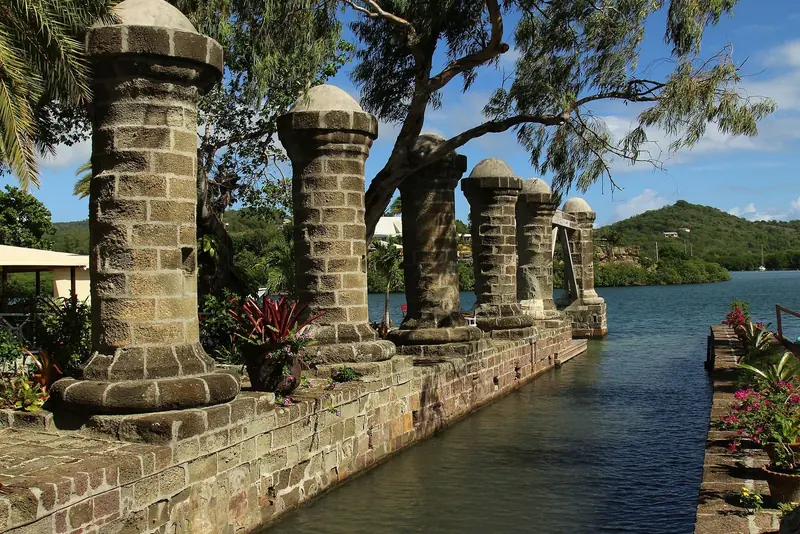
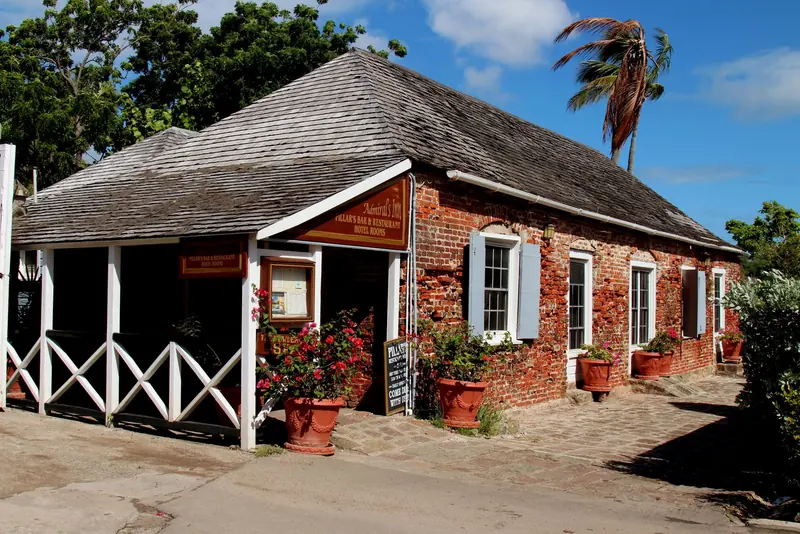
La compensación de todo lo anterior es que este es uno de los sitios más agradables del Caribe para tener un barco. Nelson's Dockyard, inscrito por la UNESCO en 2016 como Antigua Naval Dockyard and Related Archaeological Sites, es el único arsenal georgiano del mundo que sigue funcionando sin interrupción y está a quince minutos a pie de la marina, con hotel, restaurantes, una tienda de efectos navales y un supermercado dentro de sus muros. Se come mejor de lo que el tamaño del puerto haría suponer: Cloggy's, en el club náutico, de Ton y Vanessa Smit, es sistemáticamente la mesa mejor valorada de Falmouth, Boom está sobre la marina y Pillars está en el Admiral's Inn, dentro del Dockyard, con Trappas y Colibri cubriendo la franja media. El plato fuerte es Shirley Heights Lookout, sobre la rada, donde la fiesta del domingo va de 1600 a 2200 con banda de steel pan hasta las 1900 y reggae después, por USD 10 o EC 25 en la puerta, y hay una noche de reggae más tranquila los jueves al mismo precio.
Dos advertencias honestas sobre estar en tierra. El aeropuerto no está en la rada. V.C. Bird International está en la costa norte, a unos 21,7 km y de 35 a 45 minutos por carretera, y aunque tiene vuelos de largo radio diarios a Norteamérica, servicio todo el año al Reino Unido y asistencia a aviación privada, el único enlace con la Europa continental es estacional, Condor desde Fráncfort, y cada cambio de tripulación y cada llegada de invitados supone una hora de coche en cada sentido. Las tarifas de taxi las fija por zonas el Antigua and Barbuda Transport Board, pero el cuadro vigente no está publicado en ninguna parte y las copias que circulan por internet tienen años, así que acuerde el precio con el coordinador antes de subirse al coche. Y la seguridad ya no es la que era: Noonsite, apoyándose en los partes de los navegantes y en el Caribbean Safety and Security Net, registra que los robos de auxiliares, fueraborda y material suelto van en aumento en muchos puertos caribeños, este incluido, y que se llevan incluso el material cerrado y trincado. De noche, la auxiliar se iza.
En tierra, accesos y reservas
| Getting there | V.C. Bird International Airport (ANU) sits on the north coast of the island, roughly 21.7 km from English Harbour, and the drive takes 35 to 45 minutes depending on traffic. It is a real international airport with daily long-haul service to North America and year-round service to the United Kingdom, plus private jet handling, so guests from those markets arrive without connecting through a hub. Continental Europe is seasonal only: Condor from Frankfurt is the single continental link and it does not run year-round. Either way it is an hour of road at each end of every crew change. Taxi fares are set on a zone basis by the Antigua and Barbuda Transport Board; the catch is that the current schedule is not published anywhere and the rate sheets circulating online are years out of date. Ask the dispatcher at the taxi coordination point for the official rate to Falmouth or English Harbour and confirm it before you get in. Fares are per taxi for up to four passengers, and both US and Eastern Caribbean dollars are taken. |
|---|---|
| Arriving by sea | Antigua uses IALA B buoyage: red to starboard on entry, the reverse of Europe. The one hazard is Bishop Shoal, east of the Falmouth Harbour entrance, marked by a large red buoy which you leave to starboard and which breaks visibly except in flat calm. Past it, leave the next red buoy to port and follow the buoyed channel, which serves both Falmouth Harbour Marina and the Antigua Superyacht Marina. For the Catamaran Marina at the north end, leave that same red buoy to starboard and line up the two orange triangles on the hillside; there are leading lights for a night approach. Call the marina on VHF 10. Anchoring is permitted almost anywhere in the harbour provided you keep clear of the channels and of the exclusion area in front of the two large marina docks. There is no lock, no bridge and no pilotage requirement. |
| Clearing in and out | Call the Coastguard on VHF 16 from six hours out of Antigua to request entry. Come alongside at any marina and fly the Q flag; everyone stays aboard until Port Health has cleared the vessel, and only the master then goes ashore. The order is Customs, then Immigration with ED cards for every person, passports, the general declaration and six copies of the crew and passenger lists, back to Customs for final approval, then the Port Authority to pay entrance, rubbish disposal, anchorage or dockage and the cruising permit. US and EC dollars and Visa or Mastercard are accepted. Clearing out starts at the Port Authority, needs four copies of the lists, and obliges you to depart within 24 hours. All three authorities are in one building at English Harbour, an easy walk from a Falmouth berth. Online procedures run through eSeaClear. Crew leaving the boat need an onward ticket or a signed letter from the captain or a local agent. Keep every Port and National Parks receipt, because they are demanded even if you clear out through a different port. |
| Reserving a berth | Berths are booked directly through the marina's own berth request form or its office on +1 268 460-6054, and the form asks for LOA, beam, draught, gross tonnage, flag, port of registry, arrival and departure dates and your electricity requirement, so have the yacht's particulars to hand. There is no published minimum stay and no published long-stay contract, only a monthly rate that is a few per cent under the daily. Book the December Charter Yacht Show and the April regatta fortnight months out: the show alone fills three marinas with around a hundred yachts, and the Classics and Sailing Week take the harbour for two consecutive weeks every April, 14 to 19 and 21 to 25 April in 2027. Because the marina's 535 ft headline is the length of its superyacht quay rather than a vessel maximum, and the published vessel figure is 330 ft, a yacht over about 100 m should have the dockmaster confirm the berth in writing rather than rely on the website number. |
| What a berth costs | Rates are per foot per day in US dollars, read on 6 August 2026 with no season year printed on the page. Winter, 1 November to 31 May: stern-to USD 3.50 daily and USD 3.20 monthly; alongside USD 6.50 daily and USD 5.95 monthly. Summer, 1 June to 31 October: stern-to USD 2.55 daily and USD 2.45 monthly; alongside USD 4.65 daily and USD 4.44 monthly. Berthing fees are payable in advance, checkout is noon, Visa and Mastercard are accepted. Note the contradiction on the marina's own page: the terms say alongside rates are double, which would make winter alongside USD 7.00 rather than the USD 6.50 in the table, so confirm the figure in writing. As arithmetic on the published rate, a 40 m yacht at 131 ft pays about USD 852 a night alongside in winter, about USD 459 stern-to, and about USD 609 alongside in summer; a 60 m yacht at 197 ft pays roughly USD 1,280 alongside in winter. Those are Yotters calculations, not quotations, and they exclude power, water, National Parks and Port Authority fees. |
| Fuel, water, power and what is extra | Tax and duty-free ultra-low-sulphur diesel is delivered directly to the berth at flow rates of up to 1,000 litres a minute, which is genuine bunkering capacity rather than a fuel dock. Service is daily through the high season and weekdays in the low season, with overnight delivery on request; submit the vessel details and quantity in advance. No price is published, so budget from a fresh quote. Duty-free fuel is available at every marina in Falmouth and English Harbour, and the neighbouring Antigua Superyacht Marina supplies it by mobile pump. Electricity at the berth is metered at USD 0.60 per kWh, fresh water at USD 0.15 per US gallon, and showers ashore are USD 2 a person. Wifi, parking, security and waste disposal are included. On top of all of it come the per-vessel National Parks Authority charge and the Port Authority fees, neither of which has a published schedule, though the park's own visitor passes are published at US$15 a day and US$100 a season. |
| The yard, and what has to leave the island | Routine and technical work is well covered within walking distance: marine engineering, electronics and rigging, a sail loft, a dive shop, several chandleries, and yacht carpentry and refit services clustered around Nelson's Dockyard. Antigua Slipway, which also owns this marina, is the yard, hauling up to 200 tons on its marine railway, for vessels up to 150 ft length overall by 40 ft of beam by 14 ft of draft, with storage ashore on welded cradles and tie-down straps, a fuel dock, a chandlery, two restaurants and a hotel. Its rates are quoted in Eastern Caribbean dollars, are subject to government taxes and are not published; you contact the office team for an estimate, haul-outs need 24 hours' cancellation notice, and accounts unpaid at 30 days attract 2.5 per cent a month. Bailey's Boatyard in Falmouth Harbour runs a 70-ton travelift and an 80-ton Ascon lift, hauls to 12 ft of draught, and keeps hurricane cradles accepted by the major yacht insurers; Jolly Harbour across the island runs 75-ton and 85-ton travelifts and takes catamarans to 33 ft of beam, and Shell Beach has 25 tons. Nothing on Antigua can lift a superyacht, so paint, steel and structural work is a passage to another country. |
| Eating, drinking and provisioning | Cloggy's at the yacht club, run by Ton and Vanessa Smit, is the highest-rated table in Falmouth and looks down over the harbour; Boom sits on the marina; Pillars is inside the Admiral's Inn in Nelson's Dockyard; Trappas and Colibri fill out the middle of the range. The institution is Shirley Heights Lookout on the ridge above English Harbour: the Sunday party runs 1600 to 2200 with a steel pan band to 1900 and reggae after, entry USD 10 or EC 25, with drinks around EC 10 to 16 and food around EC 35, and there is a quieter Thursday reggae evening at the same admission. For provisioning, the Dockside Supermarket sits inside Nelson's Dockyard and Bailey's is near the Catamaran Marina, both fine for daily shopping. Serious provisioning means a drive: Epicurean Fine Foods, the island's largest grocer, is at Jolly Harbour and St John's on the other side of Antigua. Everything is imported and priced accordingly. |
| The fixed dates, and what is NOT published | Still ahead: the Antigua Charter Yacht Show, 4 to 9 December 2026, the 65th edition, run by the Antigua and Barbuda Yachting and Marine Association across Nelson's Dockyard Marina, Falmouth Harbour Marina and the Antigua Yacht Club Marina, with around a hundred yachts. Already run this year: the Antigua Classic Yacht Regatta, 15 to 20 April 2026, and Antigua Sailing Week, 22 to 26 April 2026, the 57th edition in a shortened four-day point-to-point format. Next spring: the Classics 14 to 19 April 2027 and Sailing Week 21 to 25 April 2027, the 58th edition. The RORC Transatlantic Race finishes here each winter, the 2026 edition having left Lanzarote on 11 January with 21 teams. Hurricane season runs 1 June to 30 November. Not published: the per-vessel National Parks Authority charge on a berthed or anchored yacht, which appears nowhere in any form, although the park's visitor passes are published at US$15 a day, US$100 a season and EC$10 for residents; the Port Authority entrance, rubbish and cruising permit fees; the marina's fuel price; the shore power amperage; any long-stay or seasonal contract rate beyond the monthly per-foot figure; and Antigua Slipway's haul-out, storage and docking rates, which its own rates page answers with an invitation to ask. |
Lo que cuentan armadores y tripulaciones
The marina's 535 ft is the length of its dock, not the length of a yacht
All At Sea, reporting the expansion of Falmouth Harbour Marina's superyacht dock after a COVID delay, describes the new custom-built concrete dock as 535 ft in length by 20 ft in width, built on piles driven some 40 ft into the seabed. That is the origin of the 535 ft on the marina's own website and of the 525 ft, or 160 metres, in the trade listings: they are the quay. The vessel figure is the trade association's, which states that yachts up to 330 ft in length can be catered for stern-to, with a 20 ft maximum draught, thirty stern-to and thirty alongside berths and electricity at 110 V, 208, 220 and 380 three-phase.
All At SeaYou can clear in on foot, and the fuel is duty-free at every quay
Cruisers report walking from Falmouth over to Nelson's Dockyard to complete clearance formalities, with Customs, Immigration and the Port Authority in a single building, and duty-free fuel available in all the harbour's marinas. The one navigational caution repeated by everyone is Bishop Shoal off the entrance, marked by a large red buoy which under the American buoyage convention is left to starboard on entry.
NoonsiteA storm took out a marina building, not the boats
A fire in the marina complex in October 2023, during Tropical Storm Philippe and locally attributed to a lightning strike, gutted the main Antigua Yacht Club Marina building and a number of well known businesses with it. Temporary services reopened on the old site in container buildings within about four months, and the operation has since been rebuilt and rebranded as the Antigua Superyacht Marina and Resort, with a further complex due to start construction in summer 2026.
NoonsiteDinghy and outboard theft is rising and locks are not enough
Based on reports to Noonsite from cruisers and from the Caribbean Safety and Security Net, thefts of dinghies, outboards and unsecured or loose items are on the rise in many Caribbean ports, this one included, and even locked and secured hardware is being stolen. The practical advice is to lift the tender at night rather than to rely on a cable.
Noonsite and the Caribbean Safety and Security NetThe yard is spending USD 2.5 million to stay relevant
Antigua Slipway Ltd announced a US$2.5 million redevelopment and upgrade of its marine railway at English Harbour, replacing the ageing underwater structure like for like with a modern steel system built to international engineering standards. Construction was scheduled to begin in June 2026, is expected to create 50 to 60 jobs during the build, and is intended to produce the largest single-vessel yacht haul-out facility in the Caribbean, also serving tugs and commercial work vessels from St John's Port. No tonnage has been attached to this tranche, but on completing phase one in March 2023, a rebuilt cradle good for 100 ft and 100 tons, the yard said phase two would take haul and launch capacity to 200 ft length overall and 270 tons.
Antigua NewsroomAn agent will budget the clearance you cannot price yourself
The yacht agency Med Yacht Services, in its Antigua fee sheet for the 2026 season, budgets customs clearance at USD 250 to 550 and immigration including escort at USD 250 to 500, and carries National Park Association fees simply as at cost, with surcharges of 10 per cent for holidays and peak season and 20 to 25 per cent for expedited events. That is the nearest thing to a public figure for the unpublished side of the bill.
Med Yacht Services
Lo bueno y lo que conviene vigilar
Puntos fuertes
- A published rate card in a market that mostly refuses to publish oneWinter and summer, daily and monthly, stern-to and alongside, all in US dollars per foot per day, with metered power at USD 0.60 per kWh and water at USD 0.15 per US gallon on the same page. An owner can build a season budget from public information, which he cannot do at most Caribbean superyacht quays.
- Clearance on foot, in one building, at a port of entryCustoms, Immigration and the Port Authority all sit together at English Harbour, a fifteen-minute walk over the hill from the berth, and the online route runs through eSeaClear. For a yacht arriving off the Atlantic this is as painless as Caribbean entry gets.
- Industrial bunkering, tax and duty-free, at the berthUltra-low-sulphur diesel delivered alongside at up to 1,000 litres a minute, daily through the high season and overnight on request, with duty-free fuel available at every quay in both harbours.
- The densest marine trade cluster in the Eastern Caribbean, on footMarine engineering, electronics, rigging, a sail loft, a dive shop, chandleries and yacht carpentry are all within walking distance, with Antigua Slipway's own yard attached to the same ownership as the marina.
- It is where the Caribbean charter market is transactedThe Antigua Charter Yacht Show, 4 to 9 December 2026 and in its 65th year, occupies three marinas and around a hundred yachts, and the Classics and Sailing Week take the harbour every April, 14 to 19 and 21 to 25 April in 2027. A charter yacht based here is in the room.
A tener en cuenta
- Nothing on the island can lift a superyachtAntigua Slipway's marine railway takes 200 tons to 150 ft and 40 ft of beam, Bailey's 80, Jolly Harbour 85 and Shell Beach 25. Paint, steel and structural work is a delivery passage to another country. Even the announced USD 2.5 million railway rebuild is aimed at 200 ft and 270 tons, which still does not reach the yachts on the marina's own dock.
- The compulsory fee nobody publishesEvery vessel anchored in either harbour or berthed at any of the five quays inside Nelson's Dockyard National Park pays National Parks Authority fees on top of dockage and Port Authority charges. The park's visitor passes are published, at US$15 a day and US$100 a season. The charge on the vessel itself is not, and it appears neither on the Authority's site nor on the trade association's clearance page nor anywhere else Yotters could find.
- The headline length on the marina's own site measures its concreteThe 535 ft the marina publishes is the length of the superyacht quay completed in the 2022 expansion, 535 ft by 20 ft on piles driven some 40 ft into the seabed, and the 525 ft or 160 metres in the listings is the same wall. The published vessel figure, from the trade association, is 330 ft. An owner reading the website alone would size a season on a number that describes the dock and not his boat. Only the 20 ft draught limit is stated the same way by everyone.
- Six months of the year the place shutsHurricane season runs 1 June to 30 November, crewed inventory leaves, restaurants and businesses close for the summer, and the marina's own bunkering drops from daily to weekdays. English Harbour is a good hurricane hole but not a safe one in a direct hit, as the October 2023 storm fire showed.
- Fuel and provisions are quoted, not posted, and everything is importedNo marina in the harbour publishes a fuel price. The island's largest supermarket is at Jolly Harbour on the opposite coast, and a landed-import premium runs through the whole cost base from diesel to groceries to spares.
- The airport is an hour of road and the taxi fare is unknowable in advanceV.C. Bird International is 21.7 km and 35 to 45 minutes away on the north coast. Fares are set by zone by the Transport Board, but the current schedule is not published and the versions online are years out of date, so every transfer is negotiated at the rank.
- Tender and outboard theft is a live problemNoonsite, drawing on cruiser reports and the Caribbean Safety and Security Net, records rising theft of dinghies, outboards and loose gear in this and other Caribbean ports, with locked and secured hardware being taken.
Para quién es: El armador que pasa un invierno caribeño con un yate grande y quiere una tarifa publicada, combustible libre de impuestos en el amarre y todo el mercado de chárter al lado, y que mandará el barco a otro sitio en cuanto haya que izarlo.