Gouvia Marina (Corfu)
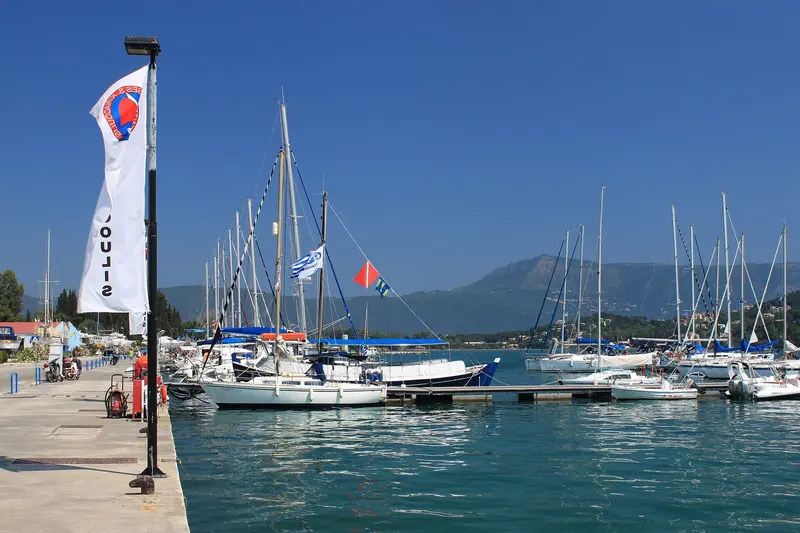
| Ubicación | bahía de Gouvia, costa este de Corfú, sobre el emplazamiento del arsenal veneciano, a unos 7 km del aeropuerto internacional de Corfú y a 6 u 8 km de la ciudad de Corfú |
|---|---|
| Posición | 39 38.9 N, 019 51.2 E. La página de D-Marin y su propia lista de precios de 2020 difieren en unos pocos segundos de latitud |
| Operador | D-Marin, 28 marinas en nueve países con más de 14,300 amarres y doce varaderos. Propiedad de Dogus Group, vendida a CVC en 2020 por un importe cifrado en EUR 200 millones, y comprometida el 6 de julio de 2026 para su venta a InfraVia Capital Partners con una valoración que el Financial Times situó por encima de EUR 1,000 millones |
| Amarres | 1,200 según D-Marin, 1,235 según varios directorios del sector, 1,198 según otro. La primera marina de propiedad privada de Grecia |
| Esloras admitidas | hasta 70 m de eslora total según D-Marin, aunque otros directorios dicen 80 m y uno dice 60 m |
| Calado máximo | 5.5 m, citado igual por todas las fuentes |
| Sondas en la aproximación | 8 a 12 m en la bahía exterior, bajando a 5 a 8 m cerca de la bocana, con un canal balizado que lleva 8 a 9 m en su eje |
| Atraque | de popa. La última tarifa publicada cobraba un 80 por ciento más por amarrar de costado y un 75 por ciento más por un catamarán |
| Plazas en seco | 500, más 6,000 metros cuadrados de almacenamiento en seco adicional añadidos en la reforma terminada en mayo de 2026 |
| Izado | travelifts de 65 y 75 toneladas, grúas móviles de 60 y 45 toneladas, un transportador de barcos de 50 toneladas y una grúa pluma de 2 toneladas |
| Suministro en tierra | consumo de agua y de electricidad a 220 V incluido en el precio del amarre; el agua potable y cualquier suministro a 380 V, o a 220 V por encima de 32 A, van con tarjetas de prepago |
| VHF | canal 69. A la llegada se piden matrícula, seguro, documento de identidad del armador o del capitán, y el transit log o la viñeta si se tienen |
| Aduana | el despacho desde o hacia un país de fuera de la Unión Europea se hace en el puerto principal de la ciudad de Corfú, no en la marina |
| Normas | prohibido fondear en cualquier punto de la bahía de Gouvia o en la marina salvo emergencia, prohibidos los generadores, prohibidos el baño, el buceo y la pesca en la dársena, prohibido el mantenimiento de gran alcance en los amarres en el agua |
| Inversión reciente | unos EUR 8.5 millones, con 104 amarres añadidos para barcos de hasta 50 m, torretas inteligentes, pantalanes flotantes nuevos y una planta solar de 100 kWp que produce alrededor de 167 MWh al año |
| Aeropuerto | Corfú Internacional, 4,343,748 pasajeros en 2024, un 6.8 por ciento más, una única pista de 2,373 m, más de 40 aerolíneas, ningún servicio de largo radio y tráfico concentrado entre abril y octubre |
La escala del sitio, y para qué sirve en realidad
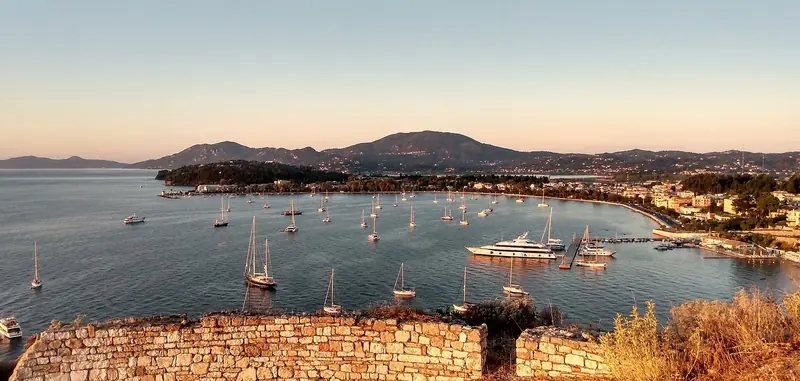
Gouvia ocupa una bahía casi cerrada en la costa este de Corfú, a unos siete kilómetros del aeropuerto internacional de Corfú y a seis u ocho kilómetros de la ciudad de Corfú según la fuente que se consulte. Las cifras que da la propia D-Marin son 1,200 amarres para embarcaciones de hasta 70 m, 500 plazas en seco, travelifts de 65 y 75 toneladas, grúas móviles de 60 y 45 toneladas y un transportador de barcos de 50 toneladas. Otros directorios sitúan los amarres en el agua en 1,235 y la eslora máxima en 80 m, y uno la deja en 60 m, de modo que el techo no está zanjado; el calado máximo de 5.5 m, en cambio, aparece igual en todas partes. Sea cual sea la cifra que se tome, este es el puerto deportivo más grande del Jónico y uno de los dos o tres mayores de Grecia, y fue la primera marina privada del país.
Aquí grande no es sinónimo de señorial. Los amarres se concentran de forma abrumadora en la franja de 10 a 15 m y la población de la marina es una flota de chárter: Sunsail mantiene una base con doce veleros y cuatro catamaranes, e Istion Yachting, Island Sailing, Sun Yachting y Bob's Yachts operan flotas sin patrón y con patrón desde dentro del puerto, junto a un nutrido contingente de barcos privados y de larga estancia. La marina está construida sobre el emplazamiento del arsenal veneciano de Gouvia, el astillero que la República de Venecia levantó durante su dominio sobre la isla, y los arcos en ruinas siguen ahí, detrás de la dársena moderna. Lo que compra un armador es capacidad, un varadero y un aeropuerto a veinte minutos, no un muelle de superyates ni un ambiente.
De quién es, y por qué desapareció la lista de precios
La marina la explota D-Marin, levantada por el grupo turco Dogus Group, vendida a CVC en 2020 por un importe que se cifró en EUR 200 millones, y comprometida el 6 de julio de 2026 para su traspaso a InfraVia Capital Partners. El Financial Times informó de una operación por encima de EUR 1,000 millones, mientras otras coberturas manejan una horquilla de EUR 1,000 a 1,500 millones; se esperaba que la transacción se cerrara a lo largo de 2026, sujeta a las autorizaciones de los reguladores. D-Marin gestiona hoy 28 marinas en nueve países con más de 14,300 amarres, de los que más de mil se describen como amarres para superyates, y doce varaderos que atienden a más de 2,500 barcos al año.
Esa historia societaria le importa al comprador de una manera muy concreta. D-Marin publicaba antes una tarifa completa de Gouvia como lista de precios descargable, por franja de eslora, temporada y tipo de contrato. Ya no lo hace. La última lista de precios de Gouvia descargable públicamente que Yotters ha podido encontrar es la edición de 2020, cuyas condiciones las plataformas de reserva de amarres siguen reproduciendo literalmente, y todo intento de dar con una sustituta de 2023, 2024, 2025 o 2026 no devolvió nada. Las tarifas actuales salen del motor de reservas de la web y la aplicación de D-Marin, o de un formulario de solicitud de amarre, y se cotizan a quien pregunta en lugar de publicarse. Eso ya es lo normal en los grupos de marinas premium, pero en un puerto cuyo negocio principal son barcos de chárter de 12 m le quita al armador pequeño lo único que antes le permitía comparar Gouvia con Léucade, Preveza o Kalamata sin descolgar el teléfono.
El puerto deportivo más grande del Jónico, un travelift de 75 toneladas, un aeropuerto a siete kilómetros, y ni un solo precio publicado.
La última tarifa publicada, y lo que todavía revela
La lista de 2020 tiene seis años y no debe leerse como precio actual, pero su estructura es la estructura que D-Marin sigue usando y sus condiciones las siguen citando literalmente las plataformas de reserva, así que merece la pena leerla como forma y no como cifra. La temporada alta iba del 1 de abril al 30 de septiembre y la baja del 1 de octubre al 31 de marzo. Todos los precios excluían el IVA, entonces del 24 por ciento. Las tarifas diarias de temporada alta eran de EUR 44 hasta 10.50 m, EUR 54 hasta 12.50 m, EUR 70 hasta 15.50 m, EUR 101 hasta 20.50 m, EUR 192 hasta 30.50 m, EUR 321 hasta 40.50 m y EUR 903 en la franja de 65.50 a 70.50 m. La temporada baja rondaba un tercio de eso: EUR 30 al día en 12.50 m. El mensual de temporada alta era de EUR 581 en 12.50 m y EUR 1,178 en 20.50 m. Los contratos anuales eran de EUR 4,727 en 12.50 m, EUR 8,964 en 20.50 m, EUR 25,672 en 40.50 m y EUR 65,139 en 70.50 m.
Las condiciones asociadas a esas cifras son la parte que no ha envejecido. Los precios corresponden al atraque de popa, y el atraque de costado se cobra un 80 por ciento más. Los catamaranes pagan un 75 por ciento más. El consumo de agua y de electricidad a 220 V está incluido, pero el agua potable y cualquier suministro a 380 V, o a 220 V por encima de 32 A, van con tarjetas de prepago. La tasa diaria corre desde la llegada hasta las 14:00 del día siguiente; quedarse más allá de las 14:00 el día de salida cuesta medio día hasta las 19:00 y un día entero después. El precio anual incluía un descuento del 17 por ciento que solo se aplicaba si se pagaba por adelantado, las tasas de amarre son pagaderas por adelantado en todos los casos, y las cantidades abonadas no se devuelven. Pregunte expresamente por cada uno de esos puntos cuando le den un presupuesto actual, porque la tarifa de titular no es la cifra que va a pagar.
El varadero, que es el activo de verdad
La explanada de Gouvia es la razón por la que muchos armadores están aquí. Quinientas plazas en tierra, dos travelifts de 65 y 75 toneladas, grúas móviles de 60 y 45 toneladas, un transportador de barcos de 50 toneladas y una grúa pluma de dos toneladas lo convierten en uno de los pocos varaderos del Jónico capaces de sacar del agua un barco serio, moverlo y guardarlo durante un invierno. La última reforma añadió 6,000 metros cuadrados más de almacenamiento en seco. Las empresas externas trabajan en la explanada bajo un sistema de acceso regulado, así que puede traer a su propia gente en lugar de quedar atado a la del puerto, aunque el mantenimiento de gran alcance no está permitido en los amarres en el agua.
La tarifa de servicios de 2020 da la forma de la facturación del varadero, de nuevo sin el IVA del 24 por ciento de entonces. Un solo movimiento de travelift o de grúa costaba EUR 223 en 12 m, EUR 298 en 15 m, EUR 933 en 20 m y EUR 1,306 por encima de 21 m, con los catamaranes un 75 por ciento más caros; el apuntalado costaba EUR 101 en 12 m y el baldeo del casco a alta presión EUR 84. Usar el travelift fuera del horario laboral, en fin de semana o en festivo añadía un 50 por ciento. Un programa de mantenimiento costaba EUR 10 por metro y mes a flote y EUR 8 por metro y mes en tierra, el uso de la rampa EUR 5 por metro para una botadura y una varada, el remolque dentro de la marina EUR 16 por metro, y el vaciado de aguas negras o de sentina EUR 1 el litro. Hay una cláusula que conviene conocer antes de planificar una invernada larga: en temporada baja, la estancia en seco que pasaba de tres meses se cobraba un 30 por ciento por encima de la tarifa mensual normal por cada mes posterior.
La aproximación, y el banco de fango que pilla a la gente
La marina se encuentra en 39 grados 38.9 minutos norte, 019 grados 51.2 minutos este, y escucha en el canal VHF 69. Bajando por el canal norte de Corfú, el islote de Lazaretto es la referencia, aproximadamente una milla al sur de la bocana de la bahía. La bahía en sí es amplia y está libre de peligros importantes desde la mar, con sondas que bajan de forma sostenida de 8 a 12 m en la parte exterior a 5 a 8 m según se acerca uno a la entrada del puerto, y el acceso a la dársena está balizado por dos parejas de boyas luminosas con 8 a 9 m en el eje del canal. El calado máximo en la marina se cifra en 5.5 m.
La trampa son las aguas someras a ambos lados de ese canal. La bahía de Gouvia se remonta en un banco de fango y los relatos de crucero son directos al respecto: aquí es fácil varar, y la instrucción es mantenerse dentro del canal balizado en lugar de recortar por una esquina. Fondear no está permitido en ningún punto de la bahía de Gouvia ni dentro del recinto portuario, salvo emergencia, de modo que no hay plan B si llega fuera de horario y sin amarre; la alternativa más próxima es Ormos Kammeno, justo al norte de la bocana, en 6 a 10 m sobre fango y alga. Los documentos que se piden a la llegada son la matrícula, el seguro, el pasaporte o documento de identidad del armador o del capitán, y el transit log o la viñeta si se tiene. La marina prohíbe además el uso de generadores, el baño, el buceo y la pesca dentro de la dársena, algo que sorprende a las tripulaciones que llegan de un crucero hecho sobre todo al ancla.
Entrar en Grecia desde Albania o desde Italia
Gouvia es una primera escala griega natural desde dos direcciones. Saranda, en Albania, queda a un salto muy corto, con el estrecho entre el extremo nordeste de Corfú y la costa albanesa midiendo entre unos 3 y 23 km de ancho, y Albania está fuera tanto de la Unión Europea como de Schengen, así que ese salto es un cruce de frontera exterior en toda regla en ambos sentidos. Desde Italia la travesía es más larga, pero Corfú es la recalada jónica evidente. En cualquiera de los dos casos el punto de despacho es el puerto principal de la ciudad de Corfú, no la marina: Noonsite es explícito en que, si viene de un país fuera de la Unión Europea o se dirige a uno, el despacho tiene que hacerse allí. Si Gouvia atiende o no a barcos de fuera de la Unión Europea se ha informado de manera contradictoria, así que cuente con el puerto de Corfú y trate como un extra todo lo que la marina pueda hacer por usted.
Para un yate con bandera de fuera de la Unión Europea el documento es el transit log, que se solicita en aduanas a la llegada, y las reglas cambiaron de forma sustancial el 24 de mayo de 2024 tras la presión de la Cruising Association. Un yate que pueda acreditar el estatuto de mercancía de la Unión, es decir, que se ha pagado el IVA europeo por él, recibe ahora un transit log ilimitado y ya no tiene que darse de alta y de baja en cada puerto controlado de Grecia. El yate que no pueda acreditarlo recibe un transit log limitado, válido 18 meses, y debe seguir dándose de alta y de baja como antes. Grecia además ha trasladado todo el trámite a un sistema digital de transit log gestionado por la agencia tributaria. Para un yate privado con bandera de la Unión Europea el documento equivalente es el cuaderno de navegación DEKPA, y su situación está realmente sin resolver: una norma de 2020 pretendía suprimirlo para los barcos de la Unión, y un informe de 2025 dice que su validez se redujo de cuatro años a uno. La guía por países de la RYA no lo menciona en absoluto. Confirme la situación vigente con la autoridad portuaria a su llegada en lugar de fiarse del consejo de la temporada pasada.
El e-TEPAI, el impuesto de navegación que nadie puede esquivar
Toda embarcación de recreo de más de 7 m que se encuentre en aguas territoriales griegas debe el TEPAI, la tasa de navegación, sea cual sea su bandera. Las cuotas mensuales, sin cambios ya en 2026, son de EUR 16 para 7.01 a 8.00 m, EUR 25 para 8.01 a 10.00 m, EUR 33 para 10.01 a 12.00 m, y EUR 8 por metro y mes para todo lo que pase de 12 m. Un yate de 20 m paga por tanto EUR 160 al mes, uno de 50 m EUR 400 al mes y uno de 64 m EUR 512. Se paga a través del sistema eTEPAI de la agencia tributaria, que emite un código de pago, y la obligación recae en el armador, en el operador o en su representante, nunca en el cliente de un chárter.
Hay dos reducciones que importan a cualquiera que base un barco en Gouvia. Las dos llevan condiciones que los folletos se dejan fuera. El propio material del eTEPAI de la agencia tributaria concede una reducción del 20 por ciento a una embarcación de más de 12 m amarrada en puertos del territorio griego durante todo el año en curso, pero únicamente cuando la cuota anual se ha pagado de una sola vez o por anticipado, lo que a su vez exige la reducción previa del 10 por ciento por liquidar el año completo en el diciembre anterior o en el enero del propio año, y el amarre debe acreditarse con un certificado de la autoridad que gestiona el puerto. Quien paga mes a mes no tiene derecho al 20 por ciento en absoluto, y la AADE lo dice con esas palabras. La reducción del 25 por ciento corresponde al uso profesional exclusivo de una embarcación de más de 12 m, y depende de la clasificación griega, no de que se fleten chárteres: la AADE afirma que un barco de recreo clasificado como profesional con arreglo a la ley de otro país no la obtiene salvo que sea además barco de recreo profesional conforme a la ley griega 4256/2014. Un yate extranjero que salga de chárter desde Gouvia con un registro comercial no griego puede quedar así fuera de la misma reducción que parecía escrita para él. Cuando se ganan las dos, son acumulables. La alternativa, y es una alternativa y no un añadido, consiste en comprar los meses que de verdad necesita, consecutivos o no, con tres días de cortesía al principio de cada mes pagado, renunciando por completo a las reducciones anuales. Las sanciones son la razón por la que la gente paga: las autoridades portuarias, tributarias o aduaneras pueden imponer una multa a tanto alzado calculada sobre la eslora, retener la documentación del barco y negarle el permiso para salir hasta que se liquiden tanto la tasa como la multa, y a los diez días la deuda pasa a la oficina tributaria para su cobro forzoso. Pagar de forma voluntaria antes de una inspección no acarrea sanción, así que un barco al que se le ha escapado un mes lo único que debe hacer es ponerse al día.
Lo que hizo la reforma, y lo que no arregló
D-Marin acaba de gastarse unos EUR 8.5 millones en Gouvia. La obra añadió 104 amarres nuevos con servicio completo para barcos de hasta 50 m, torretas inteligentes en cada amarre, pantalanes flotantes nuevos, 6,000 metros cuadrados de almacenamiento en seco adicional y una instalación solar de 100 kWp que genera del orden de 167 MWh al año, descrita como la primera generación renovable propia en una marina griega y de la que se afirma que cubre alrededor del 20 por ciento de la demanda eléctrica de explotación del puerto. La obra se apoyó en Greece 2.0, el plan nacional de recuperación y resiliencia financiado por el programa NextGenerationEU de la Unión Europea, y la finalización se anunció en mayo de 2026. Para una marina que abrió en los años noventa y que venía acusando su edad, esto es un salto real en la parte alta de la gama de amarres y es la primera vez que Gouvia dispone de plazas pensadas para barcos de 50 m.
Lo que EUR 8.5 millones repartidos entre 1,200 amarres no consiguen es renovar la marina entera. La reforma se concentra en los amarres nuevos y en las zonas comunes, y a un visitante todavía es probable que le den un amarre de tránsito bien lejos de la bocana, que los comentaristas describen como una caminata, sobre instalaciones más viejas. El dinero tampoco cambia la geografía. Esta es una bahía calurosa y cerrada: Corfú promedia una máxima de 31.2 grados en julio y de 31.5 en agosto con 8.7 mm de lluvia en todo julio, y Gouvia queda lo bastante metida en la bahía como para que el maistro del noroeste, que arrecia hacia el mediodía, alcanza fuerza 3 a 5 por la tarde y cae al ponerse el sol, no siempre llegue a los pantalanes con fuerza. Las tardes de agosto en el amarre son quietas y muy calurosas, y aquí el aire acondicionado no es un lujo.
Las debilidades, dichas con honestidad
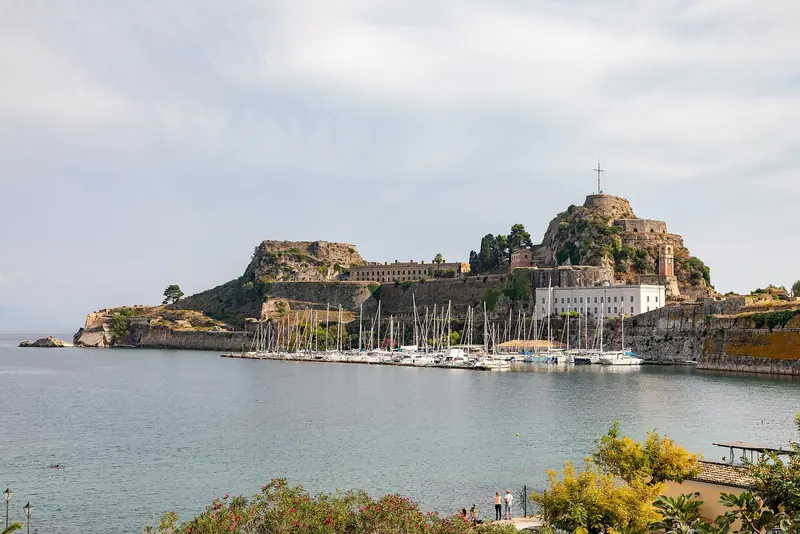
Empecemos por la cuestión del precio, porque es la mayor. No hay tarifa publicada, la última lista pública tiene seis años, y los recargos enterrados en esa lista son severos: un 80 por ciento por amarrar de costado en lugar de de popa y un 75 por ciento por un catamarán, que es un castigo enorme en una marina cuya flota de chárter está llena de catamaranes. Las cantidades abonadas no son reembolsables y el amarre se paga por adelantado. La distancia a la ciudad de Corfú es la segunda: seis a ocho kilómetros, unos veinte minutos en autobús desde la plaza Saroko o en taxi, así que el casco antiguo declarado por la UNESCO que el marketing de D-Marin describe como contiguo es en la práctica una salida decidida de antemano y no un paseo bajando por la pasarela. Los pueblos vecinos de Gouvia y Kontokali son agradables y están llenos de tabernas, pero son pueblos de veraneo, no una ciudad.
La debilidad náutica es el banco de fango somero de la bahía y la obligación de mantenerse en un canal balizado, sin opción legal de fondear y esperar si se equivoca. La debilidad de las instalaciones es la edad: fuera de los 104 amarres nuevos, esta es una marina construida hace una generación y los amarres de tránsito son los más viejos y los más alejados. La debilidad estacional es una ventana útil muy corta en los hombros de la temporada, unida a un invierno lluvioso, ya que en Corfú caen 1,111 mm de lluvia al año, con noviembre y diciembre en torno a los 190 mm cada uno. Y la laguna honesta de esta página: Yotters buscó específicamente testimonios independientes de mar de fondo o de resaca dentro de la dársena y no los encontró, ni en los relatos de crucero ni en los sitios de reseñas. Eso no prueba que no ocurra, pero nadie de los que han amarrado aquí parece quejarse de ello, y una bahía cerrada a la que se entra por un canal balizado tampoco es un candidato obvio.
En tierra, accesos y reservas
| Getting there | Corfu International Airport is about 7 km from the marina, which is a fifteen to twenty minute drive outside the summer peak. The airport handled 4,343,748 passengers in 2024, up 6.8 per cent on the year, from a single 2,373 m runway, and has over 40 airlines serving mostly the UK, Germany, Italy, Poland and France. There is no long-haul service, and traffic is heavily seasonal between April and October, so a guest arriving in November or February will connect through Athens. The airport sits only 2.7 km from Corfu Town, which is worth knowing because a taxi from the terminal to the marina goes past the old town, not through open country. Corfu is also reachable by ferry from Italy and from Igoumenitsa on the mainland, and by a short crossing from Saranda in Albania. |
|---|---|
| Arriving by sea | Call the marina on VHF channel 69 before arrival. Coming down the north Corfu channel, the islet of Lazaretto is your mark about a mile south of the bay entrance. The bay is wide and clear of major hazards from seaward and depths fall from 8 to 12 m in the outer bay to 5 to 8 m near the marina, but the basin is approached through a channel marked by two pairs of lighted buoys with 8 to 9 m in the middle, and the water either side of it shallows onto a mud bank that catches boats every season. Stay inside the buoys. Berthing is stern-to. There is no fallback anchorage: anchoring is forbidden throughout Gouvia bay and inside the marina except in an emergency, and the nearest legal alternative is Ormos Kammeno just north of the entrance in 6 to 10 m over mud and weed. Have the registration, the insurance, ID for the owner or captain and any transit log ready at the office. |
| Clearing into Greece | Gouvia is not the clearance point. If you are arriving from or leaving to a country outside the EU, which includes Albania a few miles across the strait, formalities are done at the main port in Corfu Town, and Gouvia's willingness to handle non-EU boats has been reported as inconsistent. A non-EU-flagged yacht applies to customs for a transit log on arrival. Since 24 May 2024, a yacht that can demonstrate Union goods status, meaning EU VAT paid, receives an unlimited transit log and is no longer required to check in and out at every controlled port in Greece; a yacht without that status gets a transit log valid 18 months and must continue to check in and out. Greece has moved the process onto a digital transit log platform run by the tax authority. The EU-flag equivalent, the DEKPA cruising log, is in flux and Yotters could not establish its 2026 status from two agreeing sources, so ask the port police directly. |
| How you reserve a berth, and what it costs | Berths are booked through the D-Marin website and app or through the marina's berth request form, and this is where the difficulty starts: D-Marin publishes no current tariff for Gouvia, so a rate is quoted to you rather than looked up. The last public price list is the 2020 edition, whose conditions berth-booking platforms still reproduce verbatim, and it should be read for structure and conditions rather than for price. In that list, high season ran 1 April to 30 September, all prices excluded the then 24 per cent VAT, and daily high-season rates were EUR 54 up to 12.50 m, EUR 101 up to 20.50 m, EUR 192 up to 30.50 m and EUR 903 in the 65.50 to 70.50 m band, against EUR 30 a day at 12.50 m in low season. Annual contracts were EUR 4,727 at 12.50 m and EUR 8,964 at 20.50 m, with the annual figure already including a 17 per cent discount that applied only on advance payment. When you take a current quote, get the alongside surcharge, the catamaran surcharge, the VAT treatment and the refund policy in writing at the same time. |
| Fuel, power, water and what is extra | There is a fuel station in the marina and water and electricity are supplied on a 24 hour basis. Under the last published terms, water and 220 V electricity consumption were included in the berth rate, but potable water and any 380 V supply, or 220 V drawing more than 32 A, were metered on prepaid cards, so a boat with real electrical demand pays separately for it. The upgrade completed in May 2026 fitted smart pedestals at every berth, which changes how consumption is measured and billed, and is one more reason to have the current arrangement confirmed before signing. Sewage and bilge pump-out was charged at EUR 1 a litre under the 2020 list. Generators may not be run in the marina. Greece offers no duty-free fuel to private yachts, and the standard VAT rate is 24 per cent. |
| The boatyard and the lift | This is the strongest single reason to be here. Five hundred places ashore, travel lifts of 65 and 75 tonnes, mobile cranes at 60 and 45 tonnes, a 50 tonne transporter and a 2 tonne jib crane, plus 6,000 square metres of dry storage added in the recent upgrade, make Gouvia the biggest hard standing in the Ionian. Owners may bring their own contractors in under a managed access arrangement. On the 2020 tariff a single lift or crane movement cost EUR 223 at 12 m, EUR 298 at 15 m, EUR 933 at 20 m and EUR 1,306 above 21 m, with catamarans at 75 per cent more, propping EUR 101 at 12 m and high-pressure hull cleaning EUR 84, all before VAT. Lifting outside working hours, at weekends or on holidays added 50 per cent. Watch one clause in particular: in low season, a drydock stay running beyond three months attracted 30 per cent above the normal monthly rate for every month after that. |
| The cruising tax and the annual paperwork | TEPAI, the Greek cruising fee, applies to every recreational vessel over 7 m in Greek waters regardless of flag. Monthly rates are EUR 16 for 7.01 to 8.00 m, EUR 25 for 8.01 to 10.00 m, EUR 33 for 10.01 to 12.00 m and EUR 8 per metre per month above 12 m, so EUR 160 a month for a 20 m yacht and EUR 400 for a 50 m one. It is paid through the tax authority's eTEPAI portal by the owner, operator or their representative, never by a charter guest, and you can buy individual months, consecutive or not, with a three day grace period at the start of each. The tax authority's own material sets out a 20 per cent reduction for a vessel over 12 m moored in Greek ports for the whole of the current year, but only where the yearly fee is paid as a lump sum or in advance and the earlier 10 per cent full-year reduction has been taken, and only where the mooring is certified by the port's managing authority; buying individual months rules it out, so the two options above are mutually exclusive. A further 25 per cent applies to exclusive professional use of a vessel over 12 m, and AADE confines it to ships classified as professional recreational ships under Greek Law 4256/2014, so a yacht that is commercial under another country's law does not qualify on that basis alone. Where both are earned they are cumulative. Unpaid TEPAI brings a flat fine by length, withheld documents and a refusal of permission to sail, and after ten days the debt goes to the tax office for enforcement. |
| Eating, and where the town is | The marina itself has a cluster of places rather than one destination room: OvO Piscine is a Mediterranean cafe, bar and restaurant beside the pool, Olympia Mare serves traditional Corfiot and Greek cooking on the marina, Stavento is a cafe looking out over the dock, and Blue Bar Cafe is the pool bar. There is a small supermarket and a chandlery on site, which covers a turnaround. Gouvia and Kontokali villages are within walking distance and between them hold several dozen tavernas and bars, though they are resort villages and their character in August is not the same as their character in May. Corfu Town, whose old town has been on the UNESCO World Heritage List since 2007, is six to eight kilometres away, roughly twenty minutes on the bus from Saroko Square or a short taxi, and that is where the serious eating, the Venetian fortresses and the nightlife are. |
| What is NOT published | The berth tariff, first and foremost. D-Marin publishes no current price list for Gouvia in any form, and the 2020 list still on its server is the only public document; there is no published annual rate, no published monthly rate and no published electricity or water tariff for 2026. Beyond price, the marina does not publish depths alongside its individual pontoons, only the 5.5 m maximum draught, and it does not publish an ISPS status or a superyacht service specification. The berth count and maximum LOA are both unsettled across sources, at 1,198 to 1,235 berths and 60 to 80 m. There is no published waiting list information for annual contracts, no published occupancy figure, and no published breakdown of how many of the 104 new berths are actually in the 30 to 50 m band. Yotters also found no independent reports at all of swell or wash inside the basin, which is worth saying plainly rather than leaving as an implied silence. |
Lo que cuentan armadores y tripulaciones
The transit berths are a long way from anything
Visitors report being allocated berths a considerable walk from the marina entrance and the facilities, which at a marina of 1,200 berths is a real daily cost rather than a quibble. The upgrade completed in May 2026 put smart pedestals at every berth but concentrated the new pontoons and the renewed amenities on 104 new berths, so a transient boat is still most likely to be put on the older infrastructure.
TripadvisorThe rules inside the basin are stricter than crews expect
D-Marin's published marina rules prohibit running a generator, swimming, diving, fishing and sport activities inside the marina, and large-scale maintenance at the wet berths. Anchoring is forbidden throughout Gouvia bay as well as in the marina area, except in an emergency, so a late arrival without a booking has no legal place to wait.
D-MarinThe charter fleet defines the marina's rhythm
Sunsail bases twelve sailing yachts and four catamarans here and describes it as fifteen minutes from Corfu Town; Istion Yachting, Island Sailing, Sun Yachting and Bob's Yachts all run bareboat and skippered fleets from inside the marina. A private owner should expect the same weekend handover pattern that governs every large Mediterranean charter base, and should plan arrivals and lifts around it.
Sunsail, Istion Yachting, Island SailingThe investment case has just been repriced
CVC agreed on 6 July 2026 to sell D-Marin to InfraVia Capital Partners, with the Financial Times reporting a price above EUR 1 billion against the roughly EUR 200 million CVC paid Dogus Group in 2020, and the deal expected to close during 2026 subject to approvals. For an owner signing a multi-year berth contract at a D-Marin marina, a change of control is the moment to read the term, the escalation clause and the transfer rights rather than the brochure.
Financial Times, Marina World
Lo bueno y lo que conviene vigilar
Puntos fuertes
- The biggest yard in the Ionian, attached to the berthFive hundred places ashore, travel lifts of 65 and 75 tonnes, mobile cranes of 60 and 45 tonnes, a 50 tonne transporter and 6,000 square metres of dry storage added in 2025. Very little else between Croatia and the Peloponnese can lift and hold a boat of any size.
- An airport seven kilometres awayCorfu International handled 4.34 million passengers in 2024 with over 40 airlines, and the drive to the marina is fifteen to twenty minutes. For crew changes and guest turnarounds this is one of the shortest transfers of any large Mediterranean marina.
- Real shelter and real scaleA near-landlocked bay, around 1,200 berths, 24 hour water and electricity, 24 hour security and CCTV, a fuel station and a supermarket on site. Availability at short notice is rarely the problem here that it is further west.
- EUR 8.5 million has just gone into it104 new berths for yachts up to 50 m, new floating docks, smart pedestals and a 100 kWp solar array generating around 167 MWh a year, reported as the first on-site renewable generation at a Greek marina. It is the first time Gouvia has had berths built for 50 m boats.
- A working gateway between the Adriatic and the IonianAlbania is a short hop across a strait that narrows to about 3 km, Italy is one crossing away and Igoumenitsa is on the horizon. As a first or last Greek stop with a yard, an airport and 1,200 berths behind it, the position is hard to beat.
A tener en cuenta
- No published price of any kindD-Marin has withdrawn the Gouvia tariff. The only public price list is the 2020 edition, which now survives mainly through berth-booking platforms reproducing its terms, so no current daily, monthly, annual, electricity or water rate can be checked without asking for a quote.
- The surcharges in that last list were brutalEighty per cent extra for lying alongside instead of stern-to and 75 per cent extra for a catamaran, at a marina whose charter fleet is full of catamarans, with mooring payable in advance and paid fees expressly non-refundable.
- A shallow mud bank on the way in, and nowhere to anchorThe bay shallows either side of a buoyed channel and cruising accounts agree it is easy to run aground. Anchoring is forbidden throughout Gouvia bay and in the marina except in an emergency, so a boat that arrives late without a berth has no legal option.
- Corfu Town is a trip, not a walkSix to eight kilometres, about twenty minutes on the bus from Saroko Square or a taxi. The UNESCO old town that the marketing calls adjacent is not somewhere you wander to for dinner off the passerelle, and Gouvia and Kontokali are resort villages.
- The rules inside the basin bite hardest in the heatD-Marin's own marina rules forbid running a generator, swimming, diving, fishing and sport inside the marina, and large-scale maintenance at the wet berths; anchoring is banned throughout Gouvia bay. Corfu averages a 31.2 degree maximum in July and 31.5 in August, and Gouvia sits far enough inside a closed bay that the afternoon maistro does not always reach the pontoons, so a boat that runs its air conditioning off a genset is specifically, not generally, caught.
- Ageing infrastructure outside the new pontoonsThe smart pedestals did go in at every berth, but the recent money bought 104 new berths and the shared areas out of about 1,200, and the pontoons and shore facilities beyond the new sections are unchanged. Visitors report transit berths a long walk from the entrance on the older parts of the marina, and the rest of the estate is a generation old.
Para quién es: El armador de un barco de 12 a 20 m que quiere una base jónica con servicio completo, un varadero de verdad, un aeropuerto a veinte minutos y una flota de vecinos, más que el armador que busca un amarre tranquilo y prestigioso a distancia de paseo de una ciudad.