Grand Harbour Marina (Malta)
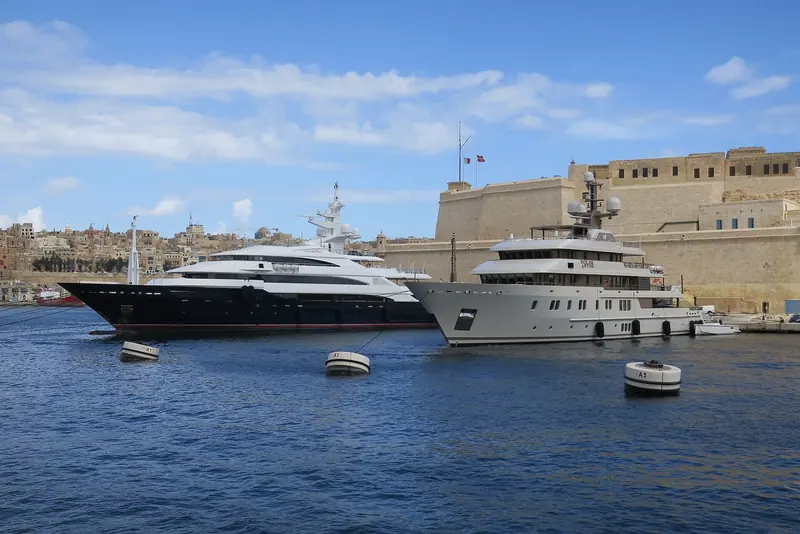
| Ubicación | Dockyard Creek, Vittoriosa Wharf, Birgu, Grand Harbour, Malta, en 35 53.2 N 014 31.2 E, frente a Valletta |
|---|---|
| Operador | Grand Harbour Marina plc, gestionada por Camper and Nicholsons Marinas Limited desde Londres, director general Gordon Vassallo |
| Propiedad | Camper and Nicholsons Marina Investments Limited posee el 86.97 por ciento, registrada en Guernsey y con registro mercantil en Hong Kong. El 13.03 por ciento cotiza en la Malta Stock Exchange desde la salida a bolsa de 2007, que la sociedad fecha en marzo y su propio análisis de 2026 en febrero |
| Título | el remanente de 97 años de una subenfiteusis de 99 años sobre la marina, adquirida en 2001 y vigente hasta alrededor de 2098 |
| Amarres | 260 según el Financial Analysis Summary 2026, esto es 232 de pantalán y 28 de superyate. El marketing habla de más de 250 con 26 amarres de superyate; el Malta Maritime Directory dice 261 |
| Esloras admitidas | desde 10 m. La eslora total máxima se publica de tres formas, 100 m, 135 m y 140 m, por la marina y por sus directorios; los amarres en concesión larga se ofrecen de 30 m a 100 m |
| Dimensiones | manga máxima 25 m y calado máximo declarado en 15 m por Dockwalk y en 10 m por Navily |
| Titularidad de los amarres de superyate: 15 de los 28 amarres grandes están en manos de terceros con acuerdos de 25 a 45 años, y alrededor del 60 por ciento del ingreso por realquiler va al titular. Las licencias nuevas se venden a 30 años | |
| Ocupación | pantalanes al 101 por ciento sobre noches de amarre en 2023, 2024 y 2025. Superyates al 64, 65 y 77 por ciento en esos mismos años, con un 72 por ciento previsto para 2026 |
| Tarifa publicada | el aviso encabezado 1 de enero de 2024, no reeditado desde entonces pese a que las cuentas registran subidas posteriores. IVA incluido: hasta 12 m EUR 83 al día, de 12.1 a 15 m EUR 116, de 15.1 a 20 m EUR 216, de 20.1 a 25 m EUR 256, por encima de 25 m presupuesto a petición. Multicascos, el doble. Agua y electricidad aparte, por contador |
| Toma de tierra | 230V 50Hz monofásica azul y 400V 50Hz trifásica roja, según BS EN 60309-2 posición 6h, conforme al anexo eléctrico de la propia marina. No se publica el amperaje |
| VHF | canal 13 para la marina. Valletta Port Control por el canal 12 a 12 millas, y de nuevo a una milla si lo piden |
| Aduana | puerto de entrada. Las llegadas desde la Unión Europea rellenan un formulario de la marina con registro y lista de tripulación; las llegadas de fuera de la Unión despachan con Aduanas e Inmigración, normalmente atendidas en el amarre. Cumplimiento ISPS completo |
| Refit | Palumbo Shipyards en la ensenada contigua, con dique seco de 160 m, dique cubierto de 140 m, travelift y varada cubierta hasta 140 m de eslora total |
| Combustible | sin surtidor. Avituallamiento entregado en camión para gasóleo y gasolina, o en gabarra. Gasóleo leído a EUR 1.21 el litro en agosto de 2026 |
| Aeropuerto | Malta International, situado por la marina a 15 minutos y a unos 7 km por carretera. Valletta queda a diez minutos de ferry desde la terminal de Cospicua, por unos EUR 3 ida y vuelta |
El Dockyard Creek, bajo Fort St Angelo
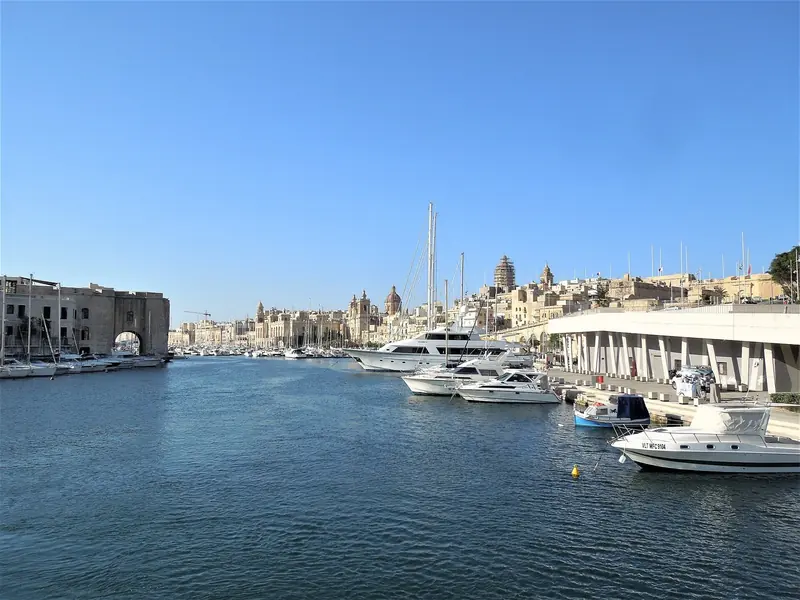
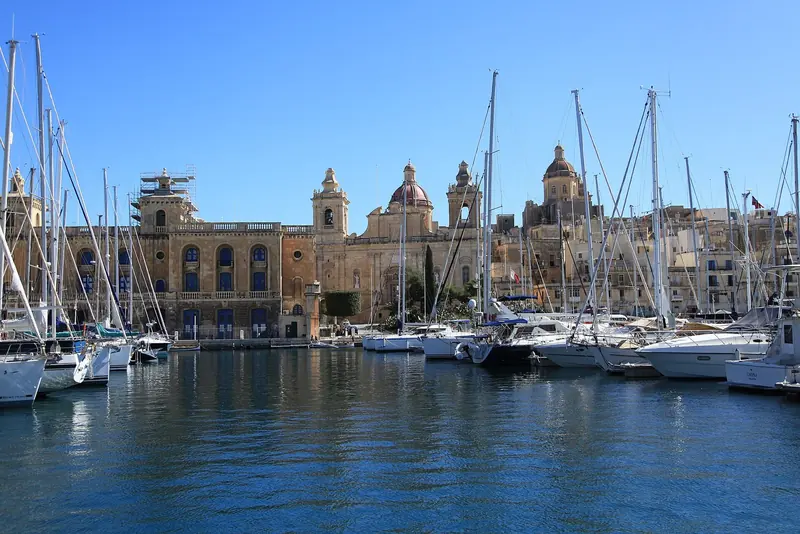
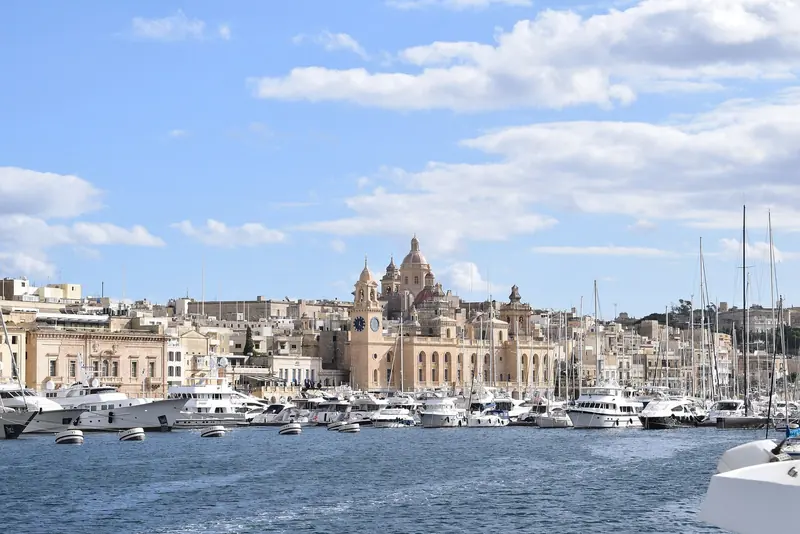
La marina se sitúa en el Dockyard Creek, la ensenada que separa las penínsulas de Vittoriosa y Senglea dentro del Grand Harbour de Malta, con fortificaciones del siglo XVI a ambos lados y los baluartes de Valletta llenando la vista al otro lado del agua. Vittoriosa, a la que los malteses llaman Birgu, fue la base de la Orden de San Juan y la capital efectiva de Malta desde 1530 hasta que Valletta tomó el relevo en 1571, y forma con Senglea y Cospicua las Tres Ciudades. El frente marítimo se reconstruyó a principios de los años dos mil: el antiguo Palacio del General de las Galeras es hoy un casino y el tesoro de la Orden alberga el Malta Maritime Museum, con la oficina de la marina, la Capitanerie, en el muelle entre ambos. Los derroteros dan de 4 a 8 metros sobre fango en la propia ensenada, con muy buen tenedero, y describen la masa de las fortificaciones como una protección en todas direcciones.
Ir a la capital es cuestión de barco, no de coche. Valletta Ferry Services opera un ferry de pasajeros desde la terminal de Cospicua, a un paseo corto desde la marina rodeando el fondo de la ensenada, hasta el waterfront de Valletta bajo los Upper Barrakka Gardens, en unos diez minutos y por unos EUR 3 ida y vuelta de día, o EUR 3.50 el trayecto sencillo y EUR 5.20 la ida y vuelta en el servicio nocturno a partir de las 19:30. Los dghajsa, los taxis acuáticos tradicionales, hacen la misma travesía a demanda, y la auxiliar de un yate la hace en cinco minutos. Por carretera el mismo trayecto se convierte en un rodeo por el fondo del puerto pasando por Marsa, y por eso las tripulaciones que viven en las Tres Ciudades casi nunca van en coche a Valletta.
La marina en cifras, y el título de 97 años
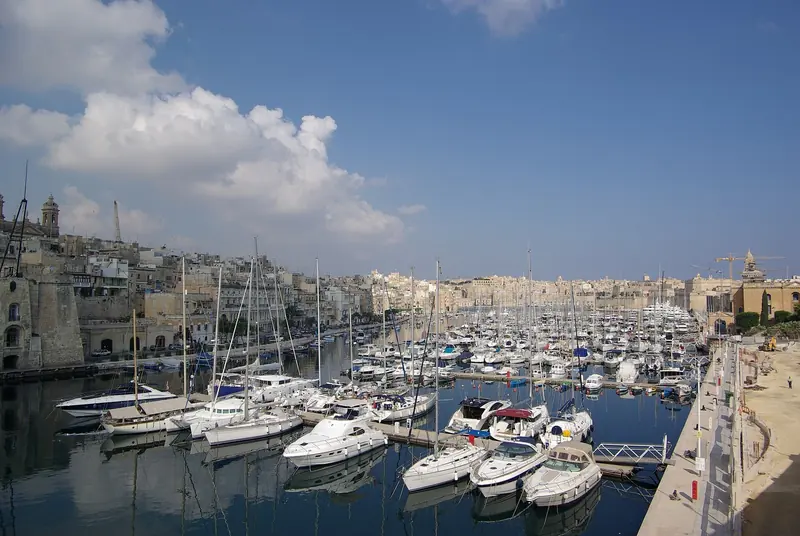
Grand Harbour Marina plc se inscribió en Malta el 31 de agosto de 2000 y adquirió en 2001 el remanente de 97 años de una subenfiteusis de 99 años sobre la marina, que llega hasta alrededor de 2098. El Financial Analysis Summary 2026 de la sociedad, elaborado por Rizzo Farrugia and Co, sitúa la marina en 260 amarres, de los cuales 232 son de pantalán y 28 para superyates; Camper and Nicholsons la comercializa como más de 250 amarres desde 10 metros con 26 puestos de superyate, y el Malta Maritime Directory da 261. Tome 260 como cifra de trabajo y tenga presente que para los amarres grandes aparecen tanto 26 como 28, según se lea el marketing o las cuentas.
El tamaño máximo se publica de tres maneras distintas, y eso importa si usted es grande. La propia página de inicio de la marina habla de 26 amarres para superyates de hasta 135 metros, mientras que el panel de datos en directo de esa misma página indica una eslora total máxima de 100 metros. Camper and Nicholsons repite ambas cifras en la misma página. Dockwalk la publica con hasta 140 metros, manga máxima de 25 metros y 15 metros de calado, mientras que Navily registra 135 metros y 10 metros de calado. La página más honesta es la de amarres en venta, que ofrece amarres en concesión larga de 30 a 100 metros. Todo lo que pase de 100 metros es en el Grand Harbour una asignación caso por caso y no un amarre que se pueda reservar, así que confírmelo con la Capitanerie antes de planificar una temporada entera sobre ello. El VHF es el canal 13 y la posición, 35 53.2 N 014 31.2 E.
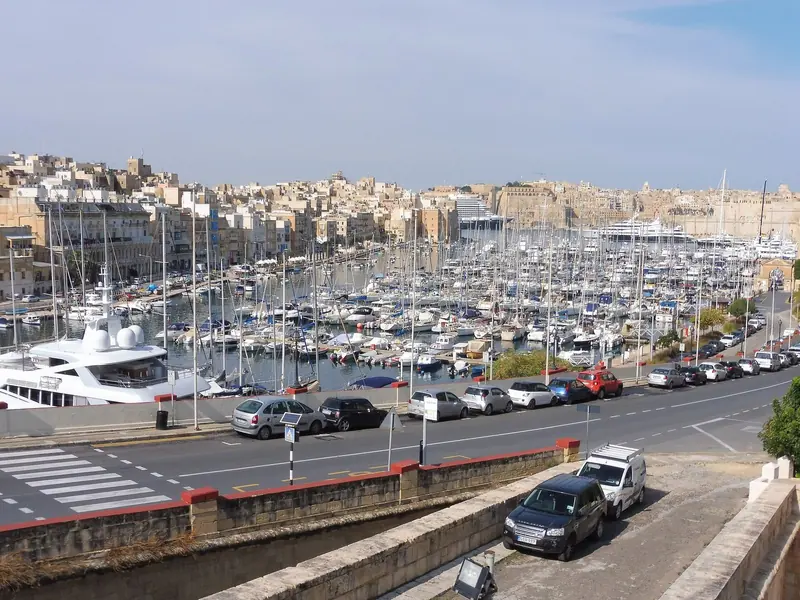
La tarifa se publica hasta 25 metros y ahí se corta en seco, que es justo todo el mercado de superyates y la línea más honesta de la página.
Los amarres de superyate, y quién los tiene en realidad
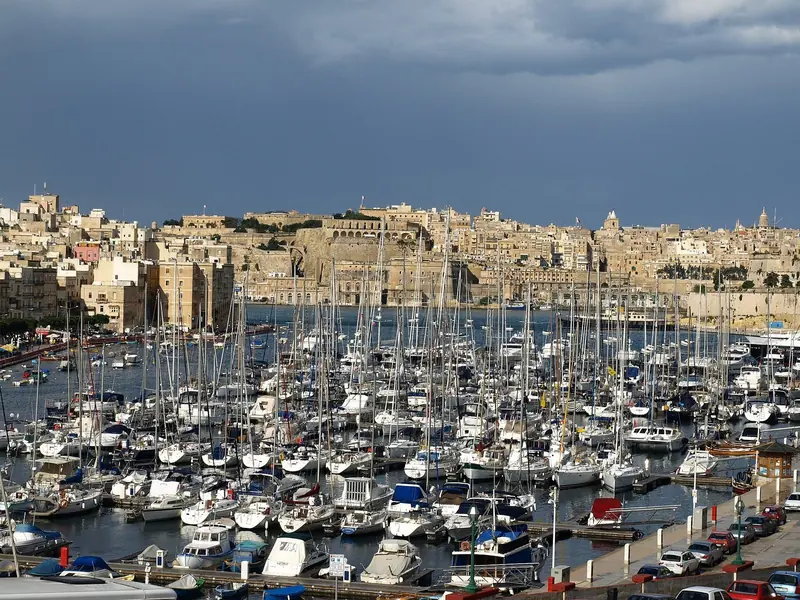
Esta es la parte de la marina que ninguna brochure explica, y cambia la forma de plantear una reserva. De los 28 amarres para superyates, 15 están cedidos a terceros mediante acuerdos de larga duración que suelen ir de 25 a 45 años, y la sociedad vende nuevas licencias de superyate de 30 a 100 metros con un plazo de 30 años. Cuando un amarre licenciado está vacío la marina lo alquila igualmente, pero alrededor del 60 por ciento de ese ingreso va al titular del amarre, y el titular paga a la marina una cuota anual de servicio que cubre los costes de las zonas comunes. De modo que si un amarre de 55 metros estará libre en agosto depende menos del inventario de la marina que de que un titular privado esté fuera en ese momento.
Las cifras de ocupación describen dos negocios distintos. La ocupación de los pantalanes, medida en noches de amarre, superó el 100 por ciento en 2023, en 2024 y en 2025, situándose en el 101 por ciento, porque la marina realquila los amarres anuales mientras sus titulares están fuera. La de superyates fue del 64 por ciento en 2023, del 65 por ciento en 2024 y del 77 por ciento en 2025, con un 72 por ciento previsto para 2026. La dirección calificó 2025 como un año récord para la actividad de superyates de la marina maltesa, y los ingresos por amarre subieron un 12 por ciento respecto a 2024, hasta EUR 3.945 millones. Los pantalanes aportaron el 53 por ciento de los ingresos por amarre y son en su mayoría contratos anuales; el negocio de superyates se compone sobre todo de visitantes de corta estancia a precios mucho más altos. Está en marcha una reconfiguración que desplaza el pantalán H, junto al Oil Wharf, hacia el puente de la Menqa, sobre agua hasta ahora sin uso, y gana cuatro amarres de 40 metros, con finalización prevista antes del cierre de 2026.
Camper and Nicholsons, y de quién es hoy la sociedad
El nombre Camper and Nicholsons se remonta a un astillero de Gosport fundado en 1782 y aquí representa, a través de Camper and Nicholsons Marinas Limited, la marca y el contrato de gestión sobre esta marina, no la propiedad del agua. La propietaria es Grand Harbour Marina plc, que en marzo de 2007 colocó el 30 por ciento de sus acciones en la Malta Stock Exchange. Camper and Nicholsons Marina Investments Limited posee el 86.97 por ciento, es decir 17,393,590 de los 20 millones de acciones, y el 13.03 por ciento está en manos del público. CNMIL está registrada en Guernsey y mantiene un registro mercantil separado en Hong Kong; en el pie de página corporativo opera como Camper and Nicholsons First Eastern. El consejo lo preside Lawrence Zammit, con Elizabeth Ka-Yee Kan como consejera delegada y Man-Yi Ho y Chi-Keung Ng como consejeros no ejecutivos, y la sede operativa del grupo está en Londres. Gordon Vassallo es el director general en el muelle.
Para un armador lo relevante es que se trata de un negocio pequeño, auditado y con información pública, cuyas cifras se pueden leer antes de firmar, algo poco habitual en las marinas. La cifra de negocio fue de EUR 5.161 millones en 2025 frente a EUR 8.231 millones en 2024, y la diferencia es una venta puntual de licencia de amarre a largo plazo por EUR 3.750 millones en 2024 que no se repitió. El EBITDA subyacente fue de EUR 2.139 millones con un margen del 41.4 por ciento y el beneficio después de impuestos de EUR 2.421 millones. Un bono no garantizado de EUR 15 millones al 4.50 por ciento, cotizado en Malta, es amortizable a la par el 23 de agosto de 2027, y el apalancamiento medido como deuda neta sobre EBITDA era de 5.0 veces al cierre de 2025, con una previsión de caída a 0.5 veces en 2026 a medida que las inversiones se conviertan en caja antes de esa amortización. La sociedad posee además el 45 por ciento de IC Cesme Marina en Turquía, que aportó EUR 2.0 millones de participación en resultados en 2025 y sigue expuesta a la inflación turca y a una lira que ese año perdió otro 13 por ciento de media frente al euro.
La bandera maltesa, y lo que cambió Bruselas
Malta es la razón por la que muchísimos yates recalan aquí. La bandera maltesa superó los 10,000 buques registrados en el primer trimestre de 2025, lo que la convierte en el mayor registro naval de Europa y el sexto del mundo, y Transport Malta lo describe como el mayor registro de superyates a escala global. Los propios datos de Transport Malta, citados en el Financial Analysis Summary 2026 de la sociedad, sitúan en más de 10,000 los buques bajo bandera en el primer trimestre de 2025. El instrumento regulatorio del extremo comercial es el Commercial Yacht Code, cuya quinta edición, el CYC 2025, sustituyó a la de 2020 el 1 de julio de 2025 y se aplica a los yates comerciales de bandera maltesa de 24 metros en adelante.
El lado fiscal cambió bajo presión, y los armadores deben saber cómo. Las antiguas directrices maltesas sobre arrendamiento de yates permitían repercutir el IVA sobre una porción presunta del alquiler, lo que producía tipos efectivos muy bajos en los yates grandes. Tras los Paradise Papers, la Comisión Europea envió cartas de emplazamiento a Chipre, Grecia y Malta el 8 de marzo de 2018, objetando entre otras cosas el tratamiento del arrendamiento con opción de compra como prestación de servicios en lugar de entrega de bienes y el tipo efectivo reducido. Malta sustituyó el planteamiento anterior por un método de uso y disfrute efectivos, y el Commissioner for Revenue publicó nuevas directrices el 12 de marzo de 2020 al amparo del artículo 59a de la Directiva del IVA. El IVA se repercute ahora sobre una proporción provisional y se ajusta después al tiempo real que el yate pasó fuera de aguas de la Unión, acreditado con datos GPS y AIS y con los diarios de a bordo del capitán. La Comisión cerró el procedimiento de infracción contra Malta el 30 de octubre de 2020. El efecto práctico es este: la estructura sigue funcionando, pero se ha convertido en un ejercicio de prueba, y la carga documental recae en el arrendatario y en el capitán en lugar de en una fórmula.
Llegar, despachar, y las normas que se firman
La aproximación es de las mejores del Mediterráneo y no tiene complicación. Identifique el dique principal con el faro de St Elmo en su extremo oriental y déjelo por estribor, deje por babor el dique corto frente a Fort Ricasoli y después monte Fort St Angelo por babor para entrar en el canal final de aproximación, balizado con pequeñas boyas rojas y verdes. Llame a la marina por el VHF 13 para las instrucciones de atraque. Los yates deben además contactar con Valletta Port Control por el canal 12 a 12 millas y pueden recibir la petición de volver a llamar a una milla de la bocana según los movimientos comerciales, que son muchos: el Grand Harbour es un puerto de cruceros y de carga en plena actividad, con tráfico intenso de abril a octubre. El atraque es a la mediterránea con muertos, con fingers hasta 15 metros, y el equipo presta asistencia al atraque las 24 horas. Malta está en la Unión Europea y en Schengen, así que una llegada intracomunitaria rellena un formulario en la Capitanerie con los datos de registro y la lista de tripulación, mientras que un yate procedente de fuera de la Unión despacha con Aduanas e Inmigración, y los funcionarios suelen acudir al barco en la propia marina. Quien deje el yate y salga en avión necesita el sello de entrada en el pasaporte.
Lea el reglamento de la marina antes de firmar, porque varias cláusulas muerden. Es obligatorio un seguro a todo riesgo que incluya responsabilidad civil frente a terceros, tripulación e invitados y cobertura de retirada de restos, y la póliza debe presentarse a la marina, igual que el documento de registro. El contrato de amarre no otorga título alguno ni derecho exclusivo sobre un amarre concreto, y la marina puede mover su barco. Un yate atracado sin contrato válido paga cinco veces la tarifa diaria hasta que se marche o firme. Vivir a bordo requiere consentimiento por escrito, y se le considera residente si promedia más de tres noches por semana a lo largo de doce semanas. El barco debe salir de la marina al menos dos veces durante la vigencia del contrato y debe poder navegar por sus propios medios en todo momento. El retraso en el pago devenga un 8 por ciento de interés anual, no se devuelve dinero bajo ninguna circunstancia, y la toma de corriente es de 230V monofásica azul o 400V trifásica roja según BS EN 60309-2, con transformador de aislamiento muy recomendable. Y la cláusula que más dice sobre el tiempo: todo barco atracado en la Menqa debe ser sacado de la marina por su propietario cuando se anuncie mal tiempo, y si no se localiza al propietario, la marina lo moverá por cuenta de este.
Lo que cuesta, y dónde se detiene exactamente la tarifa
Grand Harbour Marina es una de las pocas marinas de superyates del Mediterráneo que publica tarifa, y su aviso, en vigor desde el 1 de enero de 2024, dice lo siguiente, IVA incluido. Hasta 12 metros, EUR 83 al día. De 12.1 a 15 metros, EUR 116. De 15.1 a 20 metros, EUR 216. De 20.1 a 25 metros, EUR 256. Por encima de 25 metros, presupuesto a petición. La eslora total se mide incluyendo bauprés, pescantes, púlpito de proa y de popa y cualquier prolongación a proa y a popa, de modo que un casco de 19.6 metros con bauprés paga en la banda de 20.1 a 25 metros. Los multicascos pagan el doble de la tarifa aplicable. Las estancias reservadas por adelantado de más de seis días tienen descuento. El agua y la electricidad se cobran aparte por consumo medido y no hay precio unitario publicado para ninguna de las dos. Lea ese aviso como un suelo y no como el precio. Está encabezado como tarifas a partir del 1 de enero de 2024 y no se ha vuelto a emitir desde entonces, mientras que el propio Financial Analysis Summary 2026 de la sociedad registra EUR 0.2 millones de mayores ingresos por contratos anuales en el ejercicio hasta 2025, debidos sobre todo a subidas de tarifa, y prevé de nuevo mayores ingresos por tarifas anuales contractuales más altas. El reglamento de la marina se reserva además el derecho a modificar las tarifas a su sola discreción. El aviso publicado es, por tanto, el de enero de 2024, y es muy posible que vaya por detrás de lo que a usted le coticen.
Por encima de 25 metros, que es todo el negocio de superyates, no se publica nada, y esa única línea es lo más útil de la tarifa. Para el mercado anual la marina tampoco publica nada. Dos guías de mercado maltesas independientes dan cifras indicativas que coinciden a grandes rasgos: una sitúa un contrato anual para un yate de 15 metros entre EUR 8,000 y EUR 12,000, con una tarifa diaria de temporada de EUR 150 a EUR 250 para un yate de 20 metros y amarres de superyate negociados individualmente; la otra coloca a Grand Harbour Marina entre EUR 600 y EUR 1,100 por metro de eslora total y año para 2026, la más cara de la isla después de Portomaso. Trate ambas como indicativas y no como comparables. Los amarres de superyate a largo plazo, de 30 a 100 metros, se venden con licencias de 30 años más una cuota anual de servicio, precio a consultar. La estimación de la comunidad de Navily para la marina, consultada en agosto de 2026, ronda los EUR 119 por noche, coherente con la banda publicada de 12.1 a 15 metros. La misma fuente registraba el gasóleo a EUR 1.21 el litro.
Un astillero al lado, combustible que llega por carretera y una regata de 606 millas
Palumbo Shipyards trabaja en la ensenada contigua, una de las razones por las que un yate inverna aquí y no en una marina que no tiene nada detrás. La marina relaciona al lado un dique seco de 160 metros y un dique cubierto de 140 metros con servicios en tierra, talleres, almacenaje y oficinas para tripulaciones, además de travelift y varada cubierta hasta 140 metros de eslora total para el extremo menor. Malta cuenta con agentes y proveedores de la mayoría de los fabricantes náuticos, y la marina mantiene una lista de especialistas eléctricos y electrónicos, ingenieros de motores e hidráulica, talleres de soldadura y mecanizado y oficios de refit en acero, fibra y madera. Lo que la marina no tiene es surtidor. El avituallamiento de combustible es un servicio a domicilio: gasóleo y gasolina en camión para los yates y en gabarra para los volúmenes grandes. Transport Malta registra 17 gabarras de bunkering operando en aguas maltesas, con suministro por tubería dentro del Grand Harbour en Flagstone Wharf, en el Deep Water Quay y en los duques de alba de Ras Hanzir, además de seis zonas designadas de bunkering frente a las islas. Planifique un repostaje grande como una entrega programada y no como una parada de salida.
La fecha fija es la Rolex Middle Sea Race, que el Royal Malta Yacht Club organiza desde 1968 sobre unas 606 millas náuticas en sentido antihorario con salida desde el Grand Harbour: afuera pasando Capo Passero, por el estrecho de Mesina, vuelta a Stromboli, bajando por Favignana, Pantelleria y Lampedusa y regreso por Comino. La 47a edición sale el sábado 17 de octubre de 2026. La salida se da en el propio Grand Harbour, en el agua inmediatamente delante de la marina y bajo los baluartes de Valletta, que es el mejor punto de observación que puede ofrecer un amarre en el Mediterráneo para un espectáculo de ese tipo. Conviene tener claro qué es y qué no es la marina: el club organizador está en Ta' Xbiex, en el Marsamxett Harbour al otro lado de Valletta, y allí tiene su base la mayor parte de la flota de regatas, de manera que Grand Harbour Marina es la tribuna y no el paddock. El verdadero negocio de la marina es el invierno, y durante los meses fríos mantiene un Captain and Crew Club con yoga, karting, barbacoas y un programa de tarifas preferentes en restaurantes y bares de toda la isla.
Las debilidades, dichas con honestidad
El viento con el que hay que contar es el grigal, el gregale, un nordeste fuerte y frío que se instala cuando una borrasca pasa al sur de Malta. Es el enemigo histórico del Grand Harbour, la razón misma de que existan los diques, y sigue causando daños en el lado de Kalkara cada pocos inviernos. El Dockyard Creek está muy adentro y muy bien resguardado, pero la protección no es uniforme: el propio reglamento de la marina exige que cualquier barco en la Menqa, el fondo somero junto al puente, sea sacado de la marina cuando se anuncie mal tiempo, y una ficha náutica maltesa advierte de que los levantes frescos hacen incómoda la bocana aunque en los amarres esté todo tranquilo. Si le ofrecen un amarre en la Menqa para el invierno, esa cláusula es el precio, y es justo ahí donde se están creando los cuatro amarres nuevos de 40 metros.
Los otros tres problemas son la disponibilidad, la constancia del servicio y la travesía. Los pantalanes llevan tres años seguidos por encima del 100 por ciento de ocupación, así que un contrato anual por debajo de 25 metros es realmente difícil de conseguir, y una guía de mercado maltesa registra listas de espera de uno a cinco años en la mayoría de las marinas de la isla, aunque no atribuye ninguna lista de espera al extremo de superyates del Grand Harbour, algo que el 77 por ciento de ocupación respalda. En el extremo pequeño la calidad del servicio no es constante: varios navegantes de paso en junio y julio de 2026 describieron una oficina lenta en responder a una reserva de una noche, una llegada en la que nadie les guio hasta el amarre y un nuevo sistema digital de contadores que les impidió tomar el agua y la electricidad que ya habían pagado por internet, sin que nadie sobre el terreno pudiera emitir el código. Uno de ellos, navegante habitual del Mediterráneo, la calificó como la peor marina que había usado en el Mediterráneo. Otros, en esos mismos meses, le dieron cuatro y cinco sobre cinco por personal, ubicación y ambiente, de modo que el retrato es el de una marina que atiende bien a los superyates y a los clientes de larga estancia y de forma desigual a los barcos pequeños de paso. Por último, la marina sitúa el aeropuerto Malta International a 15 minutos y a unos 7 kilómetros por carretera, con la caseta de tarifas fijas de la parada de taxis marcando Valletta en unos EUR 17; pero usted está en el lado del Grand Harbour opuesto a la capital y todo lo que hay en tierra se alcanza por carretera o en ferry. A la ciudad, desde aquí, no se llega andando.
En tierra, accesos y reservas
| Getting there | Malta International Airport is about 7 kilometres by road and the marina quotes 15 minutes. There are facilities for chartered and private jets. Government white taxis work on fixed zone fares from the booth in the Welcomers' hall rather than a meter, and the published examples run from about EUR 12 for the nearest destinations to about EUR 37 for the far end of the island, with Valletta at about EUR 17 for a 20 minute run. Bolt and eCabs also operate and visiting crews recommend them for exploring. To reach Valletta itself, the ferry from the Cospicua terminal, a short walk from the marina, crosses in about ten minutes for around EUR 3 return by day, EUR 3.50 single or EUR 5.20 return on the night service from 19:30, and the traditional dghajsa water taxis do the same crossing on demand. A yacht's tender does it in five minutes. |
|---|---|
| Arriving by sea, and clearing in | Leave the main breakwater with St Elmo lighthouse at its eastern end to starboard, leave the short Fort Ricasoli breakwater to port, and round Fort St Angelo to port into the final approach channel, which is marked with small red and green buoys. Call the marina on VHF 13. Contact Valletta Port Control on channel 12 at 12 miles out and expect to be asked to call again a mile off depending on commercial traffic, of which there is a great deal from April to October. Berthing assistance runs 24 hours; the harbour master's office keeps 08:00 to 20:00 seven days. Mediterranean mooring on lazy lines, with finger pontoons for yachts to 15 metres. Malta is in the EU and Schengen: an EU arrival completes a form at the Capitanerie with vessel registration and a crew list, and a non-EU arrival clears Customs and Immigration, with officials normally attending the yacht in the marina. Anyone leaving the boat here and flying home must have a passport stamp on arrival. |
| Reserving a berth, and how far ahead | Book through the marina office on +356 21 800 700 or the book-a-berth form; the application form on its own does not reserve or guarantee anything, and the marina states so in its rules. Superyacht space is realistically available at short notice outside peak weeks, with large-berth occupancy at 77 per cent in 2025 and 72 per cent forecast for 2026, and one Maltese market guide records no waiting list at the superyacht end. Under 25 metres it is the opposite: pontoon occupancy has exceeded 100 per cent every year since 2023 because the marina re-lets annual berths whenever their holders are away, so an annual contract needs patience. The transient booking process itself drew complaints in mid-2026 for slow responses, so confirm by telephone as well as email. |
| What a berth costs | The published tariff is still the notice headed 1 January 2024, which has not been reissued since even though the company's own accounts record tariff increases in the years after it, so treat it as a floor rather than as the current price. VAT inclusive, it is EUR 83 a day up to 12 metres, EUR 116 from 12.1 to 15 metres, EUR 216 from 15.1 to 20 metres and EUR 256 from 20.1 to 25 metres. Over 25 metres is quoted on request and nothing is published. LOA includes bowsprit, davits, pulpits, pushpits and any extension fore and aft, so measure honestly. Multihulls pay double. Pre-booked stays over six days attract a rebate. Water and electricity are extra on metered consumption, invoiced separately, with no published unit rate, and the marina may cut supply if a bill is overdue. Late payment carries 8 per cent annual interest and no refunds are given in any circumstances. For the annual market, one Maltese guide indicates EUR 8,000 to EUR 12,000 a year for a 15 metre yacht and EUR 150 to EUR 250 a day in season for a 20 metre yacht, and another indicates EUR 600 to EUR 1,100 per metre a year for 2026; neither is the marina's own number. Long-term superyacht berths of 30 to 100 metres are sold on 30-year licences with an annual service fee, price on application. |
| Fuel, power, water and waste | There is no fuel dock. Bunkering is a delivered service, diesel and unleaded by truck for yacht quantities and by barge for larger volumes, so give notice rather than turning up. Malta itself is a serious bunkering jurisdiction with 17 bunker barges in operation, pipeline supply inside Grand Harbour at Flagstone Wharf, the Deep Water Quay and the Ras Hanzir dolphins, and six designated offshore bunkering areas, so volume is not the constraint, scheduling is. Diesel read at EUR 1.21 a litre in August 2026. Shore power is 230V 50Hz single phase on a blue socket or 400V 50Hz three phase on a red socket to BS EN 60309-2, with 125 amp three phase reported on the larger berths and up to 400V across the marina; an isolating transformer is strongly advised against electrolysis. Grey and black water discharge, refuse and waste oil disposal are all handled on site, there is a laundrette, and electric car charging bays are provided. |
| The rules you are signing | Comprehensive insurance including third party, crew and guest liability and wreck removal cover is compulsory, and both the policy and the registration document must be lodged with the marina and renewed with it. The contract grants no title and no exclusive right to your berth, and the marina may move the yacht. Berthing without a valid contract costs five times the daily rate per day. Liveaboard use needs written consent and you are treated as resident if you average more than three nights a week over twelve weeks. Commercial use, including charter embarkation, needs consent; a private sale of one vessel per six month period is allowed with the owner present. The yacht must leave the marina at least twice during the term and must always be able to move under her own power. No fishing, diving, swimming or barbecues. Contractors need prior consent and only light work is normally permitted. And any vessel in the Menqa must be removed from the marina by the owner when bad weather is forecast. |
| Eating, drinking and what is ashore | The Vittoriosa Waterfront directly in front of the marina is a line of restaurants and cocktail bars in restored 18th century warehouses, open late, with more in the streets of Birgu behind. The former Palace of the General of the Galleys on the same wharf is a casino, and the Order's old treasury is the Malta Maritime Museum. Fort St Angelo, the Inquisitor's Palace and the walled streets of Birgu are a walk from the pontoon, and Senglea and Cospicua are the next two promontories. There is a weekly market and several chandleries. The marina runs a Captain and Crew Club through the winter with yoga, go-karting and barbecues and a preferential-rate scheme at food and drink venues around the island for card-holding crew. For a bigger night, Valletta is the ten-minute ferry, and the night service runs from 19:30. |
| The fixed dates | The Rolex Middle Sea Race is the one that matters: about 606 nautical miles anticlockwise from Grand Harbour past Capo Passero, through the Strait of Messina, round Stromboli and back by Favignana, Pantelleria, Lampedusa and Comino, organised by the Royal Malta Yacht Club and first run in 1968. The 47th edition starts on Saturday 17 October 2026. The start line is laid in Grand Harbour immediately off the marina under the Valletta bastions, so a berth here is the best seat in the harbour, but the club and most of the fleet are based at Ta' Xbiex in Marsamxett Harbour on the other side of Valletta. The rest of the marina's calendar is winter-weighted: Malta's business is yachts laid up from October to April, and the crew programme runs through those months. |
| What is NOT published | Every berthing rate above 25 metres LOA, which is the entire superyacht market the marina is built around; the tariff notice says only quoted upon request. No unit rate for the metered water or electricity. No price for a 30-year superyacht berth licence, and no annual service fee figure for berth holders. No occupancy or availability by berth size. The maximum LOA is published three different ways by the marina and its own directories, at 100, 135 and 140 metres, and the maximum draught two ways, at 10 and 15 metres. The ultimate beneficial ownership above Camper and Nicholsons Marina Investments Limited is not disclosed on any of the company's own investor pages. Get the rate, the maximum dimensions and the utility charges in writing from the Capitanerie before you commit. |
Lo que cuentan armadores y tripulaciones
The utilities went digital and the codes did not follow
Two separate cruising visitors reported the same failure in mid-2026. Luis, on a 14.9 metre sailing yacht in June 2026, was told the marina had switched to a digital system for water and electricity and that staff could not issue him a code; nobody took responsibility and he abandoned the reservation and left. Stefan, on a 14.35 metre sailing yacht in July 2026, had paid for water and power in advance through the marina's own online portal and still could not draw either, because the registration data had been entered wrongly.
NavilyA one-night transient booking is handled poorly
Stefan, on AMAZING GRACE in July 2026, wrote that the office was unresponsive to a one-night booking and that on arrival nobody met him in a tender; the berth number given over VHF was of no use to a first-time visitor and he found the berth only because a staff member happened to be behind another boat. He rated the marina 1.6 out of 5 and called it the worst he had experienced in the Mediterranean. This is the single harshest independent report Yotters found on the marina and it is worth weighing against the volume of positive ones.
NavilyThe same months produced five-star reports
Marco, on a 16.5 metre sailing yacht in July 2026, rated it 5 out of 5 for professional staff and a location that combines quiet with a city nearby. Tata Martino and Freire, on a 14.75 metre yacht the same month, called it the best stop on the way to Valletta, praised the staff and the ease of reaching buses, ferries and local boats, and recommended Bolt for getting around the island. Across 50 ratings the marina averages 4.5 for hospitality, 4.5 for cleanliness, 4.4 for services and 4.7 for tourism.
NavilyCaptains rate it as a winter base for the crew programme, not the berth
Captain Dean Pilatti of the 60 metre motor yacht Arience, in a testimonial published by the marina, singled out the Crew and Captains Programme, which gives preferential rates at food and beverage venues in and around Malta, and described the team's knowledge and support as what makes a winter break work. This is the marina's own published quote rather than an independent report and should be read as such, but it identifies the same thing the accounts do: the winter crew trade is the core business.
Grand Harbour MarinaThe accounts say the superyacht end had its best year in 2025
The 2026 Financial Analysis Summary records 2025 as a record year for superyacht activity at the Maltese marina, with superyacht occupancy up from 65 to 77 per cent, berthing income up 12 per cent to EUR 3.945 million, ancillary revenue up to EUR 1.216 million, and EBITDA of EUR 2.139 million. It also records that no long-term berth licence sale took place in 2025 and none is budgeted for 2026, which is why the headline revenue fell.
Rizzo, Farrugia and Co (Stockbrokers) Ltd, for Grand Harbour Marina plc
Lo bueno y lo que conviene vigilar
Puntos fuertes
- A tariff that actually existsPublished day rates by LOA band from EUR 83 to EUR 256 including VAT, with the measurement convention, the multihull loading and the long-stay rebate all stated in writing. Almost no superyacht marina in the Mediterranean does this. The caveat is that the notice has not been reissued since January 2024 while the accounts record increases since, so it sets a floor rather than a price.
- A shipyard in the next creekPalumbo offers a 160 metre graving dock and a 140 metre covered dock alongside travel lift and covered hard standing to 140 metres LOA, so a winter lay-up and a refit happen in the same harbour.
- The flag and the tax structure are on the doorstepMalta is the largest ship register in Europe and the sixth largest in the world, with more than 10,000 vessels under the flag by the first quarter of 2025, and its yacht leasing VAT regime survived the EU infringement procedure, which was formally closed on 30 October 2020.
- Shelter and a serious approachDockyard Creek lies deep inside Grand Harbour with 4 to 8 metres over mud and very good holding, enclosed by 16th century fortifications, and the marina is ISPS compliant with 24-hour berthing assistance and a documented approach.
- You can read the owner's accounts before you signGrand Harbour Marina plc is listed on the Malta Stock Exchange and publishes audited statements and an annual Financial Analysis Summary, including occupancy by berth type, revenue mix and the state of its EUR 15 million bond.
A tener en cuenta
- Nothing at all is published above 25 metresThe tariff notice stops at 25 metres LOA with the words quoted upon request, so the entire superyacht proposition, the 30-year licence price and the annual service fee are negotiated blind.
- The grigal, and the Menqa clauseA strong northeasterly is Grand Harbour's historic enemy, fresh easterlies make the entrance uncomfortable, and the marina's own rules oblige any vessel in the Menqa to be taken out of the marina when bad weather is forecast, at the owner's expense if he cannot be reached.
- The pontoons are more than fullPontoon occupancy has exceeded 100 per cent on berth nights every year from 2023 to 2025, so an annual contract under 25 metres is hard to obtain, and Maltese marinas generally carry waiting lists of one to five years.
- Service is inconsistent for transientsTwo independent visitors in June and July 2026 could not draw water or electricity they had paid for because of a new digital system, and one reported no berthing assistance on arrival and rated it the worst marina he had used in the Mediterranean.
- No fuel dockFuel is a delivered service by truck for yacht quantities or by barge for larger volumes, so bunkering has to be scheduled in advance rather than taken alongside on the way out.
- More than half the big berths are not the marina's to sellFifteen of the 28 superyacht berths are licensed to third parties on 25 to 45 year terms, with about 60 per cent of any re-let income going to the holder, so large-berth availability turns on private owners' movements rather than the marina's inventory.
Para quién es: Un armador que quiere una base de invernada bien regulada, auditada y conforme al ISPS, con un astillero grande al lado y la bandera maltesa detrás, y que no busca un amarre en el que meterse el próximo agosto sin avisar.