ONE15 Marina Sentosa Cove (Singapore)
| Ubicación | Sentosa Cove, Singapur, a 1 14,50 N, 103 50,40 E, en el canal 77 de VHF |
|---|---|
| Operador | en funcionamiento desde 2007, parte del grupo SUTL |
| Amarres | 270 amarres en agua, incluidos unos 32 de megayate, más 60 amarres en seco |
| Eslora máxima | 220 pies, unos 67 metros, con un calado máximo publicado de 4,5 metros |
| Acreditación | construida según el estándar Platinum Gold Anchor y acreditada como Superyacht Ready en 2022 |
| Premios | International Marina of the Year en 2022 y 2023, y Best Asian Marina en siete ocasiones |
| Corriente en tierra | contada, hasta 500 amperios trifásica, con agua potable contada y sistema de bombeo de residuos |
| Despacho | la única marina privada de Singapur con instalación de aduana, inmigración y sanidad exterior en el recinto |
| Tarifa de amarre de 2026 por encima de 120 pies: SGD 8,83 por pie y día para no socios y SGD 7,63 para socios, GST incluido | |
| Tarifa mensual de 2026 por encima de 120 pies: SGD 190,31 por pie para socios, o SGD 158,60 por pie con compromiso anual | |
| Combustible | gasolina y gasóleo a la venta a diario de 8 a 23 horas, con descuentos por volumen de hasta el 20 por ciento por encima de 5.000 litros |
| En tierra | 26 habitaciones de hotel, restaurantes, sala de socios, piscina, gimnasio, pistas de tenis y de pickleball, y lanzadera a VivoCity |
| Frequency and voltage | the marina publishes up to three-phase 500 A and states neither, checked 28 July 2026. Singapore runs 50 Hz at 230 V single phase and 400 V three phase |
| What 500 A three phase at 400 V amounts to: about 346 kVA, which is a genuine large-yacht supply and enough to carry a 60 m hull alongside without generators in equatorial heat | |
| How many of the roughly 32 mega yacht berths take over 50 m, against the 67 m ceiling, is not published, checked 28 July 2026 | |
| The published maximum draught of 4.5 m is the binding constraint and applies against a 220 foot maximum length. A 67 m yacht drawing more than 4.5 m does not fit whatever its length | |
| There is no superyacht travel lift on site. The marina's 60 dry berths are for small craft, so any haul-out means leaving Singapore | |
| Hull fouling intervals in equatorial water are not published by the marina and no diving or antifouling schedule is quoted, checked 28 July 2026 | |
Un club náutico con una marina incorporada
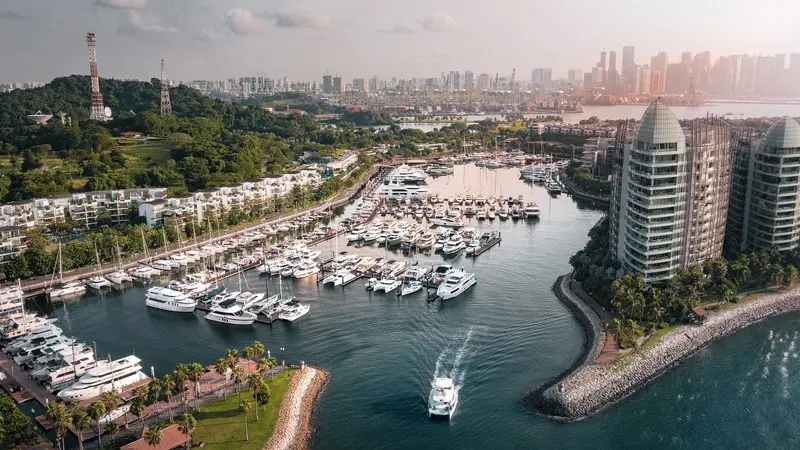
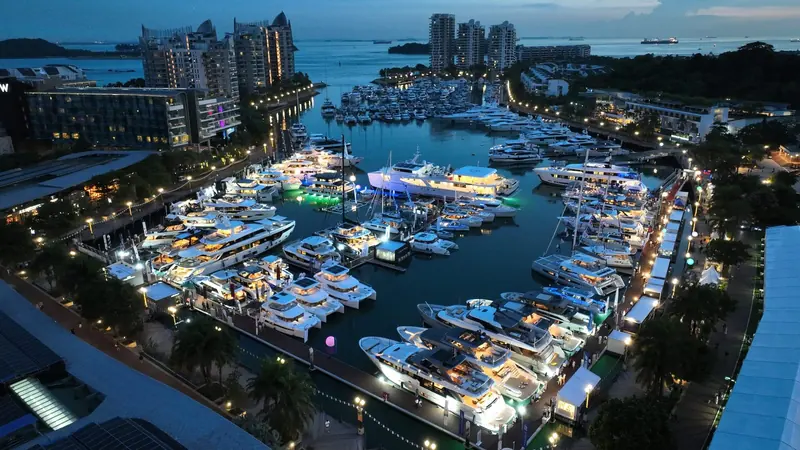
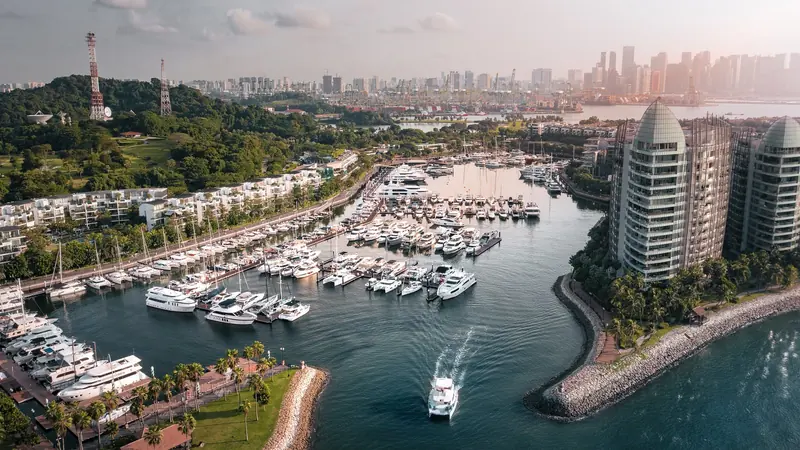
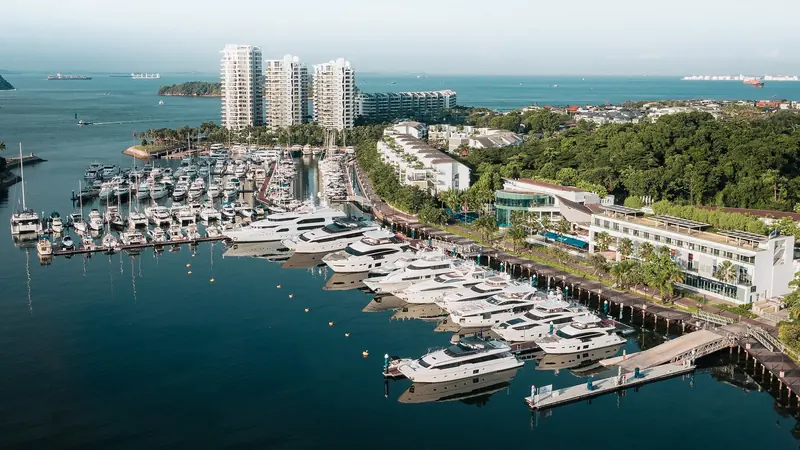
ONE15 abrió en 2007 dentro de Sentosa Cove, el barrio residencial cerrado frente al agua del extremo este de la isla de Sentosa. Es un club privado tanto como una marina, con 270 amarres en agua, de los que unos 32 están dimensionados para megayates, 60 amarres en seco, una casa club, 26 habitaciones de hotel, restaurantes, piscina y pistas de tenis. Los titulares de amarre y los socios comparten las mismas instalaciones.
Los estándares están comprobados por terceros, cosa que vale algo en una región donde la calidad de las marinas varía muchísimo. La marina se construyó según el estándar Platinum Gold Anchor que fijan la Yacht Harbour Association y la Marina Industries Association, obtuvo la acreditación Superyacht Ready en 2022, y ha sido nombrada International Marina of the Year dos veces y Best Asian Marina siete. La eslora máxima son 220 pies, unos 67 metros, con un calado máximo publicado de 4,5 metros.
Aproximarse por el agua con más tráfico del mundo
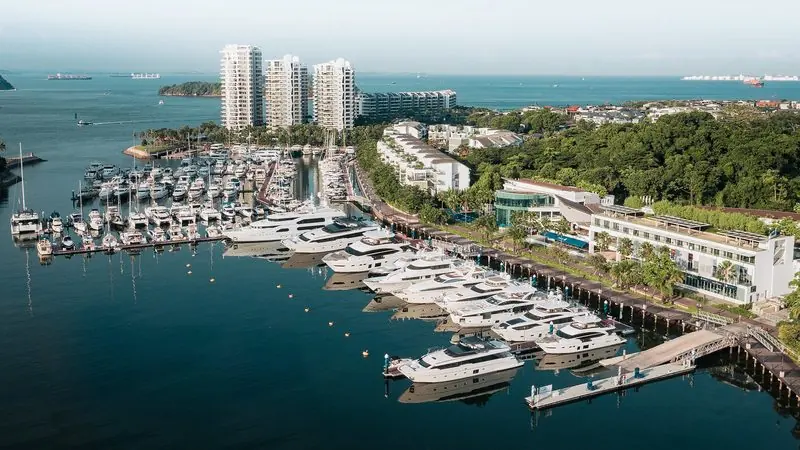
Llegar a Sentosa Cove implica cruzar o bordear el estrecho de Singapur, una de las rutas de navegación más transitadas del planeta, con fondeaderos llenos de petroleros y portacontenedores y un flujo continuo de tráfico dentro del dispositivo de separación. No es agua difícil, y exige una guardia como es debido y entender bien dónde pueden estar los buques comerciales. La marina trabaja en el canal 77 de VHF.
Una vez dentro, la dársena es cerrada, tranquila y está completamente abrigada. Singapur está casi sobre el ecuador, así que no hay temporada de tifones ni de ciclones en ningún momento del año, lo que supone una ventaja estructural real frente a Hong Kong, Phuket o cualquier punto del Pacífico Sur. Lo que sí trae el clima es calor y humedad constantes en torno a los treinta grados, dos monzones y esas líneas de turbonada repentinas que llegan de Sumatra antes del amanecer.
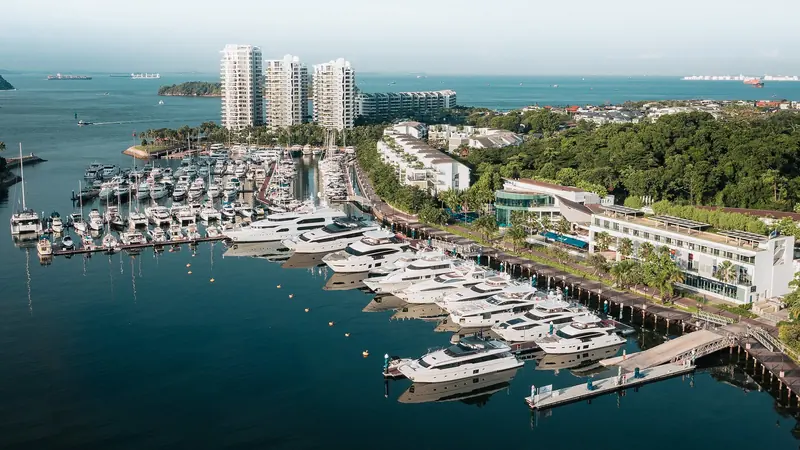
En el ecuador no hay temporada de tormentas, y esa es una forma de seguridad que no puede ofrecer ningún amarre mediterráneo ni caribeño.
Despacho en el propio muelle
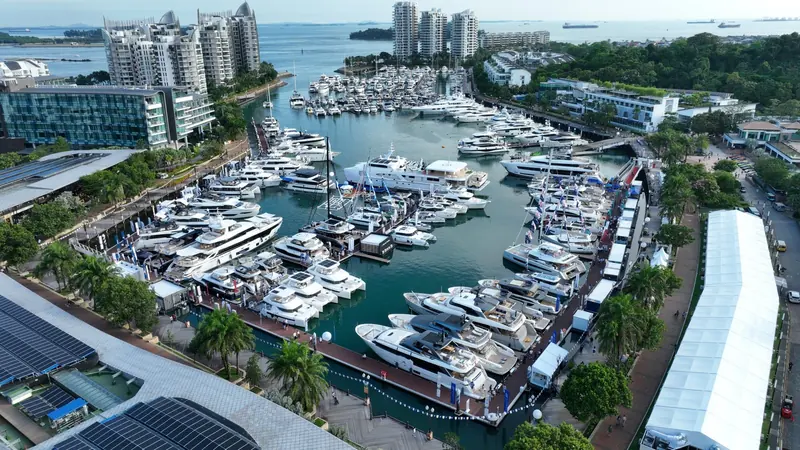
La marina tiene en el recinto una instalación de aduana, inmigración y sanidad exterior y es la única marina privada de Singapur que la tiene. Para un armador que llega de Indonesia o de Malasia eso elimina la obligación de despachar en otro sitio y después reposicionarse, cosa que en esta parte del mundo puede llevarse un día. Singapur es una jurisdicción eficiente y el papeleo funciona cuando se presenta bien.
Más allá de la llegada, lo que conviene consultar es la licencia de un yate de uso comercial y el tratamiento del charter, porque la marina aplica recargos en consecuencia. Un barco con licencia de charter paga el doble de la tarifa de amarre y un amarre comercial lleva una prima del 15 por ciento. Los bienes y servicios en Singapur llevan un 9 por ciento de GST, que está incluido en las tarifas publicadas de la marina.
Lo que cuesta
ONE15 publica su tarifa completa, cobrada por pie y con el GST incluido. Por encima de 120 pies, un no socio paga SGD 8,83 por pie y día y un socio SGD 7,63. Un yate de 60 metros mide unos 197 pies, así que una noche de no socio son alrededor de SGD 1.740. Al mes, un socio por encima de 120 pies paga SGD 190,31 por pie, o SGD 158,60 con compromiso anual, que para ese mismo yate son unos SGD 37.500 al mes o SGD 31.200 a tarifa anual.
Los cargos se basan en la medida física del barco o en la eslora del amarre, la que sea mayor, con un mínimo de 35 pies, y un catamarán o un monocasco ancho que desborde su asignación paga un 100 por ciento adicional. A los barcos de socios que se quedan más de un mes se les exige un depósito de dos meses de amarre. El combustible se vende en la marina a diario de 8 a 23 horas con descuentos por volumen que llegan al 20 por ciento por encima de 5.000 litros de gasóleo.
Energía, residuos y el día a día
La corriente va contada y se suministra hasta 500 amperios trifásica, lo que cubre a la flota que admite la marina pero conviene cotejarlo con la necesidad concreta de cada barco antes de llegar. El agua potable va contada en el amarre y hay un sistema de bombeo de residuos en toda la marina. Un sistema de protección contra incendios cubre los pantalanes y un servicio de buggy mueve a la gente entre los amarres y la casa club.
El sudeste asiático no es una región de refit como lo son Florida o el norte del Mediterráneo, y los astilleros comerciales de Singapur están orientados al buque mercante. La ingeniería de rutina, la electrónica y los oficios de interior están disponibles y son competentes. Cualquier cosa estructural o una pintura completa implica una travesía a Phuket, donde el grupo explota una marina hermana en Panwa, o una más larga hasta Australia o Nueva Zelanda.
Seguridad e intimidad
La marina está cerrada con vigilancia 24 horas y circuito cerrado de televisión en todo el recinto, dentro de Sentosa Cove, que a su vez es un enclave residencial controlado. Singapur tiene de las tasas de delincuencia más bajas de cualquier país desarrollado y el nivel ambiente de seguridad es tal que la mayoría de las precauciones que toma una tripulación en el Caribe aquí sobran. Los invitados entran y salen sin acompañamiento.
La intimidad es buena para lo que se estila en esta lista. Sentosa Cove es residencial y no un paseo turístico, así que no hay una multitud pasando y fotografiando la cubierta de popa. La casa club y sus restaurantes son para socios e invitados, sin acceso público. El armador que quiera que lo vean encontrará en Singapur un público curiosamente indiferente.
La ciudad, y adónde va de verdad un yate
Changi está a 30 o 40 minutos de la marina y es uno de los aeropuertos mejor conectados del mundo, con servicios directos a Europa, Australia, Norteamérica y todas las capitales asiáticas. La ciudad tiene la infraestructura bancaria, jurídica y de family office que explica por qué tanta riqueza internacionalmente móvil mantiene una dirección aquí. La sanidad, la escolarización y la comida son excelentes, y retener tripulación es más fácil que en casi toda Asia.
La navegación es el punto débil y lo sabe todo el mundo. Desde la propia Singapur no hay adónde ir. Los fondeaderos de verdad más cercanos están en las islas Riau de Indonesia, a una o dos horas al sur, y el grupo explota allí su propia marina en la isla de Nirup. La costa este de Malasia y Tioman quedan a un día, Langkawi y Phuket a una travesía de varios días rodeando la península, y Borneo y las Anambas compensan un compromiso más largo. Despachar entrada y salida de Indonesia y de Malasia exige un agente y paciencia.
Temporada, calendario y el inconveniente sincero
Aquí no hay temporada, y de eso se trata. El clima ecuatorial permite usar o trabajar un yate en cualquier mes, y el seguro no impone un plan de tormenta con nombre porque no hay tormentas con nombre. Los dos monzones cambian la dirección del viento y el patrón de lluvias sin cerrar nada. La navegación regional es más fácil de marzo a octubre, cuando ha aflojado el monzón del noreste.
Las reservas son el calor, la distancia y la ausencia de sitios adonde navegar. Treinta grados y un noventa por ciento de humedad son duros para los invitados y más duros para las máquinas, el aire acondicionado va sin parar, y la incrustación en el casco es lo bastante rápida como para exigir atención constante. Este es un sitio para tener el yate cerca del negocio del armador y para usarlo como base de viajes a Indonesia y Tailandia. Como destino de navegación por sí mismo no existe realmente.
Three hundred and forty-six kVA, and what it is worth here
The marina publishes a metered supply up to three-phase 500 A and, checked on 28 July 2026, states neither the voltage nor the frequency. Singapore runs 50 Hz at 230 V single phase and 400 V three phase, which puts a European yacht on the right frequency and an American one on a converter. Worked out, 500 A of three phase at 400 V is about 346 kVA, and that is a genuinely useful number rather than a marketing one. In a climate that holds thirty degrees and high humidity all year, air conditioning is the dominant hotel load and it never switches off, so the difference between a dock that can carry it and one that cannot is measured in generator hours every single night of the year.
That makes the shore supply here worth more than it would be in a temperate marina, and it is the practical argument for keeping a yacht in Singapore rather than at anchor in the Riau islands. The counterpart is what the marina does not say. There is no travel lift on site capable of a superyacht, the 60 dry berths being small craft storage, so any haul-out is a passage out of Singapore. And the fouling question, which is real in equatorial water and moves faster than most owners expect, is not sized anywhere. Neither a diving interval nor an antifouling interval is published, checked 28 July 2026, and both belong in a running budget for a yacht kept here rather than in an observation about warm water.
Four and a half metres, and how many big berths there really are
The headline is 220 feet, roughly 67 m, and the number that actually governs is the published maximum draught of 4.5 m. A 60 m yacht drawing 4.8 m does not fit this marina regardless of what the length limit says, and that is the check to run first rather than last. Of the 270 wet berths, around 32 are described as mega yacht berths, and how many of those take over 50 m against the 67 m ceiling is not published, checked 28 July 2026. On a marina that is otherwise unusually precise about money, publishing rates per foot per day and per month for members and non-members, the absence of a size breakdown at the top of the range stands out.
The rest of the proposition is settled and worth restating in that light. The customs, immigration and quarantine facility on site is the only one at a private marina in Singapore, which removes the single most tedious part of arriving. There is no typhoon season and no named storm plan, so insurance behaves differently here from Hong Kong or Phuket. What the marina cannot supply is somewhere to go, and the answer to that is the Riau islands an hour or two south, which sit in Indonesia and require a cruising permit and an agent. That permit, its lead time and its cost are the gating item on the whole cruising argument and are not documented on the marina's material.
En tierra, accesos y reservas
| Getting there | Changi Airport is 30 to 40 minutes away by car; ferries from Batam and Bintan land at nearby HarbourFront. |
|---|---|
| By sea | The marina works VHF channel 77. The approach crosses or skirts the Singapore Strait, one of the world's busiest shipping lanes, so a proper watch matters more than local knowledge. |
| Reserving a berth | Book through the marina office. Peak season, November to April, fills first and vessels over 80 feet should reserve well ahead. Member vessels staying beyond a month post a deposit of two months' berthing. |
| What a berth costs | Above 120 feet: SGD 8.83 per foot per day for non-members, SGD 7.63 for members, GST included. A 60 m yacht runs to roughly SGD 1,740 a night. |
| Monthly rate | Above 120 feet: SGD 190.31 per foot for members, or SGD 158.60 per foot on an annual commitment. For a 60 m yacht that is around SGD 37,500 a month, or SGD 31,200 annually. |
| Fluids | Shore power metered up to three-phase 500 A, about 346 kVA. Potable water metered at the berth. Diesel and petrol sold dockside 8am to 11pm, with bulk discounts up to 20 per cent above 5,000 litres. |
| Clearance | Customs, immigration and quarantine are on site, the only private marina in Singapore with all three together, which saves a day for a yacht arriving from Indonesia or Malaysia. |
| Haul-out | No superyacht travel lift on site; the 60 dry berths are small-craft storage only. The nearest capable yard is across the strait in Batam, Indonesia, 45 to 60 minutes away, with lifts up to 700 tons handling hulls to 80 m. |
| Where to eat | Quayside Isle's restaurant row is a five-minute walk from the pontoons. Sentosa Cove Village carries a supermarket and a 24-hour convenience store for provisioning. |
| After dark | The clubhouse, pool and members' lounge stay open to berth holders. Sentosa's beach clubs and Resorts World are a short taxi away, though Sentosa Cove itself stays quiet after dinner. |
| Fixed dates | Peak season runs November to April. Shoulder season, May to August, suits refits and quieter cruising. There is no named-storm season at any point in the year. |
Lo que cuentan armadores y tripulaciones
Crews who have based here describe it as an easy, low-drama stop
Captain Mark of the yacht Batavia and his crew named ONE15 among the marinas that made their season, singling out the staff and the shoreside facilities. The marina published the account itself rather than an independent survey, so it reads as a satisfied-customer story rather than a critical review, and no negative first-hand account from a captain or owner is publicly attached to their name.
Captain Mark, M/Y Batavia (via ONE15 Marina)
Lo bueno y lo que conviene vigilar
Puntos fuertes
- No storm seasonSingapore sits almost on the equator, so there is no typhoon or hurricane plan to write, unlike Hong Kong, Phuket or anywhere in the Caribbean.
- Clearance on the dockThe only private marina in Singapore with customs, immigration and quarantine together on site, which removes a full day of transiting for a yacht arriving from Indonesia or Malaysia.
- Genuine large-yacht powerA metered three-phase 500 A supply works out to about 346 kVA, enough to run a 60 m yacht's air conditioning around the clock in equatorial heat without falling back on generators.
- Independently rated, not just self-reportedPlatinum Gold Anchor status from the Yacht Harbour Association and Marina Industries Association, plus repeat International Marina of the Year wins judged outside the marina itself.
A tener en cuenta
- Nowhere to actually cruiseSingapore itself has no cruising ground. The nearest anchorages are an hour or two south in Indonesia's Riau islands and require a separate cruising permit and an agent to clear.
- No haul-out on siteThe 60 dry berths are small-craft storage only. Anything needing a lift means a passage across the strait to Batam, or further afield if the work is a full repaint.
- Heat and fouling nobody sizesA steady 30 degrees and high humidity mean air conditioning runs continuously and hull growth is fast, yet the marina publishes no antifouling or diving interval to budget against.
- The top end of the berth list is unpublishedAround 32 berths are described as mega yacht sized, but how many of those actually clear 50 m against the 67 m ceiling is not stated anywhere.
Para quién es: El armador con vida empresarial asiática que quiere el yate a 40 minutos de Changi, uso durante todo el año y ningún plan de huracanes que redactar.