Port de Saint-Tropez
| Ubicación | Saint-Tropez, Var, en el lado sur del golfo de Saint-Tropez |
|---|---|
| Capacidad | 734 amarres en dos dársenas, con unos 100 reservados a visitantes |
| Esloras máximas por muelle | dársena Jean Lescudier hasta 25 m, Puerto Viejo de 25 m a 50 m, muelle de Estienne d'Orves hasta 90 m |
| Calado máximo en el muelle de Estienne d'Orves: 4 metros | |
| Base de precio | eslora total multiplicada por manga total y por una tarifa por metro cuadrado que varía según muelle y temporada |
| Tarifa diaria de 2026, temporada muy alta del 10 de julio al 20 de agosto: EUR 9,24 por metro cuadrado en el Puerto Viejo y EUR 7,29 en el muelle de Estienne d'Orves, IVA incluido | |
| Tarifa diaria de 2026, temporada baja | EUR 1,59 por metro cuadrado en el Puerto Viejo y EUR 0,91 en el muelle de Estienne d'Orves |
| Incluido | las tarifas incluyen agua y electricidad, pero no el adaptador eléctrico ni la tasa turística |
| Reserva | los barcos de más de 18 metros reservan por Magelan eResa y confirman con un depósito del 50 por ciento de la estancia |
| Contratos | contrato de invierno del 15 de octubre al 1 de abril y contrato de verano del 1 de mayo al inicio de Les Voiles |
| Semana de regatas | Les Voiles de Saint-Tropez, del 26 de septiembre al 4 de octubre de 2026 |
| Aeropuertos | La Mole a unos 15 km para aviación privada, Niza a unos 110 km por carretera |
| Full 2026 daily tariff in EUR per square metre, VAT included: low season 1 November to 1 April, Old Port 1.59, Estienne d'Orves mole 0.91, Jean Reveille mole 0.81, Jean Lescudier basin 0.71 | |
| Intermediate season 1 to 30 April and 4 October to 1 November: Old Port 2.55, Estienne d'Orves 2.48, Jean Reveille 1.77, Jean Lescudier 1.06 | |
| High season 30 April to 10 July and 20 August to 4 October: Old Port 7.03, Estienne d'Orves 5.37, Jean Reveille 3.86, Jean Lescudier 2.35 | |
| Very high season 10 July to 20 August | Old Port 9.24, Estienne d'Orves 7.29, Jean Reveille 5.12, Jean Lescudier 2.94 |
| 2026 seasonal packages in EUR per square metre, VAT included: low season 15 October to 1 April, Old Port 90.02 and Estienne d'Orves 84.57. High season 1 May to 26 September, Old Port 628.96 and Estienne d'Orves 604.77 | |
| Worked example on the 2026 tariff | a 70 m yacht of 12 m beam is 840 square metres, so EUR 6,124 a night on the Estienne d'Orves mole in very high season, or EUR 508,007 for the whole 1 May to 26 September package |
| Rates include water and electricity but exclude the tourist tax and the rental of the electrical adapter. The tourist tax is not quantified anywhere on the port's published material, checked 28 July 2026 | |
| The day runs from 14:00 to 12:00 the following day | |
| Old Port high season and very high season daily rates include one diver intervention per day, laying up to two mooring lines. The low season Jean Reveille and Jean Lescudier packages include one diver intervention per season | |
| Maximum lengths and the draught limit by basin: Jean Lescudier up to 25 m, Old Port 25 m to 50 m, Estienne d'Orves mole up to 90 m with a maximum draught of 4 m | |
| How many positions on the Estienne d'Orves mole take over 50 m is not published, checked 28 July 2026 | |
| Anchoring framework | arrete prefectoral 123/2019 of 3 June 2019, prefet maritime de la Mediterranee, article 6 prohibits anchoring in any zone corresponding to the habitat of a protected marine plant where the act is liable to damage it. The order itself sets no length threshold; its article 7.2 leaves zones and length thresholds to local orders |
| Local order for the Gulf of Saint-Tropez: arrete prefectoral 248/2020 of 15 December 2020, consolidated to arrete prefectoral 251/2023 of 3 August 2023. It applies to vessels of 24 m overall and above from Cap du Pinet at Ramatuelle to the Pointe de Saint-Aygulf at Frejus, and permits anchoring only seaward of a 40-point line given in the annex | |
| Three inshore exceptions inside that gulf, open only to vessels of 24 m to 45 m: off the plage des Cigales at Grimaud, the plage de la Nartelle at Sainte-Maxime, and the plage de la Gaillarde at Roquebrune-sur-Argens | |
| Pampelonne bay, Cap du Pinet to the Pointe de la Bonne Terrasse, is a ZMEL, a licensed mooring zone, under interprefectural order 350/2021 of 10 December 2021 (maritime prefect) and 114/2021 of 9 December 2021 (prefet du Var), consolidated by AIP 182/2026 of 23 June 2026. It holds 184 moorings across five sectors, run by the commune of Ramatuelle from 1 April to 31 October, plus one free anchoring-on-sand area reserved for vessels of 24 m up to 45 m | |
| Of the 184 Pampelonne moorings, 60 are visitor buoys in sectors A, B and C: 27 take up to 30 m overall, 28 take up to 50 m, and only 5 in the whole bay take up to 80 m. Sector D is 50 resident berths up to 20 m and sector E is 74 places up to 15 m for passage boats and beach-club tenders | |
| The state domain fee for the Pampelonne mooring zone is EUR 42,716 for 2026 and EUR 85,431 for 2027, and the commune is entitled to charge users for the service | |
| Vessels of 45 m overall and above, or 300 GT and above: arrete prefectoral 157/2024 of 23 May 2024, modified by arrete prefectoral 177/2026 of 3 June 2026. Yachts of 45 m to 80 m must declare an intended anchoring to the nearest semaphore at least one hour ahead; yachts of 80 m and above need an authorisation from the maritime prefect via CROSS MED | |
| Mandatory anchoring zones under that order: in Pampelonne bay, one zone for vessels of 80 m and above and a separate zone for 45 m to 80 m, and anchoring anywhere else in that sector is prohibited for those vessels. In the Gulf of Saint-Tropez, between the Pointe de la Rabiou and the Pointe des Sardinaux, there is one zone for vessels requiring authorisation, and anything of 120 m and above is confined to its eastern part | |
| Penalty for breaching a maritime prefect's anchoring order: up to one year imprisonment and EUR 150,000, article L.5242-2 of the code des transports | |
| Penalty for damaging the protected seagrass itself: up to three years imprisonment and EUR 150,000, article L.415-3 of the code de l'environnement, doubled inside the core of a national park or a nature reserve | |
| The same arretes also give judicial police officers and authorised maritime agents the power to seize the vessel used to commit the offence, article L.5243-6 of the code des transports | |
| Sentences actually handed down | the Tribunal maritime de Marseille fined the master of the 26 m Take Off EUR 20,000 with a one-year ban from French territorial waters for three anchorings in prohibited zones off Cannes and Saint-Tropez between June 2021 and September 2023, and the master of the 51 m My Falcon EUR 15,000 for one anchoring off Cannes |
| On 22 November 2024 the same court awarded ecological damages of EUR 86,537 against Take Off and EUR 22,423 against My Falcon, paid to the Agence de l'eau Rhone Mediterranee Corse for seagrass restoration, plus EUR 5,000 and EUR 4,000 in moral damages to France Nature Environnement and the Ligue de Protection des Oiseaux. It was the first French ruling to recognise ecological damage to a posidonia meadow | |
| The same ruling held that a vessel anchoring in a zone protected by prefectural order is presumed to have damaged the meadow unless it proves otherwise | |
| Enforcement, 2025 figures from the prefecture: 1,500 checks on vessels at anchor across the French Mediterranean producing 100 formal reports; the semaphore chain reported 1,485 suspected offences of all kinds, of which 1,157 concerned anchoring, up 18 per cent on 2024, and 738 of those were posidonia related | |
| The semaphore chain is 19 stations, 12 on the mainland and 7 in Corsica, manned around the clock and watching with optical, radar, radio and drone sensors. This, not satellite imagery, is the mechanism that catches yachts on the meadows | |
| Seabed charting | the prefecture of the Var's own posidonia leaflet directs boaters to DONIA, an app produced by Andromede Oceanologie with the Agence de l'eau Rhone Mediterranee Corse and free to download, at donia.fr. It maps seabed type, bathymetry and the anchoring regulations. No arrete names a charting product; the legal reference is the coordinates and charts annexed to the orders themselves |
Un puerto pesquero que nunca dejó de serlo
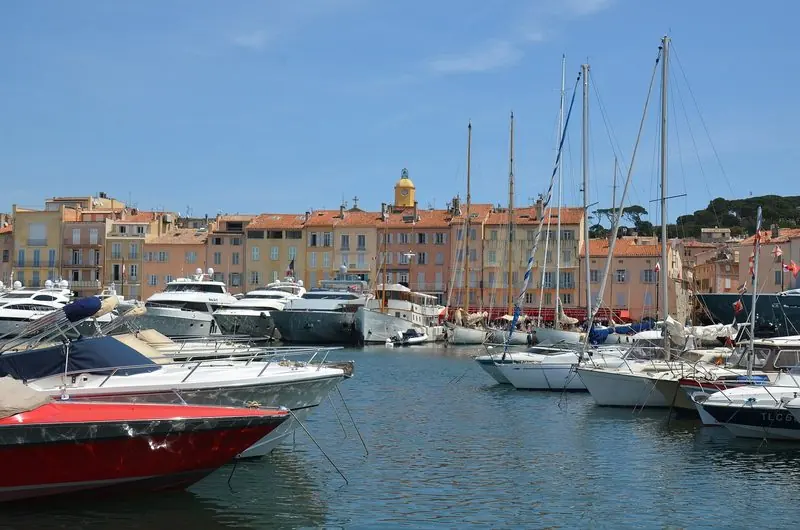
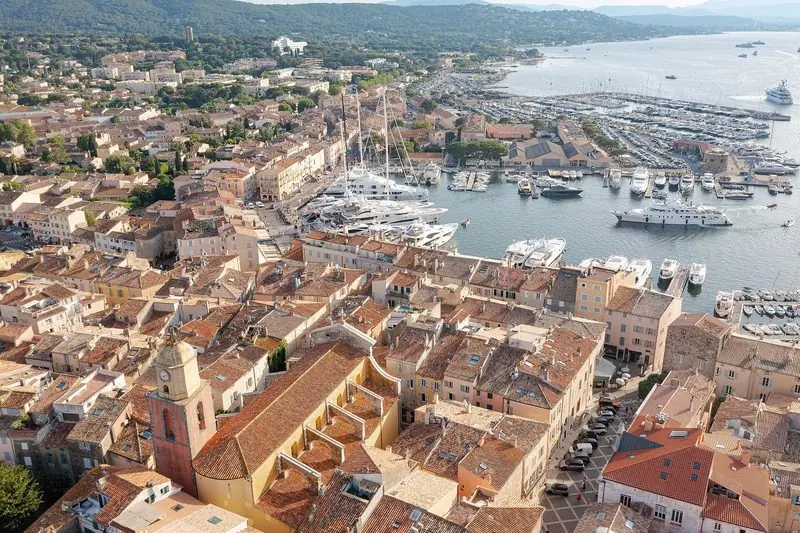
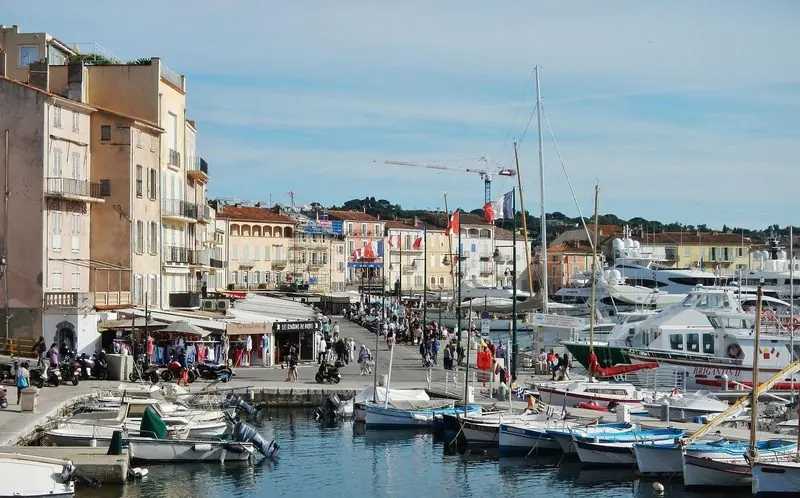
Saint-Tropez está en la orilla sur de su propio golfo, mirando al norte, al otro lado del agua, hacia Sainte-Maxime. El puerto es pequeño, antiguo y de forma incómoda, y justo por eso funciona. Los yates se ponen de popa a lo largo de los muelles con las pasarelas apoyando a unos metros de las mesas de los cafés, y el pueblo envuelve el agua en una sola curva de edificios ocres. Nada de esa disposición se pensó para un yate a motor de 70 metros, y los armadores vienen precisamente por el efecto de poner uno ahí.
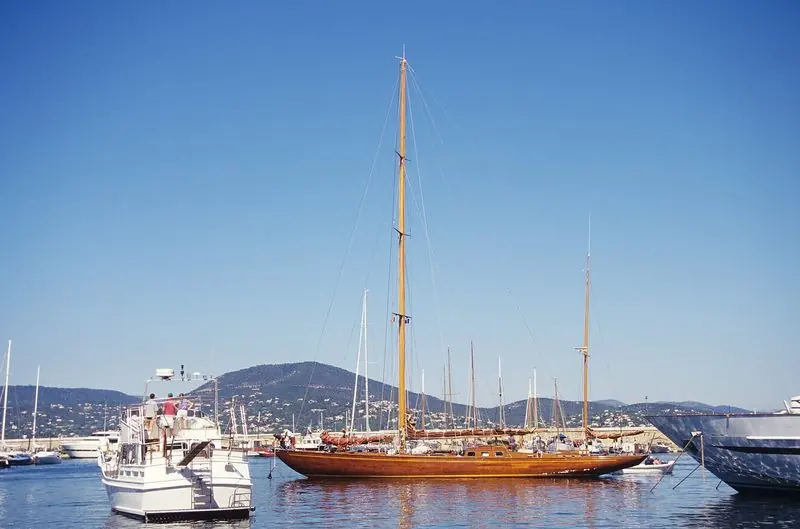
El puerto tiene 734 amarres en dos dársenas, con un centenar reservados a visitantes. A un yate grande le importan tres muelles. La dársena Jean Lescudier admite hasta 25 metros, el Puerto Viejo de 25 a 50, y el Mole d'Estienne d'Orves, el dique exterior, hasta 90 metros con un calado máximo de cuatro metros. Ese límite de calado es la cifra que decide si un casco concreto puede venir siquiera.
La aproximación y el tráfico de verano
El golfo de Saint-Tropez es una bahía ancha y profunda a la que se entra desde el este sin ninguna dificultad de navegación, y la oficina del puerto trabaja en el canal 09 de VHF y abre a cualquier hora en verano. Lo que hace exigente la llegada es la gente. En julio y agosto el golfo está espeso de tenders, barcos de excursión y embarcaciones de charter, y la bocana del puerto es un cuello de botella. El amarre en el muelle del pueblo se hace de popa sobre un cabo guía de muerto y delante de público.
El peligro dominante es el mistral, el noroeste frío que se encañona por el valle del Ródano y sopla duro por esta costa durante tres días seguidos. Llega con cielo despejado y pilla a mucha gente. El puerto incluye en algunas de sus tarifas la intervención de un buzo, que en temporada alta llega a pasar hasta dos cabos de amarre al día en los muelles del Puerto Viejo, lo que da una idea de la atención que exige aquí el montaje de amarre.
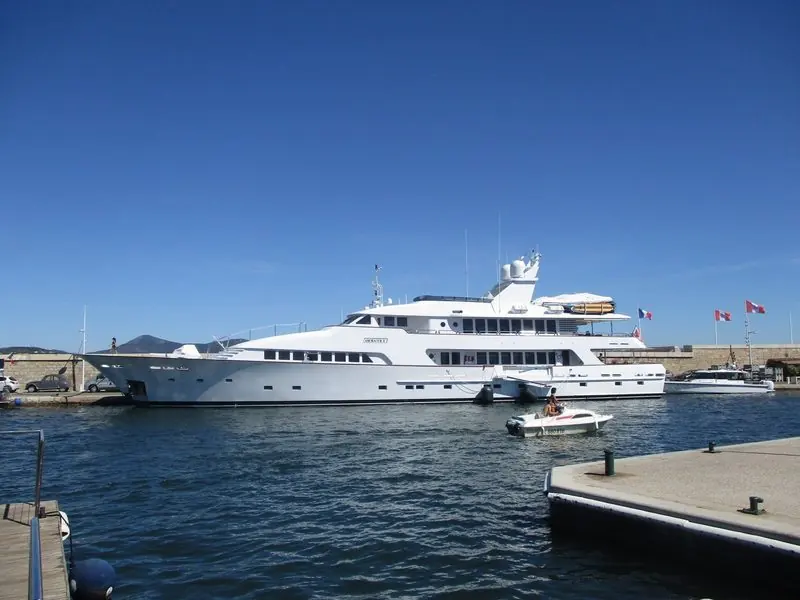
Cuatro mil euros por noche por cincuenta metros en agosto, y al puerto se le sigue acabando el sitio.
Lo que cuesta, con precisión
Saint-Tropez cobra por superficie, tomando la eslora total multiplicada por la manga total, y aplica una tarifa por metro cuadrado que cambia según el muelle y según cuatro temporadas. En la tarifa de 2026 la temporada muy alta va del 10 de julio al 20 de agosto. En esa ventana el Puerto Viejo son EUR 9,24 por metro cuadrado y día con IVA incluido y el muelle de Estienne d'Orves EUR 7,29. Un yate de 50 metros con nueve metros de manga cubre 450 metros cuadrados, que son EUR 4.158 por noche en el muelle del pueblo.
Ese mismo yate en temporada baja, del 1 de noviembre al 1 de abril, paga EUR 1,59 por metro cuadrado en el Puerto Viejo, o EUR 715 por noche. Las tarifas incluyen agua y electricidad y dejan fuera el adaptador eléctrico y la tasa turística. Las reservas de barcos de más de 18 metros pasan por el sistema Magelan eResa y se confirman con el pago de un depósito equivalente a la mitad de la estancia. Todo se paga a la llegada y no se aceptan cheques.
Conseguir un amarre, siquiera
Los amarres de Saint-Tropez se alquilan al puerto municipal y no se vende nada. Hay dos temporadas de contrato, un contrato de invierno del 15 de octubre al 1 de abril y un contrato de verano del 1 de mayo al inicio de Les Voiles, además de tarifas diarias de paso para todos los demás. Las peticiones se hacen por internet y el puerto usa dos sistemas, Navily para barcos de menos de 18 metros y Magelan eResa por encima de esa eslora.
En la práctica el puerto va casi lleno desde finales de junio hasta finales de agosto y las buenas posiciones van a yates que el puerto ya conoce. El armador que quiera el muelle del pueblo en la primera quincena de agosto debería estar hablando con la oficina del puerto en invierno. Los que lo dejan para tarde acaban fondeados frente a Pampelonne y entrando en tender, cosa que muchos hacen además por gusto.
Servicios, y lo que hay que hacer en otro sitio
El puerto tiene estación de combustible y las tarifas de amarre incluyen agua y corriente en el pantalán. El aprovisionamiento, la lavandería, las floristerías y cualquier tipo de servicio de conserjería están a unos cientos de metros, porque la economía del pueblo se sostiene cuatro meses al año atendiendo yates y a la gente que va en ellos. El puerto está certificado como puerto limpio activo en biodiversidad y se incorporó al SEA Index como miembro institucional en 2024, con viveros artificiales de peces instalados alrededor de la dársena.
Aquí no hay capacidad de astillero digna de ese nombre. Cualquier cosa que pase de un buzo y un mecánico obliga a mover el barco, y el centro regional para el trabajo serio de refit es La Ciotat, a un día cómodo de navegación al oeste por la costa, con Marsella más allá. Golfe-Juan y Antibes están más cerca para apoyo técnico. Los armadores que hacen temporada en Saint-Tropez se guardan los periodos de astillero para el invierno y para otro sitio.
Intimidad, que aquí no existe
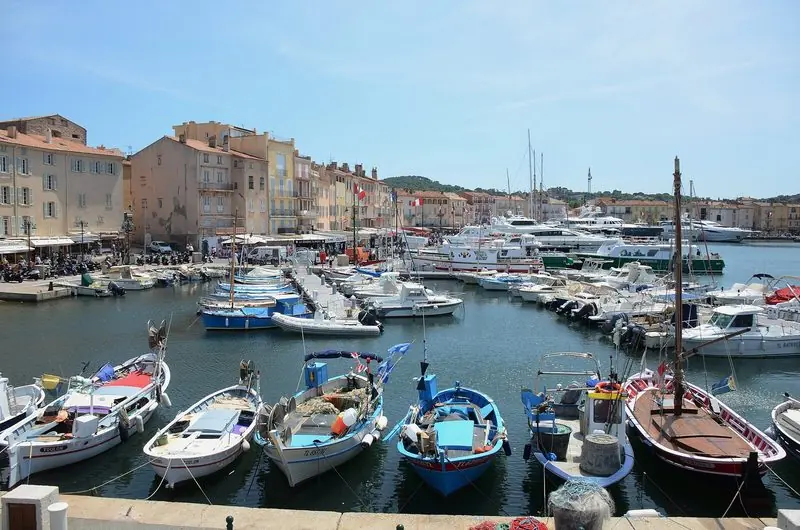
En Saint-Tropez no hay amarre discreto. Los muelles del Puerto Viejo dejan la cubierta de popa de un yate a distancia de conversación de la acera, y de mayo a septiembre pasa por delante una multitud continua fotografiando los barcos. La tripulación monta cabos y carteles y se pasa buena parte del día pidiendo a la gente que no se suba. El muelle de Estienne d'Orves está algo más apartado de los cafés y sigue estando plenamente a la vista.
Los armadores que eligen Saint-Tropez han decidido que la visibilidad es una ventaja. Los que no lo han decidido suelen fondear frente a Pampelonne o al socaire del Cap y usar el tender, lo que les da el pueblo para cenar e intimidad para desayunar. Ese es el compromiso habitual en esta costa y explica por qué el fondeadero suele tener más movimiento que el puerto.
En tierra, y la costa de alrededor
El pueblo es de verdad precioso fuera de temporada y está de verdad desbordado en agosto, cuando la población se multiplica y la carretera de entrada desde la autopista puede llevar dos horas. El aeropuerto de La Mole, a unos 15 kilómetros al oeste, mueve aviación de negocios y es el nudo de helicópteros del golfo, y Niza está a unos 110 kilómetros por carretera, cosa de hora y media con tráfico normal. La mayoría de los invitados llegan en helicóptero o en tender desde un aeropuerto mayor.
La península tiene los beach clubs de Pampelonne, el pueblo en alto de Ramatuelle y los viñedos que producen casi todo el rosado que bebe el pueblo. Por mar, las Iles d'Hyeres y Porquerolles quedan a media jornada al oeste, Cannes y las islas de Lerins a una mañana cómoda al este, y Córcega a una travesía nocturna. Para una semana en familia, la mezcla de playa, pueblo y travesías cortas es de lo mejor que ofrece el Mediterráneo.
Temporada, calendario y el inconveniente sincero
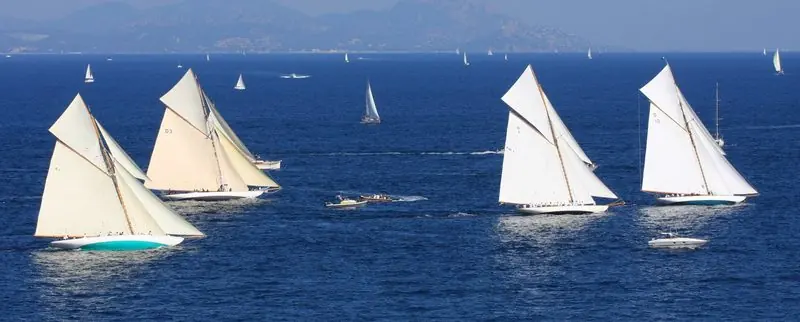
El propio calendario del puerto marca el ritmo. La temporada baja va del 1 de noviembre al 1 de abril, la media cubre abril y la segunda mitad de septiembre, la alta arranca el 30 de abril, y la muy alta es del 10 de julio al 20 de agosto. Les Voiles de Saint-Tropez, la regata de clásicos y maxis que cierra la temporada mediterránea, se corre del 26 de septiembre al 4 de octubre en 2026 y llena el puerto con una flota de más de 300 barcos de vela. La Giraglia de junio es el otro punto fijo.
Los inconvenientes son el coste, la aglomeración y ese límite de cuatro metros de calado que deja fuera en silencio a una parte de la flota moderna. Agosto en Saint-Tropez no es descansado, los precios están entre los más altos del mundo por metro cuadrado de agua, y un armador está comprando un escenario y no un refugio. La compensación es que ningún otro puerto del mundo pone a un yate grande tan cerca de tanto de aquello por lo que ha venido su armador.
Season, timing and the honest downside
The port's own calendar sets the rhythm. Low season runs from 1 November to 1 April, mid season covers April and the second half of September, high season starts on 30 April, and the very high season is 10 July to 20 August. Les Voiles de Saint-Tropez, the classic and maxi regatta that closes the Mediterranean season, runs from 26 September to 4 October in 2026 and fills the harbour with a fleet of over 300 sailing yachts. The Giraglia in June is the other fixed point.
The downsides are cost, crowding and the four metre draught limit that quietly excludes a slice of the modern fleet. August in Saint-Tropez is not restful, the prices are among the highest anywhere per square metre of water, and an owner is buying a stage and not a refuge. The compensation is that no other harbour in the world puts a large yacht so close to so much of what its owner came for.
The whole 2026 tariff, and a 70 m yacht in August
Saint-Tropez publishes its full tariff on one page and there is no reason to quote only part of it. Rates are per square metre of length overall multiplied by beam overall, VAT included, and they vary by basin and by four seasons. Daily, in the very high season from 10 July to 20 August, the Old Port is EUR 9.24 and the Estienne d'Orves mole is EUR 7.29. In the high season either side of that, 30 April to 10 July and 20 August to 4 October, they are EUR 7.03 and EUR 5.37. In the intermediate weeks of April and October they are EUR 2.55 and EUR 2.48, and in the low season from 1 November to 1 April they fall to EUR 1.59 and EUR 0.91. The Jean Reveille mole and the Jean Lescudier basin sit below both throughout.
Worked through on a 70 m yacht of 12 m beam, which is 840 square metres, a night on the Estienne d'Orves mole in the second week of August is EUR 6,124 with VAT in it and water and electricity included. The same yacht taking the high season package from 1 May to 26 September pays EUR 604.77 per square metre, which is EUR 508,007 for the season. The low season package from 15 October to 1 April is EUR 84.57 per square metre, or EUR 71,039. What none of those figures include is the tourist tax, which the port names as an exclusion and does not quantify anywhere, or the rental of the electrical adapter, which is the connector between the quay and the yacht and is charged separately. Reservations above 18 m go through Magelan eResa and are confirmed on a deposit of 50 per cent of the stay, calculated before the tourist tax and any optional services. Cheques are not accepted.
Anchoring off Pampelonne, and the rule that governs it
Lying off the peninsula is the standard answer to a full harbour in August, and it comes with a legal condition that has to be stated alongside the advice. Posidonia oceanica, the seagrass that covers much of this seabed, is a protected habitat in French Mediterranean waters, and anchoring on it is prohibited by arrete prefectoral 123/2019 of 3 June 2019. The 24 m threshold comes from the local order for this stretch of coast, arrete prefectoral 248/2020 of 15 December 2020, with Pampelonne bay governed separately by the interprefectural order of 9 and 10 December 2021 that made the bay a managed mooring zone. Vessels of 45 m and over, or 300 GT and over, also fall under arrete prefectoral 157/2024 of 23 May 2024, modified 3 June 2026, which makes them declare an intended anchoring to the nearest semaphore an hour ahead, or seek permission outright above 80 m, and confines them to designated zones in both Pampelonne bay and the gulf. Enforcement runs through the coastal semaphore stations, which watch with optics, radar and drones, and through boarding parties at sea; the penalties are set out in the key facts. The meadows off Pampelonne and around the Cap are exactly the ground in question. A yacht that drops on posidonia is not committing a technical breach of a mooring rule, it is damaging a protected habitat, and the consequences run to prosecution rather than a berth fee.
The practical version is that a large yacht anchors on sand and only on sand, that the sand patches off Pampelonne are identifiable from the chart and from the water and are not where everyone else is lying, and that a captain who cannot positively identify the bottom does not drop. Where the bottom is uncertain, the answer is a mooring buoy or the harbour. Any advice to anchor off Pampelonne that does not carry this rule is incomplete, because it is the kind of omission that costs an owner money rather than time. The port's own rates make the same point from the other direction, since the daily figure in the Old Port during high season includes a diver laying up to two mooring lines every day, which is a measure of how much attention holding gets taken seriously here.
En tierra, accesos y reservas
| Nearest airports | La Mole (business aviation) about 15 km/20 min by road; Toulon-Hyeres about 52 km, roughly 1 to 1.5 hours by road or 14 minutes by helicopter; Nice about 110 km, roughly 1.5 hours by road. |
|---|---|
| VHF and speed limit | Call the harbour master on VHF channel 9 before entering (24-hour monitoring in summer); channel 16 or +33 (0)4 94 40 54 52 (Saint-Raphael coastguard) for emergencies. Harbour speed limit is 3 knots; visiting yachts are normally directed to the first quay on the right of the entrance in the outer basin, and mooring assistance runs 8am to 7pm. |
| How berths are actually reserved | Online: Navily for boats under 18m, Magelan eResa for 18m and above, confirmed with a 50 percent deposit excluding tourist tax; cheques are not accepted. In July and August vessels over 18m are capped at two two-day stays a month. Getting a summer slot on the Old Port quay has historically depended on the port's own goodwill as much as the booking system - enough that ten former port staff and intermediaries are due before the Draguignan criminal court in November 2026 over a bribery scheme for those berths. The port says reservations have since been digitised and made more traceable. |
| Berth cost | Priced by LOA x beam. On the 2026 tariff, 10 July to 20 August: EUR 9.24/sqm/day on the Old Port quay and EUR 7.29/sqm on the Estienne d'Orves mole, including water and electricity, excluding tourist tax and the shore-power adapter rental. Low season (1 Nov to 1 Apr) falls to EUR 1.59 and EUR 0.91/sqm. |
| Fuel and fluids | SP98 petrol, standard diesel and tax-free diesel are sold from the green-lighthouse jetty (Groupe Bergon); summer hours are 8am to 8pm. Diesel across the French Riviera in 2026 is averaging around EUR 2.50 a litre. Water and electricity are included in the berth rate; the shore-power adapter itself is rented separately. |
| Services on the quay | Free waste pump-out, free wifi (password given at check-in), shore power via MARECRIAL sockets from 16A to 250A, and a diving service on request; Old Port high-season berths include one diver-laid mooring-line service a day. |
| Eat on the quay | Senequier, on Quai Jean Jaures since 1887, and Le Girelier, a seafood house on the same quay for more than 60 years, both sit a few steps from the stern-to berths. |
| After dark | Les Caves du Roy at the Hotel Byblos and the VIP Room are both a short walk from the port; Caves du Roy has been the fixture nightclub of the Riviera season for decades. |
| Fixed dates | Les Voiles de Saint-Tropez runs 26 September to 4 October 2026, filling the harbour with roughly 250 to 300 classic and racing yachts; the Giraglia passes through in June. |
Lo que cuentan armadores y tripulaciones
For years, the real price of an Old Port berth included a cash top-up
An investigation opened by the Draguignan public prosecutor in 2023 found former port employees demanding EUR 1,000 to EUR 15,000 in cash on top of the published rate for scarce Old Port slots between 2022 and 2024. Investigators seized EUR 856,000 and estimate around EUR 2 million changed hands in total. Ten defendants, including former port staff, are due before the Draguignan criminal court on 23 November 2026.
Agence France-Presse (AFP)The town hall itself admits the port cannot meet demand
Saint-Tropez's own director general of town services put the peak-season waiting list at 50 to 90 boats for every one of the roughly 30 transit berths the Old Port has for yachts over 18 metres.
Benoit Ravix, quoted by Agence France-Presse (AFP)Captains describe the stern-to turn itself as the hard part, not the paperwork
Spinning a yacht stern-first into the commercial part of the harbour means trusting "the eyes on the aft deck" doing the manoeuvre, and July and August - the port's busiest weeks - are markedly windier and more crowded than the May/June window most captains prefer for this stretch of coast.
Captain James Griffith, interviewed by Fraser YachtsA fire on a packed stern-to quay is not a hypothetical
On 10 July 2025 the 41m Sea Lady II caught fire roughly two hours after mooring in the Old Port. It took until midnight to bring under control, two crew were treated for smoke inhalation, and by August the hull had partially sunk and was being written off as likely for scrap.
Boat International
Lo bueno y lo que conviene vigilar
Puntos fuertes
- The walk-off-the-quay scene has no equal on this coastSenequier, trading on the same stretch of Quai Jean Jaures since 1887, and the seafood house Le Girelier, a fixture for more than 60 years, both sit steps from the stern-to berths, and Les Caves du Roy at the Hotel Byblos is a short walk up from the port - an owner's guests can go from swim platform to nightclub table without a car.
- It remains the historic anchor of the Riviera season, not a manufactured oneThe port has drawn big yachts since the 1950s, and Les Voiles de Saint-Tropez each autumn still fills the same basin with around 250 to 300 classic and modern racing yachts, a fixture the town has run in one form or another for decades.
A tener en cuenta
- Only about 30 transit berths exist for anything over 18 metresAgainst that, AFP reported the town's own director general of services putting the peak-season waiting list at 50 to 90 boats per space, and in July and August the port itself limits vessels over 18m to two two-day stays a month.
- Berth allocation ran on bribery for years, not just relationshipsTen people, including former port employees, are due before the Draguignan criminal court on 23 November 2026 after an investigation found cash payments of EUR 1,000 to EUR 15,000 changing hands for Old Port slots between 2022 and 2024; investigators seized EUR 856,000 and estimate roughly EUR 2 million was paid in total. The port says reservations have since been digitised.
- The 4-metre draught and the quay's own numbers quietly cap the fleet that can even tryThe only quay taking anything over 50 metres, the Estienne d'Orves mole, tops out at a 4-metre draught, and the port does not publish how many of its big-yacht positions exceed 50 metres, so a deep-draught 70m-plus yacht has to check compatibility before it books at all.
- The density that makes the quay glamorous also makes it dangerousOn 10 July 2025 the 41m Sea Lady II caught fire in the Old Port two hours after docking; it took until midnight to control and the hull later partially sank, a reminder of how tightly boats lie stern-to on the busiest berths.
Para quién es: El armador que quiere estar en medio de la temporada de la Riviera francesa y que asume que lo miren como parte de lo que está pagando.