Porto Montenegro
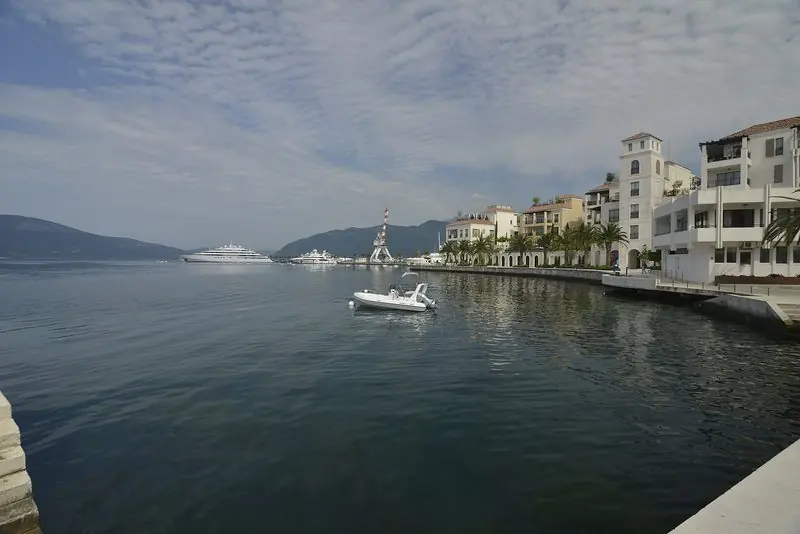
| Ubicación | Tivat, bahía de Kotor, Montenegro, a 42 26,03 N 018 41,33 E |
|---|---|
| Operador | Adriatic Marinas d.o.o., en manos de la Investment Corporation of Dubai desde 2016 según lo publicado |
| Amarres | 481 declarados en las páginas de amarre de la marina, con otros materiales que hablan de más de 500 |
| Rango de barcos | de 6 m a 250 m de eslora total |
| Amarre | a la mediterránea, de popa sobre dos líneas de fondo por proa, con boyas de amarre en los amarres de más de 50 m del Jetty 1 |
| Corriente en tierra | de 16 amperios hasta 1.000 amperios según el tamaño del amarre |
| Conectividad | fibra óptica de hasta 50 Mb/s en amarres de más de 15 m, con bombeo de aguas grises y negras en ese mismo umbral |
| Aduana | puerto de entrada oficial con aduana e inmigración en el recinto, combustible libre de impuestos, IVA preferente en repuestos, almacén aduanero |
| Acreditación | TYHA Five Gold Anchor Platinum, que la marina describe como la primera del mundo |
| Aproximación | por el estrecho de Verige, de 2.300 m de largo y 340 m en su parte más angosta, con practicaje organizado para barcos de más de 1.000 GT |
| Refit | Adriatic 42 en Bijela, Herceg Novi, con travel lift de 720 toneladas, dique flotante de 180 x 34 m y 150.000 metros cuadrados de superficie operativa |
| Aeropuerto | Tivat, a unos 10 minutos por carretera, con helipuerto en la marina |
| Berth distribution, trade directory listing read July 2026: 117 berths at 24 to 30 m, 55 at 31 to 50 m, 5 at 51 m and above, for 177 superyacht positions | |
| Berth count varies by source | the marina's own berthing page now says 580, its older material 481, TYHA lists 484 with a 250 m maximum berth and describes 450 |
| Maximum draught listed at 17 m and maximum beam at 24 m. The fuel dock is quoted for yachts to 250 m at 15 m draught | |
| Shallow water lies off Jetty 4, lit and buoyed, and night arrivals are asked to give it a wide berth | |
| Wind | bora, a cold katabatic north to north-easterly, a winter wind, most severe in the Bay of Risan where gusts have been recorded at 250 km/h, about 135 knots |
| Wind | jugo, warm and humid from the south, present all year and concentrated in autumn and spring, bringing heavy rain |
| Bora warning sign used locally | cap cloud forming on the mountain ridge above the bay |
| No rate card is published. The only public pricing signals are the marina's own packages, including a 30-day Charter Flex block usable in any number of stays and a superyacht offer open to 40 to 50 m LOA case by case | |
La aproximación, y el estrecho que hay que pasar
La bahía de Kotor es un cañón fluvial inundado que se mete unos 28 kilómetros tierra adentro desde el Adriático, formado por cuatro dársenas encadenadas. Herceg Novi está en la boca, Tivat es la bahía interior más exterior y es donde está la marina, y Risan y Kotor quedan más adentro. La profundidad media del golfo ronda los 27 metros, con un máximo cercano a 60, así que hay agua por todas partes.
La estrechez es el estrecho de Verige, el cuello de 2.300 metros entre las bahías exterior e interior que se reduce a 340 metros en su parte más angosta. Un yate de 100 metros lo pasa sin dramas con luz de día, y es la razón de que la bahía interior esté tan plana. Porto Montenegro está a 42 grados 26,03 minutos norte y 018 grados 41,33 minutos este, trabaja en el canal 71 de VHF y está señalizado con luces roja y verde en la bocana de la marina. Para barcos de más de 1.000 GT se organiza practicaje.
Qué tiene la marina
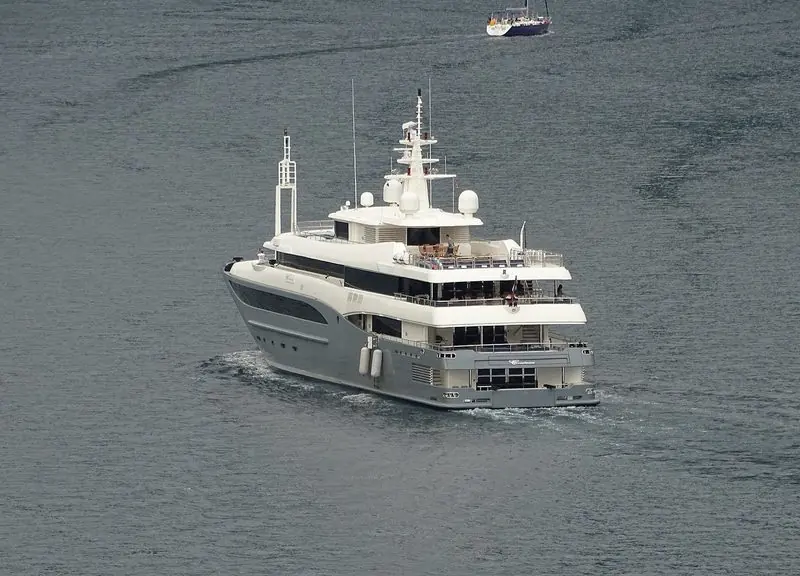
Las propias páginas de amarre de la marina declaran 481 amarres seguros para barcos de 6 a 250 metros, mientras otros materiales de la misma web hablan de más de 500 y algunos brokers listan 456. Quédese con la cifra de unos quinientos y con el extremo superior como el dato que importa, porque muy pocas marinas del mundo pueden admitir físicamente un yate de 250 metros. Amarres de esa escala son la razón por la que varios de los mayores yates del mundo han invernado aquí.
El amarre es a la mediterránea, de popa al muelle sobre dos líneas de fondo por proa, con líneas de fondo montadas en todos los amarres y boyas de amarre en las posiciones de más de 50 metros del Jetty 1. El personal de muelle atiende cabos a cualquier hora y la marina tiene un mostrador de asistencia al yate 24 horas. Maniobrar en la bahía es todo lo fácil que se puede pedir en el Mediterráneo, porque dentro del Verige no hay prácticamente mar de fondo.
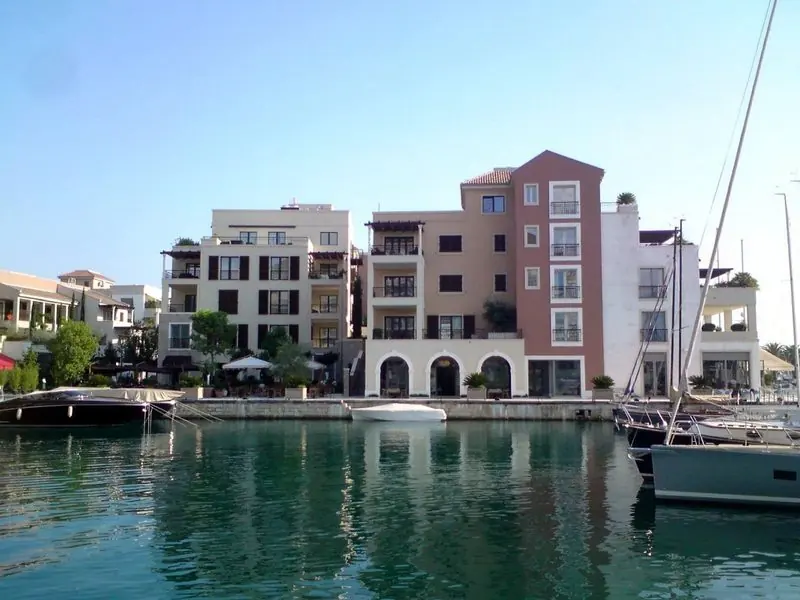
Agua para un yate de 250 metros, combustible libre de impuestos y una aduana en el muelle, en una bahía que es de los sitios más lluviosos de Europa.
La disponibilidad, que es de lo que se trata
La razón por la que los armadores miran al este es que el Mediterráneo occidental está lleno y esto no. Un yate de 70 u 80 metros que en Porto Cervo tendría que reservar en invierno cabe por lo general en Tivat avisando con poco tiempo fuera de las semanas punta, y la parte muy grande de la flota tiene aquí opciones que no existen en casi ningún otro sitio.
La marina publica directamente condiciones de alquiler semanal, mensual y anual, y los brokers de amarres llevan los acuerdos más largos. En Tivat no hay un mercado público activo de precios de amarre comparable al del dique de Antibes, así que un armador negocia sin un comparable publicado contra el que pujar. El precio va por eslora y por temporada y está bastante por debajo de la Riviera y de la Costa Smeralda.
Estar fuera de la Unión Europea
Montenegro no es miembro de la UE ni está dentro del territorio aduanero y de IVA del bloque, y toda la lógica comercial de la marina sale de ahí. Porto Montenegro es un puerto de entrada oficial con aduana e inmigración en el propio recinto, así que un yate despacha entrada y salida en el muelle. En el pantalán de combustible hay carburante libre de impuestos. Los repuestos tienen un IVA preferente y en el recinto hay un almacén aduanero.
Para un armador con un yate de pabellón extracomunitario, o que administra la admisión temporal en aguas de la UE, tener un puerto de entrada de servicio completo a un día de navegación de Croacia es un activo práctico. También significa que las normas de Schengen y de navegación comunitaria se acaban en la boca de la bahía y que una travesía al norte hasta Dubrovnik es un movimiento internacional con los trámites que eso implica. Las tripulaciones lo planifican y es rutina, pero no es lo mismo que moverse entre Italia y Francia.
Energía, agua, residuos y conectividad
Cada amarre tiene agua y electricidad propias, con tomas que van de 16 amperios hasta 1.000 amperios según el tamaño de la posición. Esa cifra máxima es poco habitual y es lo que permite a un yate muy grande pasar todo el invierno al costado sin encender generadores. Hay bombeo de aguas grises y negras en los amarres de más de 15 metros.
Los amarres de más de 15 metros tienen fibra óptica de hasta 50 megabits, con wifi en todo el recinto, cosa que importa al armador que trabaja desde el barco durante semanas seguidas. La seguridad es de 24 horas en la marina y en el conjunto del desarrollo. La marina tiene la categoría TYHA Five Gold Anchor Platinum y dice de sí misma que fue la primera marina del mundo en alcanzar ese grado.
Apoyo técnico y dónde está el astillero de verdad
En el recinto hay efectos navales, un taller de reparación local, aprovisionamiento, un almacén aduanero y un centro de formación de tripulación con cursos STCW-95 y RYA. Eso cubre el trabajo de rutina y la certificación de la tripulación sin salir de la bahía.
El refit pesado se hace en Adriatic 42, que está en la bahía de Kotor pero no en Tivat. Ocupa el antiguo astillero de Bijela, en Herceg Novi, al otro lado del agua, con un travel lift de 720 toneladas, un dique flotante de 180 por 34 metros, una superficie operativa de 150.000 metros cuadrados y 8.000 metros cuadrados de talleres. Se ocupa de refits completos, pintura, teca, interiores y sistemas, y está certificado según ISO. El armador que se basa aquí para el invierno tiene capacidad seria dentro del mismo golfo.
El pueblo, la seguridad y la intimidad
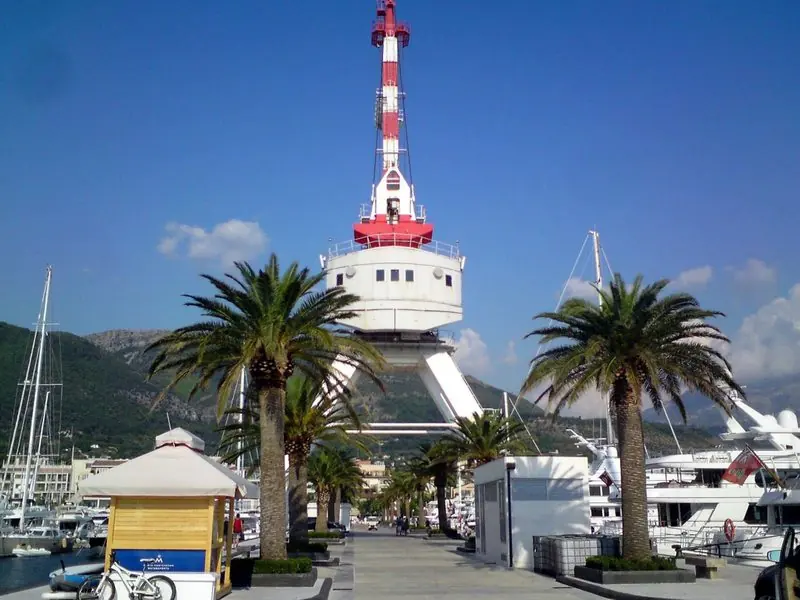
El recinto es una población de ribera planificada, no una marina pelada. Se han construido o lanzado seis barrios frente al agua, entre ellos South Village y Boka Place, con Vero y Versa sumando 202 residencias desde 2025, junto a un hotel, un Yacht Club, un Crew Club con acceso a playa y un paseo de unos 25 acres. Cuatro clubes de negocios y un auditorio de 560 plazas atienden la parte corporativa.
La historia naval sobrevive en un museo marítimo frente al agua con un submarino conservado. Para la intimidad el montaje funciona bien, porque la marina está cerrada y controlada, el pueblo de detrás forma parte de la misma finca, y Tivat no recibe nada parecido al turismo de mirones de Mónaco o de Portofino. Un yate aquí se fotografía muchísimo menos que ese mismo yate en la Riviera.
Cómo se llega y qué hace una familia
El aeropuerto de Tivat está a unos diez minutos en coche del muelle, que es el traslado al aeropuerto más corto de toda esta guía. Mueve tráfico regional y europeo de temporada con capacidad para aviación de negocios, y en la marina hay un helipuerto privado. El aeropuerto de Dubrovnik, con conexiones de largo radio más amplias, está costa arriba, en Croacia, al otro lado de una frontera internacional.
Para una semana en tierra el atractivo es la bahía. El casco antiguo amurallado de Kotor, en el fondo del brazo de mar, es Patrimonio de la Humanidad de la UNESCO desde 1979 y queda a un trayecto fácil en tender o en coche, Perast y las iglesias de las islas están a mitad de camino, y las montañas de detrás dan senderismo y carretera. Las islas croatas están a un día de navegación al norte. Lo que la bahía no tiene es la densidad de restaurantes ni el comercio del Mediterráneo occidental.
El inconveniente sincero
Llueve. La bahía de Kotor está donde se solapan el clima mediterráneo y el subtropical húmedo y es uno de los sitios más lluviosos de Europa, con unas montañas que la hacen preciosa y también mojada. La ventana de tiempo fiable es, en esencia, de junio a septiembre, más corta que la de Chipre o Turquía y no más larga que la de la Riviera. El invierno aquí es un buen sitio para dejar un yate y uno malo para usarlo.
Las otras limitaciones son prácticas. Las conexiones aéreas de Tivat son de temporada y escasas comparadas con las de Niza o Palma, y los invitados de largo radio suelen entrar por Dubrovnik o por Belgrado. La zona de navegación al norte de la bahía es magnífica, pero está en otro país con sus propias normas de despacho y de charter. Y el armador que entra en un amarre aquí entra en la finca de un solo promotor, con la concentración de riesgo que eso supone.
The wind, which has two names here
Two wind systems govern the Boka and both of them have names. The bora is a cold katabatic north to north-easterly that falls off the Dinaric wall around the bay, Orjen at 1,894 m on the west side and Lovcen on the east, and it is a winter wind. It is most severe in the Bay of Risan, the inner basin beyond the Verige, where gusts have been recorded at 250 km/h, about 135 knots, with the air temperature dropping sharply over a few hours and freezing events on the shoreline. Bora situations are frequent enough that local sailors read the mountains for them, because cap cloud settling on the ridge is the standard warning that one is building. The jugo is the other, a warm humid southerly that runs all year and concentrates in autumn and spring, and it brings the rain that makes the Boka one of the wettest inhabited places in Europe.
What the bora does not do at Tivat is put swell into the marina. The berths lie in the outermost inner basin, two constrictions from open water, and the sea state alongside stays flat in almost any conditions. The problem is the gust and not the wave. A katabatic gust arrives with no building sea in front of it and hits a stern-to yacht with high freeboard as a single hard shove on the beam, which is a different loading from the surge a Riviera port takes. A bora day at Tivat is a day for doubling springs and leaving the boat where she is, not a day of uncomfortable motion. Manoeuvring in the bay is genuinely easier than at Sibenik or on the Cote d'Azur, but the reason is the absence of swell and not the absence of wind, and those are two different claims.
En tierra, accesos y reservas
| Getting there | Tivat airport is about 4 km from the quay and the drive is under 10 minutes, the shortest airport transfer of any marina in this guide. Insist on the meter: the metered fare is around EUR 8 and rank drivers at the terminal routinely open at EUR 20 to EUR 40. There is a helicopter pad at the marina. Tivat's schedules are regional and seasonal, so long-haul guests route through Dubrovnik in Croatia, which is an international border crossing, or through Podgorica. |
|---|---|
| Arriving by sea, clearing in, and the vignette | Work VHF channel 71. Dock staff are on watch 24 hours and must be called before arrival and again before departure, with vessel name, length, berth code if known and last port of call. The entrance is lit green on the head of the north breakwater and red on the head of Jetty 5; keep clear of the outer side of Jetty 4, which is shallow and marked with orange buoys. The marina itself is a dead slow, no wake zone, the bay limit is 10 knots and the Kumbor and Verige channels are 6 knots. Pilotage is compulsory above 1,000 GT. This is an official port of entry: the dock team sends you to the customs dock on the north side near the Yacht Club, the captain completes entry with Customs, Immigration and the Harbourmaster, and the marina walks a customer through it with an English-speaking concierge at no extra cost. The crew list is stamped and a vignette, the cruising permit, is issued for anything from a week to a year. It is not needed for periods the yacht is laid up in a local marina or yard. |
| Reserving a berth | Berths are contracted directly. Marina booking is +382 (0)32 661 061 and [email protected], with [email protected] for contracts and a 24 hour line on +382 (0)32 661 063. Weekly, monthly and annual terms are offered and berth brokers handle longer arrangements. The published packages are the real pricing signal: a 30-day Charter Flex block that can be used across any number of separate stays, a summer flexible berthing offer, and a superyacht offer open to 40 to 50 m LOA case by case. |
| What a berth costs | The marina publishes no rate card and quotes on application, which is unusual even at this level. The only public annual indication Yotters could find is a Montenegro market guide (Ana Pajkovic, 2026) putting annual contracts at roughly EUR 950 to EUR 1,550 per metre of LOA a year, or about EUR 19,000 to EUR 31,000 for a 20 m berth depending on pontoon. No second independent source corroborates that range, so treat it as indicative and not as a comparable. The resale market is visible where the rental market is not: Peter Insull's Yacht Marketing listed a 50 m by 12 m berth on the main quay at EUR 900,000, cut from an original EUR 1,950,000, on an eleven-year lease running to May 2027. |
| Fuel, and why it is cheap | Montenegro sits outside the EU customs and excise territory, so the fuel dock sells at 0 per cent VAT and 0 per cent excise. Tax-free diesel was reintroduced for foreign yachts in February 2025 at EUR 0.74 a litre, and the government adjusts the price every fortnight, so budget from a fresh quote rather than that figure. The 72 hour minimum stay condition was removed on 29 August 2025. Porto Montenegro has the highest capacity of the three Montenegrin marinas offering it, taking up to 1,000 litres a minute. Orders go to [email protected] in advance, and by Thursday for a Saturday, Sunday or Monday delivery. |
| Metered fluids and services | Every berth has its own water and electricity, individually metered, from 16 A up to 1,000 A depending on the size of the position. That top figure is what lets a very large yacht sit alongside all winter without running generators. Grey and black water pump-out and fibre optic internet to 50 Mb/s are provided at berths over 15 m, with wifi across the site. On the quay there is a chandlery, provisioning, a bonded warehouse, a local repair facility and a crew training centre; heavy refit goes across the bay to Adriatic 42 at Bijela with its 720 tonne travel lift and 180 by 34 m floating dock. |
| Eating within walking distance | One is the longest-running restaurant in the village, modern Adriatic with a front-line view of the superyacht quay, and Crush Wine Station sits beside it. Al Posto Giusto is the Italian on the harbourfront promenade with wood-fired pizza and a heated terrace. Marea is the upscale seafood room on the waterfront. Murano and MayaBay are both inside the Regent Porto Montenegro. Off the promenade, Masala Art Kitchen is the Indian and Il Pescatore the casual seafood. Walk out of the gate along the town waterfront for Mala Barka, which is where Tivat itself eats grilled octopus. |
| After dark, and the fixed dates | The Clubhouse is the crew bar and the social centre of the port, with themed nights, live bands, DJs and every big sporting fixture on screen. Crush Wine Station is the wine room, and the Yacht Club carries beach club access for members. Fixed dates for 2026 at the marina: the Porto Montenegro Match Race on 8 to 10 May, a World Match Racing Tour event hosted by the Porto Montenegro Yacht Club, and the J70 Montenegro Championship on 12 to 14 June. The reliable weather window is essentially June to September. |
| What is NOT published | No berth tariff of any kind. No per kWh or per cubic metre rate for the metered power and water either, and third-party booking platforms contradict each other over whether consumption is included in the berth price, so get it in writing before you commit. The berth count itself is unsettled: the marina's berthing page has carried both 481 and 580, TYHA lists 484, a market guide says 512 and brokers list 456. Maximum draught is quoted at 17 m by the marina and at 12 m by two booking platforms, so a deep hull confirms with the berthing office rather than with an aggregator. |
Lo que cuentan armadores y tripulaciones
Tax-free diesel came back, and then the minimum stay went
Montenegro reintroduced tax-free diesel for foreign yachts in February 2025 at EUR 0.74 a litre, with the government adjusting the price every fortnight in line with the market, and removed the restrictive 72 hour minimum stay on 29 August 2025. Of the three marinas licensed to sell it, Porto Montenegro has the highest capacity at up to 1,000 litres a minute, with advance booking advised above 100,000 litres.
YACHT (yacht.de)The industry's own worry is EU accession, not competition
Radule Dragovic of DRM Maritime Services warned that the transition may challenge existing tax breaks such as the yacht fuel exemption as Montenegro aligns with EU VAT and excise duties, and the trade remembers what happened when the exemption was abolished once before. Aleksandra Janicic of the Montenegrin Sailing Federation expects Schengen accession to ease crew and passenger mobility. Separately, Montenegro plans to end visa-free entry for Russian citizens around September 2026, and Russians have traditionally been a significant share of visiting yachts.
Marina WorldClearing in is friendly rather than fast
Cruisers report the customs dock immediately to the left of the marina and describe the process as not quick but staffed by helpful people. The vignette is priced by size and hull type rather than by a flat fee: a week for an 11.5 m monohull was reported at about EUR 27 against about EUR 84 for a catamaran of the same length, and a 16 m yacht paid roughly EUR 225 for a month.
NoonsiteCrew stay the winter because of what is ashore, not what is afloat
The Crew Club runs two to three events a week from October through May, from pub quizzes and bowling to hiking and spa trips, and members get a free ski chalet at Kolasin on Bjelasica, about two and a half hours by road, available January to April and equipped down to bedding and towels. The Superyacht Winter Games run over two weekends. For an owner deciding where to leave a yacht for six months, crew retention is the argument.
Superyacht Content, ACREWThe berth you buy comes with an end date
A 50 m by 12 m berth on the main quay was listed at EUR 900,000, reduced from an original asking price of EUR 1,950,000, on an eleven year lease running to May 2027. Anyone treating a Tivat berth as a freehold asset should read the remaining term before the price.
Peter Insull's Yacht Marketing
Lo bueno y lo que conviene vigilar
Puntos fuertes
- Water and shelter no Mediterranean marina matchesBerths to 250 m, shore power to 1,000 A, and a basin two constrictions from open water, so the sea alongside stays flat in almost any conditions.
- Duty-free fuel at the highest flow rate in the countryZero VAT and zero excise, EUR 0.74 a litre when the exemption returned in February 2025, up to 1,000 litres a minute, and no minimum stay since 29 August 2025.
- A working port of entry at the quayCustoms, immigration and the harbourmaster are on site, and the marina walks a customer through the process with an English-speaking concierge at no charge.
- Availability when the western basin has noneA yacht that would need to book Porto Cervo months out can generally be accommodated at Tivat at short notice outside the peak weeks, and the winter market is the marina's core business.
- Heavy refit inside the same gulfAdriatic 42 at Bijela carries a 720 tonne travel lift, a 180 by 34 m floating dock and 150,000 square metres of operational area, so a winter base does not mean a delivery passage.
A tener en cuenta
- No published price of any kindThere is no rate card, no fluid tariff and no active public market in headline berth prices here, so an owner negotiates without a comparable to bid against.
- A short usable season in a very wet placeThe reliable window is essentially June to September, in one of the wettest inhabited corners of Europe. Winter here is a good place to leave a yacht and a poor place to use one.
- The very large berths are fewA trade directory breakdown gives 117 berths at 24 to 30 m, 55 at 31 to 50 m and only 5 at 51 m and above, whatever the 250 m headline says.
- EU accession is a live risk to the tax caseMontenegro is aiming to close its negotiation chapters by the end of 2026 and targets membership in 2028, and a Montenegrin maritime services operator has publicly warned that alignment with EU VAT and excise may challenge the yacht fuel exemption.
- Tenure is a lease with a date on itBerths trade on fixed-term leases rather than freehold. The 50 m brokerage listing above runs only to May 2027, and the asking price had been more than halved.
Para quién es: El armador con un yate muy grande que quiere amarre garantizado, combustible libre de impuestos y un invierno tranquilo, y que acepta una temporada útil de cuatro meses.