Vieux-Port de Marseille (France)
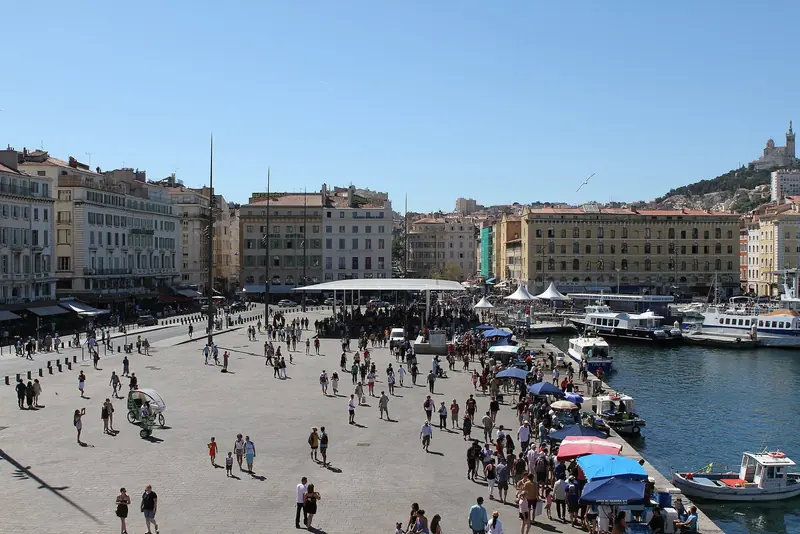
| Location | the old harbour of Marseille, entered from the east between Fort Saint-Jean and Fort Saint-Nicolas, with the Palais du Pharo as the landmark above the entrance |
|---|---|
| Authority | the Metropole Aix-Marseille-Provence is the port authority and runs the harbourmaster's office at Quai Marcel Pagnol, 13007 Marseille, telephone 04 91 99 75 60, VHF channel 9 |
| Berths | about 3,200 per the Figaro Nautisme port sheet, about 3,000 per Sea-Seek and 3,500 per Wikipedia; the Metropole publishes no berth count in the documents Yotters could read |
| Visitor berths | 20 for boats under 13 m rising to 50 in summer, plus two for vessels up to 40 m and one berth for 90 minutes maximum, per Figaro Nautisme; its entry also states that no reservation is possible |
| Reception | on floating pontoons to starboard after the Pharo, in front of the harbourmaster's office, 15 berths per Figaro Nautisme |
| Maximum length | 50 m per Figaro Nautisme, against 'yachts up to 90 m' on Sea-Seek, a crowd-sourced entry; the 2024 police regulation says the maximum size is fixed by each port's mooring plan |
| Depth | 4 to 6 m inside per Figaro Nautisme, with a 5.5 m maximum draught on Sea-Seek and Wikipedia giving 5 m in its infobox and 6 m in its text |
| Entrance width | 50 m per Figaro Nautisme |
| Speed limit | 4 knots per Figaro Nautisme, while the Metropole's police regulation sets 3 knots in basins and 5 knots in access channels |
| Mooring | floating pontoons, anchoring and mooring prohibited in the port per Figaro Nautisme |
| Passage tariff 2026 | EUR 0.84 per square metre per day excluding VAT for a 15 to 199.99 square metre footprint in the April to September high season, and EUR 0.59 from October to March |
| Reception stay limit | two nights maximum on the reception quays or pontoons, under article 6.4.1 of the Metropole's police regulation |
| Lift and crane | a 6 tonne crane and a 12 tonne lifting machine operated by a private company, per Figaro Nautisme |
| Fuel | on the Quai du Port, 04 91 91 27 85, with summer hours of 07:00 to 18:00 and 24 hour card payment per Figaro Nautisme |
| Clubs | the Cercle Nautique et Touristique du Lacydon on VHF 77 and the Societe Nautique de Marseille on VHF 60, founded in 1887 |
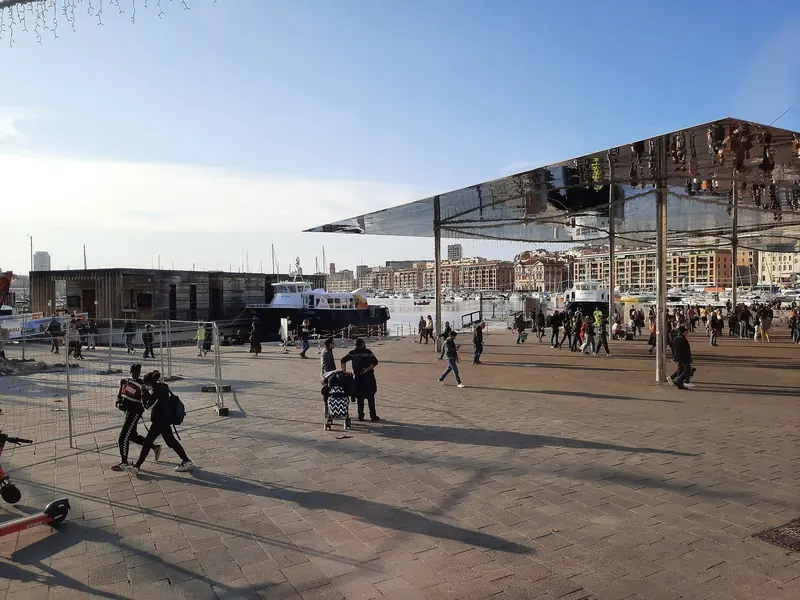
| Ombriere | a polished stainless steel canopy of 46 m by 22 m on the Quai des Belges, designed by Foster + Partners and opened in 2013 |
Where the Vieux-Port is and what it is for
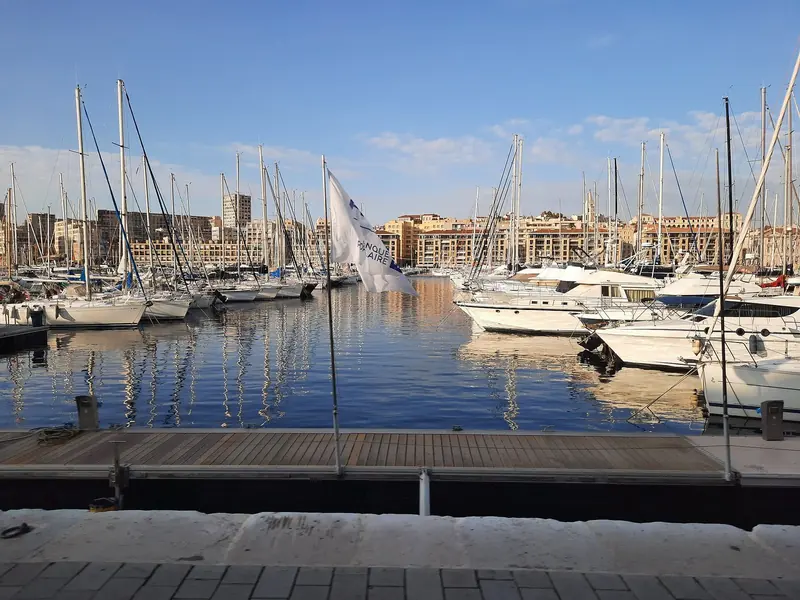
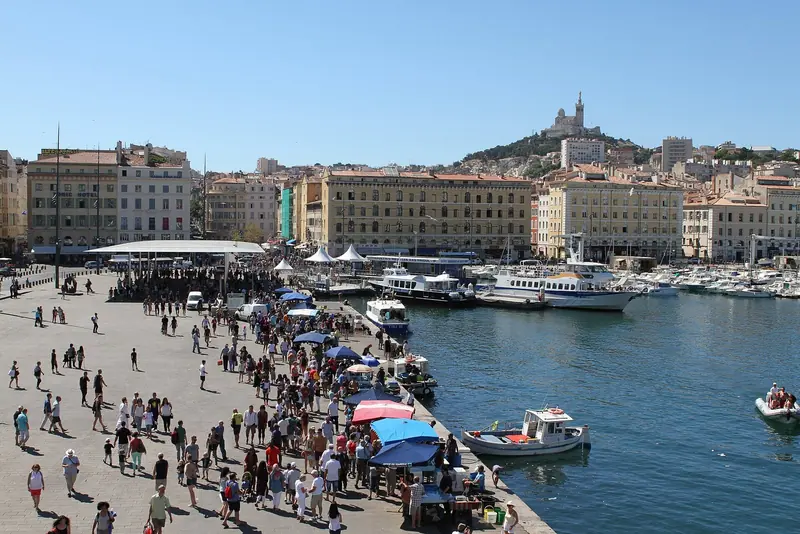
Figaro Nautisme's port sheet calls it a port in the middle of the city, reserved for pleasure boats and fishing boats, reachable in any weather, and one of the biggest marinas in the Mediterranean. The basin runs east to west into the city, with the Quai du Port on the north side, the Quai de Rive Neuve on the south and the Quai des Belges across the head of it. The Greeks from Phocaea chose it about 600 BC, and the 2021 Figaro Nautisme feature on it explains why: a long natural inlet oriented east to west, sheltered from the mistral that blows from the north. That is a very different thing from a purpose-built marina. Nobody designed this place for 40 metre yachts, and the berth layout, the noise and the traffic all show it.
The harbour is run by the Metropole Aix-Marseille-Provence, which publishes the harbourmaster's address as Quai Marcel Pagnol in the 7th arrondissement. Two clubs hold the big pontoons by concession. The Cercle Nautique et Touristique du Lacydon, set up in 1970 according to Figaro Nautisme, sits on the Pharo side of the basin and answers on VHF 77. The Societe Nautique de Marseille, founded in 1887 and known as La Nautique, has a floating clubhouse facing the town hall and answers on VHF 60. So there are really three operators in one harbour, which matters the moment you ask who has a free berth.
Getting in past the ferries and the forts
Figaro Nautisme's port sheet gives the access as due east through the main passage, with the south entrance shared by the commercial and pleasure harbours, and says not to get in the way of commercial vessels. Landmarks are the Planier light about five miles from the Maire island and the Palais du Pharo above the entrance. The entrance itself is 50 metres wide. The entry lights are the Fort Saint-Jean at Q.R.4m4M and the Fort Saint-Nicolas at Iso.G.4s8m1M, and between the two forts you need to watch for the dolphins marking the road tunnel that runs under the passage. The sheet also warns of shoal water along Fort Saint-Jean and of the Digue des Catalans.
The 2021 Figaro Nautisme feature describes the trap better than a chart does: do not let yourself be drawn into the axis of the commercial harbour, where the ferries connecting Europe to North Africa run, and slip to starboard at the foot of the Palais du Pharo instead. Noonsite, in an entry last updated in February 2018, goes further and says the ferries charge in and out at high speed with no regard for yachts moving about. Speed inside is capped, though the sources disagree on the number. Figaro Nautisme says 4 knots. The Metropole's own police regulation, which is the legal text, says 3 knots in basins and 5 in access channels. Work to the lower figure.
The Vieux-Port publishes its passage tariff to the square metre and does not publish how many berths it has: the sources give 3,000, 3,200 and 3,500.
Reservations, the reception pontoon and the two night limit
Article 6.1 of the Metropole's police regulation, adopted in 2024, says the skipper of any vessel wishing to stop must ask the harbourmaster before entering, by telephone or VHF, and if cleared must then report in person during opening hours with the boat's details, owner's details, insurance, intended stay and the number of people on board. Boats arriving from or heading to a non-Schengen state also need an entry and exit form. A boat that does not declare itself is billed an administrative fee. Out of hours you take one of the reception quays and declare when the office opens, and a reception berth is limited to two nights.
The regulation and the port sheet disagree on one point that matters to anyone with a larger boat. Figaro Nautisme's sheet states 'no reservation possible' and tells you to contact the harbourmaster. Article 6.4.2 of the regulation says a deposit is compulsory at reservation for vessels over 24 metres, which presupposes that those vessels can reserve. Yotters could not find a published booking channel for either case. The reception berths are listed by Figaro Nautisme as 15 floating berths in front of the harbourmaster's office, with 20 visitor berths for boats under 13 metres in all, rising to 50 in summer, two berths for vessels up to 40 metres and one berth for 90 minutes. The sheet also notes that the harbourmaster can lend you a berth belonging to a regular who is away.
What a night costs, worked out from the Metropole's tariff
The Metropole's tariff for its 29 pleasure ports, effective 1 January 2026 and published in euros excluding 20 percent VAT, prices a passage by the square metre of footprint per day. In the high season, 1 April to 30 September, a footprint of 0 to 14.99 square metres is EUR 0.73, 15 to 199.99 is EUR 0.84, 200 to 399.99 is EUR 1.74 and 400 and above is EUR 2.33. In the low season, 1 October to 31 March, the bands are EUR 0.42, 0.59 and 0.73, and the sheet gives only that top figure for 200 square metres and above. The footprint is not just the hull: the tariff notes say the surface must include the room needed for mooring lines and fenders.
Check it against Figaro Nautisme's 2026 table for the Vieux-Port pontoons. An 8 by 3 metre boat is 24 square metres, which at EUR 0.84 plus VAT is EUR 24.19 and the table says EUR 24. A 10 by 3.5 metre boat is EUR 35.28 against EUR 35, and a 12 by 4 metre boat is EUR 48.38 against EUR 48. The 14 by 4.5 metre line comes out at EUR 63.50 on Yotters' arithmetic against EUR 62 in the table, so use the table as a guide and the Metropole sheet as the rule. Figaro Nautisme gives weekly and monthly prices too: EUR 336 a week and EUR 1,260 a month at 12 metres. The Societe Nautique's own pontoons are listed a little lower, at EUR 45 a day for 12 metres.
Berths, the three operators and what size really fits
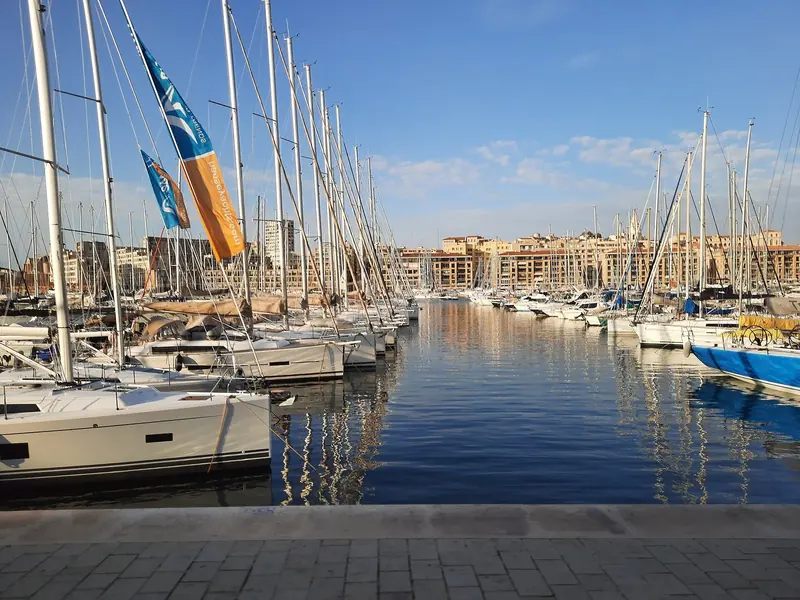
Nobody agrees how many berths there are. Figaro Nautisme says about 3,200, on pontoons and on the quay. Sea-Seek says about 3,000. Wikipedia says 3,500. A French boating article cited by tourism listings puts roughly 3,500 craft across about ten nautical societies. The Metropole's tariff and regulation, which are the authoritative documents, publish rates and rules but no count. The honest summary is somewhere between 3,000 and 3,500, and the regulation adds that a contract berth cannot be sublet or transferred.
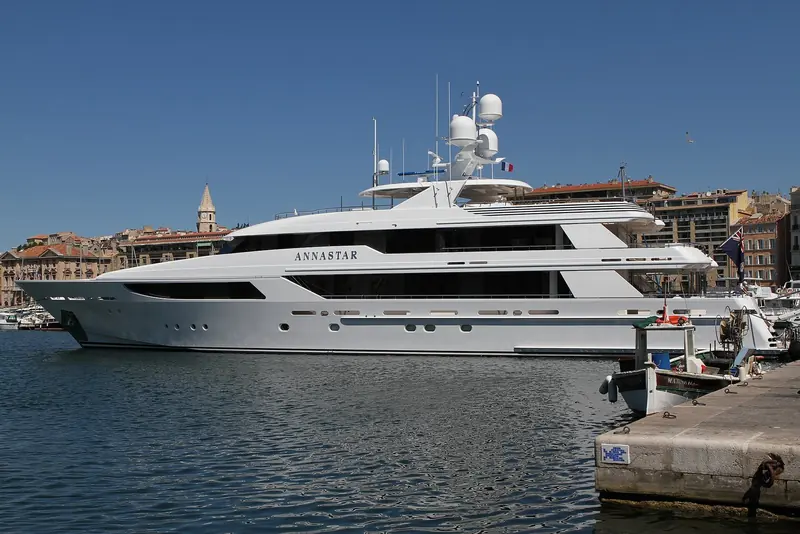
Size is murkier still. Figaro Nautisme puts the maximum at 50 metres and keeps two visitor berths for vessels up to 40. Sea-Seek says yachts up to 90 metres are accepted with a 5.5 metre maximum draught. The regulation says the maximum size is fixed by each port's mooring plan, which Yotters could not find. Depth is 4 to 6 metres per Figaro Nautisme. A photograph on Wikimedia Commons from 30 June 2013 shows the superyacht Annastar alongside a quay in the Old Port, so big yachts do come. If your boat is over 24 metres, the regulation's deposit clause is your cue to phone the harbourmaster weeks ahead rather than hail on arrival.
Water, power, fuel and the lift
Figaro Nautisme lists fresh water, 220 volt electricity, toilets and showers, sorted waste collection, a 6 tonne crane and a 12 tonne lifting machine operated by a private company, plus shipyards and ships' chandlers. The fuel quay is on the Quai du Port, telephone 04 91 91 27 85, open 07:00 to 18:00 in July and August and 07:00 to 13:00 out of season, with Sunday hours of 09:00 to 17:00 in summer and 24 hour payment by card. That is useful and it is also the ceiling: a 12 tonne hoist is a motor-cruiser hoist, not a yacht yard. Anything larger goes to the commercial yards in the port of Marseille or round the coast. No source Yotters could find gives a three-phase shore power rating, a pump-out price or the harbourmaster's opening hours.
The harbour carries the Blue Flag per Figaro Nautisme, English is spoken at the harbourmaster's office, and the Metropole prints tariffs for berth fees only and leaves service charges to the operators. The Societe Nautique's pontoons are listed with night surveillance. If you're going to stay a week, ask the CNTL or the Nautique directly what they charge for shore power, because the tariff sheet of the authority will not tell you.
The quay, the canopy and what is close by
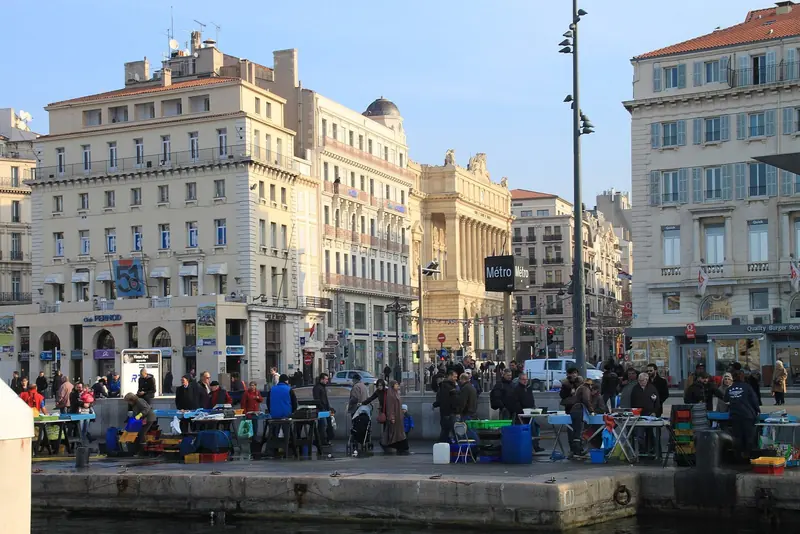
The Quai des Belges, now officially the Quai de la Fraternite, holds the daily fish market, where roughly ten stalls sell directly from the fishermen from 8:00 to 13:00 according to the Marseille tourist office. Across the head of the quay stands the Ombriere, Foster + Partners' polished stainless steel canopy, 46 metres by 22 metres and 6 metres high on slender posts, which opened for the 2013 European Capital of Culture when the quay was largely pedestrianised. Metro line 1 stops at Vieux-Port, and the Saint-Charles station is a 15 to 20 minute walk or a short ride.
For lunch, the bouillabaisse is the question every visitor asks and every guide warns about. The Charte de la Bouillabaisse Marseillaise dates from 1980, requires a set of Mediterranean rockfish, and has Le Miramar at 12 Quai du Port as its address. Prices in 2025 and 2026 guides range from EUR 65 a head at the Miramar to EUR 100 to 160 elsewhere, and several warn that EUR 20 to 25 bouillabaisses on the quay don't follow the charter. Yotters has no official price list, so phone before you book.
After dark, the noise and the fixed dates
Figaro Nautisme's 2021 feature calls night the best moment to approach, with Notre-Dame de la Garde lit up on the hill and the Mucem lit blue at the entrance. Noonsite calls the harbour very sheltered but rather noisy. The one review of a stay Yotters found, a single user's comment on the SamBoat charter platform, complained of noise through the night and sanitary facilities that were not accessible, and that's one person, not a survey. Fishermen work the rocks at the entrance at all hours.
The harbour has hosted big arrivals, notably the finish of The Race in 2001, when Grant Dalton's Club Med crossed the line and the Societe Nautique's pontoons took the whole fleet. For fixed dates today, the regatta calendar belongs to the two clubs, so ask them. If you're planning for a summer weekend or a regatta, assume the place is full, and treat a booked berth at the Frioul or Pointe Rouge as the plan and the Vieux-Port as the bonus.
En tierra, accesos y reservas
| Getting there | Marseille Provence airport is about 26 to 27 km away. The line 91 shuttle to Saint-Charles station takes about 25 minutes, then Metro line 1 reaches Vieux-Port, and a taxi is quoted at EUR 45 to 70 for 20 to 30 minutes. Shuttle fares were reported to change in July 2026, so confirm on the airport website. Saint-Charles is a 15 to 20 minute walk from the basin. |
|---|---|
| Arriving by sea | Call the harbourmaster on VHF 9 or 04 91 99 75 60 before entering, from the east through the 50 m wide main passage between the forts, and keep out of the commercial axis to the north. Speed is 4 knots on Figaro Nautisme and 3 in basins and 5 in channels under the Metropole's regulation. Anchoring in the port is prohibited. |
| Reservations | The Figaro Nautisme sheet says no reservation is possible. The Metropole regulation requires a deposit at reservation for boats over 24 m. Reception is on floating pontoons to starboard after the Pharo in front of the harbourmaster's office, 15 berths, two nights maximum. Out-of-hours arrivals take a reception quay and declare when the office opens. |
| What a berth costs | The 2026 Metropole passage tariff is EUR 0.84 per square metre per day excluding VAT for 15 to 199.99 square metres in the April to September season and EUR 0.59 from October to March. Figaro Nautisme lists EUR 24 a day at 8 m, EUR 35 at 10 m, EUR 48 at 12 m and EUR 62 at 14 m, with weekly and monthly rates. The Societe Nautique is listed from EUR 22 at 8 m to EUR 59 at 14 m. |
| Payment rules | The fee is due immediately in full for the planned stay, the day runs from noon to noon, payments over EUR 1,000 including VAT go by bank cheque or transfer and cash is capped at EUR 300 per invoice. A boat that uses no water or electricity gets one free hour if it declares itself. |
| Metered fluids | Fresh water and 220 volt power are listed. No unit price for either appears in the Metropole tariff or the port sheet, and no three-phase rating is published. |
| Services on the quay | Toilets, showers, sorted waste, a 6 tonne crane, a 12 tonne lifting machine run by a private company and a fuel quay on the Quai du Port, 04 91 91 27 85, open 07:00 to 18:00 in July and August and 24 hours by card. |
| Where to eat | The fish market runs about 8:00 to 13:00 on the Quai de la Fraternite. Le Miramar at 12 Quai du Port is the address of the Charte de la Bouillabaisse Marseillaise. Quoted charter prices run from EUR 65 to EUR 160 a head; ask before you sit down. |
| After dark | The basin is lit, busy and loud. Ferry traffic comes in and out of the commercial harbour and Noonsite calls the port sheltered but noisy. The Societe Nautique's pontoons carry night surveillance. |
| Fixed dates | No marina-published event calendar was found. The Cercle Nautique et Touristique du Lacydon and the Societe Nautique de Marseille hold the regatta calendars, so ask them. |
| What is not published | A berth count, the length and draught of each berth, the harbourmaster's opening hours, a reservation channel for visitors, shore power and water unit prices, the mooring plan that fixes maximum vessel size, and any bill for a yacht over 24 m. |
Lo que cuentan armadores y tripulaciones
The ferries charge in and out and the basin is noisy but sheltered
Noonsite's entry for the Vieux-Port, last updated in February 2018, warns that ferries enter and leave at high speed without regard for yachts moving about, calls the harbour very sheltered but rather noisy and recommends the pontoons on the southern side run by the Cercle Nautique et Touristique du Lacydon. The entry is eight years old, so confirm the club's current situation before relying on it.
NoonsiteYou may not find a berth unless you arrive off season or at night
A 2021 Figaro Nautisme feature on the port says that unless you arrive really out of season and on the tips of your bows at night, you can't be sure of finding a place. It still describes the run in and out as an experience in itself, and points to the quieter, cooler anchorages along the coast to the east as the alternative.
Figaro NautismeA boat landing here is a legal declaration, not a courtesy call
Article 6.1 of the Metropole's 2024 police regulation requires the skipper to ask the harbourmaster by phone or VHF before entering and then report in person with the vessel's papers, owner's identity, insurance and passenger count. It sets a two-night limit on reception quays and makes a deposit compulsory at reservation for vessels over 24 metres.
Metropole Aix-Marseille-ProvenceOne stay, one complaint: noise and sanitary access
A single user of the SamBoat charter platform complained of noise through the night and of sanitary facilities that were not accessible. That is one review and not a survey, and Yotters found no other first-hand account of staying afloat in the basin.
SamBoatNo owner or captain report of the larger berths could be found
Yotters could find no captain, crew or owner account of using the two vessel-up-to-40-metre berths Figaro Nautisme lists, nor a bill for a boat of that size, nor a berth-broker listing. The 90 metre figure on Sea-Seek is a crowd-sourced entry and does not name a berth. Treat the large-yacht capacity as an enquiry and not a fact.
Yotters desk
Lo bueno y lo que conviene vigilar
Puntos fuertes
- The position is unbeatableYou berth at the head of the city, with the Metro at the end of the basin, the fish market on the quay and the Foster canopy next to your bow. No other major Mediterranean city port puts a visiting boat this close to everything.
- The tariff is public and checkableThe Metropole publishes the passage fee per square metre per day, so you can compute your own bill. Three of Figaro Nautisme's four sample prices reproduce within a euro from the official sheet.
- The rules are written downThe 2024 regulation spells out the two-night limit, the declaration, the out-of-hours procedure and the deposit for boats over 24 metres, which most city harbours leave to the harbourmaster's mood.
- Two historic clubs with VHF contactThe CNTL on channel 77 and the Societe Nautique on channel 60 each run their own pontoons, so a full public reception pontoon is not the end of the search.
- It's a harbour with a past, not a theme parkThe basin has been in use for about 2,600 years and still has working fishermen selling off the quay every morning.
A tener en cuenta
- No reliable berth countThe sources give 3,000, 3,200 and 3,500 and the authority publishes none, so you can't gauge how full it is.
- The visitor berths are fewFigaro Nautisme lists 20 visitor berths for boats under 13 metres (up to 50 in summer), two for vessels up to 40 metres and one for 90 minutes, and says reservations are impossible. In July and August that's a lottery.
- Ferries and noiseNoonsite warns of fast ferries at the entrance and calls the harbour noisy, and the only owner-style complaint found was about noise and showers.
- Open to the mistralFigaro Nautisme's port sheet says the port is open to the mistral and exit is delicate in a strong one, which contradicts the sheltered picture.
- Conflicting facts on speed, size and reservation4 knots against 3 and 5 knots, 50 metres against 90 metres, no reservation against a deposit at reservation for boats over 24 metres. The official regulation should be the one you plan against.
- No superyacht infrastructureA 12 tonne lifting machine, no published shore power rating and no published yard for anything large mean you'd leave the basin for any serious work.
Para quién es: A sailor or motor-cruiser under about 20 m who wants to spend a night or two in the middle of Marseille, accepts that the berth is first come first served at the reception pontoon, and is happy to be woken by ferries and a city. Not for a superyacht owner who needs a booked berth with a deposit schedule, a known depth along the quay and a fuel and crew-services package: those buyers belong at a purpose-built marina along the coast, or at the Frioul or Pointe Rouge ports a few miles away.