SEABOB (Cayago)
| Categoría | propulsor acuático personal eléctrico |
|---|---|
| Fabricante | Cayago, Alemania |
| Fundada | 2007 |
| Productos estrella | SEABOB F5 y F5 S |
| Generación más nueva | F9, estilizado por Studio F. A. Porsche (el estudio de diseño de Porsche) |
| Propulsión | chorro eléctrico recargable, sin escape ni hélice expuesta |
| Posición | ampliamente considerado el juguete náutico de lujo por defecto |
| Superseded F5 generation | 2.5 kW to 4.5 kW and 29 kg to 35 kg, still the machine in most yacht toy lockers |
| Charging | about four to six hours on the standard charger, about one to one and a half hours on the quick charger |
| Prices from Cayago's September 2025 EMEA list: F9 at EUR 9,285 net of VAT and F9 S at EUR 12,380 net | |
| Warranty | 24 months from transfer including the battery, with an annual inspection at an authorised facility |
| Depth | Cayago's own data sheet, read July 2026, gives a depth-sensor safety cut-off at 3.0 m and an electronic control system settable to a maximum of 25 m, and publishes no top speed for the F9 or F9 S |
| Flag reach | Part A Chapter 14 of the Red Ensign Group Yacht Code covers the United Kingdom, the Cayman Islands, Gibraltar, the Isle of Man and the other British Overseas Territories and Crown Dependencies, so a Cayman-flagged yacht is inside the same chapter MGN 681 interprets |
| Cayman Islands Shipping Registry | no separate lithium battery shipping notice in its published notices as of July 2026, so REG Yacht Code Chapter 14 plus a vessel-specific risk assessment is the operative standard |
| Marshall Islands | the 2026 edition of Yacht Code MI-103, effective 1 January 2026, introduces specific rules for spaces used to store or charge lithium-ion powered toys and tenders |
| Malta | a Transport Malta Commercial Yachting Notice of 22 June 2022 and Information Notice 45 of 7 September 2022, both written as strong recommendation, with the Commercial Yacht Code 2025 Revision 1 as the surveyed document |
| IMO | no mandatory instrument covering portable lithium battery powered craft aboard yachts as of July 2026 |
| Class | DNV's Battery (Safety) notation triggers only above 50 kWh aggregate installed capacity. Lloyd's Register LR-GN-052 of 10 June 2025 is advisory guidance, not a rule |
| Certified charging locker | no marine manufacturer publishes a price. EN 14470-1 Type 90 industrial cabinets listed at EUR 3,270 net (asecos ION-CHARGE 90, July 2026) and GBP 4,571.04 net or GBP 5,485.25 gross (asecos ION-CORE-90, United Kingdom, July 2026) |
| The SEABOB battery is integrated and does not come out. No spare pack appears on Cayago's EMEA list of September 2025 or on the Maltese dealer list of May 2026, and no replacement price is published | |
| MCA Safety Bulletin 35, updated 15 November 2024: a container marketed as fully MGN 681 compliant was found not able to comply fully, and the MCA noted that no international standard governs these products | |
El fabricante alemán Cayago
El SEABOB lo construye Cayago, una empresa alemana fundada en 2007 para desarrollar embarcaciones personales de altas prestaciones. Desde el principio se concentró en una sola idea: un propulsor eléctrico potente que un nadador sujeta y gobierna por el agua. Cayago fue de las primeras empresas en llevar la propulsión eléctrica a este tipo de juguete náutico personal. El SEABOB se convirtió en su producto definitorio y dio a la marca un estatus casi icónico en los yates. La empresa ha seguido afinando el diseño durante más de una década.
Cayago posiciona el SEABOB como un producto de ingeniería premium y no como un simple juguete de piscina. La calidad de construcción, los materiales y la electrónica apuntan a compradores que esperan el mismo nivel que el de los yates que los llevan. Ese foco en la ingeniería ha mantenido a la marca por delante de los imitadores más baratos. El nombre SEABOB se usa hoy casi como abreviatura de toda la categoría. Su base fabril alemana es parte de esa reputación.
El F5 y la nueva generación
El núcleo de la gama ha sido durante mucho tiempo el F5 y el más potente F5 S, propulsores esbeltos que llevan al usuario por encima y por debajo de la superficie. Estos modelos fijaron el estándar de prestaciones de la clase y son una imagen habitual frente a las plataformas de baño de los yates. Una variante más enfocada, el F5 SR, añadió velocidad extra para los usuarios entusiastas. Más recientemente Cayago introdujo una generación nueva, el F9, estilizado con el estudio de diseño de Porsche. La gama cubre desde el nadador ocasional hasta quien busca las máximas prestaciones.
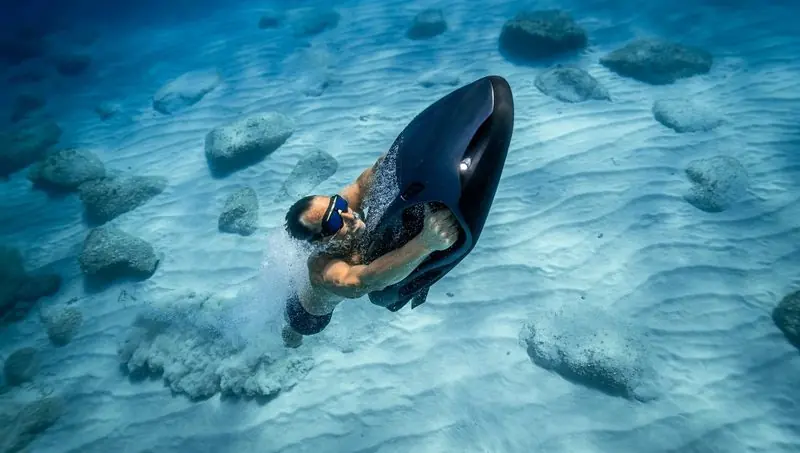
El SEABOB funciona aspirando agua por un chorro y empujando al usuario hacia delante, controlado por una empuñadura sencilla y por la inclinación del cuerpo. Puede ir por la superficie como un bodyboard o bajar para un nadador con máscara. Los distintos modelos ofrecen distinta potencia y distintas características de inmersión. Las versiones más nuevas traen baterías y electrónica actualizadas a un formato probado. Cayago ha explorado además ediciones especiales con socios del mundo del automóvil.
El propulsor eléctrico que se convirtió en el juguete que se da por hecho en toda plataforma de baño.
Propulsión eléctrica y control inteligente
En el corazón del SEABOB hay un potente chorro eléctrico alimentado por una batería recargable. No hay gasolina, ni escape, ni hélice expuesta al usuario. El sistema gestiona la entrega de potencia para que un principiante pueda ir tranquilo y un experto pueda acelerar fuerte con la misma máquina. La flotabilidad está ajustada para que el propulsor vuelva de forma natural hacia la superficie, lo que añade un margen de seguridad. Esa mezcla de potencia y de control es lo que separa al SEABOB de un scooter submarino básico.
Mantener todo eso fiable en agua salada es una tarea de ingeniería seria. La electrónica tiene que ir estanca, la batería gestionada y la propulsión protegida de la corrosión. El foco largo de Cayago en un solo producto le ha permitido afinar esos detalles a lo largo de muchos años de modelo. El resultado es un juguete que se siente rápido y vivo y que aun así resulta manejable para invitados que no lo han usado nunca. Esa accesibilidad explica en buena parte su éxito en los yates de charter.
Lo primero que sale de la plataforma de baño
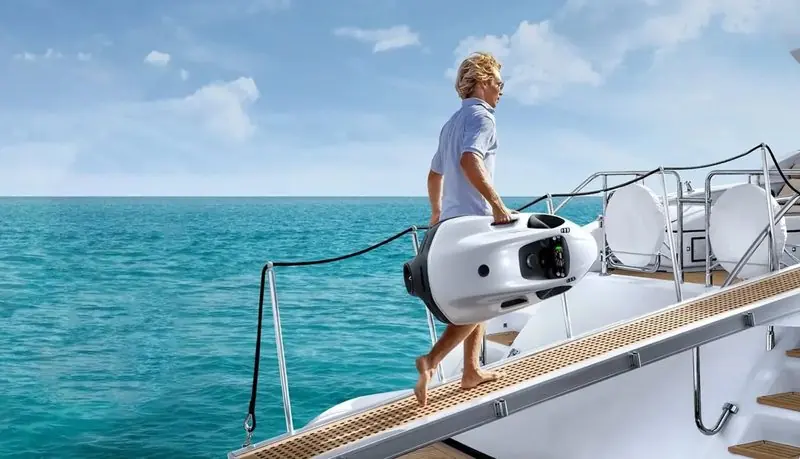
En un yate fondeado, el SEABOB suele ser el primer juguete que entra en el agua. Los invitados lo usan para explorar una cala o para nadar más rápido de lo que podrían por sí mismos, deslizándose junto a un arrecife con máscara. Va bien a un rango amplio de edades y de capacidades, lo que lo hace ideal para un grupo mixto a bordo. La tripulación puede entregar uno con una explicación breve y dejar que los invitados lo disfruten con seguridad. Esa facilidad de uso explica por qué casi todos los yates llevan al menos uno.
El propulsor cabe bien en el pañol de juguetes y se carga con la propia energía del yate. Su propulsión eléctrica limpia significa que se puede usar cerca de bañistas y de playas sin humos ni una hélice peligrosa. Para las familias es un favorito porque lo pueden montar niños y adultos. El SEABOB se ha convertido en parte de la estampa estándar de un día fondeado. Pocos juguetes náuticos están tan asociados a la vida del yate.
El juguete náutico de lujo por defecto
El SEABOB ha alcanzado una posición que casi todos los fabricantes solo pueden envidiar: ser la opción que se da por supuesta en su categoría. Cuando un yate enumera sus juguetes, casi siempre hay un SEABOB entre ellos. La mezcla de prestaciones, seguridad y acabado de la marca la ha convertido en la referencia con la que se miden los demás. Su asociación con el diseño de Porsche en el modelo más nuevo refuerza esa imagen premium. Cayago ha convertido un invento de nicho en una parte esperada de la experiencia del yate.
Para el armador, el atractivo es que el SEABOB sencillamente funciona y está a la altura. Es un juguete que los invitados reconocen y disfrutan sin instrucciones, y que deja bien al yate. La propulsión eléctrica encaja además con el giro del sector hacia equipos más silenciosos y más limpios. La inversión continuada de Cayago en modelos nuevos mantiene la gama al día. El SEABOB sigue siendo el juguete náutico que define la categoría que él mismo creó.
The SE63 for Lamborghini
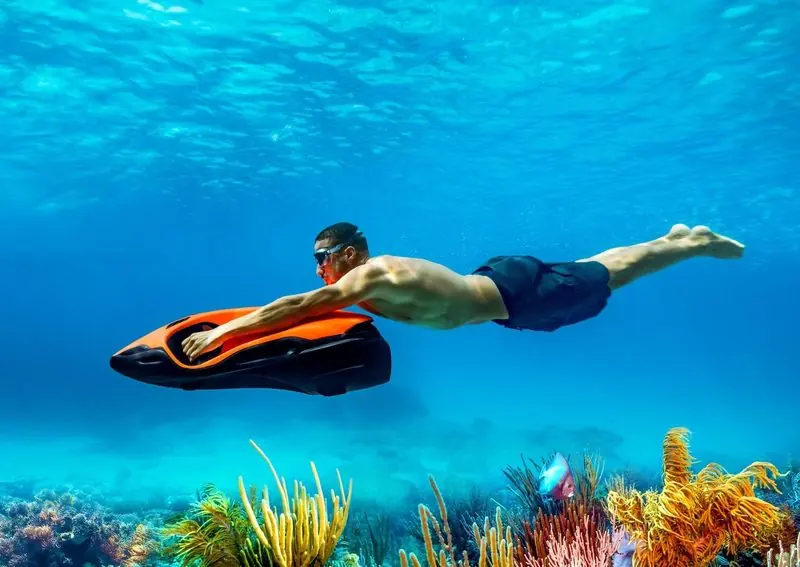
Cayago has built a licensed special edition with Automobili Lamborghini, and it is a different machine. The SE63 runs a 6.3 kW motor at 162 TP, nearly three times the plain F9, weighs 35 kg, runs about 60 minutes and is quoted at 35 km/h, roughly 19 knots, with the optional rear-mounted Performance Board fitted. Production started in the second quarter of 2026 with deliveries from that summer.
The 63 refers to 1963, when Ferruccio Lamborghini founded the car company. A figure of 63 knots circulates on social media and on review aggregators and appears nowhere in Cayago's technical documentation. The SE63 is allocation only and priced on application, in six Lamborghini finishes not offered on the standard machines.
What it costs, and when that was quoted
Cayago's EMEA list of September 2025 puts the F9 at EUR 9,285 net of VAT and the F9 S at EUR 12,380 net. A Mediterranean dealer publishing Maltese gross figures in May 2026 showed EUR 10,956.30 for the F9 and EUR 14,608.40 for the F9 S with 18 percent VAT applied. Every regional number moves with the tax rate and the exchange rate, so the net figure is the one to compare.
The options are not trivial against the base price. The same 2026 list showed Battery Capacity Plus at about EUR 847 gross, the driving stability system at about EUR 490 on the F9, a lifting dock at about EUR 1,095, a rack at about EUR 348, a bag at about EUR 352 and a cover at about EUR 99. Add the quick charger and a spare battery and a well-equipped F9 S lands close to EUR 20,000.
Lithium aboard, and which flags it actually binds
The Maritime and Coastguard Agency issued MGN 681 (M) Amendment 1 on 19 December 2025, covering fire safety, stowage and charging of small electrically powered craft and their lithium-ion batteries aboard yachts. Under it, lithium-ion batteries may only be charged aboard inside a certified container or space, any spare or removed battery above 100 Wh must sit in a dedicated cabinet built to EN 14470, EN 16121 or EN 16122, and from 1 January 2027 those containers on UK-registered vessels must carry UK type approval from a nominated body. The reach is wider than the initials suggest, because MGN 681 sits on Part A Chapter 14 of the Red Ensign Group Yacht Code, and the Red Ensign Group is not only the United Kingdom. The Cayman Islands, Gibraltar, the Isle of Man and the other British Overseas Territories and Crown Dependencies register under the same code, so a Cayman-flagged yacht is already inside Chapter 14. The Cayman Islands Shipping Registry goes further than the Code. Guidance Note 06/2023, read July 2026, annexes the United Kingdom's MGN 681(M) on the fire safety and storage of small electric powered craft and strongly recommends it be followed on every yacht that carries them, so a surveyor works to Chapter 14, that note and a vessel-specific risk assessment together.
The two flags outside the Red Ensign Group have moved separately and unevenly. The Republic of the Marshall Islands rewrote Yacht Code MI-103 with a 2026 edition effective 1 January 2026, and that edition introduces specific rules for spaces used to store or charge lithium-ion powered toys and tenders, so an RMI yacht now has a code requirement of its own rather than a borrowed one. Malta moved earlier and more softly. Transport Malta's Merchant Shipping Directorate issued a Commercial Yachting Notice on battery charging and storage aboard commercial yachts dated 22 June 2022, and Information Notice 45 on lithium-ion battery fires dated 7 September 2022, both framed as strong recommendation, with the firm requirement being that any suspect or defective pack is landed immediately and that deviations from the Commercial Yacht Code need the administration's approval. A Maltese yacht is surveyed against the Commercial Yacht Code, at its 2025 revision, not against MGN 681. The practical answer for an owner buying three SEABOBs is that the charging arrangement should be built to the strictest of the three, because flags change hands more often than garages get rebuilt.
Warranty, service and the alternatives
Cayago gives 24 months from transfer, batteries included and without a separate cycle limit, registered to the original purchaser. The warranty requires an annual inspection at an authorised facility and excludes use outside normal use, which is the clause that matters to anyone chartering the yacht. Declare the charter profile to Cayago before delivery, because those cases are assessed individually. Opening or modifying the machine voids it outright.
The rivals are the electric surfboards and the foils, not other sea scooters, because they compete for the same platform time and the same charging locker. A SEABOB works for a guest who cannot ride anything, at any age, with five minutes of instruction, which is where Awake, Fliteboard, Lift Foils and JetSurf all lose. It also does not get anyone out of the water, and after twenty minutes some guests want to stand up.
What class and the IMO add, and what they do not
Nothing at the International Maritime Organization binds a water toy today. The IMO's work on lithium-ion batteries has run through the Maritime Safety Committee's review of alternative fuels and new technologies, where MSC 109 added swappable traction battery containers to the list under review and identified nineteen regulatory gaps, eleven of which were confirmed for further work, and MSC 110, sitting from 18 to 27 June 2025, closed the review of regulatory barriers. None of that has yet produced a mandatory instrument reaching a 1.2 kWh sled in a yacht garage, and an owner told that the IMO requires something should ask which instrument.
Class arrives at the same place from a different direction. DNV's Battery (Safety) notation becomes mandatory where installed battery capacity exceeds 50 kWh in aggregate, which is more than forty times an F9 S pack, so a locker full of toys never triggers it. What the societies have produced is advice rather than rule. Lloyd's Register published LR-GN-052, Guidance Notes on Lithium-Ion Battery Powered Crafts and Vehicles carried on Yachts, on 10 June 2025, addressed to designers, builders and operators. DNV, Lloyd's Register, RINA, Bureau Veritas and ABS formed a Yacht Safety and Environmental Consortium in 2024. The obligation a yacht is actually surveyed against still comes from the flag, not from class and not from the IMO.
What the certified charging space costs
No manufacturer of a marine lithium charging locker publishes a price. The active-suppression systems yacht suppliers sell against MGN 681, the RACLAN boxes and the modular RAMBSS, and the passive ZARGES BatterySafe cases, were all quotation only in July 2026. The published prices that do exist are for shore-side industrial cabinets built to EN 14470-1 Type 90, which is one of the standards MGN 681 names for spare-battery stowage. A German supplier listed an asecos ION-CHARGE 90 with pull-out shelves at EUR 3,270 net of VAT in July 2026, and a United Kingdom supplier listed the taller asecos ION-CORE-90 at GBP 4,571.04 net or GBP 5,485.25 gross. Those figures set the order of magnitude for a box, not the cost of a compliant installation.
The SEABOB makes the problem harder than an eFoil does, because the battery does not come out. The ION-CHARGE 90 has an internal envelope of 470 by 452 by 582 mm and shelves rated at 25 kg, which suits a removable eFoil pack and will not take a sea sled. On a SEABOB the certified space has to be a compartment designed into the yacht rather than a cabinet bought and bolted down, and that is a refit drawing and a yard bill rather than a purchase order. One warning belongs alongside any quotation. In Safety Bulletin 35, updated 15 November 2024, the MCA found that a lithium storage container marketed as fully compliant with MGN 681 was not able to comply fully, stated that no international standard governs these products, and advised that any certification a manufacturer claims should be viewed with caution.
Información práctica
| New price (net) | F9 EUR 9,285 and F9 S EUR 12,380, per Cayago's EMEA list of September 2025 |
|---|---|
| Gross Mediterranean price | F9 EUR 10,956.30 and F9 S EUR 14,608.40 with 18 percent VAT, a Maltese dealer list read May 2026 |
| Main options | Battery Capacity Plus about EUR 847 gross, quick charger about EUR 1,752 gross, driving stability system about EUR 490 on the F9 |
| Running cost | the pack is integrated and does not come out, so a failure out of warranty is a specialist rebuild with no published price |
| Storage and charging | from 1 January 2027 UK-flagged yachts need a type-approved certified locker; shore-side EN 14470-1 cabinets run EUR 3,270 to about GBP 5,485 gross and are sized for a removable eFoil pack, not a SEABOB, so plan a built-in compartment |
| Warranty | 24 months from transfer including the battery, with an annual inspection required and cover void for undeclared charter use or for opening the unit |
| What is not published | no top speed for the F9 or F9 S, no spare battery on any dealer list, and no price anywhere for a certified charging locker built for the integrated pack |
Solicitar presupuesto para SEABOB (Cayago).
Dinos el modelo y adónde debe llegar. La redacción obtiene una oferta por escrito del fabricante o de un distribuidor autorizado, la contrasta con los precios publicados en esta página y te responde por email. Sin compromiso y sin coste.
- 01Una oferta por escritoEn tu moneda, con IVA, entrega y plazo indicados, no una cifra de catálogo.
- 02Entregado donde está el yateEn el puerto, el astillero o tu dirección, con la documentación que exige una batería de litio o una maniobra de grúa.
- 03IndependienteYotters no depende de ningún distribuidor, así que la oferta se compara antes de llegarte.
Lo que cuentan armadores y tripulaciones
No independently attributable owner or crew testimony found
trade coverage repeatedly describes the SEABOB as the first toy named when a captain lists what is in the locker, but no publication found in this research names an owner, captain or crew member willing to be quoted on the record about the F9 specifically
Yotters research desk
Lo bueno y lo que conviene vigilar
Puntos fuertes
- Any guest can ride itfive minutes of briefing suits a nervous teenager and a confident diver alike, which is where eFoils and jet boards lose most guests
- Nine kilos lighter than the F5the F9 S drops from about 35 kg to 25.9 kg, turning what used to be a two-person lift off the swim platform into a one-person job
- Positive buoyancy is a real safety marginletting go of the throttle stops the motor and floats the rider back to the surface rather than leaving him stranded below
A tener en cuenta
- One charge, one sessionthe integrated battery cannot be swapped, so a standard F9 gives about 40 minutes of riding and then a four to six hour wait before the next guest can use it
- No published top speedCayago confirms thrust in its own TP units but has never given a knots figure for the F9 or F9 S, so a buyer cannot compare it directly against a rival sea scooter on speed
- The certified charging locker is an unbudgeted refit itemno marine supplier publishes a price for a locker sized to a non-removable SEABOB pack, and the MCA's Safety Bulletin 35 found at least one product marketed as MGN 681 compliant was not able to comply fully
Para quién es: Armadores e invitados de charter que quieren un juguete náutico eléctrico, rápido y seguro que pueda manejar cualquiera a bordo.