Botin Partners
| Founded | 1995 by Marcelino Botin, who remains founder and president |
|---|---|
| Based | Santander, on the north coast of Spain |
| Discipline | naval architecture, hydrodynamics, aerodynamics and velocity prediction; styling and interiors are not the studio's field |
| Team | a compact core group, with partner Adolfo Carrau leading velocity prediction and rating work |
| America's Cup | Botin was design chief at Emirates Team New Zealand from 2004 to 2011, whose boat won the 2007 Louis Vuitton Cup before losing the Match 5-2 to Alinghi |
| Later Cups | principal designer for NYYC American Magic (36th Cup, 2021) and for Alinghi Red Bull Racing (37th Cup, Barcelona 2024) |
| Grand prix record | the studio describes itself as the most successful design office in TP52 history, and designed five TP52 world championship winners for Quantum Racing |
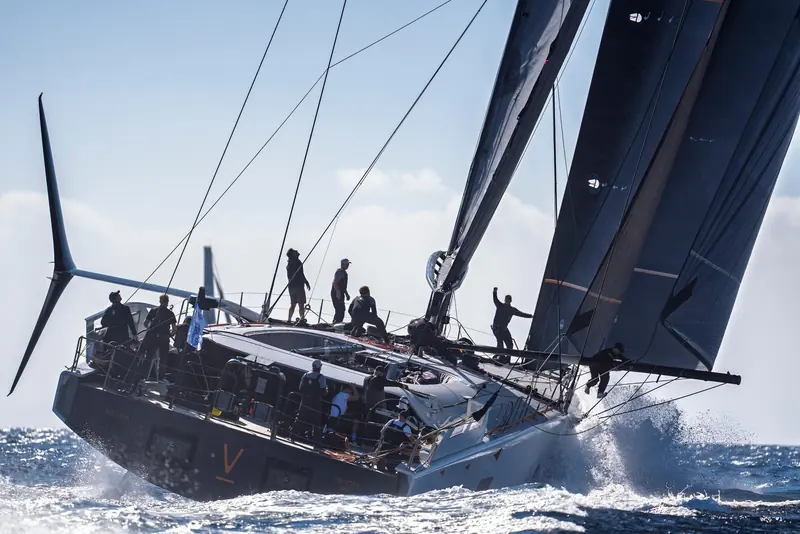
| Raven | Baltic 111, 34 m LOA, built by Baltic Yachts in Jakobstad, Finland, launched 2023 and delivered in December 2023 |
| Raven team | concept, exterior and interior by Jarkko Jamsen of Aivan; naval architecture by Botin Partners; structural engineering by PURE Design and Engineering |
| Raven awards | Outstanding Exterior Design, Best Interior Design, Best Naval Architecture and Innovation of the Year, Boat International Design and Innovation Awards, 2 February 2025 |
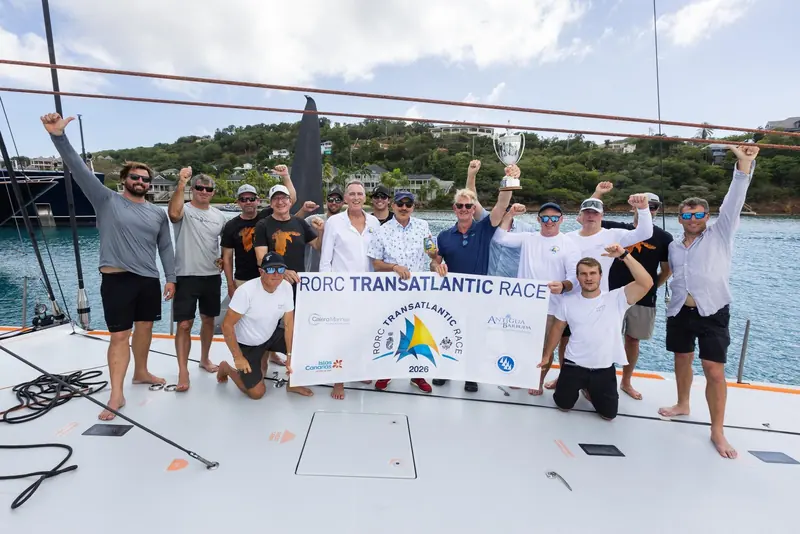
| Raven record | monohull race record in the 2026 RORC Transatlantic Race, Lanzarote to Antigua, in 6 days 22 hours 27 minutes 47 seconds |
| Melges 40 | canting-keel one-design, 11.99 m, 3,250 kg, built by Premier Composite Technologies in Dubai, first boats 2016 and 2017 |
| Design fee | no Botin fee scale is published; the SuperYachtReview guide of March 2026 puts a superyacht designer at 1 to 5 per cent of build cost, outside the yard price |
| Not included | exterior and interior styling, structural engineering on Raven, construction supervision and classification were all separate appointments |
Santander, 1995
The studio did not begin as a consultancy. With backing from the insurer Zuritel, Botin set up a small yard, Astilleros Mouro, in Santander to design, build and race a 33 foot IMS yacht on the Spanish circuit. The boat raced as Zuritel with a local crew, and by the studio's own account it did well enough in the 1996 and 1997 seasons to turn a one-off campaign into a practice. The yard was a means to an end. What Botin wanted to sell was the drawing, the numbers behind it and the speed on the water.
That origin still explains the business. Botin Partners is organised around naval architecture and performance prediction, not around styling. Its own team page lists Botin himself on hydrodynamics and aerodynamics, partner Adolfo Carrau on velocity prediction and rating optimisation, plus a small group of production designers and deck and systems specialists. It is a racing office that also takes on cruising work, and an owner should understand that before walking in expecting a full-service superyacht studio with interior designers on the next floor.
The America's Cup years
Botin ran design at Emirates Team New Zealand from 2004 to 2011. His boat won the Louis Vuitton Cup in Valencia in 2007 and then lost the Match to the defender Alinghi 5-2, the last monohull the New Zealanders built before the Cup went to catamarans. In the same period the studio drew for the Volvo Ocean Race: its site lists the Puma Volvo 70 of 2008, which finished second overall in 2008-09, and Camper, drawn with Team New Zealand, which finished second in 2011-12.
In 2017 the New York Yacht Club challenge signed Botin Partners as its exclusive designer for the 36th Cup. The campaign, American Magic, capsized its AC75 Patriot in January 2021 and was then knocked out 4-0 by Luna Rossa in the Prada Cup semi-finals. Botin moved on to lead the design of Alinghi Red Bull Racing for the 37th Cup in Barcelona, where the Swiss finished fourth in the round robin and lost their Louis Vuitton Cup semi-final to INEOS Britannia. The record is deep and serious, but it is not a run of Cup wins, and a fair reader should hold both facts at once.
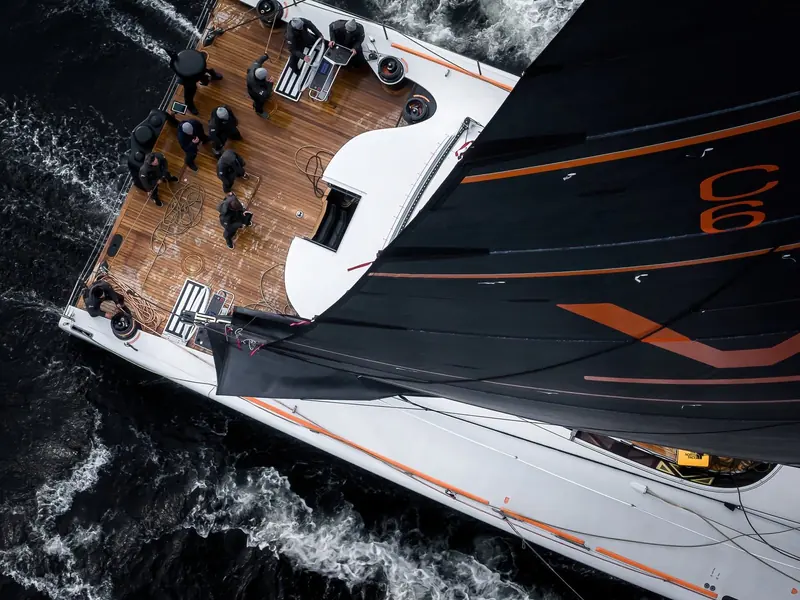
Raven was drawn to skim rather than fly, and her naval architect's own warning is that if you do not stop her at 34 knots she will break in two.
What a performance naval architect actually does
On a Botin project the core product is a hull and appendage package backed by a velocity prediction program, the software model that tells an owner and a yard what speed the boat should reach at each wind angle and strength. The studio's grand prix work is built on that loop: design, predict, race, measure, refine. Its own description of its method is that technology developed on the race course is then refined for cruising clients. On Raven that meant foils, trim tabs and a live display of dynamic righting moment that the studio says it knows of on no other boat.
What the studio does not do is equally important. On Raven the overall concept, exterior styling and interior were drawn by Jarkko Jamsen of the Helsinki agency Aivan, and structural engineering was done by PURE Design and Engineering in New Zealand. An owner commissioning a high-performance sailing superyacht from Botin should therefore expect to assemble a team: a stylist, a structural engineer and an owner's project manager alongside the naval architect. That is normal at this end of the market, but it is a different arrangement from studios that carry every discipline under one roof.
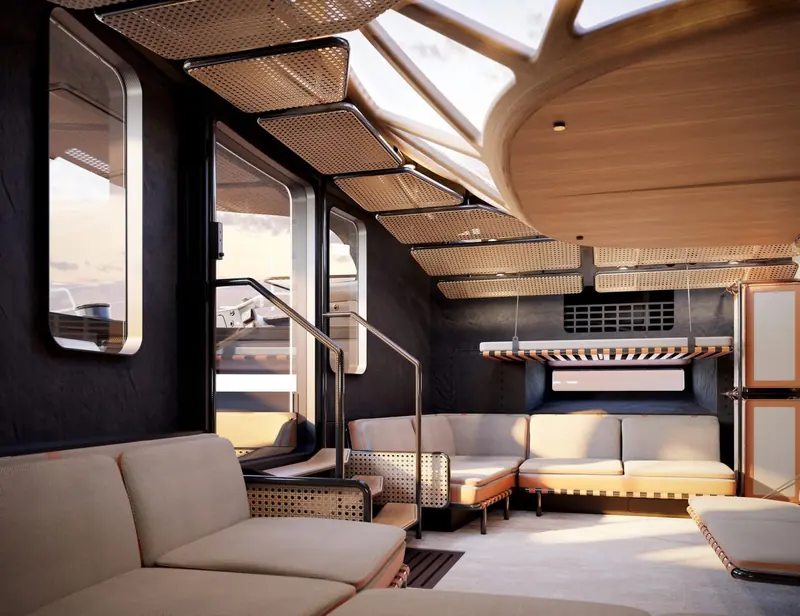
Raven: the brief
Boat International quoted the owner directly: he wanted a superyacht, but a fast one with a nice interior, and that requirement led to foils. The result is a 34 metre carbon sloop, 111 feet overall, with a beam of 7.40 m, a 4.80 m draught and a light displacement of about 55 tonnes, against the 95 tonnes Yachting World gives for Baltic's conventional 110 Zemi. A fixed fin carries a 9.3 tonne bulb, and water ballast tanks sit in each aft quarter.
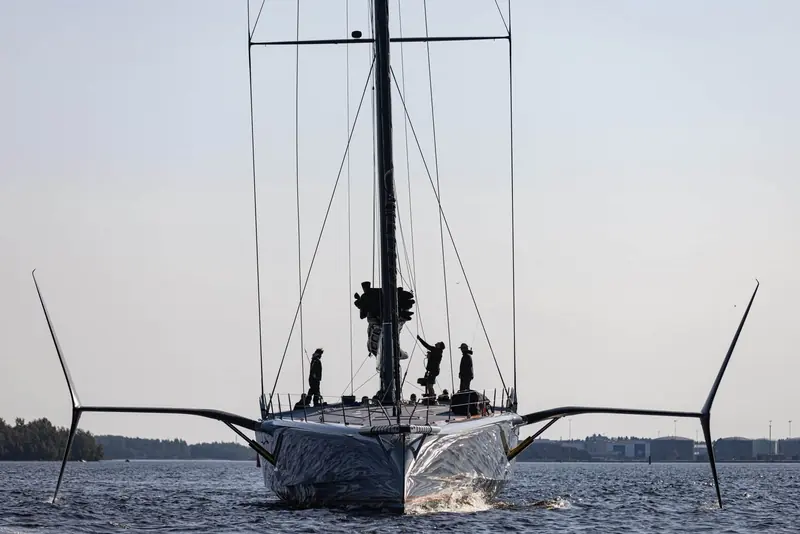
The distinctive element is a pair of T-shaped foils on hydraulically canting side arms, each around 7 m long, with trailing edge trim tabs. Baltic Yachts says they support roughly 60 per cent of the displacement at speed. Raven is not designed to fly clear of the water like an AC75. Botin partner Adolfo Carrau told Yachting World the idea was never to make a foiling boat as such, and the sailing team compare the foils to a turbo boost. The goal was a boat that skims fast and upright while still carrying a real interior.
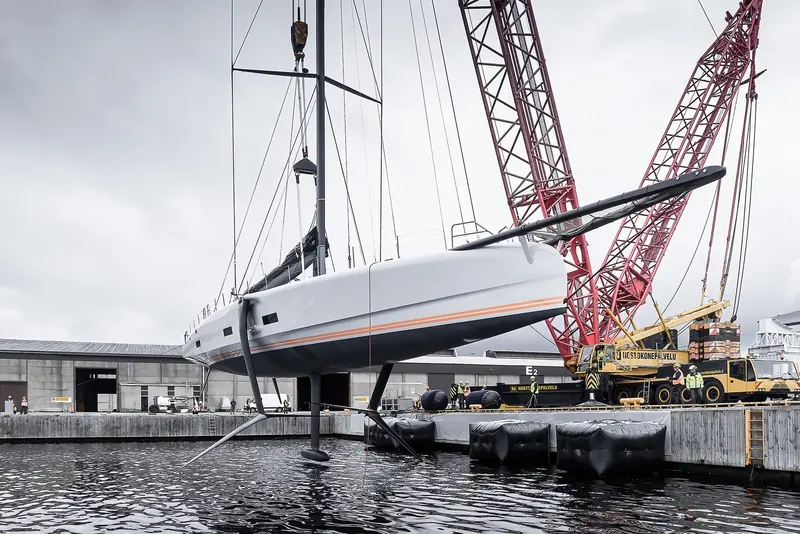
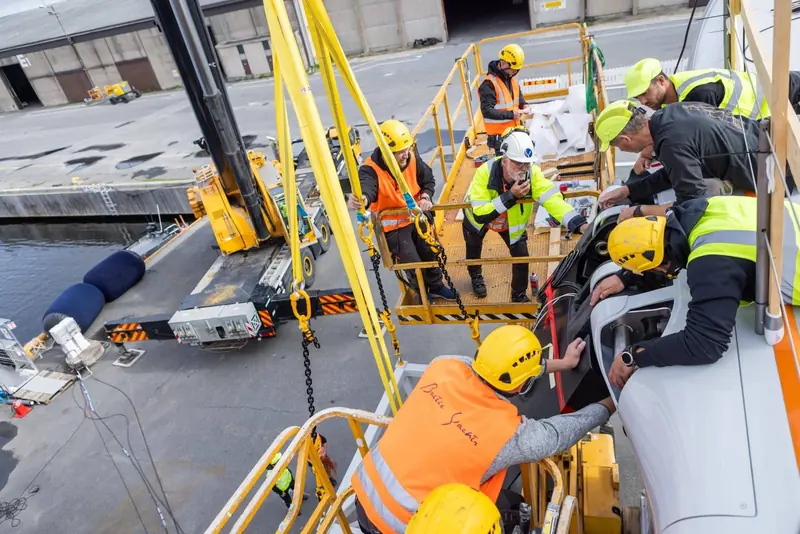
Raven: the build and what it cost in weight
Baltic's executive vice-president Henry Hawkins told Boat International he knew of no other superyacht where achieving the target weight to the last kilogram meant the difference between success and failure. The response shows everywhere on board. Glazing is Perspex rather than glass, saving about 250 kg by Boat International's count. Walls and ceilings use foam-backed SeaDek, furniture frames are carbon tube with rattan panels and fittings include 3D-printed titanium parts. Propulsion is diesel electric with a retractable carbon propeller.
The trade-offs are stated openly. Yachting World's test notes that there is no conventional sound deadening, so the boat is noisy at speed, and crew sleep in pipe cots. Accommodation is modest for 34 metres: Boat International lists four guests in two cabins, with the owner's berth aft on the centreline folding away for racing. Jamsen turned the exposed structure into the look of the boat, telling Boat International that what is not normally visible is now on display. A buyer expecting a conventional 34 metre layout will find Raven a very different animal.
Raven under sail, and the awards
At the Boat International Design and Innovation Awards in Kitzbuhel on 2 February 2025, Raven took Outstanding Exterior Design, Best Interior Design, Best Naval Architecture and Innovation of the Year, a sweep Baltic Yachts reported the same week. The Best Naval Architecture prize is the one that belongs most directly to Botin Partners. Baltic credited the result to a shared team that included Jamsen, A2B Marine Projects, Botin Partners, PURE Design and the owner's team led by Klabbe Nylof.
On the water, Raven finished the 2026 RORC Transatlantic Race from Lanzarote to Antigua in 6 days 22 hours 27 minutes 47 seconds, taking monohull line honours and the IMA Trophy on her first attempt, as both the Royal Ocean Racing Club and Boat International reported. Her navigator Will Oxley was careful with the comparison: he said Raven has clear advantages at certain angles, but that the maxi Comanche still has the edge in pure downwind VMG. Yachting World adds that she is not optimised for upwind or dead downwind work and is at her best on a broad reach.
The Melges 40
The boat is 11.99 m long and displaces 3,250 kg, with a carbon fin that cants up to 45 degrees and carries a bulb of about 1.1 tonnes. Hulls are epoxy-infused carbon over foam, built by Premier Composite Technologies in Dubai. Sailing World reported the first boat launched in September 2016, the studio's own portfolio dates the launch to 2017, and Yachts and Yachting named her its 2017 performance keelboat of the year. Yachting World measured her at about 800 kg lighter than a Fast 40+ and quoted downwind speeds of 22 to 24 knots.
The class made its public debut at PalmaVela in 2018 with five boats, from teams in Sweden, Italy, Japan and Monaco, aimed at the Mediterranean grand prix circuit. Carrau told Yachting World the concept and the way the boat behaves are unique. The honest note is scale: a fleet of five is small, and a one-design depends on numbers to hold value and give owners racing. For Botin the Melges 40 is proof the studio can package grand prix technology into a boat that ordinary owner-drivers race, which is the same argument it makes for Raven.
What it costs to hire a racing naval architect
Those guide figures sit outside the yard price and cover the designer's appointment in general, not naval architecture specifically. On a project run the way Raven was, the naval architecture fee is only one line. The owner also paid a separate concept and interior designer, a structural engineering firm and an owner's project management company, A2B Marine Projects, and each of those carries its own fee and its own contract. A performance brief usually adds tank or computational testing, appendage development and a post-delivery optimisation phase; Baltic planned 12 to 18 months of development after Raven's handover.
The practical point for a buyer is that a foil-assisted or grand prix derived yacht moves money from the interior budget into engineering hours and testing. Nobody published what Raven cost, and Yotters has found no public figure for her design fees. An owner should ask for a staged fee proposal that separates concept, velocity prediction, appendage design and on-water support, and should expect the performance work to continue, and be billed, well after launch.
What an owner should expect and check
Raven shows the working model. The owner's side appointed a project manager, Garth Brewer of A2B Marine Projects, and a sailing team manager, Klabbe Nylof, and the yard, stylist, naval architect and engineer worked as a coalition. That puts a premium on clear contracts, because a speed prediction is an engineering estimate, not a warranty, and a missed weight target can undo a performance design. Ask to see how the studio's predictions compared with measured numbers on earlier boats of a similar type.
Then ask the operational questions. Raven has a structural speed limit of about 33 to 34 knots, which Carrau explained bluntly to Yachting World, and racing her needs a dedicated foil trimmer. Her skipper Damien Durchon told the RORC that if a foil stalls the boat simply behaves like a conventional yacht, which is reassuring, but a complex boat still needs a professional crew. Check the crew numbers, the noise levels you will accept and the guest capacity before the lines are drawn, not after.
Strengths and trade-offs
Few offices can point to a hull, appendage and prediction pipeline tested at this level for this long. The TP52 record, the Volvo boats and three Cup campaigns mean the studio has been measured against the best designers in the world repeatedly and in public. Raven converted that into a cruising yacht that won Best Naval Architecture and then broke a transatlantic record with her owner's team, which is the strongest evidence an owner could ask for that the method transfers.
The limits are just as real. Raven is, on the studio's own portfolio, its only delivered superyacht, so an owner commissioning a 40 or 50 metre boat is asking the office to scale up from one data point. The studio does not style or fit out interiors, so a separate designer and extra coordination are unavoidable. Its Cup record includes more semi-final exits than wins. And the performance-first philosophy has costs owners feel daily: less volume, more noise and more crew than a cruising yacht of the same length.
Informations pratiques
| Design fee | Not published by Botin Partners; quoted per project. For reference the SuperYachtReview price guide (March 2026) puts a superyacht designer at 1 to 5 per cent of build cost and project management at 2 to 4 per cent, both outside the yard price |
|---|---|
| What is NOT included | Exterior and interior styling, structural engineering, owner's project management, construction supervision and classification. On Raven these went to Jarkko Jamsen of Aivan, PURE Design and Engineering, A2B Marine Projects, Baltic Yachts and the classification society respectively |
| Recent yards worked with | Baltic Yachts (Raven, Jakobstad, delivered December 2023); Premier Composite Technologies, Dubai (Melges 40 one-design) |
| What to check before commissioning | Ask how the studio's velocity predictions compared with measured speeds on earlier boats, agree the weight budget and who polices it, and settle crew numbers, noise and guest capacity before the lines are drawn |
| Design process an owner should expect | A team built around the naval architect: separate stylist, structural engineer and owner's project manager, velocity prediction and appendage development through design, then a post-delivery optimisation phase; Baltic planned 12 to 18 months of development after Raven's handover |
Ce que rapportent propriétaires et équipages
The naval architects set a hard structural ceiling on Raven's speed
Botin partner Adolfo Carrau explained that Raven's maximum allowable speed is about 33 to 34 knots because dynamic righting moment keeps climbing with speed, and said that if you don't stop the boat, it will break in two. The boat displays its live dynamic righting moment to the crew, which Carrau said is a first as far as the studio knows.
Adolfo Carrau, partner, Botin Partners, quoted by Yachting WorldThe skipper says the foils make the boat safer, not more fragile
After the record transatlantic crossing, Raven's skipper said the boat is incredibly stable and that the better it performs the safer it becomes. He added that if a foil stalls, the boat simply behaves like a conventional yacht.
Damien Durchon, skipper of Raven, quoted by the Royal Ocean Racing ClubThe builder says weight decided whether the project succeeded
Baltic's executive vice-president said he knew of no other superyacht where achieving the target weight down to the last kilogram meant the difference between success and failure, and that Raven still supports a superyacht level of systems and comfort despite the weight programme.
Henry Hawkins, executive vice-president, Baltic Yachts, quoted by Boat International and Yachting WorldThe navigator is candid about where Raven is not the fastest
Comparing Raven with the maxi Comanche, the navigator said Raven has clear performance advantages at certain angles, but that Comanche still has the edge in pure VMG downwind and that the team continues to work on it.
Will Oxley, navigator of Raven, quoted by Boat International and the Royal Ocean Racing Club
Les points forts et les points de vigilance
Points forts
- Performance design proven at the highest levelThree America's Cup campaigns as lead designer, Volvo Ocean Race podium boats and a TP52 record the studio calls the most successful in the class mean its hull and appendage work has been tested against the best in public for three decades.
- Raven proved the method transfers to a superyachtThe 34 m Raven won Best Naval Architecture among four Boat International awards in 2025, sustains 25 knots at under 10 degrees of heel and set a RORC Transatlantic monohull record of 6 days 22 hours in January 2026.
- Candid engineering limitsThe studio states Raven's structural speed ceiling plainly and builds a live righting moment display for the crew, the kind of transparency a performance owner needs from a naval architect.
Points de vigilance
- One delivered superyachtRaven is the only superyacht in the studio's portfolio, so a larger commission asks Botin to extrapolate from a single delivered project rather than a fleet.
- Narrow discipline means more appointmentsStyling, interiors and structural engineering on Raven were all separate firms, so an owner carries the coordination and the extra fees that a full-service studio would absorb.
- Performance costs comfortRaven has no conventional sound deadening, crew sleep in pipe cots and she carries four guests in two cabins at 34 m, and her navigator concedes the maxi Comanche is still faster in pure downwind VMG.
Pour qui: An owner who wants a genuinely fast sailing yacht, will appoint a separate stylist and project manager, and will accept less volume and more noise in exchange for grand prix performance.