Cristina Gherardi Design
| Founder | Cristina Gherardi Benardeau, an Italian architect trained in Florence |
|---|---|
| Partner | Marcello Bozzarelli |
| Studio | CG Design, founded in Paris in 2011 |
| Earlier career | retail architecture for Virgin Megastore and Kenzo; director of architecture worldwide for Christian Dior Couture (LVMH); founder of the Giorgio Armani Interior Design Studios in New York and Milan |
| First yacht | Odessa, 48.77 m Christensen, delivered 2009, interior design; won the 2010 ShowBoats Design Award for Best Interior Design |
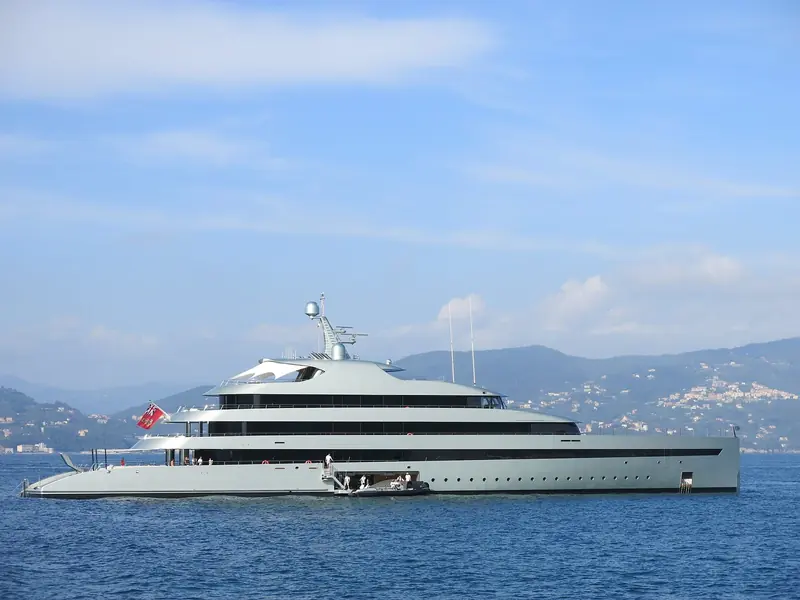
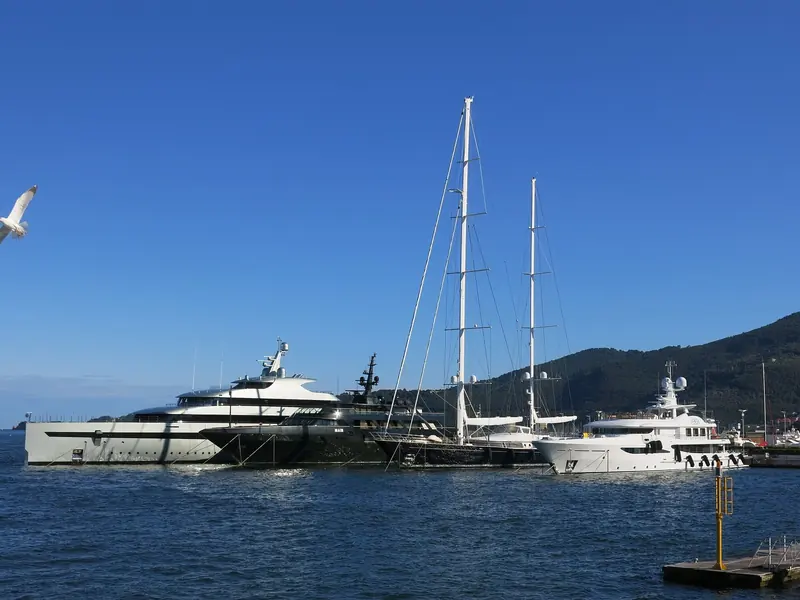
| Signature yacht | Savannah, 83.5 m Feadship, delivered 2015, both interior and exterior by CG Design |
| Savannah was the world's first large hybrid-propulsion superyacht and the first superyacht finished in a full metallic paint scheme, including her underwater hull | |
| Awards for Savannah | three 2016 ShowBoats Design Award Neptune trophies (exterior, interior, holistic design, Motor Yacht Above 500GT), World Superyacht Awards Motor Yacht of the Year, ISS Best Power Yacht over 65 metres |
| Propulsion | 1 Wartsila 9L20 main diesel (1,800kW), three Caterpillar gensets, a 1MWh Corvus Energy battery bank, azimuthing thruster, five operating modes, approximately 30 per cent fuel saving over a conventional yacht of the same size (Feadship's own figure) |
| Range approximately 6,500 nautical miles; cruising speed approximately 14 knots; top speed approximately 17 knots | |
| Guests 12 in 6 cabins; crew accommodation for up to 22-26 | |
| Original owner | Lukas Lundin, the Swedish-Canadian mining and energy entrepreneur who chaired the Lundin Group; he died in July 2022 |
| Savannah was listed for sale in September 2023, cut by EUR 29 million to an asking EUR 140 million in June 2024, and sold in-house at Edmiston in May 2025; the sale price was not disclosed | |
| A 2020 refit at MB92 Barcelona, including a full repaint in the original Sea Foam colour, cost more than EUR 9 million | |
| Reported second credit | interior of O3, a 109 m Lurssen ice-classed explorer delivered 2026, after a 2022 change of ownership; BOAT International reports this as credible but not fully confirmed by the yard |
| Design fee | not published by the studio; the market-wide SuperYachtReview 2026 price guide band is 1 to 5 per cent of build cost plus 2 to 4 per cent project management, neither specific to CG Design |
From Dior's Shopfronts to a Feadship Hull
Cristina Gherardi Benardeau is an Italian architect trained in Florence who spent the first half of her career nowhere near a boatyard. Her early work was retail architecture: she conceived the Virgin Megastore and Kenzo stores in France and department store projects for the Brunswig family in Switzerland. From there she joined the LVMH group as director of architecture for Christian Dior Couture, running the brand's retail build-out worldwide, before founding and running the Giorgio Armani Interior Design Studios in New York and Milan, where she spent roughly a decade on private residences, Armani Casa real-estate projects and, for the first time, a yacht interior.
That first yacht was Odessa, a 48.77 metre Christensen delivered in 2009, where Gherardi worked on the interior under the Armani Casa banner and made changes to the general arrangement. Odessa won the ShowBoats Design Award for Best Interior Design in 2010. It was the owner's own next commission, not a marketing push, that turned her into a yacht designer: when he decided to go bigger, he asked her to help pick a yard and to design the boat with him. That became Savannah, and it was the reason Gherardi set up her own practice, CG Design, in Paris in 2011, working alongside Marcello Bozzarelli.
One Office, Both Ends of the Boat
CG Design's defining fact is that it did not split Savannah's design the way almost every yacht in this size is split. Feadship and its in-house De Voogt Naval Architects handled naval architecture and engineering, but Gherardi and Bozzarelli were given both the interior and the exterior styling, an arrangement most studios of any size never get offered once, let alone on a first large commission. Most offices in this directory, including Espen Oeino International, hand the interior to a separate house appointed by the owner; here the same two people who set the layout below also drew the silhouette above the waterline.
The practical effect is a boat where the outside and the inside were argued out by the same eye. The glass that wraps the aft end of each deck, the black band that ties the windows together visually, and the curved partitions inside are not two separate briefs that happened to land on the same hull, they are one idea carried through from the sketch to the joinery. That is unusual enough in superyacht design that it is worth stating plainly before anything else on this page: CG Design is not primarily an interior house or an exterior house, it is the rarer case of a studio hired to do both at once.
Every partition on Savannah is curved. Gherardi's own test for the crew was simple: if there was no genuine nautical reason for a convention, she changed it.
The Nemo Lounge and the Secret Bow Room
Savannah's most photographed space is the Nemo lounge, a two-level room set aft and partly below the waterline with tiered, stadium-style seating facing a curved glass wall onto the sea. It sits in one of the most stable parts of the hull, so anchored guests can watch marine life pass by daylight, and at night a drop-down screen converts the same room into a cinema. Nothing else on a yacht this size does both jobs in the same space, and it is the feature every subsequent review of Savannah leads with.
Forward, and far less publicised, is a second lounge tucked into the bow, a quiet retreat among the waves that most guests never find on a first visit and that CG Design has described as deliberately hidden rather than announced. Between the two, Savannah runs an open-plan main deck where sliding curved-glass doors let the saloon and the weather deck merge into one space, and an owner's suite lit by a large skylight. The studio's own account of the brief is that Gherardi kept asking Feadship's engineers whether a given convention had a genuine nautical reason behind it, and where the answer was no, she changed it.
No Straight Lines, and a Hull Painted Like a Car
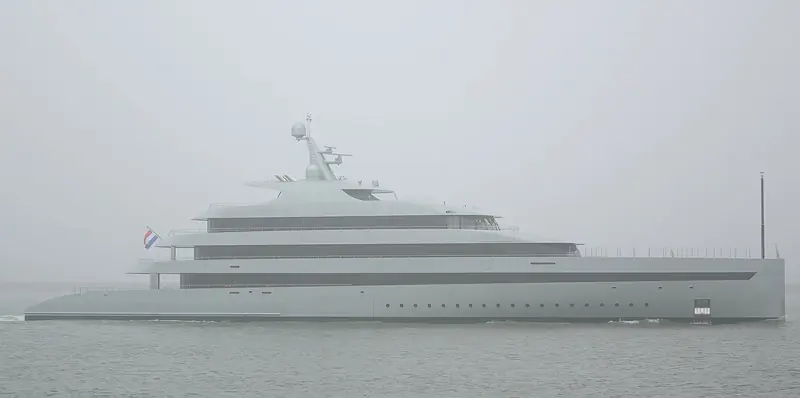
Every partition and corridor on Savannah is curved. Gherardi has described the intent plainly: the curves let a guest feel the space and move from one room into the next rather than walking a straight passage from door to door, and the effect is meant to feel like floating rather than transiting. It is a genuinely unusual choice at 83.5 metres, where straight structural bulkheads are the cheap and simple default, and it shows the studio treating the whole interior as one continuous architectural gesture rather than a sequence of separately decorated rooms.
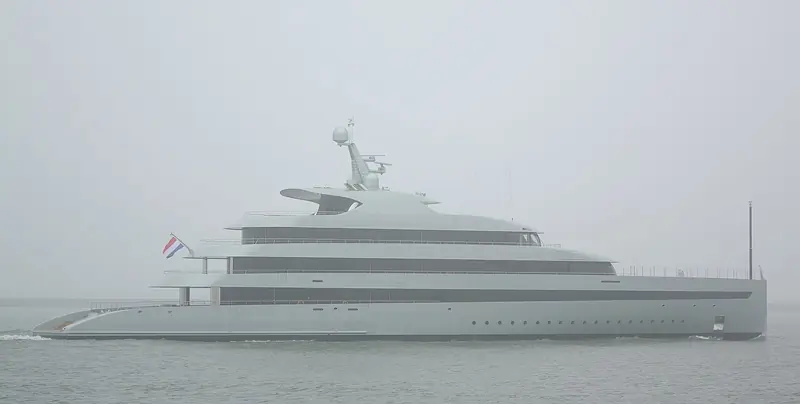
The exterior carries the same commitment to a single idea taken all the way through. Savannah was the first superyacht finished in a complete metallic paint scheme, including her underwater sections, in a colour the yard calls Sea Foam. The finish was applied in one continuous pass by a six-person team using a spray technique Feadship developed specifically for the job, because a metallic base coat shows every join and every stop-start mark that a normal topcoat hides. Milan's Metis Lighting did the lighting design, which on a hull this reflective is not a decorative afterthought but part of making the paint scheme read correctly after dark.
A Hybrid Drivetrain, and What 30 Per Cent Actually Means
Savannah's hybrid propulsion was engineered by Feadship, not by CG Design, but it is inseparable from why the boat exists and it is worth stating in real numbers rather than the marketing shorthand. The system pairs one Wartsila 9L20 main diesel engine of 1,800kW with three Caterpillar gensets, a 1 megawatt-hour Corvus Energy battery bank and an azimuthing thruster mounted in the main propeller's slipstream, switchable across five different operating modes depending on whether the yacht is cruising, manoeuvring in port or sitting at anchor.
Feadship's own figures put the fuel saving at roughly 30 per cent against a conventionally powered yacht of the same size, with the hull itself running seven to eight per cent more efficiently than a standard displacement form. Savannah cruises at around 14 knots, reaches a top speed near 17 knots, and carries a published range close to 6,500 nautical miles, drawn from a 171,470 litre fuel capacity. In her first year of operation she covered 14,000 nautical miles without a reported mechanical issue, which for a genuinely new propulsion architecture, rather than an incremental update of an existing one, is the number that mattered most to Feadship and to the owners of the yachts that followed her.
Three Neptunes in One Year
Savannah won three ShowBoats Design Award Neptune trophies at the 2016 ceremony: Exterior Design and Styling, Interior Layout and Design and Holistic Design, all in the Motor Yacht Above 500GT class. Only one other yacht that year, the sailing yacht Nikata, matched that haul, and Nikata split its credits across separate exterior and interior teams. Savannah's three wins went to the same two-person office for both ends of the brief, which is the rarer achievement of the two.
The same year brought Motor Yacht of the Year at the World Superyacht Awards and Best Power Yacht over 65 metres at the International Superyacht Society Awards. Taken together, a boat conceived by an architect with no previous yacht design credit of her own, on only her second yacht project, swept the major juries of 2016. It is a genuinely rare outcome, and it is also the reason CG Design's public identity still runs almost entirely through this one hull a decade later.
Eight Years, One Change of Owner and a Second Credit
CG Design's yacht portfolio is short: Odessa's interior in 2009, Savannah's interior and exterior in 2015 and then, by most trade reporting, nothing publicly credited for the better part of a decade. That changed with O3, the 109 metre ice-classed explorer Lurssen delivered in 2026 after an eight-year build that began at Peene-Werft in 2018 under the name Project Icecap for a different owner and a different design team, Salt Ship Design on the exterior and Adam Lay Studio on the interior.
The project changed hands in 2022, was renamed Project Shackleton, gained a certified helideck and a length extension, and had its exterior substantially reworked by Espen Oeino International. BOAT International's own delivery report describes Cristina Gherardi Design as having been brought onto the new team to rework the interior, while flagging at an earlier point in its coverage that the credit was still unconfirmed and rumoured rather than formally announced by the yard. Other trade outlets state the interior credit as settled fact. This page follows the more cautious of those two positions: CG Design is reported, credibly and by more than one outlet, to have reimagined O3's interior after 2022, but Yotters has not seen the studio or the owner confirm it directly, and readers comparing the studio for a new commission should treat it as a strong probable second credit rather than a certain one.
What a Client Still Does Not Know Going In
Nothing about what CG Design charges is published anywhere this research could find, which is consistent with every boutique studio in this size bracket: none of them post a rate card, and the only public figure is the market-wide band, not one specific to this office. The SuperYachtReview 2026 price guide puts a designer's fee generally at 1 to 5 per cent of build cost, with project management running a further 2 to 4 per cent on top, both figures sitting outside whatever a yard itself quotes. On a hull costed anywhere near Savannah's market value, that band alone spans tens of millions of dollars, which is exactly why an owner needs the fee written into the design contract rather than inferred from an industry rule of thumb.
A two-person studio also carries a specific, practical risk that a fifty-person office does not: almost everything CG Design has produced publicly runs through Gherardi personally, and the standard industry trading conditions for design consultants say nothing about what happens if a named principal becomes unavailable mid-project. An owner commissioning this studio for a new build should ask for that in the contract explicitly, the same way an owner would with any small named practice, rather than assume it is covered.
Informations pratiques
| Design fee | not published by CG Design; the market-wide band is 1 to 5 per cent of build cost plus 2 to 4 per cent project management, both outside a yard's quoted price (SuperYachtReview 2026 price guide) |
|---|---|
| What is confirmed on paper | interior and exterior design credit for Savannah (Feadship, 2015) and interior design credit for Odessa (Christensen, 2009); the studio's own site and BOAT International's directory list only these two by name |
| What is reported but not fully confirmed | the interior of O3 (Lurssen, 109 m, delivered 2026) is credited to CG Design by several trade outlets, but BOAT International's own reporting has also described the credit as rumoured rather than yard-confirmed |
| How the studio is structured | a small, named practice run by Cristina Gherardi Benardeau with Marcello Bozzarelli, based in Paris, working across interior architecture, yacht interiors and, on Savannah, exterior styling as well |
| Build-cost context for the signature project | Savannah's original build cost was not published; her last public asking price before the 2025 sale was EUR 140 million, and a 2020 refit including a full repaint cost more than EUR 9 million |
| Charter | Savannah has chartered at rates reported around EUR 1,000,000 a week before typical additional costs such as APA, tax and gratuities; charter availability depends on the current owner's programme and is not guaranteed |
Ce que rapportent propriétaires et équipages
No independently attributable owner or crew testimony found
press coverage of Savannah repeats quotes from Cristina Gherardi herself and from Feadship's own team, but this research found no on-the-record account from a private owner, guest or named captain describing how the finished boat actually lives day to day; Savannah's original owner operated under the same discretion typical of yachts this size, and the current owner has not spoken publicly since the 2025 sale
Yotters research desk
Les points forts et les points de vigilance
Points forts
- A rare single-office credit for both interior and exteriorGherardi and Bozzarelli drew the whole boat rather than one half of it, so the outside and the inside were designed as one continuous idea instead of two briefs stitched together
- A genuinely singular design executed at full scalecurved partitions throughout, a fully metallic hull finish including the underwater sections, a submerged viewing lounge and a hidden bow room are all real, delivered features, not renderings or concepts
- The strongest possible jury result on the one finished projectthree 2016 ShowBoats Design Award Neptune trophies plus World Superyacht Awards Motor Yacht of the Year and an ISS award, an outcome very few studios of any size have matched in a single year
- Proven ability to work inside a genuinely new engineering briefthe interior and exterior were resolved around Feadship's first large hybrid drivetrain and a paint process invented for this hull, rather than around a conventional, already-solved set of systems
Points de vigilance
- A one-boat track record for fifteen yearsbetween Odessa's interior in 2009 and the reported, not fully confirmed, O3 interior credit for 2026, Savannah in 2015 is the only finished superyacht this studio is known to have designed end to end; a prospective client has almost nothing else finished to judge the office against
- No published fee scalethe only public figure is the market-wide SuperYachtReview band of 1 to 5 per cent of build cost, which says nothing about what this specific studio charges
- A bespoke look that took nearly two years to sellSavannah was listed in September 2023, needed a EUR 29 million price cut in June 2024, and sold in 2025 at an undisclosed price; a design this singular does not have the dense pool of comparable hulls that helps a series yacht move faster
- A high-maintenance signature finishthe full metallic paint scheme that makes Savannah instantly recognisable also needed a full repaint during a 2020 refit that cost more than EUR 9 million, a heavier cost than a conventional topcoat typically carries
- Key-person risk on a two-name practicealmost everything CG Design has publicly produced runs through Gherardi personally, and standard design-consultancy trading conditions do not by default cover what happens if a named principal becomes unavailable mid-build; a replacement clause has to be negotiated in, not assumed
Pour qui: An owner who wants one office to own the whole aesthetic of the boat, interior and exterior together, and who is commissioning something genuinely singular rather than a series hull with dense resale comparables.