Philip L. Rhodes
| Philip Leonard Rhodes, 1895 to 1974, born in Thurman, Ohio; MIT naval architecture, 1918 | |
| Own New York office by 1925; Cox & Stevens partner from 1934 (Mystic Seaport; Good Old Boat says 1932); chief designer from 1935 | |
| Firm renamed Philip L. Rhodes, Naval Architects and Marine Engineers in 1946 or 1947 (sources differ); closed 1974 | |
| Weatherly (US 17) | Luders, Stamford, launched 1958; beat Gretel 4 to 1 in the 1962 America's Cup; National Register of Historic Places, 2012 |
|---|---|
| Carina II | 53 ft centreboard yawl, Heidtmann, Hamburg, 1955; won the Fastnet in 1955 and 1957; lost in 2004 |
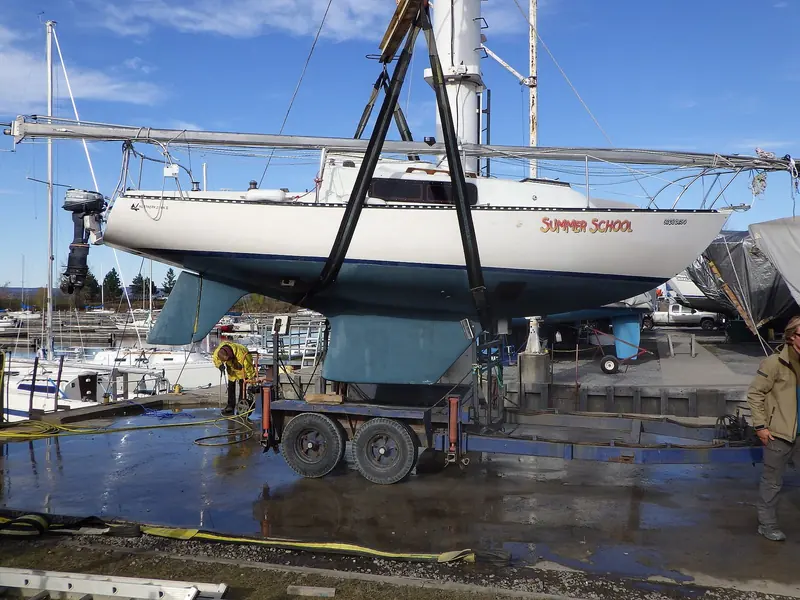
| Bounty II, 1956 | Aeromarine Plastics, California; about 50 Pearson Rhodes 41s followed, 1961 to 1967 or 1968 |
| Rhodes 41 specification | 40.83 ft overall, 28.00 ft waterline, 10.25 ft beam, 18,800 lb, 8,075 lb lead ballast (Practical Sailor) |
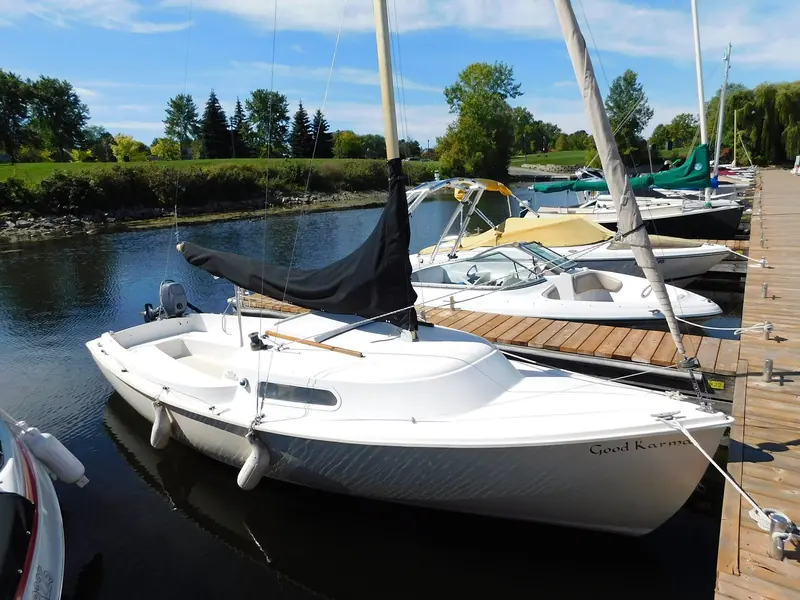
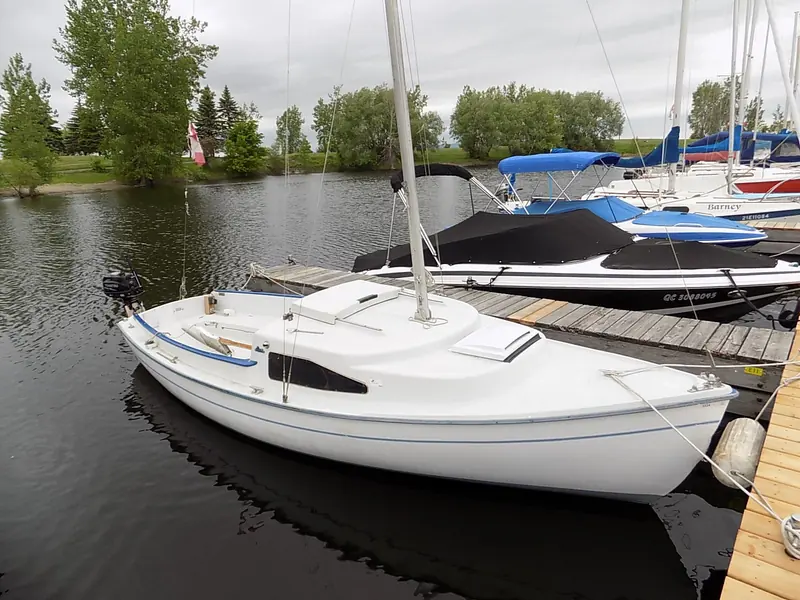
| Rhodes 19 | about 3,200 built (Wikipedia) or 3,500 (US Sailing); built today by Stuart Marine |
| Rhodes 22 | General Boats, first built 1968, about 1,000 built (Practical Sailor) |
| Used Rhodes 41 | about USD 70,000 tired to USD 140,000 rehabbed in Practical Sailor's estimate; listings USD 10,000 to 100,000 |
| Archive | Mystic Seaport Museum, ships plans collection and about 1,985 manuscript items |
| Succession | none; McCurdy and Rhodes (1965) is a separate firm that built on the heritage |
From an Ohio Hydroplane to a New York Drawing Office
Wikipedia puts his birth in Thurman, Ohio. Good Old Boat says he watched paddle-wheelers on the Ohio River as a boy and, still at high school, designed and built a single-step hydroplane called Dusty and had two articles about it published in Motor Boating. He studied at Denison University and moved to MIT in 1916 for naval architecture. Mystic Seaport's finding aid, which holds his papers, dates his earliest design to 1916, an 18.5 ft hydroplane, and confirms the 1918 MIT degree.
The next years were ordinary shipyard work. Mystic Seaport and Wikipedia both record Army Corps of Engineers service in the last year of the First World War, then jobs at American Shipbuilding in Lorain, Ohio and Union Shipbuilding in Baltimore. By 1925 he was self-employed in New York. Good Old Boat describes the first office as a hole in the wall with room for himself and one assistant, and says Olin Stephens once filled that seat. That detail matters to a buyer: the man who drew some of the most admired American ocean racers of the 1950s learned his trade on hydroplanes and commercial hulls, which helps explain why his sailing boats are so seamanlike and so rarely fashionable.
Cox & Stevens, the Rhodes Office and What It Drew
The sources disagree on dates and it's worth saying so. Mystic Seaport dates a partnership contract between Cox & Stevens and Rhodes to 1 June 1934, Wikipedia says he joined in 1934 and Good Old Boat says 1932. All agree he became head of design in 1935 after the lead designer Bruno Tornroth died, and that the firm was renamed Philip L. Rhodes, Naval Architects and Marine Engineers. Mystic Seaport and Good Old Boat say 1947, Wikipedia says 1946. The office closed in 1974.
Good Old Boat counts 386 designs in a listing of his work, most of them sailboats and says he had 498 men under his direction during the Second World War; both are single-source figures here. What isn't in dispute is the range. Mystic Seaport's abstract runs from the 1916 hydroplane to a 1973 diesel yacht, Wikipedia from 7 ft dinghies to 123 ft motor-sailers, minesweepers and police boats. He drew in wood, metal and glassfibre and wrote up designs for Yachting, Rudder, Motor Boat and Motor Boating. Bill Tripp, Jim McCurdy, Charles Wittholz and Olin Stephens are among the designers Good Old Boat says started in his office.
A man who learned his trade on hydroplanes and commercial hulls ended up drawing the boat that defended the America's Cup.
Kirawan, Carina and Weatherly: The Racing Record
Weatherly (US 17) was built by Luders at Stamford, Connecticut and launched in 1958 for a syndicate of New York Yacht Club members, according to Wikipedia. Emil 'Bus' Mosbacher Jr. steered her to the 1962 defence. She is 66.9 ft overall with a 45.5 ft waterline and about 1,783 sq ft of sail, and she was listed on the National Register of Historic Places in 2012; Wikipedia says she now sits at a Newport marina and is available for charter. Mystic Seaport holds her design calculations and 1962 tank-test material, filed under Rhodes number 676.
Carina II is the offshore one. Classic Sailboats and Good Old Boat agree she was a 53 ft centreboard yawl built in Hamburg by H. Heidtmann in 1955, in a record four months and finished in New York before the Transatlantic Race to Sweden. She won that race, took the Britannia Cup at Cowes and won the Fastnet in both 1955 and 1957. Good Old Boat also credits Kirawan, a 53 ft boat, with winning the 1936 Bermuda Race on her first outing. Both Carina's sources record a sad end: Classic Sailboats lists her as destroyed in 2004 through neglect, Good Old Boat says she sank at her mooring. The wooden, shoal-draft centreboard form Rhodes developed in 1932 was used through the 1960s on 40 to 55 footers.
Bounty II and the Move into Glassfibre
Good Old Boat says Bounty II's lines were drawn by Rhodes's son Bodie as a reduction of the sloop Altair, and that her glass scantlings were largely guesswork, so the boats came out heavy. Early glassfibre masts proved too flexible and were swapped for aluminium. Practical Sailor adds that Aeromarine closed in 1960 and Grumman executives bought the tooling, which went to Pearson Yachts in Rhode Island. Pearson switched iron ballast to lead, raised the freeboard and sold it as the Rhodes 41 from 1961 or 1962; Practical Sailor and Sailing Magazine both count about 50 built before production stopped in 1967 or 1968.
Not every glassfibre experiment went well. The first eight Chesapeake 32 hulls, drawn in 1959 for the George Walton company of Annapolis and moulded in Denmark, had a thin shell that oilcanned and later boats got longitudinal stringers, says Good Old Boat. A sailboat database puts total Chesapeake 32 production at 95 between 1960 and 1965. Good Old Boat also reports that the Reliant of 1963 was copied by Cheoy Lee as the Offshore 40 and that Rhodes considered legal action but didn't pursue it, after which he drew no more large offshore glassfibre boats; Wikipedia instead lists a Rhodes Reliant built by Cheoy Lee, so the licence question isn't settled in print.
The Small Boats That Outlived the Big Ones
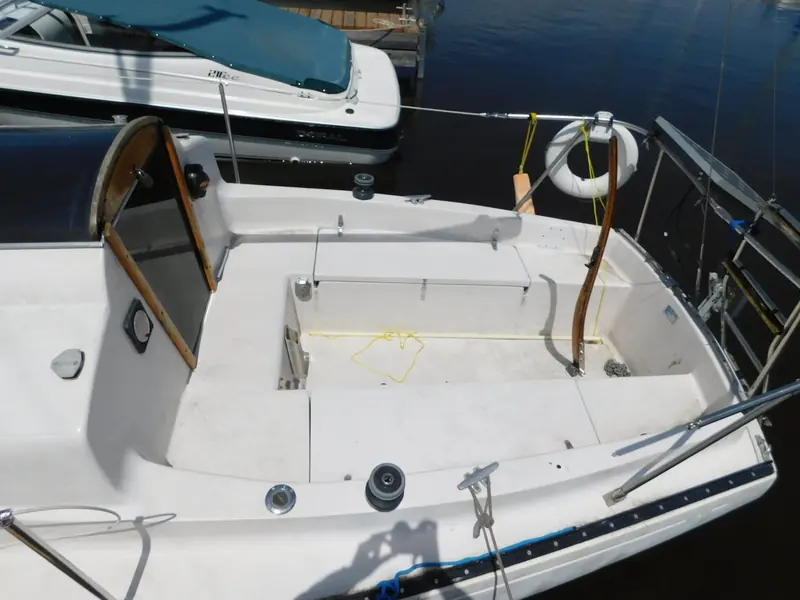
The Rhodes 19 began as a commission from Allied Aviation of Cockeysville, Maryland for a boat first called the Hurricane, says the class association; a Massachusetts group took up unfinished hulls in 1947 and George O'Day's company renamed it the Rhodes 19 in 1958 or 1959. Stuart Marine of Maine bought the moulds in December 1982 and began building in 1984. Wikipedia counts 3,200 boats built and US Sailing about 3,500, so treat the total as approximate. The 2026 national championship was sailed on Lake Michigan with a full start line, a good sign of a class that has outlasted its builders. The Mariner 19 shares the same hull.
The Rhodes 22 is the commercial survivor. Practical Sailor lists 1968 as the first year, General Boats as builder and roughly 1,000 built, and calls owner feedback more uniformly enthusiastic than it had seen for years; Small Craft Advisor says it has been in production for over a quarter century. The Northern 25 was Rhodes's design adapted by Dennis Fernice and built by Northern Yachts in Ajax, Ontario from 1970 to 1989, about 250 boats, per Wikipedia. The Pearson Vanguard, a 32 ft full-keel sloop built 1963 to 1967, is credited with 404 hulls on Wikipedia, a count the desk could not confirm in a second source.
Who Carries the Name Now
Mystic Seaport holds the Philip L. Rhodes ships plans collection and a manuscripts collection of roughly 1,985 items dated 1894 to 1978, including design data notebooks from 1930 to 1975; access is limited to its research library and copying is restricted. Good Old Boat adds that the Reliant file alone runs to 25 sheets. If you own a Rhodes boat and need original drawings, that is where the answer sits, not with a living office.
McCurdy and Rhodes was founded by Jim McCurdy, formerly Rhodes's chief yacht designer and Philip 'Bodie' Rhodes, the designer's son, in 1965 according to its own site (Good Old Boat says 1966). It drew the Hinckley Sou'wester line and the Navy 44 sail trainers, 20 of which were built for the US Naval Academy, and today advises on rebuilding and Coast Guard certification of historic vessels. It is a separate company that says it builds on Rhodes's heritage; it isn't his office under another name.
Informations pratiques
| Rhodes 41 price | Practical Sailor estimates about USD 70,000 for a sound but tired boat and up to USD 140,000 fully rehabbed; online listings it found ran from about USD 10,000 for a gutted project to USD 100,000 restored; one 1964 Annapolis boat appeared at USD 25,000 on a broker's site and USD 35,000 on an aggregator, so the sample is thin |
|---|---|
| Rhodes 22 price | a factory buy-back reconditioned boat starts around USD 10,000 per Practical Sailor, which also lists a 1986 model at USD 14,950 and a 1996 model at USD 22,900; it calls the new boat pricey for a daysailer |
| Chesapeake 32 price | one 1962 boat with a 2025 refit was listed at USD 48,900 in Texas; a single listing is not a market price |
| What to survey on a Rhodes 41 | cored deck for moisture, hull blisters, tank access in the bilge, keel and rudder condition, shaft packing, wiring, rigging and the engine, which is often an original Atomic 4 |
| Drawings and history | the Philip L. Rhodes collection at Mystic Seaport Museum, research use only, with copying restricted |
| Where the classes are | the Rhodes 19 Class Association runs a national championship; General Boats builds the Rhodes 22; Stuart Marine builds the Rhodes 19 |
| What is not published | a verified total of designs and boats built, a Rhodes 19 used price, the Weatherly refit history and any current office that holds the Rhodes name |
| Alternatives | Sparkman and Stephens for American ocean racers of the same era, and Laurent Giles for British ones, both covered elsewhere on this site |
Ce que rapportent propriétaires et équipages
The Rhodes 41 is slow in light air and its decks need watching
Practical Sailor says the heavy displacement and long keel make her sluggish without breeze, and that the balsa-cored decks can delaminate or take in water, with small areas injected with epoxy and larger ones needing new core
Practical SailorA restored 41 can still win
Restless, a restored Pearson 41, won Class 1 of the 2000 Newport to Bermuda Race, aided by reaching conditions and an age allowance, and White Wings placed sixth in the 1995 Marion to Bermuda Race
Sailing MagazineEngines, rigging and electrics are the usual bills
the review notes the engine and standing rigging may need replacing, the electronics are outdated and the original electrical systems were minimal, so many owners rewire; one owner fitted a 27 hp Westerbeke in place of the Atomic 4
Practical SailorEarly glassfibre was overbuilt in some places and thin in others
Bounty II's scantlings were guesswork and her first glass masts too flexible, while the first eight Chesapeake 32 hulls had a soft shell that was stiffened with stringers
Good Old BoatRhodes 22 owners are unusually happy
the magazine said owner responses were more uniformly enthusiastic than it had seen in recent years, and noted a General Boats buy-back programme for used boats
Practical SailorFew Rhodes boats have a proper double berth
the author attributes it to clients not asking for one, and notes some owners' cabins had two narrow, widely separated bunks
Good Old Boat
Les points forts et les points de vigilance
Points forts
- Boats with a long recordWeatherly won the 1962 America's Cup defence and Carina II took the Fastnet twice, and a 40-year-old Rhodes 41 won the 2000 Bermuda Race according to Good Old Boat
- Strong construction and a kind motionthick solid-glass hulls that tolerate repair, high comfort ratios and a gentle motion at sea, with good directional stability on the Rhodes 41
- Boats still supported by classes and buildersthe Rhodes 19 has an active national class and a current builder, and General Boats still makes the Rhodes 22
- A deep archiveMystic Seaport keeps the plans, notebooks and calculations for owners and researchers
Points de vigilance
- No living officethe firm closed in 1974, so there is no designer to ask for new work or confirm changes
- Age of the glassfibre fleeta Rhodes 41 or Chesapeake 32 is now 60 years old, and cored decks, blistered hulls, tanks and rigging are likely jobs
- Modest accommodationnarrow, heavy hulls with slack bilges carry less interior volume than a modern boat of the same length, and the Rhodes 41 has no dedicated chart table
- Facts that conflict between sourcesdates for the firm's name change, production counts and licensing of the Reliant differ between Wikipedia, Mystic Seaport and Good Old Boat, so check a boat's own papers
Pour qui: Buyers of a 1960s Rhodes cruiser such as the Rhodes 41, Vanguard or Chesapeake 32 who want to know what is original, what is a known weakness and what the boat is worth. Owners of Rhodes 19s and 22s, and anyone researching the history of American yacht design and the early years of glassfibre.