Aruba
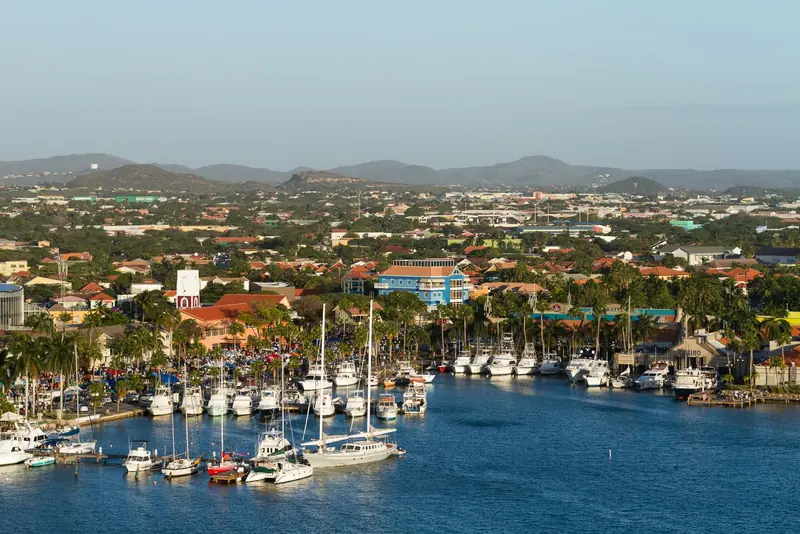
| Location | about 15 nautical miles off Venezuela at roughly 12.5 degrees North, part of the ABC islands with Bonaire and Curacao but administratively separate |
|---|---|
| No direct hurricane strike recorded since Atlantic tracking began in 1851; closest approach Hurricane Felix, 2 September 2007, passing roughly 80-95 km northeast at Category 2 strength (NOAA HURDAT2 via Aruba Playbook analysis, corroborated by Aruba.com's own hurricane-season page) | |
| Queen Beatrix International Airport (AUA): approximately 24 airlines to 52 destinations in the 2026 schedule, new US departures terminal opened April 2025 (flightconnections.com) | |
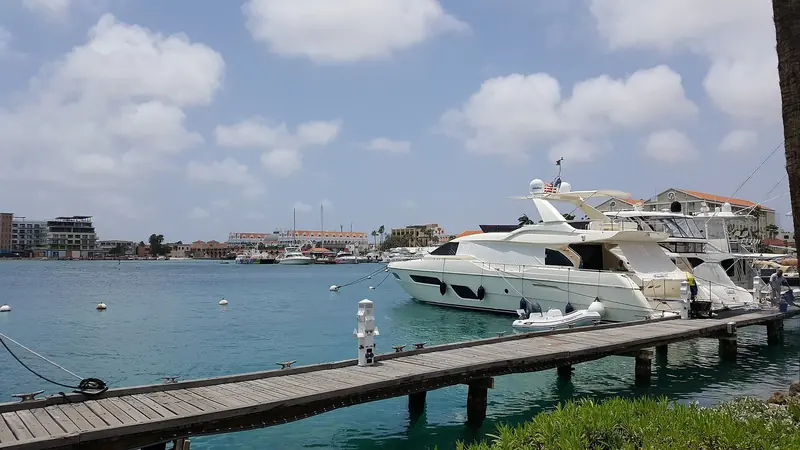
| Wind Creek Marina (formerly Renaissance Marina), Oranjestad: 40 berths per the marina's own site; third-party directories (Yachting Pages, Onboard Online) instead describe 50 slips including 2 superyacht berths over 30 m to 200 ft, an unresolved discrepancy | |
| Wind Creek Marina published dockage | 1.10 USD/ft/day up to 5 days, 0.80 USD/ft/day beyond 5 days, 0.60 USD/ft/day beyond 22 days, flat 1.10 USD/ft/day over 100 ft LOA, 30 percent multihull surcharge |
| Varadero Aruba Marina and Boatyard | over 70 wet berths per the marina's own site; hydraulic trailer lift to about 80 ft length and roughly 40 ft beam, 60 tons |
| Aruba Nautical Club | draft limited to about 12 ft through a shoal approach channel from Barcadera; no published berth count or tariff |
| Marine Park Aruba | 60.2 sq km across four reserves, created 2018, managed since 2019 by Fundacion Parke Nacional Aruba (Aruba National Park Foundation); anchoring on coral banned, mooring buoys provided at sites including Mangel Halto |
| Port of entry for pleasure craft | Barcadera (per Noonsite and the sailing vessel Blue Joline's 2024 report); megayachts clear instead at Oranjestad's H-pier via an appointed agent (per Aruba Ports Authority's own yachting page) |
| Initial stay | 30 days for people, up to 180 days for the vessel; time hauled out at Varadero does not count against the 180-day limit |
| Aruba Sustainability Fee | 20 USD per person on air arrivals, effective 1 January 2025 via the ED Card, cruise passengers exempt (Aruba tourism authority sources, corroborated by tax-guide site Trippz) |
| Aruba Ports Authority cruise-passenger count: 970,803 passengers across 376 calls in 2025, up from 897,273 across 347 calls in 2024 | |
| Trade winds | roughly 20-35 knots May through August, easing to about 10-18 knots September through November, 20-25 knots December through April (Aruba kitesurf industry sources, corroborated by weather-and-climate.com's monthly averages) |
| Population approximately 125,000; tourism reported to account for the large majority of GDP, 2025 visitor spending put at 3.06 billion USD | |
| Nearest comparable haul-out beyond Varadero's size ceiling: Curacao Marine, Willemstad, a 25,000 sqm yard hauling to 35 m, reachable by an inter-island flight of roughly 20-40 minutes | |
Aruba is not a third ABC island entry
Bonaire's whole cruising identity is built around STINAPA's ban on anchoring almost everywhere around the island, funnelling every visiting yacht onto a registered mooring buoy capped at 18 metres. Curacao runs Curacao Marine, a 25,000 square metre yard in Willemstad hauling out to 35 metres, and a lagoon at Spanish Water that holds around 100 boats as a recognised hurricane hole. Aruba has neither of those signature features. It has a resort marina built into a casino and shopping complex in the middle of its capital, a boatyard built for catamarans and sportfishers rather than superyachts and by far the busiest cruise-ship economy of the three, with Aruba Ports Authority recording 970,803 cruise passengers across 376 calls in 2025, up from 897,273 the year before.
The legal and administrative regime differs too. Bonaire and Curacao are two separate constituent countries within the Kingdom of the Netherlands with their own customs and tax rules; Aruba is a third, distinct one, with its own port authority, its own sustainability fee introduced in 2024, and its own single port of entry for pleasure craft. An owner who already knows Bonaire's mooring-buoy discipline or Curacao's yard should not assume either experience transfers. Aruba's appeal is a livelier, more built-up, more infrastructure-dense island in the same hurricane-free pocket of the southern Caribbean, not a quieter variation on its neighbours.
Getting there and the season behind the flight schedule
Queen Beatrix International Airport (AUA) sits a few kilometres from Oranjestad and, as of the 2026 schedule tracked by flightconnections.com, carries roughly two dozen airlines including American, Delta, United, JetBlue, Southwest, Air Canada, KLM and several Latin American and regional Caribbean carriers to 52 destination airports. A new US departures terminal came into service in April 2025, and Air Canada and Air Transat both add seasonal Montreal service from December 2026, a sign of a schedule still being built out rather than one already at capacity. That is a materially larger, more North America-facing schedule than Bonaire's or Curacao's smaller airports run.
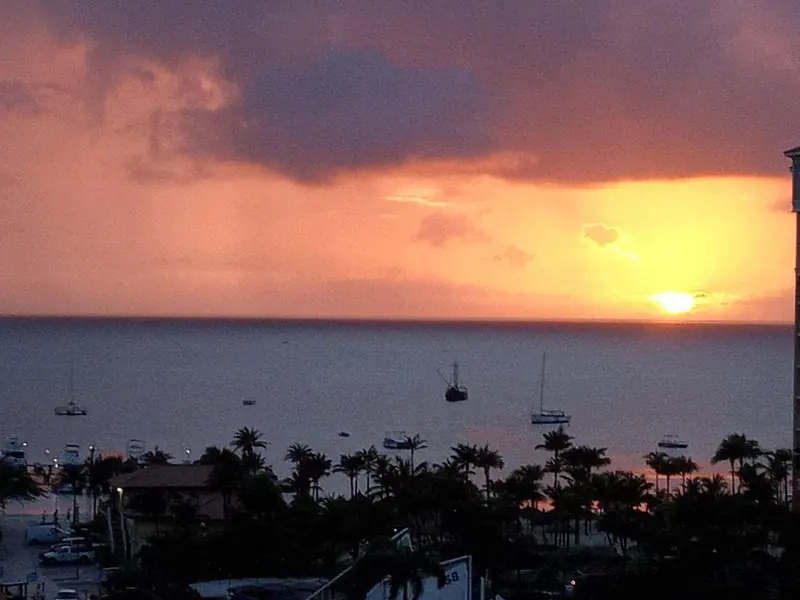
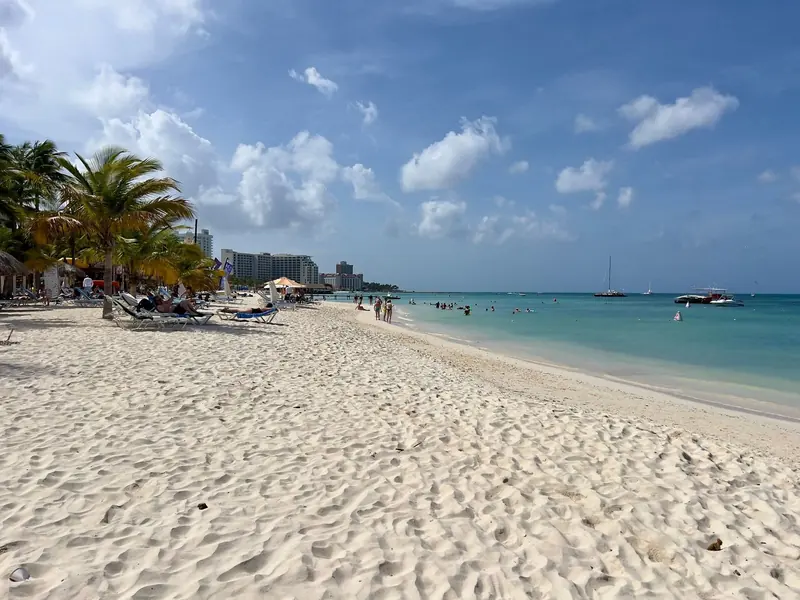
Because Aruba sits outside the hurricane belt, owners are not working around a storm season the way they would in the northern Caribbean or Bahamas; the practical season is instead set by wind. The steady easterly trade wind that gives Aruba its kitesurfing reputation runs strongest from May through August, averaging 20 to 35 knots by kitesurf-industry measurement, and eases to roughly 10 to 18 knots in the calmer September-to-November stretch, with December through April holding a moderate 20 to 25 knots. A yacht anchoring or berthing on the island's calm leeward west coast is sheltered from the worst of this; the windward north and east coasts are a different matter and are, in any case, mostly unusable for anchoring due to reef and swell exposure.
Aruba Ports Authority recorded 970,803 cruise ship passengers across 376 calls in 2025, and the same island's only harbour for clearing in a private yacht is a commercial cargo dock built for that traffic, not for yachts.
Wind Creek Marina: the downtown berths, and a rate schedule not everyone agrees on
Wind Creek Marina sits inside Oranjestad harbour, built into the Wind Creek (formerly Renaissance) resort and casino complex, a short walk from the cruise terminal and the shopping district. The marina's own website describes a 40-berth facility with shore power (110/220V, 30 to 100 amp), potable water, WiFi and 24-hour security, plus full guest access to the resort. Its published rate schedule runs 1.10 dollars per foot per day for stays up to 5 days, 0.80 dollars per foot per day beyond 5 days, and 0.60 dollars per foot per day past 22 days, with a flat 1.10 dollars per foot per day for any vessel over 100 feet regardless of length of stay, and a 30 percent surcharge on multihulls.
That published number does not fully agree with how the same marina is described elsewhere. Yacht industry directories including Yachting Pages and Onboard Online describe the facility as 50 slips with 2 dedicated superyacht berths for vessels over 30 metres up to 200 feet, and Marinalife's own listing quotes a different rate structure entirely (1 dollar per foot per day, 5 dollars per foot per week). None of these sources cites a source for its figure, and the marina's own current site is the most authoritative, so an owner should treat the 40-berth, tiered-rate figure as the one to plan around and confirm anything beyond it directly with the marina before arrival.
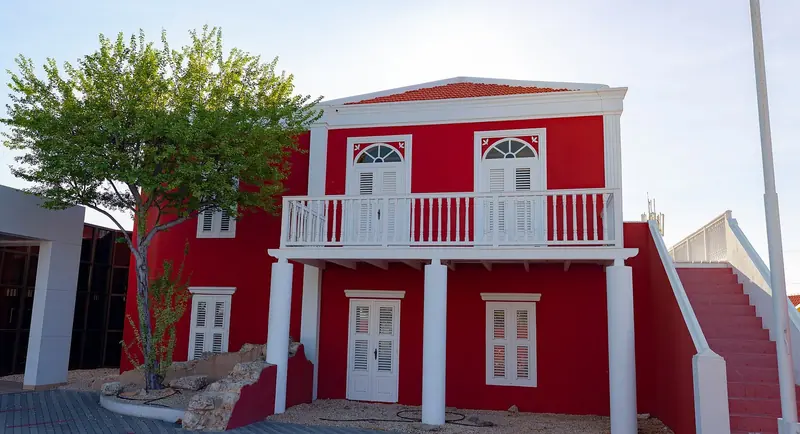
Varadero Aruba: the only real boatyard in the ABC islands' Aruba arm
Varadero Aruba, at Bucutiweg 34 near the airport and Aruba Nautical Club, runs a protected lagoon marina with, by its own published figures, over 70 wet berths including transient slips, alongside a working boatyard. Its hydraulic trailer lift handles vessels up to about 80 feet long and 40 feet of beam and up to 60 tons, a figure the Aruba Cruising Guide corroborates independently at a similarly sized capability, describing Varadero as the only boatyard in the region able to lift a boat with a beam over 35 feet. That size ceiling puts real superyacht refit work beyond Varadero's reach; it is a yard for cruising sail and motor boats and large catamarans, not for anything approaching the 60 metre-class vessels Wind Creek Marina can berth.
Varadero markets its location on the same hurricane-free logic as the rest of the island, citing the last hurricane to pass over Aruba as 1877, and it also offers duty-free customs entrepot storage and apartments for owners overseeing yard work. Time spent hauled out at Varadero does not count against the 180-day stay limit that otherwise applies to a foreign-flagged yacht, a detail that matters to an owner planning a longer refit period on the island. Nothing in the research for this page found a published day rate for hauling, storage or yard labour; an owner is quoting the job directly with the yard rather than from a public rate card.
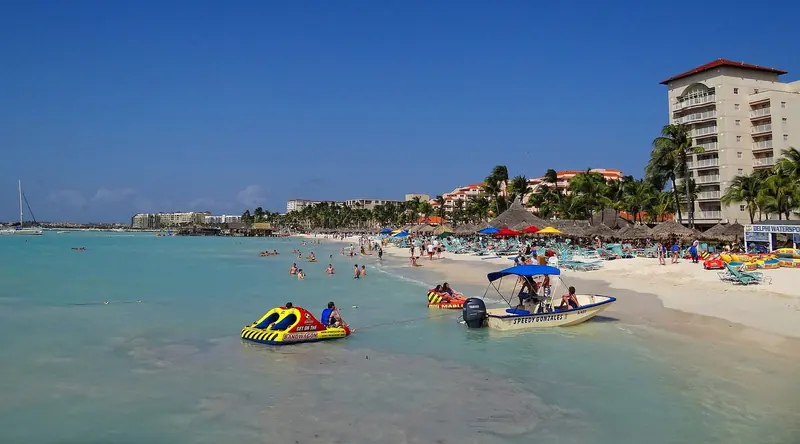
Bucuti Yacht Club and Aruba Nautical Club: the smaller, quieter options
Bucuti Yacht Club (BYCA) sits beside Varadero Aruba south of the airport and functions as a members' club rather than an open marina, so a visiting yacht typically finds Varadero's own wet berths the practical option in that part of the island rather than BYCA itself. Aruba Nautical Club, sited between the water desalination plant and Spanish Lagoon, is smaller again: a modest basin with a small restaurant on site, reached by a channel through shoal water that the Aruba Cruising Guide flags as requiring care and limited to a maximum draft of around 12 feet.
Neither club publishes berth counts, size limits by length, or a tariff online in any source found for this page, which puts both firmly in the category of an arrangement made by phone or through an agent rather than booked from a website. For a yacht drawing more than about 7 to 7.5 feet, the marked channel into Varadero and the approach to Aruba Nautical Club both become the limiting factor before any marina's own berth dimensions do, so a deep-draft yacht is generally better served at Wind Creek Marina in Oranjestad harbour itself.
Marine Park Aruba and Mangel Halto: what the mooring buoys are actually protecting
Marine Park Aruba's four reserves, run by Fundacion Parke Nacional Aruba (the Aruba National Park Foundation), prohibit anchoring on coral, fishing and collecting inside their boundaries, with mooring buoys provided at popular sites including Mangel Halto, the mangrove-fringed snorkelling reef on the island's south coast, where a marked cut through the reef and a documented steep drop-off with strong current beyond the second buoy are cited repeatedly in visitor guides as a hazard to respect rather than a place to free-dive casually. The Foundation has stated an intention to extend the park to cover the whole island's coastline, which would bring Aruba's regime closer in scope to Bonaire's, but as of the research for this page that expansion had not been completed.
This is a materially lighter-touch regime than Bonaire's, where STINAPA bans anchoring almost everywhere around the entire island and requires every visiting yacht to register for one of a capped set of overnight mooring buoys. Aruba's rule is narrower: keep off the coral and use a buoy where one is provided, with much of the island's calm west coast otherwise open to conventional anchoring in sand. An owner who found Bonaire's system restrictive will find Aruba considerably freer, though the corollary is that Aruba's reef protection is also less comprehensive and its most popular sites see correspondingly more casual boat traffic.
Clearing in: Barcadera for a yacht, Oranjestad for a megayacht
Multiple current cruiser-facing sources, including Noonsite's Aruba clearance page and a first-hand report from the sailing vessel Blue Joline covering visits in June and November 2024, describe Barcadera as the only port of entry for pleasure craft: a yacht calls Aruba Ports Authority on VHF channel 16, ties to the northwest dock, flies the yellow Q flag, and the captain then clears immigration first and customs second, both of whom board the vessel. Aruba Ports Authority's own website, by contrast, describes Barcadera primarily as a cargo terminal that took over container handling from Oranjestad around 2015, and its dedicated yachting page instead gives clearance instructions for Oranjestad's H-pier, with megayacht traffic explicitly routed there through an appointed agent. The practical reading, consistent across the cruiser sources, is that ordinary pleasure craft clear at Barcadera and megayachts clear at Oranjestad, but the authority's own site does not spell out that split in one place.
Clearance itself is reported as straightforward and free of entry or exit fees, typically under an hour, aided by pre-filing Aruba's digital ED (Embarkation/Disembarkation) card and a crew list in advance. An initial stay of 30 days is granted to people, with the vessel itself permitted up to 180 days; an older 2012 report describes a requirement to declare the yacht through a licensed customs broker within two days of arrival at a cost of 65 to 100 dollars, a rule not repeated in any 2024 or 2025 source found for this page, so whether it remains in force is an open question rather than a confirmed current rule.
What it costs beyond the berth
Since 1 January 2025 Aruba has levied a 20 dollar per person Sustainability Fee on air travellers, collected through the same ED Card system used for entry, with cruise ship passengers explicitly exempted; a separate, older BBV accommodation tax and a roughly 37 dollar airport departure levy round out the standard visitor tax package, according to Aruba's own tourism and immigration pages and corroborated independently by tax-guide site Trippz. None of the sources found for this page addresses whether a private yacht's own guests, arriving by boat rather than by air, owe the Sustainability Fee, the way Menorca's eco-tax leaves the same question open for a charter yacht's guests staying aboard rather than ashore.
Beyond the tax line items, Aruba Ports Authority references applicable harbour tariffs on its yachting page without publishing a rate card, and no source found for this page gives a current fuel price at the fuel dock, though Caribbean Fuels operates a bunkering service at Oranjestad offering marine gas oil to commercial and leisure vessels. An owner budgeting a season in Aruba is working from Wind Creek Marina's published per-foot dockage rate, a stated but unquoted port tariff, an unclear yacht-guest tax position and no public fuel price: materially less transparent than Bonaire's flat 40 dollar-a-year STINAPA nature fee, even though Aruba's overall regulatory burden is lighter.
Provisioning, and the honest limits of technical support
Aruba's tourism economy, with visitor spending put at 3.06 billion US dollars in 2025 and tourism contributing the large majority of GDP on an island of roughly 125,000 people, supports a correspondingly deep retail and hospitality base: supermarkets, chandlery including Budget Marine's Aruba branch and the independently stocked Deepwater Marine, and duty-free shipping of spare parts that cruiser reports single out as easier in Aruba than at many other Caribbean stops. Fuel is available at Oranjestad and through Caribbean Fuels' bunkering service, though, as noted above, no source found for this page publishes a current price.
For anything beyond Varadero's own lift capacity, roughly 80 feet and 40 feet of beam, there is no larger haul-out on the island: Curacao Marine's 35 metre lift in Willemstad, a short inter-island hop away (Aruba and Curacao's airports are linked by flights of roughly 20 to 40 minutes, and the islands themselves lie under 100 nautical miles apart by sea), is the nearest comparable yard, exactly the role Palma plays for Menorca. An owner planning to base a large yacht in Aruba year-round should treat Curacao, not anywhere on Aruba itself, as the answer to a serious mechanical or structural job.
What owners on the water actually report
Petra Guertler, writing up Blue Joline's visits of 28 June to 4 July and 25 November to 5 December 2024, records that the main Surfside Beach anchorage near Oranjestad sits directly beneath the airport's approach path, advising that boaters track incoming flights before dinghying across it, and recommends anchoring toward the airport end of the bay rather than further west for that reason. The same report describes clearing in at Barcadera against large rubber ship fenders sized for commercial vessels rather than yachts, a detail echoed independently in a Cruisers Forum discussion in which sailors said they nearly skipped Aruba entirely on the strength of other cruisers' complaints about the same commercial dock.
Set against that, the same Blue Joline report and a separate Cruisers Forum thread both single out Varadero Aruba's yard specifically for praise, describing it as the best and effectively only haul-out option in the area, with reasonable prices and a capable team, and noting Aruba's duty-free status as a genuine practical advantage for shipping in spare parts without the friction reported at other Caribbean stops. The pattern across both sources is consistent: the clearance experience is the rough edge, the yard work and the parts supply chain are the strong points, and an owner should plan for the former rather than be surprised by it.
À terre, accès et réservation
| Getting there | Queen Beatrix International Airport (AUA), a few kilometres from Oranjestad, runs roughly 24 airlines to 52 destinations in the 2026 schedule, weighted toward North America, with a new US departures terminal opened April 2025. |
|---|---|
| Berthing in Oranjestad | Wind Creek Marina (formerly Renaissance Marina) publishes 40 berths with shore power, water and WiFi, at 1.10 USD/ft/day short-stay, dropping to 0.60 USD/ft/day past 22 days, plus a 30 percent multihull surcharge. Third-party directories describe a larger 50-slip, 2-superyacht-berth facility; the marina's own current figures should be treated as authoritative. |
| Haul-out and yard work | Varadero Aruba Marina and Boatyard, near the airport, is Aruba's only lift, to about 80 ft length and 40 ft beam, 60 tons; no larger facility exists on the island. Time on the hard there does not count against the 180-day stay limit. |
| Clearing in | Ordinary pleasure craft clear at Barcadera, a working cargo harbour, via VHF channel 16, the yellow Q flag, and boarding by immigration then customs; megayachts are instead routed to Oranjestad's H-pier through an appointed agent. Clearance is reported free of entry/exit fees and under an hour with the ED Card pre-filed. |
| Anchoring and marine park rules | Marine Park Aruba (4 reserves, 60.2 sq km, run by Fundacion Parke Nacional Aruba) bans anchoring on coral and provides mooring buoys at sites including Mangel Halto; conventional sand anchoring remains permitted on much of the calm west coast, a lighter regime than Bonaire's island-wide no-anchor rule. |
| What it costs beyond the berth | A 20 USD per person Sustainability Fee applies to air arrivals since January 2025 (cruise passengers exempt); no source found for this page confirms whether it, or the harbour tariffs Aruba Ports Authority references but does not publish, apply to a private yacht's own guests. |
| What is NOT published | No current fuel price at the Oranjestad fuel dock; no rate card from Aruba Ports Authority for harbour dues; no confirmation whether the 2012-reported customs-broker requirement for declaring a yacht is still in force; conflicting berth counts for Wind Creek Marina across the marina's own site and third-party directories. |
Ce que rapportent propriétaires et équipages
The main anchorage sits directly under the airport approach, and the customs dock is built for ships, not yachts
Recording two visits in 2024 (28 June to 4 July, and 25 November to 5 December), Blue Joline's report advises checking flight trackers before dinghying across the Surfside anchorage because it sits beneath the airport's landing path, and describes clearing in at Barcadera's commercial dock, fendered with large tires meant for ships, as the rough edge of an otherwise straightforward process.
Petra Guertler, sailing vessel Blue Joline, 2024 cruising reportSome cruisers nearly skipped Aruba entirely over the check-in dock, but the yard work changed their minds
A Cruisers Forum discussion records sailors saying they almost bypassed Aruba on the strength of other boaters' complaints about the commercial check-in dock's tire fenders and limited cleats, while separately praising Varadero Aruba as the best, and effectively only, haul-out in the area for reasonable prices and a capable team.
Cruisers & Sailing Forums (cruisersforum.com), Aruba marinas discussion thread
Les points forts et les points de vigilance
Points forts
- A hurricane-free base with real flight accessNo direct hurricane strike since Atlantic tracking began in 1851, paired with a 24-airline, 52-destination schedule at Queen Beatrix International skewed toward North America, a materially bigger schedule than Bonaire's or Curacao's airports run.
- A downtown marina an owner can actually walk ashore fromWind Creek Marina sits inside a resort, casino and shopping complex in the middle of Oranjestad, a level of onshore amenity neither Varadero's boatyard-adjacent basin nor Bonaire's mooring field can match.
- A real, if size-capped, yard on the island itselfVaradero Aruba lifts to about 80 feet and 40 feet of beam, genuine haul-out capability Bonaire has none of, and duty-free parts shipping that cruiser reports single out as easier than at many other Caribbean stops.
- A lighter anchoring regime than Bonaire'sMarine Park Aruba bans anchoring on coral and buoys off specific reef sites like Mangel Halto, but leaves much of the calm west coast open to conventional sand anchoring, unlike Bonaire's near-total no-anchor rule.
Points de vigilance
- Clearance sends a yacht to a cargo dock, not a yacht berthBarcadera's customs dock is fendered for commercial ships, and cruiser accounts describe large tire fenders marking the hull; sailors on Cruisers Forum reported nearly skipping Aruba over other boaters' complaints about exactly this.
- No marina or berth-count figure fully agreesWind Creek Marina's own site states 40 berths; Yachting Pages and Onboard Online describe 50 slips with 2 superyacht berths to 200 ft; Marinalife quotes yet another rate structure. An owner cannot get a single confirmed number without contacting the marina directly.
- No haul-out beyond about 80 feet on the whole islandVaradero's lift ceiling, roughly 80 ft length and 40 ft beam, is well short of superyacht scale; anything larger means a flight or passage to Curacao Marine in Willemstad, the nearest comparable yard.
- The main anchorage sits under the airport flight pathBlue Joline's 2024 report places the principal Surfside anchorage directly beneath Queen Beatrix's approach corridor, advising boaters to check flight trackers before crossing it by dinghy.
Pour qui: An owner who wants a genuinely hurricane-free base with real North American flight access and a livelier, more built-up island than Bonaire or Curacao offer, and who accepts a resort marina rather than a superyacht-scale one, a boatyard capped at about 80 feet and a clearance system that sends an ordinary yacht to a working cargo dock rather than a yacht-dedicated berth.