Komodo & the Flores Sea
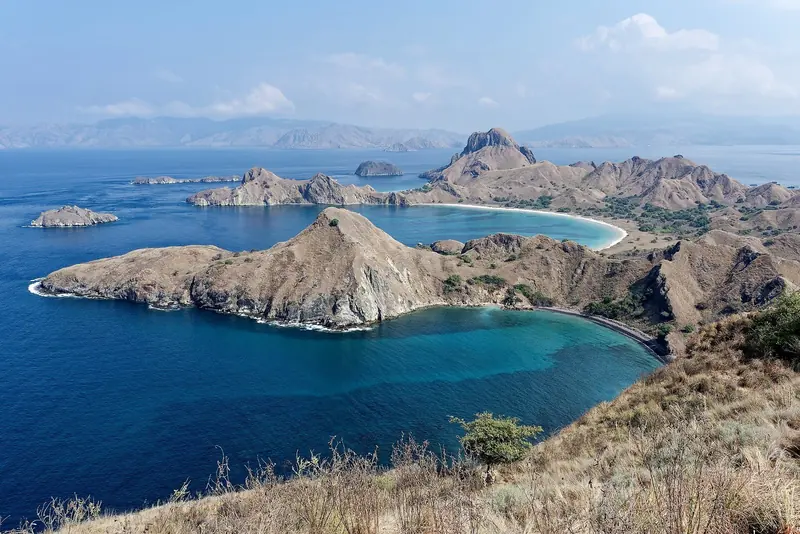
| Komodo National Park covers 1,733 square kilometres, 603 km2 of it land, established in 1980 and a UNESCO World Heritage Site since 1991. | |
| The park holds an estimated 3,400 wild Komodo dragons across five islands: about 1,700 on Komodo, 1,300 on Rinca, around 100 each on Gili Motang and Gili Dasami, plus roughly 2,000 more on the Flores mainland outside the park; the species is extinct on Padar. | |
| The Komodo dragon was uplisted from Vulnerable to Endangered on the IUCN Red List in 2021. | |
| Komodo Airport (LBJ) at Labuan Bajo has four to six daily flights from Bali, about one hour, and daily direct service from Jakarta, two and a half to three hours; there is no direct international flight into Labuan Bajo. | |
| Batu Bolong's nickname, Current City, describes currents strong enough that five divers swept away there in 2008 drifted forty kilometres before swimming ashore on Rinca, an incident reported at the time by NBC News and CBS News. | |
| Manta Alley in the park's south peaks December to March, the same months the surface sailing season is at its roughest, so the best diving season and the best sailing season do not coincide. | |
| Indonesia's foreign-yacht clearance process has moved from the paper-based CAIT system to an online Vessel Declaration, roughly halving turnaround time according to cruising resource Noonsite. | |
| A proposed Rp 3.75 million annual park conservation membership fee was floated in 2019 and shelved by December 2022, per Indonesia's tourism minister. |
A National Park Built Into The Itinerary Itself
Komodo National Park is a 1,733 square kilometre UNESCO World Heritage Site, 603 km2 of it land, straddling the strait between Sumbawa and Flores, established in 1980 to protect the Komodo dragon and now home to an estimated 3,400 of the lizards across five islands, per Wikipedia's summary of park and IUCN data. Three main islands, Komodo, Padar and Rinca, sit inside 26 smaller ones, and every one of them is reachable only by boat, which is why the park exists on the yacht charter map at all rather than as a place with an airport of its own.
The draw for a yacht is that the whole park compresses a week's worth of separate holidays into one anchorage-hopping itinerary. Trekking with a ranger to see a wild dragon, a hike up Padar's saddle for the three-bay view every brochure photograph borrows, a swim off a beach genuinely tinted pink by crushed red coral, and a drift dive through a current so strong it earned the nickname Current City, all sit within a single day's cruising range of each other and of the gateway port, Labuan Bajo, on Flores.
Getting There Means Flying Into Flores, Not Sailing In From Somewhere Else
Almost every yacht guest reaches Komodo by air, through Komodo Airport (IATA code LBJ, ICAO WATO) at Labuan Bajo on the western tip of Flores. Direct flights from Denpasar run four to six times a day and take about an hour, with AirAsia Indonesia, Batik Air, Wings Air and Super Air Jet all flying the route, while Jakarta is a two and a half to three hour direct flight on Batik Air or Lion Air. There is no direct international service into Labuan Bajo, so anyone flying in from outside Indonesia connects through Bali, Jakarta or, less often, Singapore or Kuala Lumpur.
Sailing in is the alternative for owners already cruising Indonesia, most commonly on the Lombok to Komodo run through the Sumbawa strait, a multi-day passage that charter brokers and sailing guides both flag as the reason most private owners fly in and charter locally rather than deliver their own yacht from Bali or Lombok. From the airport it is a ten to fifteen minute drive into Labuan Bajo harbour, where a charter yacht sends a tender in rather than the guest walking to a berth, since most of the charter fleet anchors off rather than docking.
In 2008 five divers swept off Tatawa Besar inside the park spent roughly nine hours drifting forty kilometres before swimming ashore on Rinca and fighting off a Komodo dragon with rocks, and all five survived.
The Sailing Season Runs Dry From April To October, With A Sweet Spot In The Middle
The dry season, running April to October, is when the park is sailed, and May through July is repeatedly named by charter operators and dive guides as the calmest window: settled weather, strong underwater visibility and the start of the southern manta upwelling, before the July and August school-holiday peak brings the fullest anchorages and the highest phinisi rates. September still carries the dry season's clear skies with noticeably fewer boats than August.
The wet season, November to March, is not a closed season the way a hurricane season would be. Boats keep running through it, at reduced rates, in exchange for rain squalls, choppier crossings between anchorages and an itinerary skewed toward the more sheltered northern half of the park. Divers chasing Manta Alley in the park's south, however, are working to a different calendar: that aggregation peaks December to March, the same months a surface itinerary would otherwise call rough, so the best manta season and the best sailing season do not fall together, a genuine trade-off no brochure states plainly.
The Park Fee Structure Is Genuinely Unsettled, And You Should Book Assuming So
Komodo's entrance tariff has changed shape repeatedly since 2019, when the park authority floated an annual conservation membership as high as Rp 3.75 million and then walked it back within months after a public backlash; Indonesia's tourism minister confirmed the increase was shelved at a Jakarta press conference in December 2022. The last clearly regulation-backed figure, set under a 2014 non-tax revenue schedule, put the foreign visitor's daily park entry at around Rp 150,000 on weekdays and Rp 225,000 on weekends, plus small separate charges for trekking, snorkelling or diving of Rp 15,000 to 25,000 each.
Multiple charter and dive-operator sites now describe a different, bundled 2026 structure: a single ticket of around Rp 650,000 a person covering Komodo Island, Padar and Pink Beach, or Rp 900,000 if the route includes Rinca, sold only through a pre-booking app several of those sites name as SiOra, alongside a cap of 1,000 visitors a day introduced from April 2026. Yotters could not verify that specific figure against a government or independent press source, only against the tourism trade's own sites, several of which repeat each other's wording closely. The honest position for a charterer is to budget for something in the Rp 300,000 to 900,000 per person per day range depending on route, and to have the charter broker or liveaboard operator, who deals with the park office directly and daily, confirm the live number and book the permit before departure rather than trust any single published figure, this one included.
You Moor, You Do Not Anchor, On The Reefs That Made The Park Famous
Komodo National Park requires boats to use fixed mooring buoys rather than drop anchor on the reef at its best-known stops, a rule written after conservation surveys found uncontrolled anchoring and snorkelling had damaged the reef at Pink Beach and at Manta Point, prompting the installation of dedicated mooring buoys at both sites. A liveaboard or charter yacht that drops anchor directly onto coral inside the park, rather than picking up a buoy or anchoring in sand well clear of reef, is doing exactly what the rule exists to stop.
Away from the buoyed hotspots, anchoring in sand is still how most nights are spent, in the deeper bays off Rinca, Kelor and the sheltered coast of Komodo itself, where depths and holding suit a phinisi far better than the exposed pinnacles the dive sites are built around. The practical test any responsible operator applies, and one worth asking a charter broker to confirm before booking, is whether the crew actually uses the buoys where they exist rather than anchoring on the reef beside them because the buoy is occupied or awkward to reach, since that is precisely where the park's own conservation messaging says the damage still happens.
Labuan Bajo Now Has The Fuel, Provisioning And Agents A Charter Needs, But No Deepwater Marina Berths
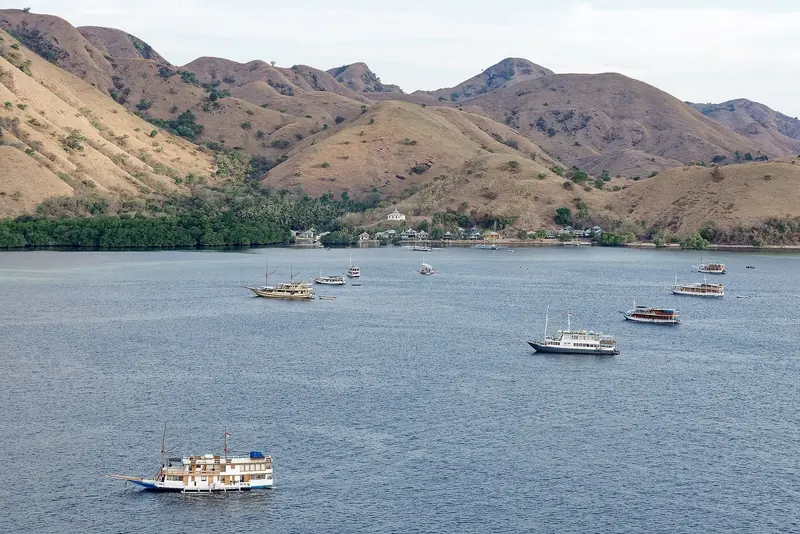
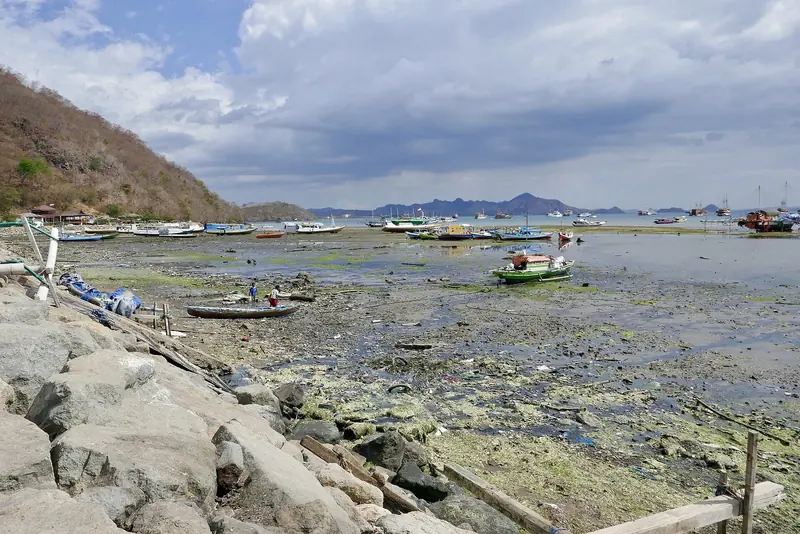
Labuan Bajo has grown from what Wikipedia's account of the town describes as a small fishing village into a designated national tourism priority since 2018, and the harbour now supports fuel bunkering, fresh water and provisioning runs that most of the charter fleet did not have a decade ago. Bajo Marina, on the western Flores waterfront, offers dedicated small-boat berths with shore power alongside anchorage areas and mooring buoys for the larger phinisi and liveaboard vessels that make up most of the fleet, plus fuel suppliers, marine repair shops and a growing but still developing black and grey water disposal service, by the operator's own account.
Provisioning runs through the town's markets and a handful of supermarkets stocking fresh seafood, local produce and imported goods, sufficient for the three to seven night trips most charters run, though anyone assembling a longer or more particular provisioning list is better served ordering from Bali before flying in. Yacht agents based in Labuan Bajo, Bali and Jakarta now handle the paperwork side, including the clearance process that used to be the main friction point for a foreign-flagged yacht; Indonesia has since moved that process online through the customs authority's own portal, cutting turnaround time roughly in half compared with the paper-based system it replaced, per cruising-guide site Noonsite's reporting on the change.
The Diving Is Current-Driven, And The Current Is The Whole Point
Komodo's diving is built entirely around the collision of warm Pacific water pushing down from the north and cold, nutrient-rich Indian Ocean upwelling forcing up from the south, an oceanographic seam that makes sites like Batu Bolong and Castle Rock among the richest reef dives in Asia and, in the same current, genuinely dangerous to enter at the wrong moment of the tide. Batu Bolong, nicknamed Current City, is dived almost exclusively along its sheltered eastern face; guides study the day's tide charts and wait for a slack window before letting divers in, because the pinnacle's northern and southern faces carry currents that can reverse direction with little warning and pull a diver down rather than along, according to diver accounts collected on the diving forum ScubaBoard.
The clearest account of what happens when that goes wrong is a 2008 incident widely reported at the time by NBC News and CBS News: five divers, three British, one French and one Swedish, were swept away at Tatawa Besar inside the park, spent around nine hours in open water tied together by their BCDs, and eventually swam ashore on Rinca roughly forty kilometres from where they had entered the water, fending off a Komodo dragon with rocks before rangers and local fishermen found them. All five survived, and the incident is still cited by dive operators as the reason Komodo is rated intermediate to advanced diving, with a current or drift-diving course strongly recommended before a first Komodo trip, DSMBs and personal locator beacons carried as standard, and guides given the final word on whether a site is diveable that day rather than the schedule.
Padar's Viewpoint And Pink Beach Are The Two Stops Every Itinerary Builds Around
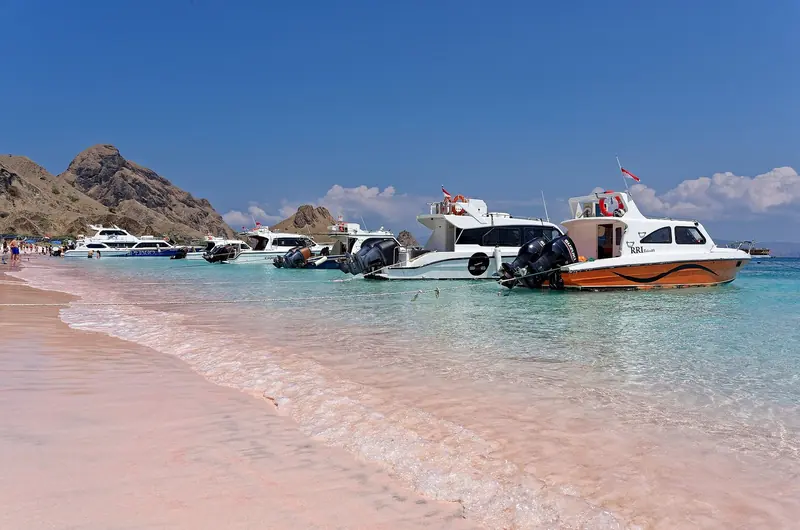
Padar Island's summit trail looks down on three curved bays in a single frame, black sand on one side, white on another and the tinted pink of the third, that has become the park's most reproduced photograph and the reason most itineraries schedule the climb for sunrise or the last hour before sunset, when the light is workable and the day-tripper boats from Labuan Bajo have mostly gone. Pink Beach, on the same island, owes its colour to crushed red foraminifera shell mixed into ordinary white coral sand, a detail repeated across cruising and dive-guide sites and consistent with what the shoreline itself shows in close-up photographs.
Neither stop is remote or exclusive any longer. Both sit on the standard day-boat circuit out of Labuan Bajo, and a charter yacht's real advantage over a shared speedboat tour is scheduling around the crowd rather than avoiding it: an early or late slot at Padar, and an early-morning call at Pink Beach before the first tenders from town arrive, buys something close to the empty version of both places that the photographs promise. An owner paying for a private yacht specifically to see either spot without dozens of other visitors in frame should ask the itinerary planner to confirm timing against known day-boat departure windows before assuming a private boat alone solves it.
A Wild Dragon Is A Genuine Encounter, Escorted, With Rules Written After Real Attacks
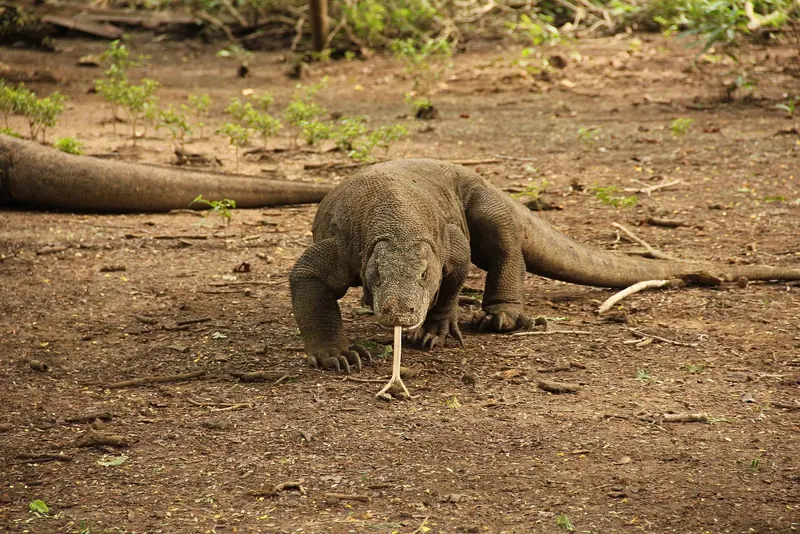
Every legal encounter with a wild Komodo dragon happens on a ranger-escorted trek carrying a forked stick, on Komodo Island itself, home to roughly 1,700 of the park's estimated 3,400 dragons, or on Rinca, home to around 1,300, because the species has a documented history of attacking rangers and villagers as well as tourists, and no licensed operator lets a guest walk unescorted. The dragon was uplisted from Vulnerable to Endangered on the IUCN Red List in 2021, a reassessment driven by evidence of range contraction on the Flores mainland and by climate projections threatening more than 30 per cent of its habitat within decades, as reported by NPR and reflected in the IUCN's own listing.
The most-repeated safety claim among guides, that a menstruating woman should not trek because dragons can smell blood from kilometres away, is not an official park rule and has no scientific evidence behind it according to researchers who have examined the claim directly, though many guides still ask and place a menstruating guest further back in the group as a precaution rather than a requirement. Sightings are not guaranteed on either island; Rinca's smaller, drier terrain generally produces easier daytime sightings than Komodo's, according to comparisons published by multiple dive and trek operators, though none offer a money-back guarantee, and a charter guest who wants the best odds should ask the crew which island that week's rangers are reporting the most activity on rather than picking one on reputation alone.
The Real Cost Is The Charter Rate, Not The Park Fee
A private phinisi charter in Komodo is quoted anywhere from roughly USD 1,800 to over USD 20,000 a night depending on the boat's size, age and finish, a range given independently by several Labuan Bajo-based charter brokers including Komodo Luxury and Luxury Phinisi, both of which also flag a 15 to 25 per cent premium across the June to August and December peak weeks. Set against that, the park's own entry cost, whatever the exact current figure turns out to be on the day, runs to a few hundred thousand rupiah a person, genuinely small change against the charter rate, fuel and crew gratuities that make up the bulk of a trip's cost.
What is not published anywhere Yotters could find is a transparent, operator-independent rate card for the wider Komodo fleet, or reliable data on what liveaboards actually charge once discounts, shared-cabin bookings and off-season deals are applied, so every figure quoted, this one included, should be treated as a starting point for negotiation through a broker rather than a fixed price. Budget charterers can join a shared open-trip departure on a liveaboard from around USD 250 to 300 a night per cabin, per rates quoted by liveaboard operator sites and cited in diver discussion on ScubaBoard, a materially different proposition from chartering the whole boat and worth stating plainly since the two are often advertised on the same page without the distinction being obvious.
À terre, accès et réservation
| Getting there by air | Komodo Airport (LBJ), Labuan Bajo. Direct from Denpasar (Bali) 4-6 times daily, about 1 hour; direct from Jakarta 2.5-3 hours on Batik Air and Lion Air. No direct international flights; connect via Bali, Jakarta, Singapore or Kuala Lumpur. |
|---|---|
| Getting there by sea | Most private owners fly in and charter locally rather than sail their own yacht in; the closest common cruising approach is the multi-day Lombok to Komodo passage through the Sumbawa strait. |
| Season | Dry season April to October; May to July is the best-conditions window before the July-August peak. Wet season November to March brings rain and rougher crossings but boats keep running at reduced rates. |
| Park fees | Disputed. Older, regulation-backed tariff: around Rp 150,000 (weekday) or Rp 225,000 (weekend) per foreign visitor per day plus small activity fees. Charter and dive-trade sites describe a newer bundled 2026 fee of around Rp 650,000 (Komodo/Padar route) or Rp 900,000 (Rinca route), sold through a pre-booking app, plus a 1,000-visitor daily cap from April 2026. Yotters could not confirm the newer figures against a government or independent source; confirm the live number with your broker before departure. |
| Mooring and anchoring | Mooring buoys mandatory at Pink Beach and Manta Point after anchor damage to both reefs; anchor in sand elsewhere, never on coral. |
| Charter rate | Private phinisi charters commonly quoted USD 1,800 to over USD 20,000 a night depending on size and finish, plus a 15-25 per cent premium in June-August and December; shared open-trip liveaboard cabins from around USD 250-300 a night. |
| Yacht clearance | Foreign-flagged yachts clear in through an online Vessel Declaration via Indonesia's customs portal, which replaced the older paper CAIT process and roughly halved turnaround time. |
| Fuel and provisioning | Available in Labuan Bajo through Bajo Marina and independent suppliers; adequate for 3-7 night trips, though longer or more particular provisioning lists are better sourced in Bali before flying in. |
| What is not published | No transparent, operator-independent rate card exists for the Komodo charter fleet, and no government source Yotters could find confirms the exact 2026 park fee figures quoted across the charter trade. |
Ce que rapportent propriétaires et équipages
Current timing makes or breaks a Batu Bolong dive
Divers on the diving forum ScubaBoard describe the same site as current-free around one full moon and severely current-affected on another visit, crediting operators who study tide charts and wait for slack water over those who dive to a fixed schedule.
ScubaBoardLiveaboard cabin comfort varies sharply by boat and berth
TripAdvisor reviewers of Komodo liveaboards report recurring cockroach problems in cabins on at least one named vessel and recommend a midship cabin over a forward luxury cabin for anyone prone to seasickness on the overnight crossings.
TripAdvisorThe 2019 closure scare still shapes how the park is marketed
Indonesia's environment and forestry minister stated that dragon numbers on Komodo Island had been stable from 2002 to 2019 with no evidence of decline, the basis on which a planned year-long closure of the island was cancelled months after being announced.
The Jakarta PostA severe current incident is still cited as the reason to train first
Five divers swept away at Tatawa Besar in 2008 survived roughly nine hours adrift and a forced swim to Rinca, an incident still referenced by dive operators as the reason Komodo is rated intermediate to advanced rather than a beginner destination.
NBC NewsForeign yacht clearance genuinely got faster
Indonesia's move from the paper-based CAIT process to an online Vessel Declaration cut clearance turnaround roughly in half, a change cruising sailors had asked for over several prior seasons.
Noonsite
Les points forts et les points de vigilance
Points forts
- Wildlife and scenery in one itineraryA wild Komodo dragon trek, Padar's summit viewpoint and Pink Beach all sit within a day's cruising range of each other and of Labuan Bajo, a concentration of headline stops few other cruising grounds match.
- Serious diving for a trained diverBatu Bolong and Castle Rock are rated among Asia's richest current-driven reef dives, sustained by the same north-south upwelling that makes the park biologically unusual.
- Port infrastructure has caught upLabuan Bajo now has fuel bunkering, provisioning, marine repair and yacht agents handling clearance, a marked change from its recent past as a fishing village.
Points de vigilance
- The two signature stops are no longer quietPadar's viewpoint and Pink Beach sit on the standard Labuan Bajo day-boat circuit, and a private yacht only avoids the crowds by timing its visit around the tenders, not by access alone.
- Diving currents can turn dangerous fastBatu Bolong and Castle Rock are intermediate-to-advanced sites where guides time entries around tide charts, and a 2008 incident swept five divers forty kilometres before they swam ashore on Rinca.
- Published pricing on both fees and charters is unreliableThe park's own entrance tariff has been rewritten and disputed repeatedly since 2019, and no independent rate card exists for the charter fleet, so every number in this piece needs reconfirming against the day's live figure.
Pour qui: Suits an owner or charterer who wants wildlife, a signature viewpoint and serious current-driven diving in one week-long itinerary out of a single gateway port and who accepts broker-negotiated, not fixed, pricing; it does not suit anyone wanting an undiscovered anchorage away from day-boat crowds at the two headline stops, or a diver who has not trained for current.