Newport & Narragansett Bay
| Location | mouth of Narragansett Bay, west side of Aquidneck Island, Rhode Island, USA |
|---|---|
| Outer harbour depth | 100 feet (about 30 m) or more, west of Goat Island; vessels drawing over roughly 16 ft typically anchor there |
| Main superyacht marina | Safe Harbor Newport Shipyard, 3,500 linear feet of dockage, stated capacity to 350 feet, dock office 401 846 6002 / VHF 9 |
| Downtown marina | Newport Yachting Center, rated to about 45 m, also the boat show venue |
| Transient hotel marina | Newport Harbor Hotel and Marina, 60 slips, 49 America's Cup Avenue |
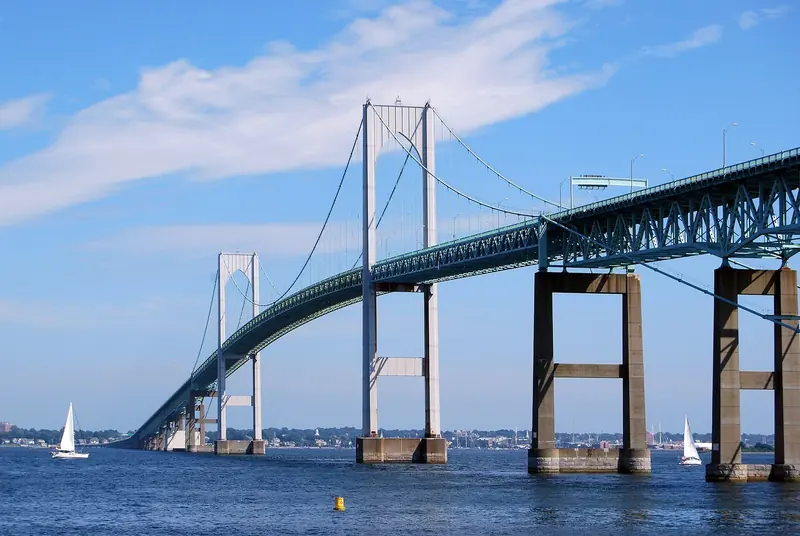
| Claiborne Pell Newport Bridge (East Passage): mid-span vertical clearance cited at 206 ft in the bridge's engineering record | |
| Customs | Newport is Rhode Island's designated CBP Port of Inspection; all arrivals, any flag, must clear within 24 hours; foreign-flagged vessels need a face-to-face inspection even when using the ROAM app; CBP Warwick 401 732 6701, port hours 0700 to 2000 daily |
| Nearest jet-capable general aviation | Newport State Airport (UUU), FBO FlightLevel Aviation, runways to just under 3,000 ft, parking to about Cessna CJ2 class |
| Nearest large-jet airport | T.F. Green International (PVD), Providence, about 45 minutes by road; Boston Logan about 75 to 90 minutes |
| Core season | June to September; water in the low-to-mid 20s C in August at the warmest |
| 2026 Newport Bermuda Race | 635 nm ocean race, biennial, start off Castle Hill mid-to-late June |
| 2026 Newport International Boat Show | 55th edition, 17 to 20 September, Newport Yachting Center |
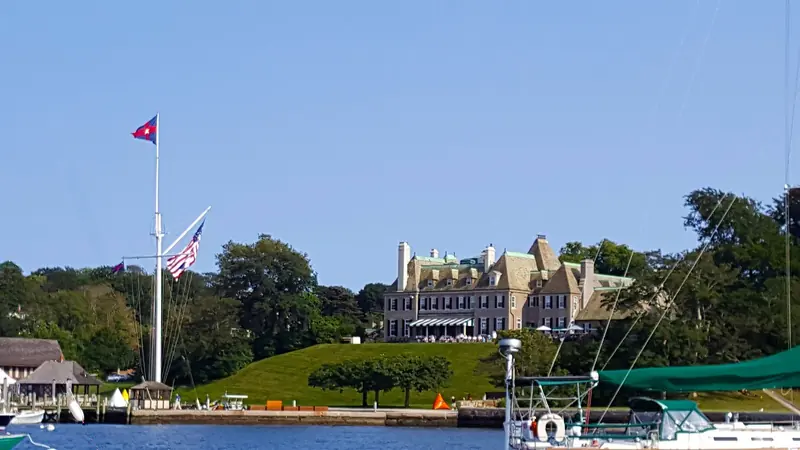
| New York Yacht Club has been based at Harbour Court, Newport, since acquiring the former Brown family estate in 1987 | |
| Hurricane risk | rare but on the record; 1938 hurricane brought a 12 to 15 ft storm surge to Narragansett Bay, Hurricane Carol (1954) up to 14.4 ft; no major New England landfall since Carol |
| Large-yacht dockage rate guide, East Coast peak season: broadly 60 to 90 USD per foot per month at a premier central-harbour marina, quoted per vessel, not published flat | |
The harbour and what shapes it
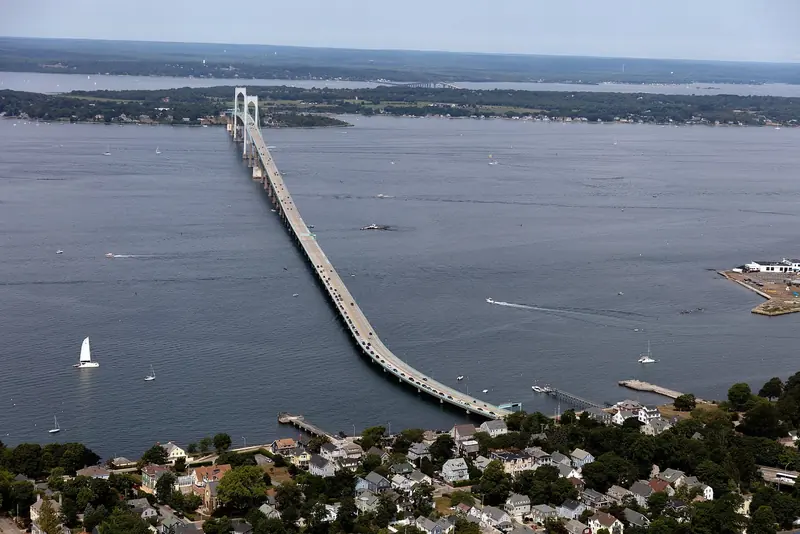
Newport sits at the mouth of Narragansett Bay, on the west side of Aquidneck Island, about 20 nautical miles south of Providence and 60 nautical miles from Boston by sea. The harbour itself is a deep, well-sheltered natural basin protected by Goat Island and the causeway that carries America's Cup Avenue, with Fort Adams guarding the western approach. The outer harbour, west of Goat Island, runs to depths of 100 feet (about 30 metres) or more, which is where boats with a draft over roughly 16 feet are directed to anchor. The inner harbour is shallower and packed with mooring fields, day-boat traffic and the working wharves that give the waterfront its character.
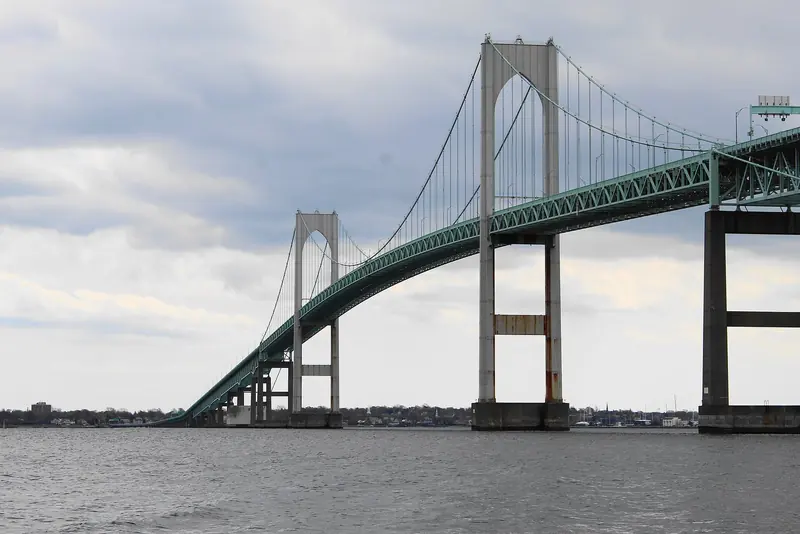
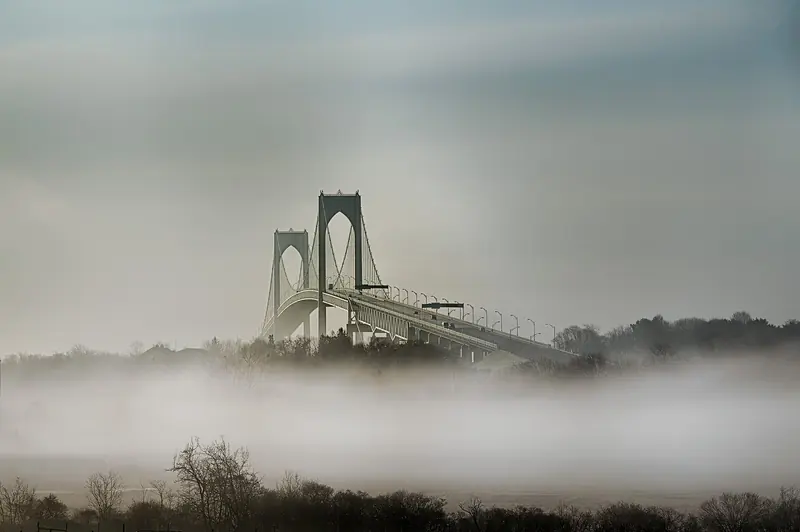
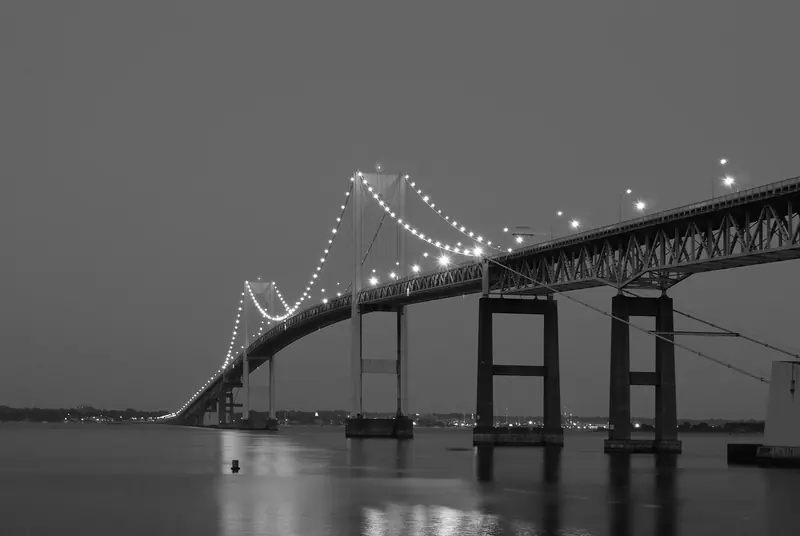
Above the harbour, the Claiborne Pell Newport Bridge crosses the East Passage between Newport and Jamestown, carrying Route 138 on towers over 400 feet tall. Published vertical clearance at mid-span is cited at 206 feet in the bridge's own engineering record, with the original 1969 design brief asking for enough headroom to clear a US Navy aircraft carrier's island. Either way, nothing that calls at Newport itself needs to worry about it: the bridge only becomes relevant to a boat continuing north up the West or East Passage toward Providence, Bristol or the upper Bay, and even then it is a non-issue for anything without a mast reaching into the fog.
The marinas, in order of what they actually offer
Safe Harbor Newport Shipyard, on the Newport waterfront a short walk from the centre of town, is the address that matters. It publishes 3,500 linear feet of dockage and states it can accommodate yachts up to 350 feet, with fuel, engineering support, a marina store and a concierge desk on site. Like most full-service superyacht yards it does not publish a flat tariff: rates are quoted per vessel through the dock office (401 846 6002, [email protected], VHF channel 9), and market pricing for a large motor yacht on the American East Coast in the June to October season runs broadly in the 60 to 90 USD per foot per month range at a premier central-harbour facility, before fuel, power and provisioning are added.
Below that scale, Newport Yachting Center sits in the heart of downtown and is rated to roughly 45 metres, doubling as the venue for the Newport International Boat Show every September. The Newport Harbor Hotel and Marina at 49 America's Cup Avenue holds 60 transient slips with fuel and pump-out, walking distance to everything. Smaller working marinas line Waite's Wharf and Lee's Wharf (Casey's Marina, West Wind Marina, Newport Marina), and Bannister's Wharf and Goat Island Marina both sell fuel. None of the smaller docks are built for anything close to superyacht scale; a large yacht without a Shipyard berth typically anchors in the outer harbour and tenders ashore, or picks up one of the designated mooring areas off Fort Adams reserved for the Museum of Yachting and Sail Newport.
Newport is where the transatlantic fleet clears into the United States, and the harbourmaster still answers the radio.
Anchoring, mooring and the harbourmaster
Anchoring in Newport Harbor is permitted but is run under the direction of the Harbormaster's office, contacted on VHF channel 16, and the city's own rule is that no vessel may anchor on its own ground tackle and then be left unattended. In practice a visiting yacht either takes a Shipyard berth, arranges a mooring through an agent, or anchors in the outer harbour with a crew aboard or standing tender watch. The city's harbor management plan sets aside specific mooring areas along the Fort Adams shore, including a Quarantine Mooring Area, a Museum of Yachting Mooring Area and a Sail Newport Mooring Area, each with its own use rules rather than open first-come anchoring.
August and the two weeks around the Newport International Boat Show and any NYYC regatta are the tightest windows of the year; a berth or a serviced mooring should be arranged well in advance rather than assumed on arrival. Outside those weeks Newport is noticeably less pressured than the Mediterranean's August, which is part of its appeal to an owner who has done a Riviera summer and wants somewhere the harbourmaster still answers the radio promptly.
Clearing in: Newport as a port of entry
Newport is the designated CBP Port of Inspection for Rhode Island, and it is the standard American landfall for yachts finishing a transatlantic passage from Bermuda or the Azores, or arriving from the Caribbean at the start of the northern summer. Every person aboard must report to CBP within 24 hours of arrival regardless of nationality, and no one may go ashore before that clearance is complete. US-flagged vessels and their crew are directed to the CBP ROAM app for remote reporting; foreign-flagged vessels can also use ROAM to schedule, but current guidance requires a face-to-face inspection rather than a fully remote one. The local CBP office in Warwick can be reached on 401 732 6701 to arrange timing, and the port's operating hours are 0700 to 2000 daily.
This matters more here than at most East Coast harbours because Newport genuinely functions as a gateway rather than a stop: a yacht arriving from Horta or St George's routinely clears in at Newport before continuing to New York, the Chesapeake or Maine. Agents in the harbour handle the paperwork routinely, but a captain arriving for the first time should expect the same seriousness CBP brings to any federal port of entry, not the informality of a Caribbean check-in.
Getting people there
Newport State Airport (UUU), on Aquidneck Island in Middletown, is a genuine convenience for owners and guests: FlightLevel Aviation runs it as the FBO, with jet fuel, hangar space and customs available on request. Its two runways, just under 3,000 feet and 2,673 feet, and a stated parking limit around Cessna CJ2 class mean it suits light jets and turboprops, not a large-cabin Gulfstream or Global. For those, the practical airport is T.F. Green International (PVD) in Providence, roughly 45 minutes by road, or Boston Logan, about 75 to 90 minutes depending on traffic, both handling full business aviation.
This is a real difference from the Mediterranean model, where Nice puts a 200 metre yacht's owner into a helicopter seven minutes from Monaco. Newport asks for a longer road transfer for anyone flying in on a large aircraft, which is worth building into a guest itinerary rather than discovering on the day.
The calendar that puts Newport on the map
The Newport Bermuda Race, a 635 nautical mile ocean race first run in 1906 and held in even years, starts off Castle Hill in mid to late June and fills the harbour with a fleet of offshore racers and their support crews for the week before the start. The New York Yacht Club, based at Harbour Court since the club bought the former Brown family estate in 1987, runs its own regatta calendar out of Newport through the summer, most visibly NYYC Race Week and the Museum of Yachting events staged from the Fort Adams moorings. The Newport International Boat Show, the 55th edition running 17 to 20 September 2026 at Newport Yachting Center, is the other fixed point: it takes over the downtown waterfront for four days and is the reason a September berth needs booking months ahead, not weeks.
Outside those dates the season runs a fairly classic New England pattern: June through September for cruising and racing, with July and August the busiest and most reliably warm. Water temperature in the outer bay typically peaks in the low-to-mid 20s Celsius in August, cooler than the Mediterranean or Caribbean and a genuine factor for guests expecting to swim off the boat rather than admire the view from the deck.
The weather risk nobody in the brochure mentions
New England's hurricane risk is real but statistically rare: only a handful of major hurricanes have made a direct New England landfall since colonial records began, most notoriously the unnamed 1938 hurricane, which drove a storm surge of 12 to 15 feet into Narragansett Bay and destroyed entire yacht club fleets, and Hurricane Carol in 1954, which produced a surge up to 14.4 feet and hit the Rhode Island Yacht Club directly. Neither event has been repeated at that scale since, and forecasters note the northeast has avoided a major hurricane landfall since Carol, but the risk window (roughly August through October) overlaps with the Boat Show and the tail of the cruising season.
Boatyards around the bay hauled vessels ahead of more recent storms like Irene in 2011 and treat a hurricane watch as a standing operating procedure, not a novelty. A captain planning a September stay should have a haul-out or a sheltered-berth contingency identified before arrival, the same way a Bahamas season plan assumes a named storm at some point. It is a genuinely lower-probability risk than the Caribbean's winter hurricane exposure, but it is not zero, and Newport's own worst-case history is on the record.
What Newport is actually for
An owner comes to Newport for a specific reason, not as a generic New England stop: it is the place where American sailing's institutional weight, from the New York Yacht Club to the Museum of Yachting's Fort Adams moorings, still concentrates, and it is the practical, well-organised front door for a boat crossing the Atlantic into the United States. It rewards a crew that plans the CBP clearance and the September calendar in advance and accepts that the town's own airport will not take a large business jet.
Set against the French Riviera or the Balearics, Newport trades warmth and density of ports for a genuinely deep, sheltered natural harbour, a shorter and less frantic peak season, and a sense of sailing history that is functional rather than decorative: the club that owns Harbour Court still races out of it every summer. For an owner whose season includes a transatlantic leg, Newport is less a lifestyle choice than the correct answer to where the boat clears in.
À terre, accès et réservation
| Getting there by air | Newport State Airport (UUU) takes light jets and turboprops only (FBO FlightLevel Aviation, parking to about Cessna CJ2 class). A large-cabin jet routes through T.F. Green (PVD), Providence, about 45 minutes by road, or Boston Logan, 75 to 90 minutes. |
|---|---|
| Clearing in | Newport is Rhode Island's CBP Port of Inspection. All arrivals, US or foreign flag, must clear within 24 hours of arrival before anyone goes ashore. Use the CBP ROAM app to schedule; foreign-flagged vessels should expect a face-to-face inspection. CBP Warwick: 401 732 6701. Port hours 0700 to 2000 daily. |
| Berthing a large yacht | Safe Harbor Newport Shipyard, 3,500 linear feet, stated to 350 feet, is the only facility built for genuine superyacht scale. Rates are quoted per vessel, not published; dock office 401 846 6002 / [email protected] / VHF 9. Newport Yachting Center (to about 45 m) sits in the heart of downtown. |
| Anchoring | Permitted in the outer harbour west of Goat Island (depths 100 ft / 30 m or more) under Harbormaster direction, VHF 16. City rules bar leaving a vessel unattended at anchor on its own tackle; most large yachts berth, take a serviced mooring, or keep an anchor watch. |
| What it costs | Market guide for a large motor yacht at a premier East Coast marina in season: broadly USD 60 to 90 per foot per month, before fuel, shore power and provisioning. Confirm current pricing directly; none of Newport's marinas publish a flat tariff. |
| Best season | June to September for cruising and the social calendar; the Bermuda Race fills the harbour in June and the Boat Show does the same in mid-September. Book well ahead for both. |
| What is not published | Exact per-foot dockage rates (quoted per vessel by every major marina), the size of the current Fort Adams mooring fields, and any guaranteed hurricane-season contingency berth; all are confirmed directly with the yard or an agent, not listed online. |
Ce que rapportent propriétaires et équipages
Foreign-flagged yachts should expect a face-to-face CBP inspection even when using the remote app
Current CBP guidance for Newport directs foreign-flagged vessels to the ROAM app to schedule, but still requires an in-person inspection before clearance is granted, unlike the fully remote option available to some US-flagged boats.
US Customs and Border ProtectionThe 1938 hurricane and Hurricane Carol are still the reference events for storm risk in the bay
The 1938 storm brought a 12 to 15 foot surge into Narragansett Bay and destroyed yacht club fleets on the highest tide of the year; Hurricane Carol in 1954 produced a surge up to 14.4 feet and struck the Rhode Island Yacht Club directly.
NOAA historical hurricane recordsA large yacht without a Shipyard berth plans around designated mooring areas, not open anchoring
The city's harbor management framework sets aside named areas off Fort Adams, including moorings for the Museum of Yachting and Sail Newport, rather than leaving the shore open to first-come anchoring by a large vessel.
City of Newport HarbormasterNewport State Airport's own limits push large-jet traffic onto the mainland
The airport's FBO states aircraft parking to roughly Cessna CJ2 class and requires prior permission for jet arrivals, which is why a large-cabin business jet is routed to Providence or Boston instead.
FlightLevel Aviation, Newport State Airport
Les points forts et les points de vigilance
Points forts
- The correct, well-organised American landfall for a transatlantic yachtNewport is Rhode Island's designated CBP Port of Inspection and the standard clearance point for boats arriving from Bermuda, the Azores or the Caribbean, with a routine, agent-familiar process rather than an improvised one.
- A genuinely deep, sheltered natural harbourThe outer harbour west of Goat Island runs to 100 feet or more, and Fort Adams and Goat Island give real shelter; nothing here forces the anchoring gymnastics of a shallow Bahamian cut or a rolly open Mediterranean roadstead.
- Sailing history that is still operating, not preservedThe New York Yacht Club has raced out of Harbour Court since 1987, the Newport Bermuda Race has run since 1906, and the Museum of Yachting's Fort Adams moorings are working infrastructure, not a static exhibit.
- A shorter, less frantic peak season than the MediterraneanAugust in Newport does not carry the wall-to-wall August pressure of the French Riviera or Sardinia; outside the Boat Show and the Bermuda Race weeks, berths and the harbourmaster's attention are easier to get.
Points de vigilance
- The town's own airport cannot take a large business jetNewport State Airport parks to about Cessna CJ2 class; a Gulfstream or Global-class aircraft has to land at T.F. Green in Providence or Boston Logan, adding 45 to 90 minutes of road transfer that a Mediterranean owner is not used to budgeting.
- Cold water by Mediterranean or Caribbean standardsOuter bay water peaks in the low-to-mid 20s Celsius in August; guests expecting Caribbean swimming temperatures in June or September will be disappointed.
- A real, if rare, hurricane exposure late in the seasonThe 1938 hurricane and Hurricane Carol in 1954 both drove double-digit-foot storm surges into Narragansett Bay and wrecked yacht club fleets; the risk window runs through the Boat Show and into October, and a captain needs a haul-out or shelter plan, not just faith in the statistics.
- No published dockage rates anywhere in the harbourEvery marina capable of taking a large yacht quotes per vessel rather than publishing a tariff, so budgeting a Newport season takes a direct call to the dock office well before arrival, not a look at a website.
Pour qui: An owner whose season includes an Atlantic crossing, or who wants the working institutional heart of American sailing rather than a resort marina, and who will plan the CBP clearance, the September calendar and a hurricane contingency rather than assume Newport runs on Mediterranean rules.