The Algarve & Lisbon
| Region | about 100 nautical miles of Algarve coast from the Guadiana to Cape St Vincent, then 120 miles north to Lisbon |
|---|---|
| This is the Atlantic | a tidal range of two to three and a half metres, ocean swell independent of local wind, and the summer nortada from the north |
| Marina de Vilamoura | 825 berths for boats up to 60 m in up to 4 m of draft, including 68 superyacht berths |
| Vilamoura publishes a 2026 berth price list as a downloadable document, which most Portuguese marinas do not | |
| Marina de Portimao | 620 moorings taking yachts to about 50 m, on the Arade river with commercial and cruise quays alongside |
| Portimao has been adding 30 mooring places for megayachts, twelve of them sized for vessels up to 45 m | |
| Marina de Lagos | 462 berths behind a lifting bridge with the old town at the end of the pontoon |
| Doca de Alcantara in Lisbon | about 425 berths but quoted for yachts up to 20 m, with up to 7 m of draft |
| Cascais Marina | roughly 640 to 650 berths in two basins at the mouth of the Tagus, thirty minutes from Lisbon |
| The International Shipping Register of Madeira (MAR) is an EU flag on the Paris MOU white list and is not an ITF flag of convenience | |
| MAR is among the top three EU registers by vessel numbers and registered tonnage | |
| Crew on MAR commercial yachts have no citizenship requirement and are exempt from Portuguese personal income tax | |
| Non Portuguese crew are not obliged to contribute to Portuguese social security where an alternative pension scheme is guaranteed | |
| Madeira International Business Centre | 5 per cent corporate income tax on qualifying income for entities licensed by 31 December 2026, running to 31 December 2033 |
| Also nil Portuguese withholding on dividends outside blacklisted jurisdictions, nil on interest and services to non residents, and an 80 per cent stamp duty and property tax exemption | |
| Commercial yachts operate within the VAT exemptions of Article 14 of the Portuguese VAT Code, covering repair, maintenance and fuel for ocean going commercial vessels | |
| Benagil cave | access restricted to licensed boat tours and guided kayak or paddleboard trips only |
| Swimming into the cave has been banned since August 2024, and landing on the sand inside it is prohibited | |
| A kayak or paddleboard may stay inside for a maximum of 8 minutes, with caps on the number of craft inside at once | |
| Maritime activity in the cave is prohibited from sunset to sunrise, with fines from EUR 300 to EUR 216,000 for operators and up to about EUR 2,500 for individuals | |
| Ocean legs | roughly 500 nautical miles from the Algarve to Madeira and 700 to the Canaries, where the Atlantic crossing fleets gather in November |
| Air | Faro is twenty minutes from Vilamoura and about an hour from Lagos. Lisbon is the long haul gateway, thirty minutes from Cascais |
| Portugal is in the EU and Schengen, the currency is the euro, and clearance from Spain is a formality | |
| Climate | the mildest on the European mainland, with swimmable water from June to October and a winter that rarely stops a boat |
An Atlantic coast, not a Mediterranean one
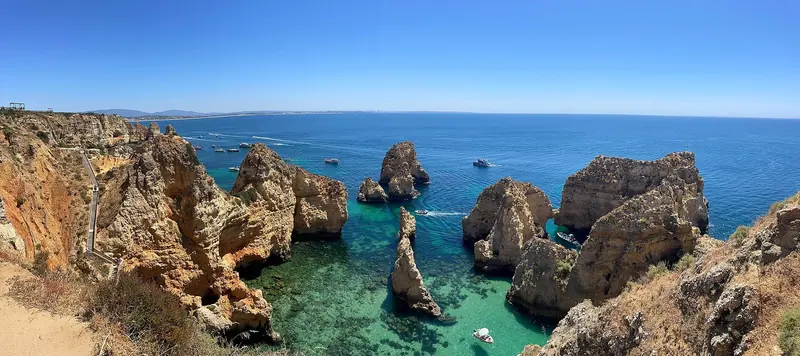
The Algarve runs about 100 nautical miles from the Spanish border at the Guadiana river west to Cape St Vincent, then turns north for the long exposed run up to Lisbon, another 120 miles. The eastern Algarve is low, sandy and lagoon backed. The central section from Albufeira to Lagos is the limestone coast of arches, stacks and caves that the postcards use. West of Lagos it hardens into cliff, and Sagres and Cape St Vincent are the south western corner of Europe, where the sea state changes and the wind usually increases.
The important adjustment for a Mediterranean crew is that this is the Atlantic. There is a tide of two to three and a half metres, there is ocean swell that arrives regardless of the local wind, and the summer brings the nortada, a persistent northerly along the west coast that makes the run from Lisbon to the Algarve fast and the run back slow. None of it is difficult. All of it needs planning that a Mediterranean season does not teach.
Vilamoura is the base
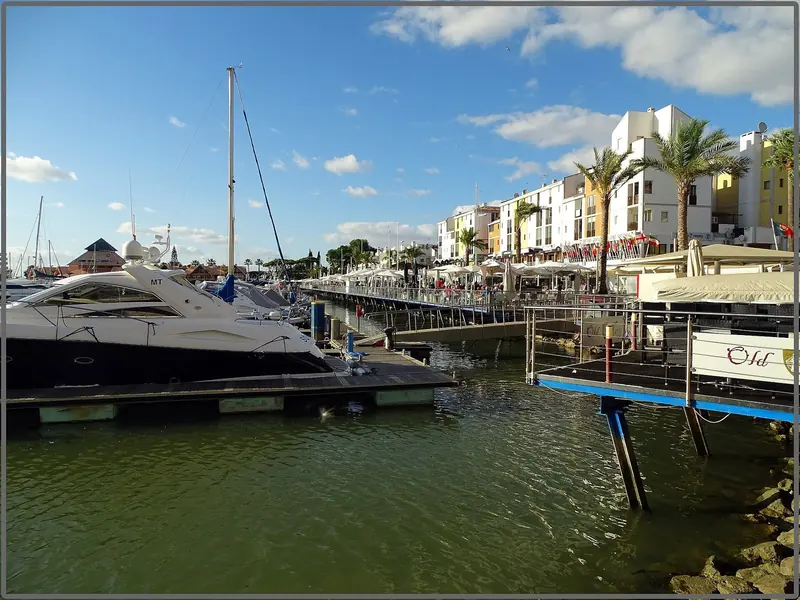
Marina de Vilamoura is the largest and the most complete marina in southern Portugal, with 825 berths for boats up to 60 metres in up to four metres of draft, of which 68 are superyacht berths. It sits in the middle of the Algarve coast, twenty minutes from Faro airport, surrounded by golf courses, restaurants and a resort town built around the harbour, and it publishes a berth price list for 2026 as a downloadable document, which most Portuguese marinas do not.
The four metre draft limit is the constraint to check. Vilamoura is a dredged basin behind a river entrance rather than a natural deep water harbour, and a yacht drawing more than four metres is looking at Portimao or Lisbon instead. What Vilamoura offers in exchange is the fullest support on the coast, a genuine year round operation, and a location that puts guests twenty minutes from an international airport and a hundred metres from dinner.
An EU flag whose crew pay no Portuguese income tax, a marina that publishes its prices, and a tide of three and a half metres to remind a Mediterranean crew where it is.
Portimao is where the size is going
Marina de Portimao, in the mouth of the Arade river a few miles west, runs 620 moorings and takes yachts to about 50 metres. It has been expanding for megayacht traffic, with a project creating 30 additional mooring places, twelve of them sized for vessels up to 45 metres, on a river that has the depth Vilamoura does not. Portimao also has the commercial quay and the cruise berth, which means an owner has options that a resort marina cannot offer.
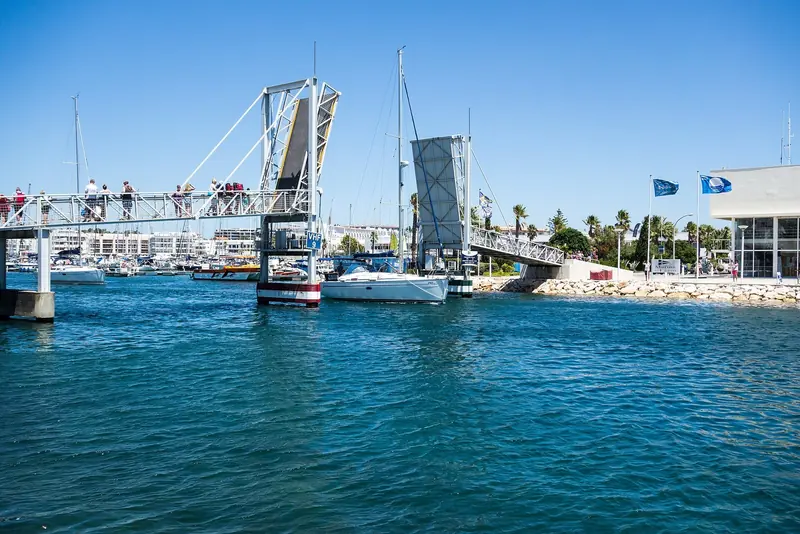
Around them the coast fills in the smaller sizes. Marina de Lagos has 462 berths behind a lifting bridge and is the prettiest of the Algarve marinas, with the old town at the end of the pontoon. Albufeira, Alvor and Faro handle local traffic. Olhao and Tavira sit inside the Ria Formosa lagoon, which is shallow, tidal and a natural park, and is a tender and shoal draft cruising ground rather than a yacht one.
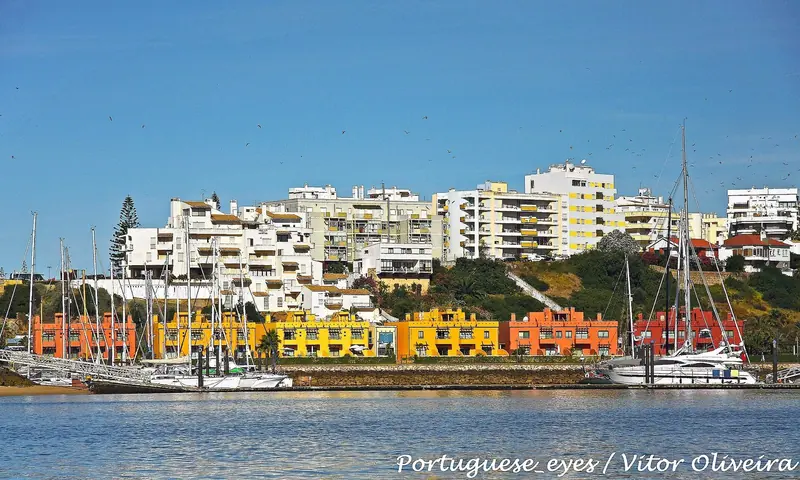
Lisbon berths smaller than its reputation suggests
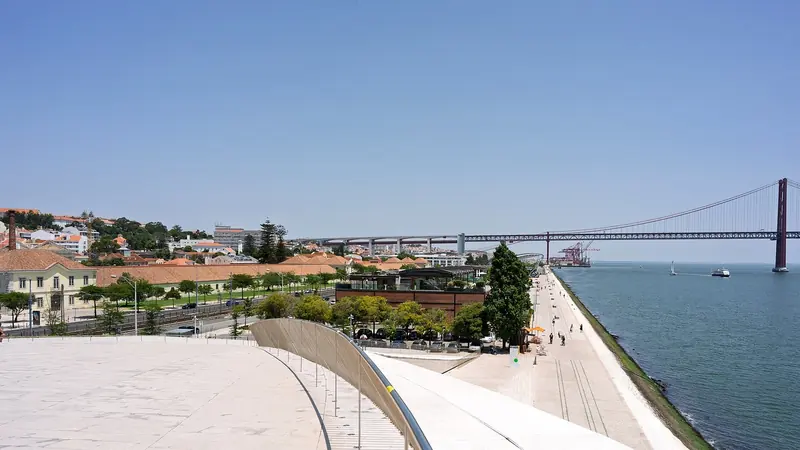
The Tagus is one of the great natural harbours of Europe and Lisbon does not yet berth large yachts in the way that geography implies. Doca de Alcantara, under the 25 de Abril bridge, holds around 425 berths but is quoted for yachts up to 20 metres, albeit with up to seven metres of draft. The other city docks, Belem, Santo Amaro and the Parque das Nacoes marina upriver, are smaller again. A large yacht in Lisbon negotiates commercial quay space rather than booking a marina slip.
Cascais, at the mouth of the Tagus half an hour west of the city by train, is the practical answer. Its marina holds roughly 640 to 650 berths in two basins with modern facilities and is where the yachts that come for Lisbon actually stay, with the town, the beaches and the road to Sintra behind it. The trade off is that Cascais is exposed to the Atlantic swell in a way the river is not, and that the Tagus entrance with an ebb tide against a westerly swell is a genuinely rough piece of water.
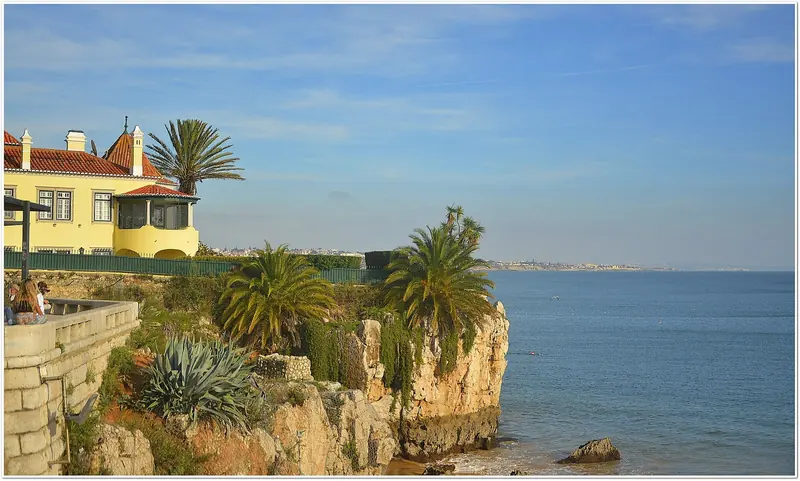
The flag argument, which is the strongest thing Portugal offers
The International Shipping Register of Madeira, MAR, is a Portuguese and therefore an EU flag, administered from Funchal, on the Paris MOU white list and not classified as a flag of convenience by the International Transport Workers Federation. It is among the top three EU registers by vessel numbers and registered tonnage. For a commercial yacht the register's attraction is the crew position: there are no citizenship requirements, crew are exempt from Portuguese personal income tax, and non Portuguese crew are not obliged to contribute to Portuguese social security provided an alternative pension scheme is in place.
Held through a licensed Madeira company, the ownership structure sits inside the International Business Centre regime, which applies 5 per cent corporate income tax on qualifying income for entities licensed by 31 December 2026 with the benefit running to 31 December 2033, no Portuguese withholding on dividends to shareholders outside blacklisted jurisdictions, no withholding on interest and services paid to non residents, and an 80 per cent exemption from stamp duty, property taxes and regional and municipal surtaxes. Commercial yachts also operate inside the VAT exemptions of Article 14 of the Portuguese VAT Code, which cover repair, maintenance and fuel supply for ocean going commercial vessels.
Benagil, and the rules that came with the fame
The sea caves between Carvoeiro and Albufeira, and the great domed one at Benagil with its hole in the roof, are the single most photographed thing on the Portuguese coast, and they are now tightly controlled. Access is restricted to licensed boat tours and guided kayak or paddleboard trips. Swimming into the cave has been banned since August 2024. Nobody may land on the sand inside it, paddle in independently or swim in from a neighbouring beach, and the number of boats and kayaks inside at any moment is capped.
A kayak or paddleboard may stay inside for a maximum of eight minutes, and maritime activity in the cave is prohibited from sunset to sunrise. Fines run from EUR 300 up to EUR 216,000 for operators and up to around EUR 2,500 for an individual. The practical consequence for a yacht is that the caves are a licensed tender or shore excursion rather than something the boat's own tender may improvise, and an owner who has promised guests the inside of Benagil should book a licensed operator before he arrives.
The weather, the tide and the swell
The Algarve has the mildest climate in mainland Europe, with 300 days of sun a year, swimmable water from June to October and a winter that rarely stops a boat moving. Summer on the south coast is generally light in the morning with a sea breeze in the afternoon. The west coast is a different animal: the nortada blows from the north or north west through the summer, often 20 knots and more by mid afternoon, which is why the Lisbon to Algarve run is a fast reach and the return is often done at night when the wind drops.
Cape St Vincent is the corner where the two systems meet, and it deserves respect. The tide runs, the swell wraps and the wind accelerates around the headland. The Atlantic tidal range of two to three and a half metres governs the marina entrances, the river bars and the lagoon channels of the Ria Formosa, and the sensible practice, unfamiliar to a Mediterranean crew, is to plan an arrival on a rising tide and to read the swell forecast as carefully as the wind.
The Atlantic staging point
The other reason yachts are here is that this is where the ocean legs start. From Lagos or Vilamoura it is roughly 500 nautical miles to Madeira and 700 to the Canaries, and the Canaries are where the Atlantic crossing fleets gather in November. A boat leaving the Mediterranean in autumn for the Caribbean stops in Portugal, and a boat coming the other way in spring makes its European landfall here. The support trade in the Algarve is built partly around that traffic, which is why the yards and the chandleries are better than a resort coast would otherwise justify.
It also means the shoulder seasons are busy in a way the summer is not. September and October fill with boats heading south and preparing for an ocean passage, and April and May with boats coming north. An owner planning a berth in those months should book earlier than the weather suggests, and one planning maintenance should expect the good contractors to be committed to the transatlantic fleet.
Getting guests in
Faro is the Algarve airport, twenty minutes from Vilamoura and about an hour from Lagos, with heavy northern European scheduled traffic through the summer and a reduced but genuine winter schedule. Lisbon is the long haul gateway, with transatlantic and African connections, about two and a half hours by road from Vilamoura and thirty minutes from Cascais. For a private aircraft both work, and Lisbon has the better handling.
Portugal is in the EU and Schengen, the currency is the euro, English is widely spoken in the coastal trade, and clearance from Spain is a formality. The train from Lisbon to Cascais runs along the sea front and takes about forty minutes, which makes a guest change at Cascais unusually painless. The road between Lisbon and the Algarve is fast and the drive is two and a half hours, which is worth knowing when an aircraft can only take one of the two airports.
Ashore
Lagos is the best of the Algarve towns, walled, cobbled and small, with the Ponta da Piedade cliffs and stacks twenty minutes away by tender. Sagres and Cape St Vincent are the end of the known world in the medieval sense and still feel like it. The Ria Formosa behind Faro and Olhao is a lagoon national park of sandbanks, salt pans and barrier islands with restaurants that serve the clams and oysters grown in front of them. Tavira in the east is the prettiest town on the coast and the least visited.
Lisbon is a great European capital that happens to be on the water, with Belem and its monastery and tower a mile downriver from the docks, the tram network, the food markets, and Sintra's palaces half an hour inland. It is materially cheaper than Spain, Italy or France for provisioning, eating and labour, and it has the best value fine dining in western Europe. For guests who want a city with the boat, only Barcelona competes.
The honest downside, and what is not published
The cruising is thin. There are very few anchorages an owner would choose to spend a night in, the swell reaches most of them, and the coast is a run of marinas separated by beaches. The Ria Formosa is beautiful and too shallow for a yacht. Draft limits catch people out, at Vilamoura in particular. Lisbon cannot berth a large yacht in the city. And the Atlantic itself, tide, swell and the nortada, means this is a coast for a well found boat with a crew that plans, rather than a place to drift between lunch anchorages.
Checked in August 2026, Vilamoura publishes a 2026 berth price list as a downloadable file, but the file is not machine readable, and no figure could be quoted from it here. Portimao, Lagos, Cascais and the Lisbon docks quote on enquiry. No Portuguese marina publishes a fuel price. The Benagil rules are published in detail by the tour trade and inconsistently by the authorities. And nothing published tells an owner which of Vilamoura's 68 superyacht berths is free in the transatlantic rush of October, which is the number that decides the autumn.
À terre, accès et réservation
| Getting there | Faro serves the Algarve, twenty minutes from Vilamoura and about an hour from Lagos, with heavy northern European schedules in summer and a reduced but real winter timetable. Lisbon is the long haul gateway with transatlantic and African connections, thirty minutes from Cascais and two and a half hours by road from Vilamoura, and it has the better private aviation handling. Portugal is in the EU and Schengen so clearance from Spain is a formality, and the train from Lisbon to Cascais runs along the sea front in about forty minutes. |
|---|---|
| Where the boat berths | Marina de Vilamoura is the base, with 825 berths to 60 metres and 68 superyacht berths, but the draft limit is about four metres in a dredged basin. Marina de Portimao takes about 50 metres across 620 moorings on the Arade river, with more depth and an expansion adding 30 megayacht places, twelve of them to 45 metres. Marina de Lagos has 462 berths behind a lifting bridge. In Lisbon, Doca de Alcantara is quoted to 20 metres in up to 7 metres of draft, so a large yacht uses Cascais or negotiates a commercial quay. |
| The Atlantic adjustments | Plan for a tidal range of two to three and a half metres, which governs the marina entrances, the river bars and the Ria Formosa channels, and arrive on a rising tide where there is any doubt. Read the swell forecast separately from the wind, because Atlantic swell arrives regardless of local conditions. The nortada blows from the north or north west through the summer on the west coast, often 20 knots and more by afternoon, so the Lisbon to Algarve leg is fast southbound and usually done at night northbound. Cape St Vincent accelerates all of it. |
| The flag, and why owners look at it | The International Shipping Register of Madeira is a Portuguese and therefore EU flag, on the Paris MOU white list and not an ITF flag of convenience, and among the top three EU registers by vessels and tonnage. Crew have no citizenship requirement, are exempt from Portuguese personal income tax, and non Portuguese crew need not contribute to Portuguese social security where an alternative pension scheme is guaranteed. The register is administered from Funchal with its own technical commission. |
| The ownership structure | Holding the yacht through a licensed Madeira company brings it inside the International Business Centre regime: 5 per cent corporate income tax on qualifying income for entities licensed by 31 December 2026, with the benefit running to 31 December 2033, no Portuguese withholding tax on dividends to shareholders outside blacklisted jurisdictions, no withholding on interest and services paid to non residents, and an 80 per cent exemption from stamp duty, property taxes and regional and municipal surtaxes. Commercial yachts also fall inside the Article 14 VAT exemptions for repair, maintenance and fuel. |
| Visiting the caves | The Benagil cave and its neighbours are open only to licensed boat tours and guided kayak or paddleboard trips. Swimming in has been banned since August 2024, landing on the sand inside is prohibited, independent paddling in is not allowed, the number of craft inside is capped, and a kayak or SUP may stay a maximum of eight minutes. Maritime activity there is prohibited from sunset to sunrise. Fines run from EUR 300 to EUR 216,000 for operators and up to about EUR 2,500 for an individual, so book a licensed operator rather than sending the yacht's own tender. |
| The ocean legs | It is roughly 500 nautical miles from the Algarve to Madeira and 700 to the Canaries, and the Canaries are where the transatlantic fleets gather in November. That makes September and October the busiest berthing months of the year here, and April and May the busiest for boats coming north. Book berths in those shoulder months earlier than the weather suggests, and expect the best contractors to be committed to the crossing fleet rather than available at short notice. |
| Ashore | Lagos is the best of the Algarve towns, walled and small, with the Ponta da Piedade stacks twenty minutes away by tender. Sagres and Cape St Vincent are the south western corner of Europe. The Ria Formosa lagoon behind Faro and Olhao is a national park of sandbanks and barrier islands with the clams and oysters grown in front of the restaurants that serve them, and Tavira in the east is the prettiest and least visited town. In Lisbon, Belem is a mile downriver from the docks and Sintra half an hour inland. |
| What is NOT published | Checked in August 2026, Vilamoura publishes a 2026 berth price list as a downloadable file, but the file is not machine readable and no figures could be quoted from it here. Portimao, Lagos, Cascais and the Lisbon docks all quote on enquiry. No Portuguese marina publishes a fuel price. The Benagil restrictions are set out in detail by the licensed tour trade and inconsistently by the authorities themselves. And nothing published tells an owner how many of Vilamoura's 68 superyacht berths are free in the October transatlantic rush. |
Ce que rapportent propriétaires et équipages
The Madeira register is the practical reason many owners look at Portugal
Practitioners administering MAR describe it as a Portuguese and therefore EU flag, on the Paris MOU white list, not classified as a flag of convenience by the International Transport Workers Federation, and among the top three EU registers by vessel numbers and tonnage. The distinguishing feature for a commercial yacht is the crew position: no citizenship requirements, exemption from Portuguese personal income tax, and no obligation on non Portuguese crew to contribute to Portuguese social security where an alternative pension scheme is guaranteed.
Madeira Corporate Services and Dixcart Air MarineThe company regime has a licensing deadline attached to it
Yachts held through a licensed Madeira company sit inside the International Business Centre regime, which applies 5 per cent corporate income tax on qualifying income for entities licensed by 31 December 2026, with the benefits running to 31 December 2033, no Portuguese withholding on dividends paid to shareholders outside blacklisted jurisdictions, no withholding on interest and services paid to non residents, and an 80 per cent exemption from stamp duty, property taxes and regional and municipal surtaxes. The licensing date is a hard one, not a rolling one.
Madeira Corporate Services and the International Business Centre of MadeiraPortimao is where the coast is adding size
Marina de Portimao, which already takes yachts to about 50 metres across 620 moorings on the Arade river, has been creating 30 additional mooring places for megayachts, twelve of them sized for vessels up to 45 metres, as part of an expansion of the port infrastructure. It is the deeper of the two main Algarve marinas, and it sits alongside commercial and cruise quays that a resort marina cannot offer.
Marina de Portimao, reported by Megayacht News and Sul InformacaoBenagil is now a licensed excursion with a stopwatch on it
Access to the cave is restricted to licensed boat tours and guided kayak or paddleboard trips, swimming in has been prohibited since August 2024, landing on the sand inside is not permitted, the number of craft inside at any moment is capped, a kayak or paddleboard may remain for a maximum of eight minutes, and maritime activity there is banned from sunset to sunrise. Fines run from EUR 300 to EUR 216,000 for operators and up to about EUR 2,500 for an individual.
Portuguese maritime authority rules as published by licensed Algarve operatorsThe published pricing stops at the download button
Checked in August 2026, Marina de Vilamoura publishes a 2026 berth price list as a downloadable document, but the file is not machine readable and no figure could be quoted from it. Marina de Portimao, Marina de Lagos, Cascais and the Lisbon docks quote on enquiry, and no Portuguese marina publishes a fuel price. No independent published owner or captain account of superyacht service standards at any Portuguese marina could be found.
Yotters desk, checked August 2026
Les points forts et les points de vigilance
Points forts
- An EU flag with a crew tax position nothing else matchesMAR is a Paris MOU white list EU register, top three in the Union by vessels and tonnage, with no crew citizenship requirement, crew exempt from Portuguese income tax and no compulsory social security for non Portuguese crew.
- One marina that actually publishesVilamoura posts a 2026 berth price list, holds 825 berths to 60 metres including 68 superyacht berths, and is twenty minutes from an international airport.
- The mildest climate on the European mainlandAround 300 days of sun, swimmable water from June to October and a winter that rarely stops a boat moving, which makes a year round base realistic.
- The natural staging post for the AtlanticAbout 500 miles to Madeira and 700 to the Canaries, with a support trade built around the autumn crossing fleet and better yards than a resort coast would otherwise carry.
- Cost and quality ashoreMaterially cheaper than Spain, Italy or France for provisioning, labour and eating, with Lisbon and Sintra behind Cascais and Lagos, Sagres and the Ria Formosa along the coast.
Points de vigilance
- There is very little to anchor inA coast of marinas separated by beaches, with Atlantic swell reaching most open roadsteads and the Ria Formosa too shallow for a yacht to use.
- Draft rules out the main base for many boatsVilamoura is a dredged basin with about four metres, so a deeper hull is looking at Portimao or Lisbon before it starts.
- Lisbon cannot berth a large yacht in the cityDoca de Alcantara is quoted to 20 metres. Anything bigger uses Cascais, which is exposed to Atlantic swell, or negotiates commercial quay space.
- The Atlantic asks more of the crewThree and a half metres of tide, ocean swell independent of the wind, the summer nortada on the west coast and a headland at Cape St Vincent that accelerates all of it.
- The famous cave is now a licensed excursionNo swimming since August 2024, no landing, an eight minute limit for kayaks, caps on numbers and fines to EUR 216,000 for operators. The yacht's own tender is not the way in.
Pour qui: An owner repositioning between the Mediterranean and the Atlantic, or one who wants an EU flag with a crew tax position no other register matches, and who accepts a coast of marinas and towns rather than anchorages.